
The ski industry decided to find out about the meanderings of what it suspected was an unfaithful consumer base. The unsuspecting targets of the investigation were people who had identified themselves as skiers to the Gallup Poll and the Leisure Trends Tracking study in the previous 15 months. The results reveal that the customer base, while full of good intentions, has had difficulties remaining loyal. (This research project was called the USIA Vacation Planning Survey — VPS).
In a November 1991 interview with people who had earlier identified themselves as skiers, 61% indicated they had skied in the 1990-91 season; in an April 1992 survey of the same universe, 55% said they had skied in the season just completed (1991-92). And this despite the fact that in the November interview, 79% had said they intended to.
| Skied in 1990-91 | 61% |
| Planned to ski in 1991-92 (asked 11/91) | 79% |
| Skied in 1991-92 (asked 4/92) | 55% |
In addition to this research, the National Skier Opinion Survey (NSOS) was administered at 19 ski areas in four regions of the U.S. over a nine-week period last winter. The NSOS yields a very good profile of the person who skied last year, while VPS profiles Americans who say they are skiers. The difference in the make-up and skiing activity of the two universes reveals who is skiing and who is not. Some of the contrasts are stark.
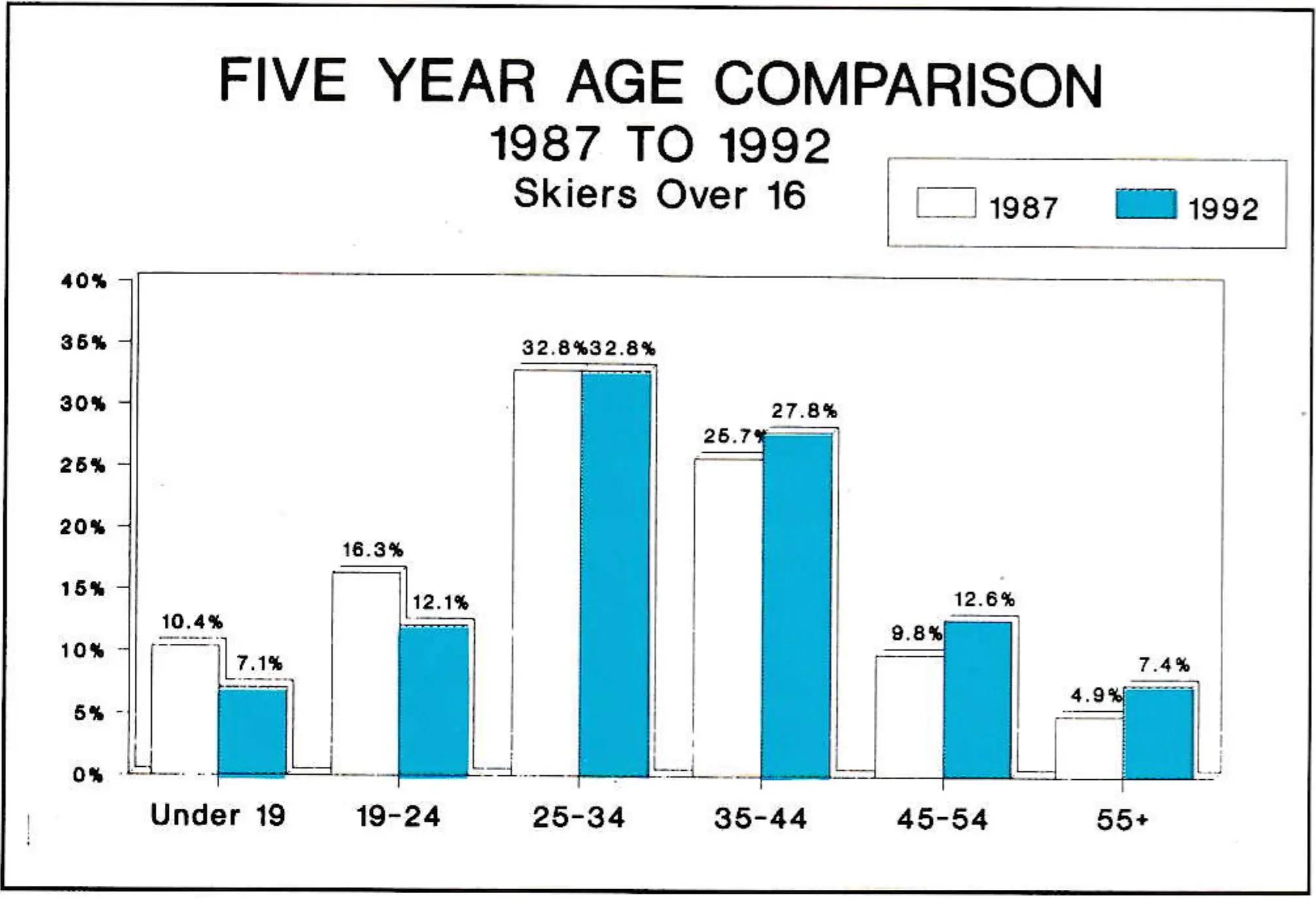
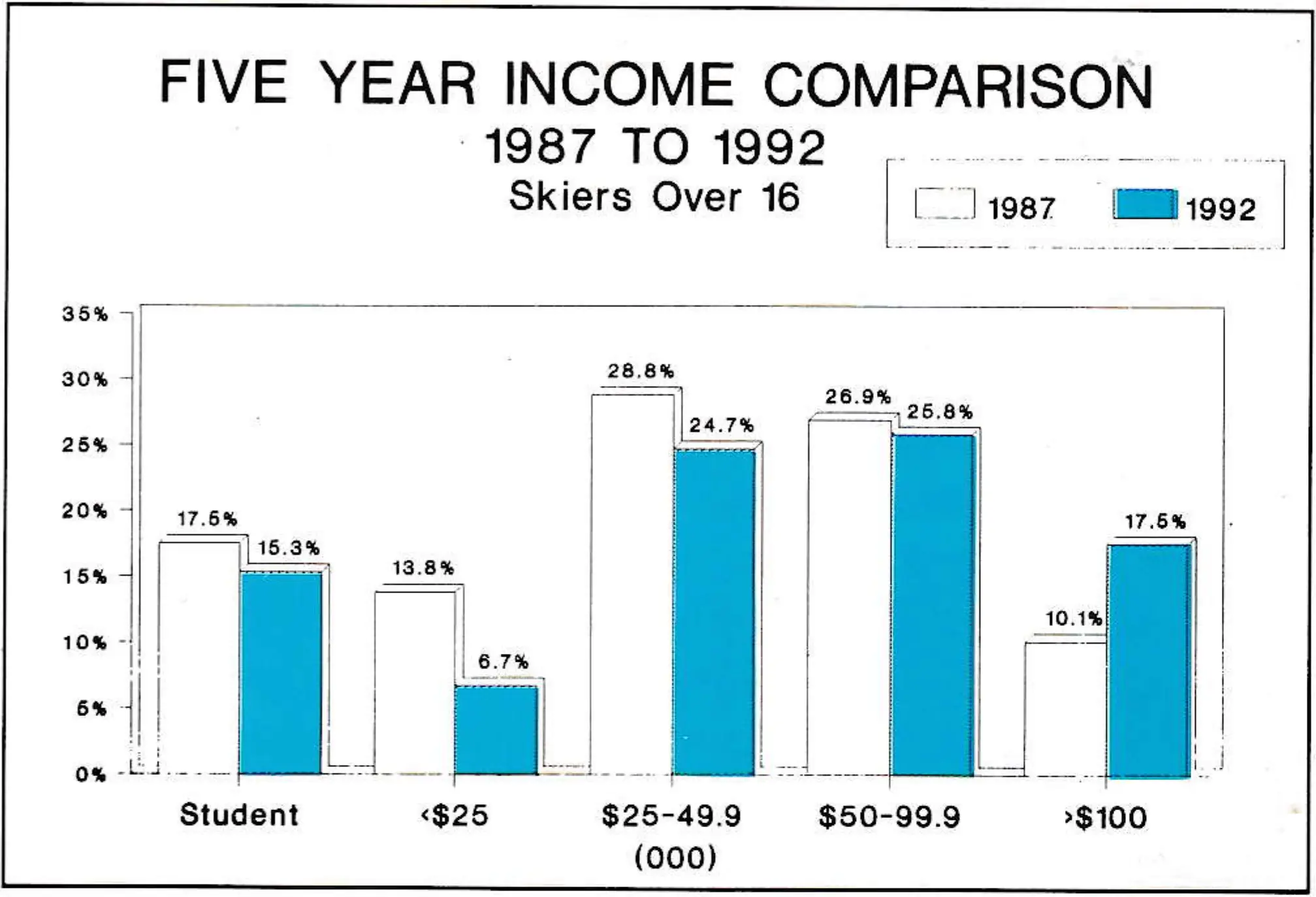
The conclusion I come to is that skiing is attracting more singles and, increasingly, households with very high incomes. This is a case of vanishing horizons since singles represent just 25% of all U.S. households, while households in the $100,000-plus income range represent only 3%. Yet, among skiers interviewed last winter (NSOS), 47% were single and 17% had incomes of $100,000 or more. Of the people who had identified themselves as skiers (VPS), but of whom only 55%, as we saw, skied this past season, some 8% had incomes in the $100,000-plus range.
With regard to the incidence of singles skiing, we can accept that marrieds, especially if they have children, have less money to spend. And 60% of all baby boom households now contain children, and because of later marriages and begetting, the kids in these boomer households tend to be younger. Furthermore, these households strongly tend to include two people working. Time and money are precious, and these married boomers are strapped for each.
And married skiers not skiing represent a double whammy, because a family with one child represents a minimum of three lift tickets compared to a single skier. More importantly, kids represent the future. (Almost half of skiers say they learned to ski when under 17.)
One means of uncovering where the problem lies is to take a look at skiers who are not skiing. Who are they and why aren’t they out on the slopes?Demographically, those skiers tend to be between 25 and 34, the laggard half of the baby boom. They tend to be younger married couples with children. Females are skiing less, and of those who do ski, they ski less often than men. The stay-aways are less well-educated and have lower-paying service and labor occupations.
Households with $40,000 or less income skied far less in 1990-91, and by this past season, the same could be said about skier households in the $60,000-and-under range.
The reasons cited among the 45% of skiers who did not ski last season are revealing. A little over half said skiing was a financial burden. The second most cited reason (42%) said they had made other vacation plans, while another 29% said they had started to do “something new.” The complaint that children, spouse or friends do not ski was cited frequently, while 17% answered they weren’t interested anymore. (Answers add to over 100% because multiple responses were allowed.)
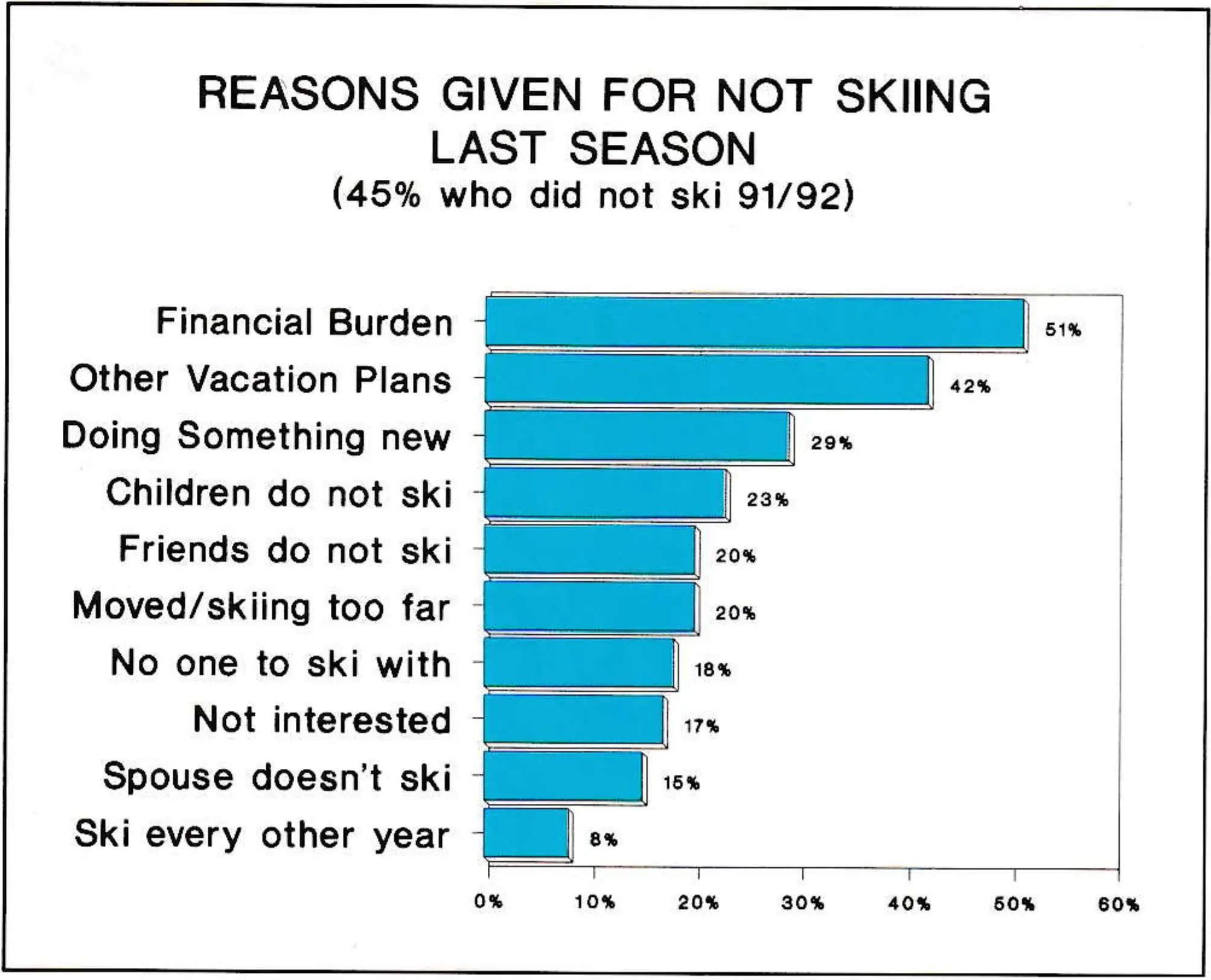
It is apparent that for households earning $40,000 or less, skiing is too expensive.The problem is that this is quickly expanding into households earning $60,000 or less, and it is sobering to realize that 73% of all U.S. households are in that same category which also accounts for 47% of skiing households.
The second and slightly more confusing conclusion is that those “financial burdens” are being experienced by many skiers among higher income groups who did not feel such burdens ten years ago. These burdens have to do with having two kids in college, payments on a second mortgage purchased during the go-go ’80s, an unwillingness to sell a second home because real estate prices are depressed and other real-world pressures.
As for the other reasons cited — “made other vacation plans” and “started doing something else” — it seems to me that is called competition.
The “other vacation plans” group tended to be between 24 and 34 — where the ski industry’s largest shortfall in on-slope skiers was last year — and 35 to 44. They also tended to be male, married, college graduates and have incomes between $60,000 and $100,000. When asked what the other vacation plans were, 25% said to sunny, warm climates; the balance was a quilt of the world from Europe to Disneyland to camping.

From the group who “started something new,” we asked, “What?” Working more, the answers said, spending more time with the family, going back to college or school and other recreational activities. They tended to be from lower-income households.
One interesting contradiction — or perhaps commentary on priorities — showed that out of the 3% who were unemployed when interviewed, 73% skied last season — far higher than the 55% of the whole universe.
The other issue is competition. Baby boomers are the most travelled and best educated of any generation in our history. They are the most time-starved and consider time precious. When they take time off from work to vacation they expect a lot from that vacation. When they ski they compare their time on the slopes with other vacations in sun spots, adventure travel, European and Far Eastern travel or other sports and activities. They compare not just the fun and excitement they have, but the price/quality relationship or value received.
The logical question is, are the non-skiing skiers not skiing because they can have an equally good time doing something else which offers greater value for the money?
The VPS does not address this issue, but NSOS provides some clues. Those interviewed were asked to compare the ski vacation they were on to a comparable non-ski vacation. While skiing ranked terrific or better for fun, excitement and exercise, among the majority of skiers on the slopes, it ranked the same or worse for value received and social life. Today, skiing is no longer a unique experience; it is another choice to make among many.
| Fun | Excitement | Exercise | Value | Social Life | |
|---|---|---|---|---|---|
| Terrific | 41% | 37% | 49% | 20% | 17% |
| Better | 30% | 35% | 37% | 26% | 25% |
| Same | 28% | 26% | 13% | 40% | 48% |
| Worse | 1% | 2% | 1% | 14% | 10% |
It is interesting how the individual services offered by a ski area generally fell into the good or excellent ratings. That’s the snowmaking, grooming, nursery and so on. Yet, the overall experience ratings, while high for the most part, are beginning to erode.
Our conclusion is that the focus of too many areas has been on the individual services offered, and not on the customer. Thus, while the skier says, “You can cook great hamburgers and make great snow,” he or she still wonders about whether or not they had a great time.
This focus on the deliverable is very important; it cannot fall into disarray. Now it is time to make the skier feel as if his patronage is appreciated, to offer extra services and amenities and catch up to the competition.
Note: The NSOS and VPS studies are available from USIA.