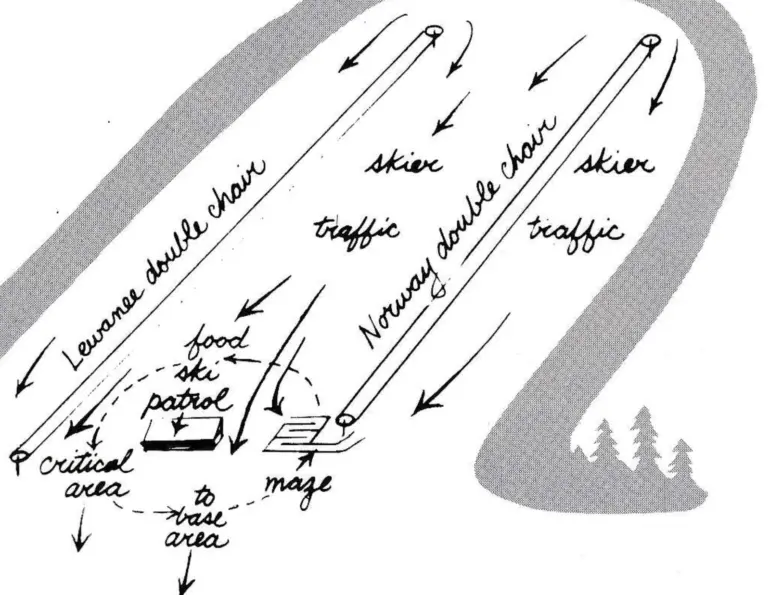
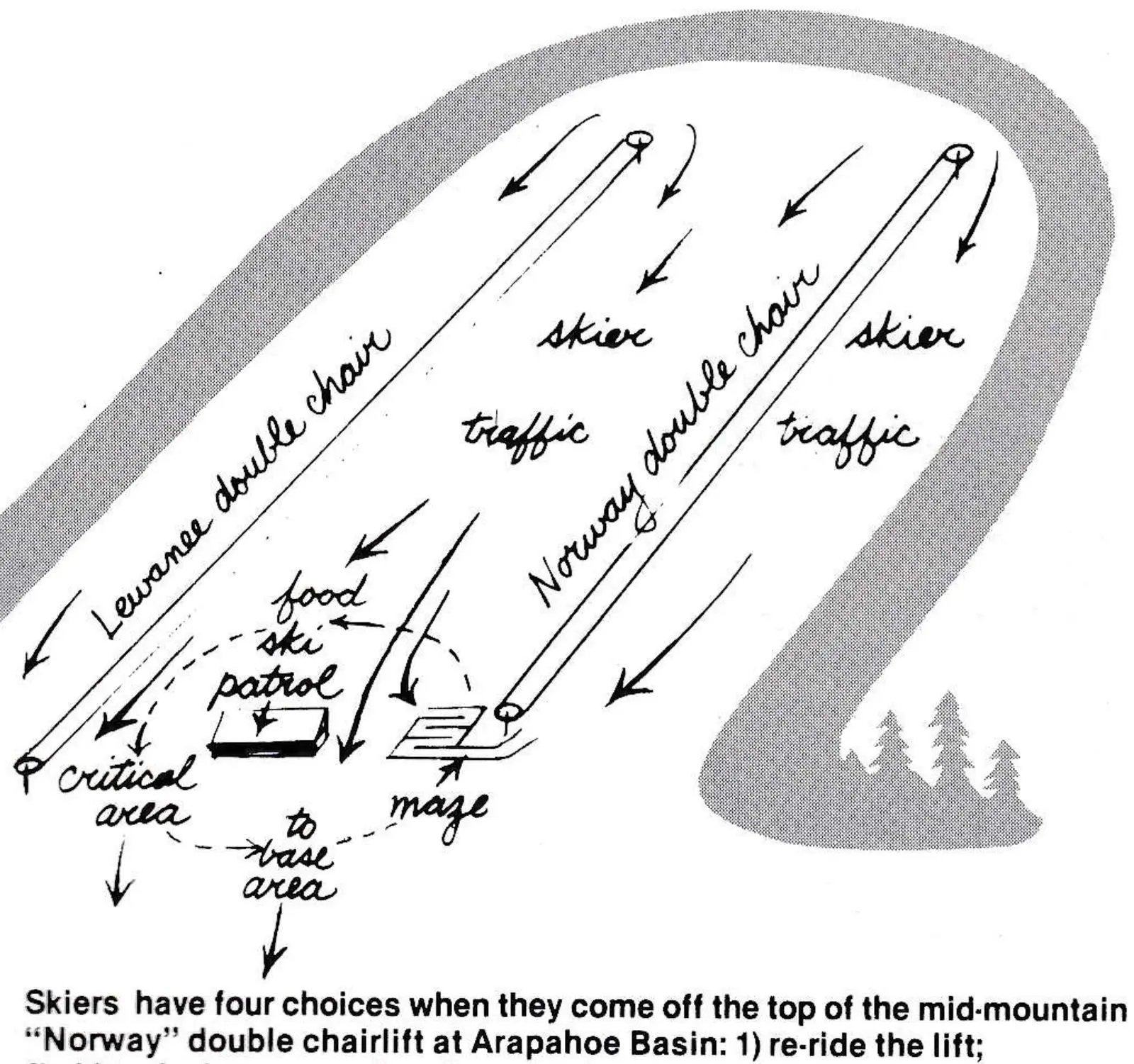
Amid the hoopla about new construction, additions and refurbishing that resounds through the ski resort business each fall, the new lift mazes at Arapahoe Basin seem pretty squeaky. Actually more consideration, testing, adjusting and fine-tuning have gone into the establishment of those mazes than goes into most multi-million dollar construction projects.
The reason for this concern is simple: lift line psychology.
So important is the skier’s attitude about the maze he’s in that Jon Reveal, Arapahoe’s area manager, spent two years trying different configurations of portable systems. This summer he settled on some permanent designs.
Aside from skier comfort—both psychological and physical—there are some general considerations in designing and building a lift maze, according to Reveal. The primary one is the type of lift. For instance, the maze for a triple chairlift is laterally wider and 1,800 skiers per hour need to pass through it, whereas 1,200 per hour pass through the double chair maze. If slope capacity balances the lift capacity, the waiting area is the only thing to worry about. However, if slope capacity far exceeds lift capacity, the options of waiting in a long line or skiing elsewhere on the mountain should exist. Furthermore, the location of the maze and its direction of movement is determined by the need to have an efficient flow of on-slope traffic (midmountain) or room in the base area for all kinds of traffic, for reasons of convenience and safety. Area operators need to consider whether their lift lines jut out into a major traffic flow erea.
Illustrations by Bob Ritter
Head Stuff
But the psychology of lift lines is an equally important consideration in designing and building lift mazes. “You’ve got to keep in mind what a person thinks about while waiting in line.” For instance, most people double the amount of time they think they are waiting. Then, they start calculating the cost of standing in line. Also, they’re taking stock, hoping things will go well. The ramp incline might create a fear of falling. If it’s their first time on the lift, they’re worried about getting on—or if someone will help Junior get on the chair. Or, they’re feeling hasseled by the ticket checker. They may feel “lost,” wondering what’s over the ridge.
“There’s another group of skiers,” he adds. “They’re the ones who have no fear for themselves, but have a great concern for their children or for the novice who is skiing with them. It’s imperative to keep them together. For instance, if loading a triple chair, you have to make sure children stay ‘caught up’ with their parents and get on the chair while the parents attend to their own loading.”
Reveal poses other questions: “Can you keep them entertained during the wait? What will a person respond to on a cold day in a long lift line? Is the ticket checker going to be a help or a hassle? You’ve got to keep people’s minds off the cold and the wait.
“Meanwhile, you’ve also got to inform them about the type of lift they’re riding and the terrain it serves. You’ve got to communicate directions on loading the lift and advise skiers unfamiliar with the lift to ask for help.” Furthermore at base area lifts, they’ve got the Skier’s Responsibility Code to read and another sign on the trail marking system.
“On top of that, especially if you have chairlifts with center posts, as well as those without, you have to remind them which hand to hold their poles in and which way to look when loading. With six seconds to load, the skier and the lift operator are concerned with how quickly and easily they move from the waiting area into the loading area.”
According to Reveal, the key to lift line psychology is the personality of the personnel working to load the lifts and to check tickets. At Arapahoe these people are called “lift hosts,” rather than “ticket checker.” Reveal insists that this makes a difference in the employees’ attitude about the job they’re doing. They are more willing to assist people, supply information on riding the lift (and on slope conditions, weather, etc.) and, with as little hassle as possible, check and punch lift tickets during the early morning and early afternoon hours. They make sure Junior stays “caught up,” gloves and poles are in the right place and, generally make people feel “at home.”
Says Reveal: “People will get to know lift hosts and hostesses much better than they’ll ever know me. Those front-line employees are the most important people on the mountain when it comes to customer relations. You’ve got to make sure your front-line people represent you as you want to be represented. They do what they have to do, in this case safely load people on a lift or check their tickets, with as little negative impact on the customer as possible. I’ve also learned that our regular skiers start to feel that they are a part of the ‘ski area family.’ Last year, at Arapahoe, we rotated employees to top or bottom stations. A customer told me he had just gotten to know the Arapahoe lift operators when we changed them. For him, it was a negative experience.”
Maze design
Illustrations by Bob Ritter
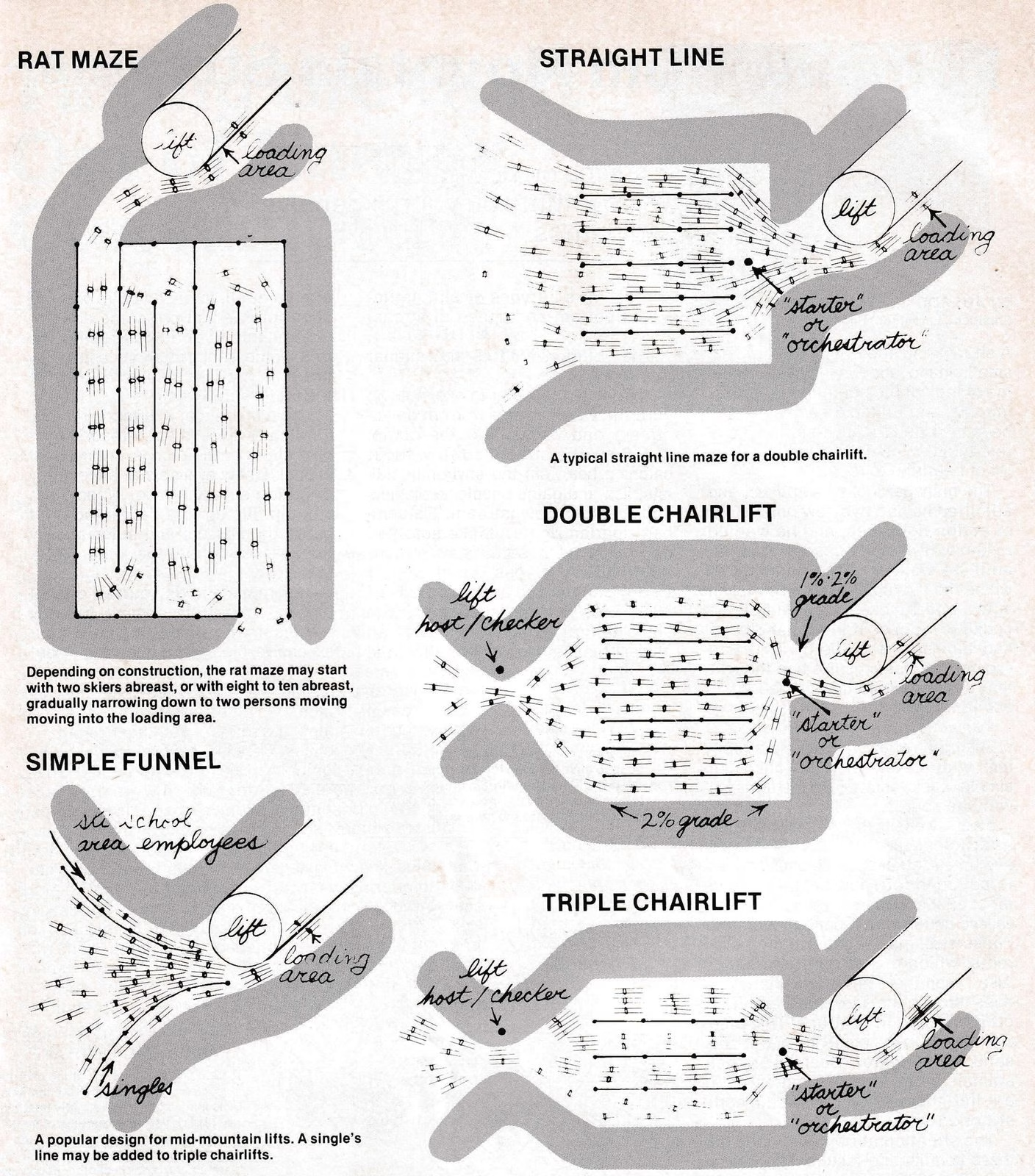
The lift maze design depends, on the type of lift and skier it serves. Currently, there are three popular maze designs in use: the rat maze, the simple funnel and the straight line (also known as the “orchestration” design at Arapahoe).
The rat maze offers continual forward motion in a lift line which may be a psychological plus, but not for recreational skiers at a base elevation of 10,800 feet and a mid-mountain elevation of 11,800 feet, says Reveal. Motion takes energy and, since a good portion of Arapahoe’s skiing terrain is strenuous, the area’s mazes are designed for skier relaxation.

“It’s better for our client if we put him or her into a maze where they can relax and catch their breath,” says Reveal. “If they usually live at sea level and are in a moving lift line at 11,800 feet, taking those rat maze corners can be hard work.”
The funnel configuration usually consists of eight lines that merge into four, two and then one line into the loading area. Reveal says it’s a fair system easily bringing people into the unloading area in an uncomplicated manner. It doesn’t require a checker/assembler and the “fairness” system generally prevails, with people willingly alternating with skiers in other lines.
“Fairness comes into question with the funnel design,” says Reveal. “Savvy skiers know tricks and they can move a lot faster through the line. People rate their progress to that of people who got in line at the same time and they don’t like to see the others move along at a faster rate.”
Called “Orchestration” at Arapahoe, the straight line system is the maze design Reveal favors. It is 10 lines wide, but individual lines can be temporarily closed according to traffic volume or for maintenance (shoveling, etc.), without disrupting flow to the lift. “Fairness” is controlled by a host/checker.
Arapahoe’s adaptation of the straight line system incorporates fairness and low hassle with efficient line movement. A lift host stationed at the maze entrance checks tickets, advises people on which line they should be in and supplies witty repartee when needed. From that point the skier moves into one of 10 lines. A second host, called the assembler, controls the order of their entrance into a single line into the loading area. Two operators work in the loading area, one responsible for passenger loading, the other for control of the machinery.
Construction
An area operator’s goal is to keep the lift operating at 100 percent capacity and the maze must facilitate loading at that rate. A flat area, with a 1 percent to 2 percent grade in some sections is desirable, while uphill or sidehill approaches and ruts are bad. The maze construction is determined by the type of lift, how much maze space is available and how much time, energy, effort and money, management is prepared to invest in order to make it efficient. Annual snowfall also determines construction constraints. If an area generally has a base of 15 feet of snow, it’s easy to maintain a flat maze area with a snow cat regardless of terrain variations. Snowmaking areas may be working with 2 to 3 feet of snow, complicated by terrain and vegetation considerations.
Arapahoe’s new mazes incorporate knowledge from observations over two winters at individual lift locations. Says Reveal: “We studied the lift requirements, traffic patterns around each lift, the type of customer using the lift and the behavior we want from that customer.” He’s confident enough in that knowledge to put permanent maze posts in the ground, knowing that, with 4 to 8 feet of snow, he won’t have to worry about moving them.
Permanent maze construction consists of 4″ x 4″s, creosoted for 2 to 3 feet on the underground end. Their height is determined by the expected annual snowfall for the particular mountain location. At Arapahoe, the posts are 8 feet tall at the base of the mountain and 12 feet midway. (Some ski areas use metal pipe for posts.)
The main problems with a permanent maze, says Reveal, is that snowcat drivers use posts as markers and occasionally snap them off. They are also an obstruction and must be padded. In a record snow year another kind of hazard looms: they may be too short causing skier injury.
Reveal advises areas to experiment with portable mazes until they are relatively sure of what works for a particular lift. This takes time and attention, because changes may be needed on a daily basis, depending on snowfall, projected crowds, etc. Arapahoe used Durafiber posts—literally vaulting poles that are “rejects”—for portable mazes. The poles cut in half are light, easy to handle and move, and they have absolute rigidity. They get harder as temperatures get lower, but won’t become brittle.