The manager looked surprised, and admitted he had two new pumps out of action right then, and he wanted to know how I had guessed. I waited until we went into the pumphouse where the two pumps had been taken apart, and I picked up some of the packing. I rubbed it in my hands and had him do the same. Grit. It had scoured the bearings. He had thought that nothing could be done about it, but he was wrong.
We went to the intake, where I explained that whenever there is a problem with water, there is only one simple, basic answer, and it turns up with the source.
While wells will normally suffice as a water supply for ski base lodges and hotels, other sources usually have to be found for snowmaking, and in most cases these sources are in the valleys and involve mountain streams. These streams are fast-running currents, which pick up grit and sand. Also, when there is a thaw, the water drips through the snow pack and runs off just above the surface. This also contributes to the presence of grit and sand in the water. Deer and other animals cross streams and can stir grit into them, as will upstream construction work.
The situation at hand included all these contributing factors. The intake was an open 24-in. culvert at the bottom of the stream, covered with a 1-in. mesh which got clogged with leaves and weeds.
The first step was to define the degree of the problem, and involved a simple sedimentation test. We got three clear milk bottles (there are still some around) and filled them in sequence at 3-hour intervals. We observed the settling rate over a ten-hour period.
In seeking the solution, I explained that there are no mathematical formulas to follow, because streams are all different. They vary in depth, percentage of silt, types of silt, nature of the bottom and speed of stream flow.
The solution for this and similar situations is:

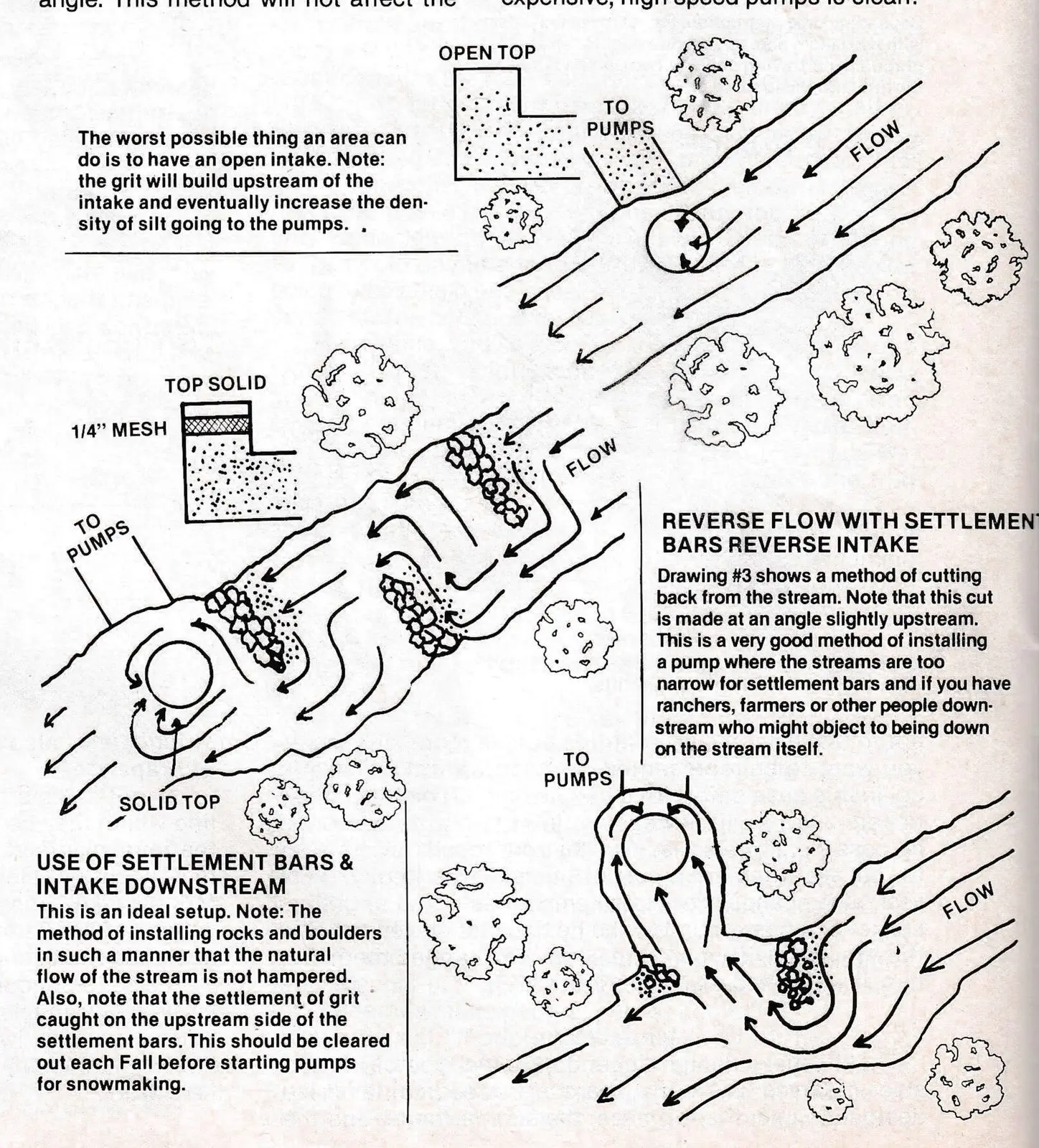
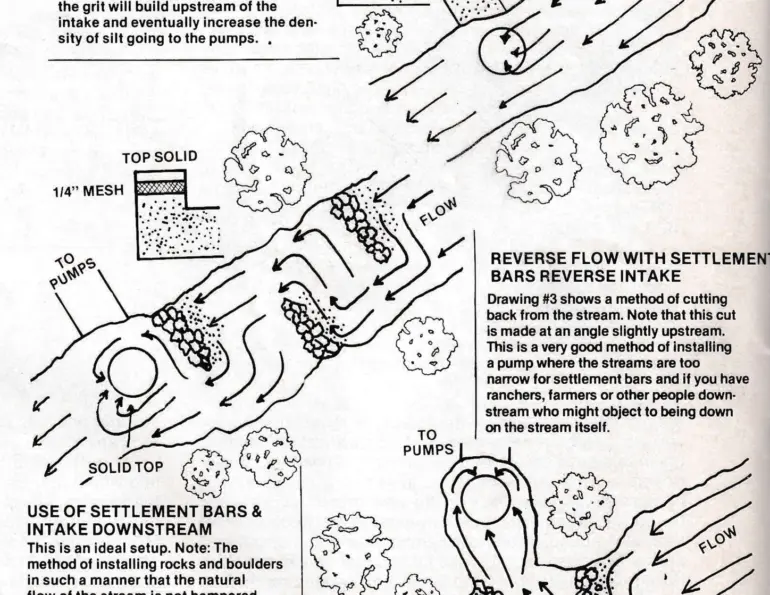
- Change the water intake, making sure the water comes in from downstream and backs into the sump.
2. Slow the stream down without catching hell from the environmentalists, fish and game people, ecologists and everyone downstream. (Remember: riparian rights!) Make sure you do not put your settling bars more than halfway across the stream. If by any chance you are on a grade of over 15%, you can accomplish the same thing by making a cut at an angle. This method will not affect the stream at all, in case you’re worried about problems from some agency.
After this is done you repeat the milk bottle sedimentation tests, only this time you take your samples from the pump sump itself.
I have found that if, after doing this, I still have excess silt, I resort to intake filters at the pumps. A filter that is dual is now available at almost any irrigation supply house. When such a pump fills up to a certain point, it builds up pressure and automatically flushes out while the other filter takes over.
In summary, to rid yourself of a lot of headaches this coming season, make sure the water going into your expensive, high-speed pumps is clean!