The North American ski world is having to come to grips with the implications of a shrunken marketplace, as measured in product choices, now that both the lift and groomer markets are essentially limited to two places to buy a detachable or gondola and two places to buy a grooming vehicle. Does this suggest there will be less competition? Is there an implicit hint that, while doing nothing illegal, there could be a natural evolution resulting in a form of divvying up of the market and little motivation to go to the mat on price to make a sale? Is there a danger in this consolidation taking place at a time when the total market is contracting? What happens should the market for these high-ticket items no longer support even two suppliers?
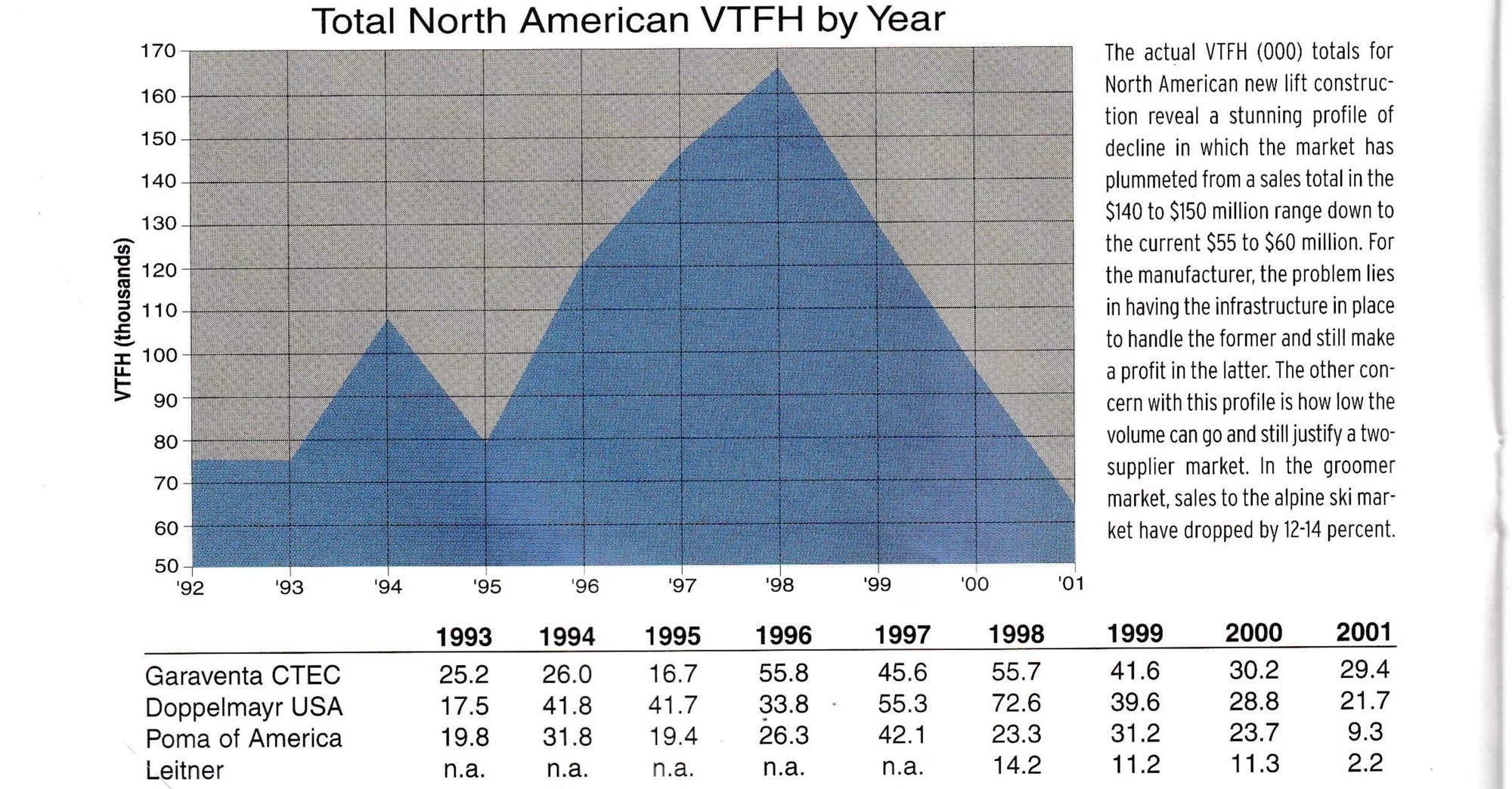
These are not idle questions when you look at the picture of declining sales of lifts and vehicles experienced before the economy went into recession and before the events of 9/11.
Of course, we are hardly alone facing this. Everything from the airline industry (now down to Boeing and Airbus for big planes) to the funeral industry is facing a post-consolidation world where the result is often a two- or one-source market.
The reader deserves to be let off the hook with the assurance that competition is alive and well—exuberantly alive and well, even if the market itself couldn’t be described with those words. That’s the inescapable conclusion for now, but it would be well to understand the background that underlies the marketplace and the competition it currently sustains.
Cast your mind back 30 years to 1972. No less than 220 new lifts became operational that year. But more impressive than the volume of lift construction was the array of manufacturers: there were 17 of them, more than half of them with double-digit totals in lift installations. A decade later the 78 lifts installed came from just nine suppliers. Today, if you plan to place a lift order, your choices are down to four, counting Partek and Riblet. If you want a detachable or a gondola, you’re down to two: Leitner-Poma and Doppelmayr-CTEC.
The other possible big-ticket item on an area shopping list is a grooming vehicle and here North American buyers are also down to two suppliers, Bombardier and Kassbohrer, as indeed it has been for the last three-plus years.
The North American marketplace for lifts and groomers has many of the characteristics of a Moroccan bazaar. Negotiated price provides the market dynamic and the happy players are obligated to express their outrage at the deal.
“We’ve been beaten up so badly over the years,” cry the lift suppliers; “it’s absolutely crazy! Like, forget about diminishing margins—there are no margins left!”
And from the resort executives, comes the flip-side wail: “These things have become so expensive. I mean, where is the payback on a lift that costs several million dollars, needs huge maintenance and requires hiring M.I.T. graduates to keep the exotic software and electronics in operation?”
Ditto the grooming field, except that the players are less emotional. And since both groomer suppliers are answerable to stockholders who insist on healthy bottom lines, they may find it easier to say “No” and walk away from a deal.
A little hurry-up history here as background. In the years of exuberant growth, double and triple chairlifts were popping up like May asparagus, engineered by the likes of Borvig, Hall, Poma, Lift Engineering and CTEC. In the 10 years from 1963 through 1972, no less than 1,837 lifts were installed, more than half of them chairlifts. Come the ’80s and a trend started toward bigger, more sophisticated, (more expensive!) lifts and there was brutal competition among suppliers. The competition was less for market share than it was for survival. A number of manufacturers fell by the wayside. Capacity was king.
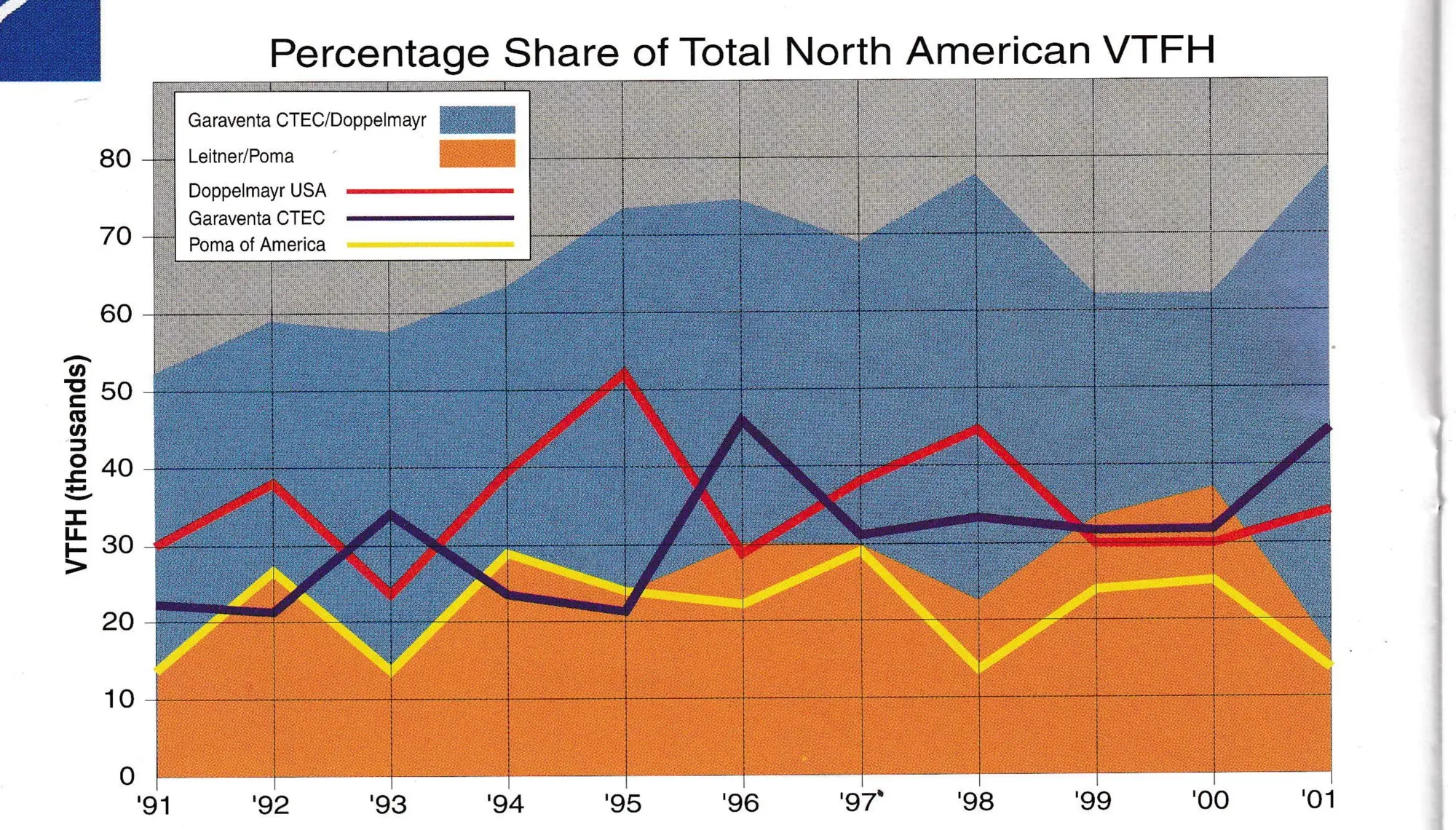
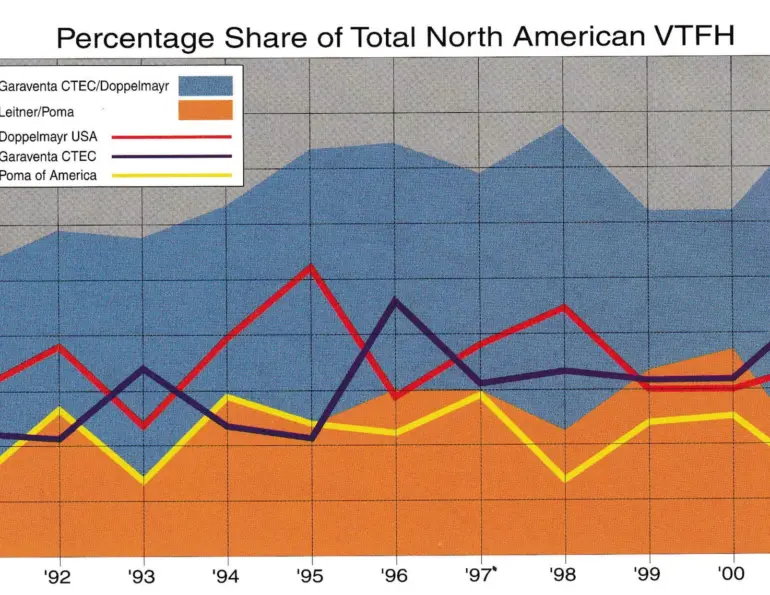
The European giants, Doppelmayr and Poma, started to dominate, especially as the detachable market began to take off in the mid-’80s. Lift Engineering played a critical role as a homegrown supplier of the lower-cost detachables the market wanted. By the early ’90s, all these trends were accelerating, with CTEC—first teaming up with Von Roll and then with Garaventa—becoming a major force in the North American detachable market. By the mid-’90s, Lift Engineering had imploded, leaving the market principally to the Europeans—or more accurately, to their American subsidiaries.
The competition all this while was extremely intense among the manufacturers, made all the more so by the surge of area consolidations that put—or was perceived as putting—almost unbearable leverage in the hands of a buyer with a multiple resort lift order to shop around.
Then add to the mix the entry of the Italian giant, Leitner, in 1998 and the marketplace became bloodier than ever.
That year was a confusing one because the lift manufacturers were maxed out in meeting demand. The “Big Four” conglomerates (ASC, Vail Resorts, Intrawest and Booth Creek) alone accounted for 63,531 in new VTFH, which was 43 percent of the total that year. In addition, a lot of production capacity was being devoted to “fixes” for the doomed Yan detachables.
But something had to give. A study by the European resort conglomerate, Compagnie des Alpes, made the startling discovery that comparable lifts were being installed for some 20 percent less in North America than in Europe. The gallows humor was that French resorts were maneuvering to order their new Pomas from Poma of America (POA).
In the meantime, Leitner was finding the North American market a tough one to crack, while in Europe, with traditional trade boundaries starting to crumble in a world of European Common Union, Leitner was making inroads on its non-Italian neighbors like France, Switzerland and even Austria. Consolidation was in the air. Doppelmayr, which had earlier scarfed up Von Roll and the cabin-maker CWA, crafted an assimilation of the Swiss Garaventa (a complex deal involving family trusts and a holding company). And Leitner did the same with Poma.

But North Americans should understand that the dynamics of these mergers were more driven by world marketing considerations than by North American ones; certainly more driven by European considerations than North American ones. And the new order of things will play out differently in North America than it will elsewhere. Pragmatism is the key. Doppelmayr may own Garaventa-CTEC, its erstwhile rival in the trenches, but it’s not about to risk losing the intense loyalties that Jan Leonard and his merry men have earned for themselves over many successful years in the marketplace. Likewise, Leitner may own Poma, but it’s not about to tinker with the intense field loyalties that Poma of America’s crew can call on.
The background on the groomer side is somewhat simpler. Ever since LMC folded its tents in 1997-98 (occasioned by a combination of profit siphoning by DeLorean and degraded innovation), the groomer market has been down to Bombardier and Kassbohrer, with the former enjoying a substantial edge in market share. (Prinoth tried, but never dented the North American market and Tucker Sno-Cat, while popular, does not compete for the same market.) In the meantime, Bombardier decided to withdraw from the European market and Prinoth likewise decided to bow out of the North American market. Today, each looks after the other’s service and maintenance in the abandoned markets.
Major change had also been absorbed in the Kassbohrer operation when that large family company broke up and its component parts were sold off. The Pisten Bully operation was organized as a publicly held stock company and the North American operations subsequently moved from Gray, Maine, to their current location in Nevada.
Today, the Bombardier vs. Kassbohrer battle for market share is as vigorous as it has ever been. It’s [a battle] about an alpine grooming market of what used to range between 200 and 230 vehicles per year, but which is now expected to settle in the 180 to 200 range. The decrease is more a function of increased efficiency than of decreased need: groomers groom more, cost less to operate and last longer. Those benefits are ultimately the happy result of manufacturers competing with each other in addressing customer priorities.
The big question is whether a company can sustain itself with the smaller share of a market if that market continues to contract. Both players emphasize that not all their eggs are in the alpine grooming business. Bombardier’s Chris Nyberg points to excellent business in groomers for snowmobile trails, as well as good prospects in the utilities and oil exploration fields. He is also scouting possibilities for Bombardier vehicles in food distribution in Afghanistan. Similarly, Kassbohrer’s Dennis McGiboney points to a self-propelled, fully powered beach-cleaning vehicle, Beach-Tech, that he thinks has good prospects. He also feels that Kassbohrer’s commitment to aggressive product development assures them continued vitality in the market.
Also to be kept in mind is that the North American market represents only 18 to 20 percent of Kassbohrer’s world sales. McGiboney points to his company’s strength and penetration in the home European market, as well as to new markets as evidenced by their recent sale of 35 Park Bullys to Japan.
Both Nyberg and McGiboney feel the competition between their companies will in no way decrease in intensity. “It’s still a relationship business,” says McGiboney. “We’re real strong at Mammoth, Whistler and Copper, for instance, while we get bloodied up when we go after Vail, Stratton or Tremblant. You’ve got to get prepared for it. Things are extremely aggressive. If you take a sale away, you’d better be watching your back door because likely you’ll be losing one.” A one-supplier market? Neither thinks it’s likely. Even less likely, a third supplier.
On the lift front the effect of consolidation is less clear if only because it is so new and is still evolving. For instance, in the Doppelmayr-Garaventa assimilation, the products of both companies are going to be available for the next two years in North America; only in 2004 is it planned for a single product line to be offered. Thus areas with lift plans can shop for both product lines. In the meantime, these products will be marketed in Europe according to whatever works best, country by country.
On the Leitner-Poma side, it’s going to be business as usual in North America, with the standard Poma product line.
What about the smaller suppliers still in the market? Riblet’s Doug Sowder senses little effect on his firm from the consolidations. Both he and Hagen Schulz, of Partek, acknowledge it’s hard to sell a fixed grip lift to a big ski area. “A big area buying a package of lifts can afford to leave a bunch of money on the table on the fixed grip in order to get the detachable order. I can’t do that.”
The biggest concern among the lift suppliers is for the continued health of the ski/snowboarding business as a whole. They acknowledge they can no longer hope to sell lifts to areas that just want to keep up with the Joneses. Today, real estate considerations are much more likely to drive lift sales than prestige; also, environmental constraints mean less expansion. It is not a pretty picture against a backdrop of negative growth in the skier market itself.
A reduction to a one-supplier market? Unthinkable for now is the consensus. If Doppelmayr took too much market share in North America, Leitner (which enjoys equivalent muscle) would be in a position to take business away from Doppelmayr in Europe.
But does that mean that there will be a move toward mutual accommodation and then upward pricing? You certainly didn’t read that here. What you can be sure of is a highly motivated, highly charged continuation of battles between sales managers who, quite apart from financial considerations, hate nothing as much as losing a sale—even one they know they can’t afford to make.