International safety organizations say that for every disaster or fatality there are 30 minor accidents, 300 near misses and 30,000 unsafe actions, mistakes, slips and other errors. Experience indicates that these numbers can vary greatly depending on the attitude of the individual and the organization he or she works for. However, in looking at the frequency and causes of accidents we find that human error experts also estimate that the average person makes about six significant errors per week.
It’s a wonder more people don’t injure themselves on a regular basis. That’s because the errors we make, piling up as they do, are often interrupted by random influences or unconscious changes we make in our daily routines. These changes have the net effect of preventing many accidents from ever coming to pass.
In understanding accidents, it is important to note that studies of numerous accidents, large and small, have shown that they all have multiple causes. One tragic example of how these multiple causes came together in an uninterrupted sequence is the crash of TWA Flight 800 off the coast of Long Island. The Boeing 747 sat on an empty runway for hours because of flight delays on a hot July day in 1996. It had an almost-empty center fuel tank and while the air conditioning system cooled the 230 people on board, the system’s discharged heat warmed the vapors in the fuel tank. Jet fuel generally isn’t explosive or even highly flammable, but only a few minutes after takeoff those warmed vapors exploded when an improperly insulated wire caused a spark. If the fuel tank had more liquid in it, if the plane hadn’t waited on the runway for so long, if it wasn’t such a hot day, if the wire hadn’t sparked, if, if, if. It’s a sad, but typical, instance in which a chain of events resulted in disaster.
Analysis of incidents around the world shows that they all ultimately result from a combination of errors and these errors can be separated into three classifications. There are:
1) Design deficiencies
2) Implementation deficiencies
3) System/control deficiencies
Design deficiencies are the physical roots of the incident. These are the situations where a road is designed with a driveway just over the crest of a hill or a car is designed with two controls set so close together that, in reaching for one you occasionally hit the other.
Implementation errors are the human gaffes we all occasionally commit. In the road-and-driveway example mentioned above, one possible implementation error could be the tendency among some to ignore the yellow “caution—driveways” sign and not reduce speed while cresting the hill.
The last group, the system and control problems, comprises the latent roots that allow the human errors and design deficiencies to take place. This system can be considered the environment in which the designing and implementation happens.
Within the huge body of knowledge about accidents, most reliability and safety experts offer four definitions of human blunders that take place in the three classifications outlined above:
- Mistake—This is an incorrect intention. The action goes as planned, but the plan is poor.
- Slip—The plan is not properly executed. The plan is good, but the action doesn’t follow it.
- Error—This is a deviation between the action performed and the action that should have been performed.
- Accident—When enough of these errors occur in sequence, the result is an unintended event, or an accident, that usually has negative consequences.
When you consider how errors work together, it’s easy to see how individuals usually only have the power to change implementation errors, but people in management positions also have the ability to affect the latent errors.
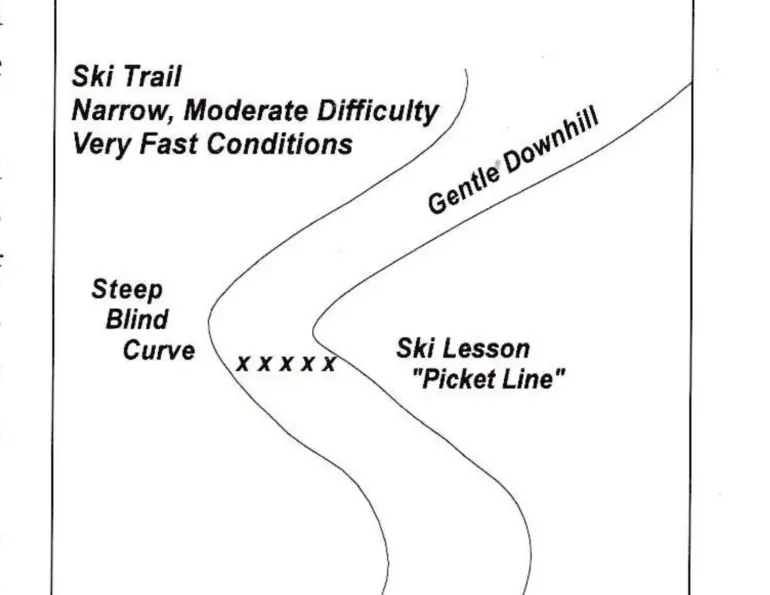
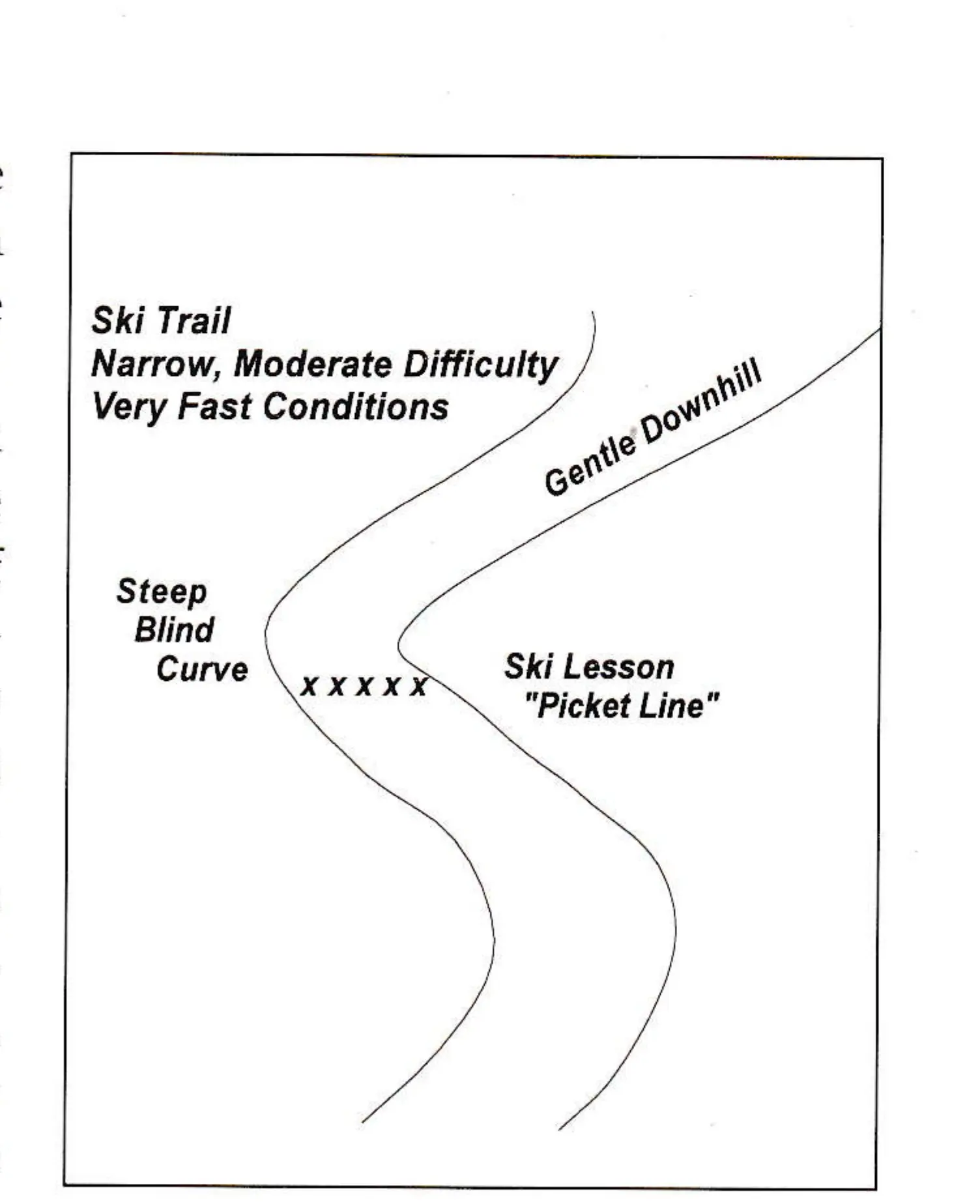
The diagram on this page shows an actual example of the layout of a slope on which I witnessed the latent roots of an error and a near miss. It was a moderately busy Saturday morning and I was skiing down around a blind corner just above a group of young children in a lesson. I passed and stopped, turning to watch as the instructor started them out in a line that zigzagged across the hill, playing follow-the-leader. At that moment, a group of four adults came down around the corner and one of them had to turn sharply to avoid flattening one of the tykes.
At the bottom, the instructor skied over to the lift line and began screaming at the adult, accusing him of endangering the children. The instructor was so irate that it wouldn’t have done much good to explain his contribution to the incident. Instead, I spoke to management later about how the choice of technique in that spot almost contributed to a serious accident. It was gratifying to hear that the area was going to adjust policy to help prevent a recurrence.

That adjustment is the kind of a fix that Charles Latino, a human reliability expert, describes in “The Error—Change Phenomena.” His theory is that an unmolested sequence of errors will eventually accumulate to cause an accident. But if an observant person is aware of one of the errors about to occur and prevents it somewhere along the line to break the sequence, the accident never takes place.
Unfortunately, humans almost universally overestimate their skills and think that they are both more competent and more aware of safety problems than they actually are. Improving our safety performance involves:
1) Developing procedures so that jobs don’t have distractions.
2) Instilling the practice of analyzing “Near Misses” to prevent repeats from becoming accidents down the road.
3) Training personnel to recognize hazards so they can be eliminated.
4) Followed by more training, training and training.
A little advance training can save in the long run. Consider another example: We were skiing at a small local area on a weekday evening when there was a deropement.
There was a group of about 15 teenagers moving up to the loading point. There were no maze ropes in place; they had been removed earlier because the ski area wasn’t expecting big crowds for its night-skiing session. The group of teens was engaged in typical good-natured fooling around and harassing each other as they were jostling to determine which threesome would be the next to get on the lift. The activity distracted the lift operator working at the time and neither he nor the three skiers who won the right to load noticed that the safety bar on the incoming chair was down. At the last moment, after it had rounded the bullwheel, the operator finally noticed and with a heroic effort pushed the chair out of the way of the teenagers. After passing them it swung back and hit the first tower, knocking the rope off the sheaves. It fell on the cable catcher and the lift came to a stop without further incident.
If the maze ropes had been there, the 15 students wouldn’t have been fighting for position. If they hadn’t been fighting for position, the operator wouldn’t have been distracted. If he hadn’t been distracted, he probably would have noticed the chair coming in with the safety bar down, etc.
Since we have learned that accidents almost always result from multiple causes and humans make frequent mistakes, it is imperative to study each incident in order to prevent a bigger accident in the future. When an accident almost happens, it’s important to realize that there was a random break in the chain of errors that prevented it from becoming a serious incident. Throw in the fact that humans don’t work well in unfamiliar situations, especially under pressure, and we begin to realize the importance of playing an active role in heading off potential problems.
Managers of all departments at ski areas should encourage employees to report and track incidents and near misses very carefully and to be on the lookout for emerging patterns. Sharing this information with other departments is critical because prevention might require the effort of everyone at the resort. Oftentimes, breaking the chain need only be a small fix, but that small fix can stop a snowball effect that could lead to a larger, potentially disastrous situation. On the other hand, remaining complacent and relying on chance that the cycle of errors will be broken is just asking for serious trouble.