


Counter-seasonal attractions and businesses have become significant sources of income for many winter resorts over the past few decades. These developments often produce other benefits, such as allowing for additional staff to be kept on as full time employees. By broadening the resort’s offerings, they also improve the potential for sales of timeshare and residential real estate. And they can provide positive cash flow on an annual basis. Two recent additions to the mountain resort scene, the canopy walk at Big Mountain and the Zip Rider at Park City (and now, two other locations in Utah), illustrate many of these benefits.
The Canopy Walk
The canopy walk at Big Mountain, Montana, was one of the first two ever created in North America (the idea originated in the jungles of Costa Rica). The concept was to provide a total premium-priced experience lasting two to three hours. But where is the appeal? Maybe it’s because the feeling is almost like being able to fly, and a canopy walk is a convenient and environmentally friendly way to reach those heights. For whatever reason, it has an almost magical affect on people. The walk attracts teens, families with small children, and older couples.
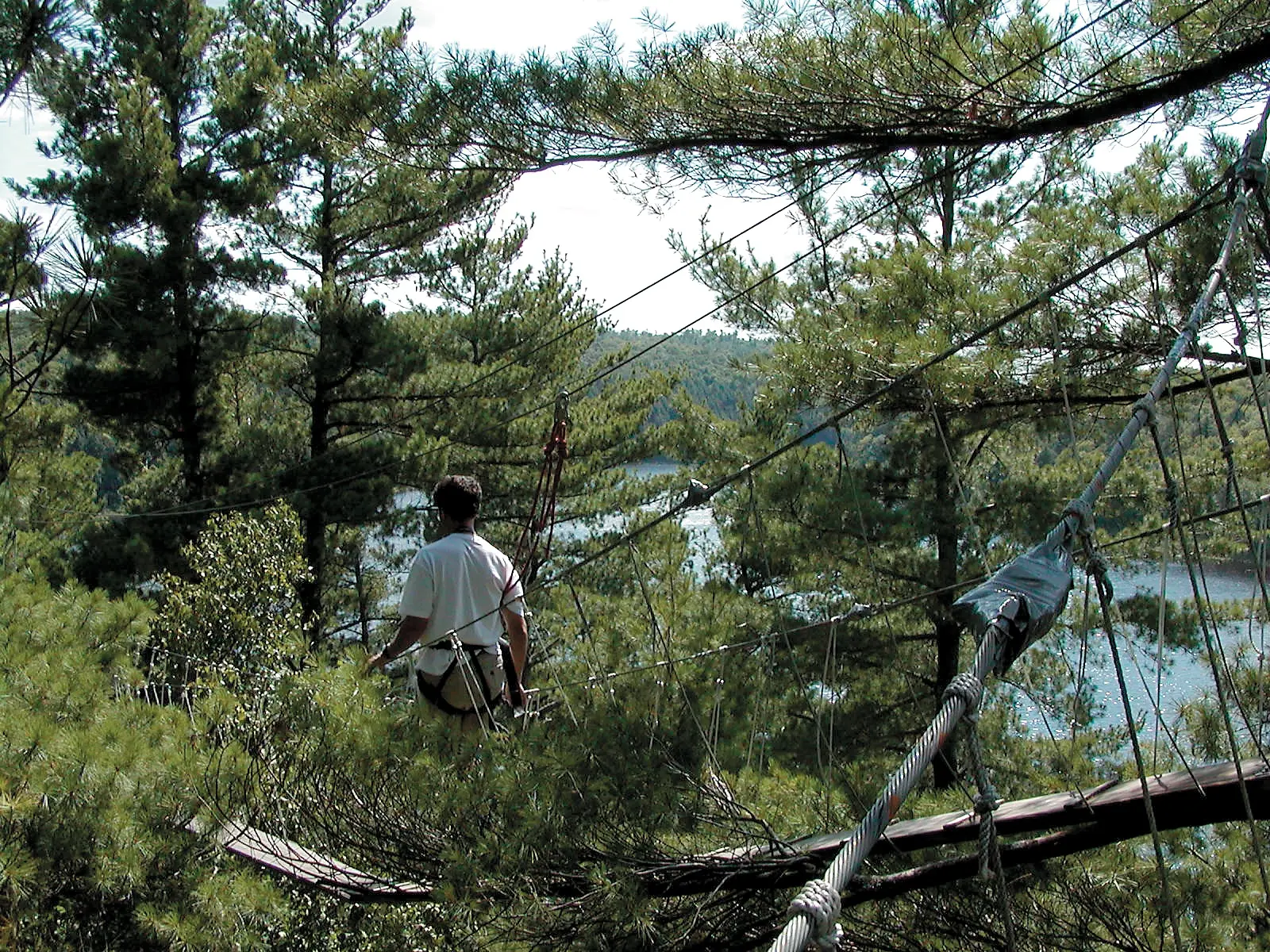
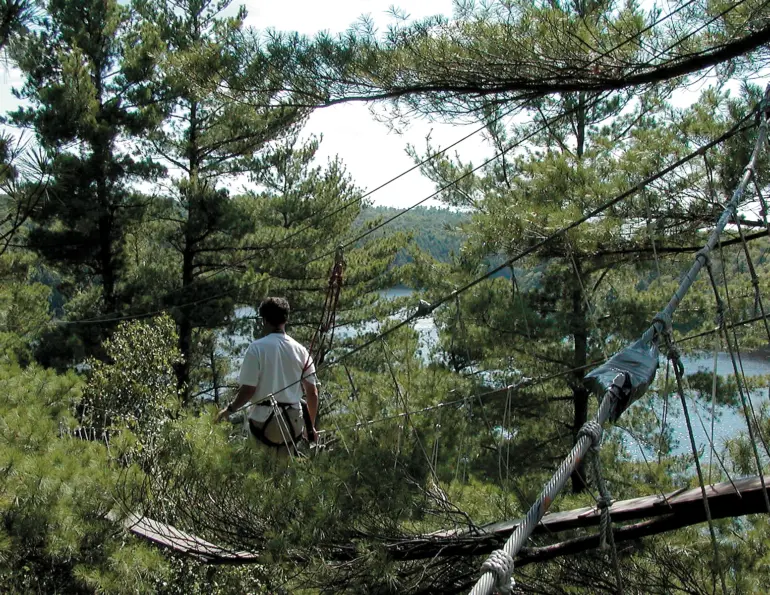
Construction is relatively simple. The walkway is like a rope bridge with handrails; it consists of a cedar plankway about a foot wide, suspended by cables that are attached to the trees via slings, to avoid damaging the trees themselves. Depending on the size of the trees, the walk can be as much as 70 feet above the ground. To ensure that guests don’t fall, they wear a security harness and clip into an overhead cable. Still, the walkway is free to sway, bounce and sag, and that adds to the thrill.
Generally, the Big Mountain installation can accommodate two groups of 13 at a time, along with two guides per group. Groups depart at morning, noon, and dusk. The guides serve two purposes. First, they make sure that the guests navigate the walk safely and provide encouragement to the apprehensive. Second, they provide local color, telling stories and describing the world of the treetops.
In fact, the walk is just the centerpiece for a larger adventure at Big Mountain that includes a covered wagon ride, safety talk, environmental hike and the canopy tour. Other features could be added, such as a campfire dinner at a cowboy tent camp, to generate added value and income.
From an operational standpoint, a canopy walk has several positive features. There are no moving parts, staffing needs are low, and it’s extremely safe—you can even invite your insurance agent along to see for himself. And the staff has fun working at the facility.
The Zip Rider
The Zip Rider is a more high-thrill, low-skill activity. From a ski area’s standpoint, it’s a good year-around, high-volume, high-profile business. Park City was the site of the first Zip Rider, and there are now four installations in Utah: two at the Olympic Park, and one at Snowbird. Riding the Zip Rider is as close to flying as most humans will ever get, and that has wide appeal.
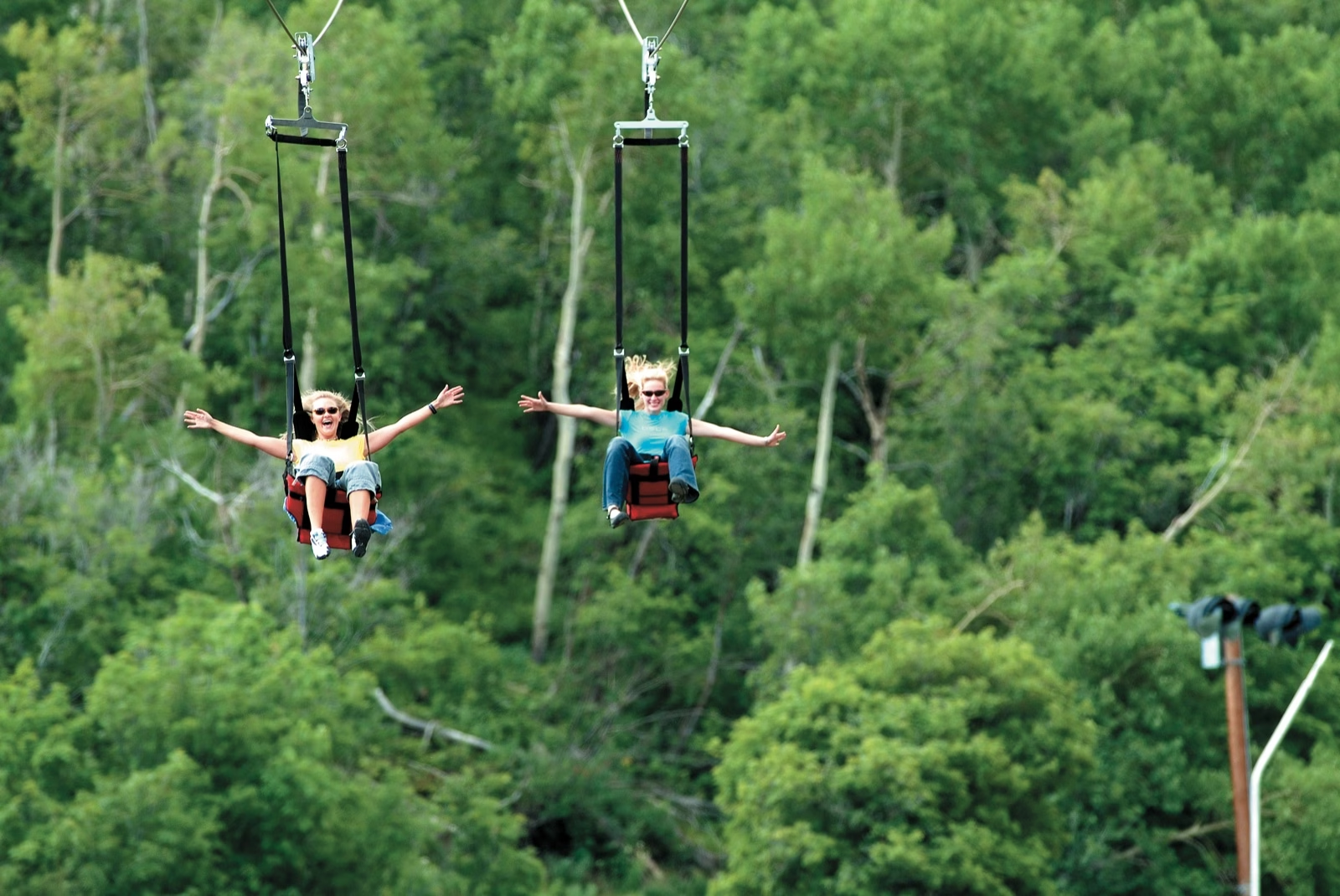
Installation is much like a simple chairlift. It involves top and bottom tower/terminals and cables between them. It’s possible, in fact, to retrofit lift towers for this purpose, if the length between them and the pitch are favorable. But most locations will require starting from scratch. The facility must be placed in a location where there is literally a free fall from top to bottom. In addition, you need to tie the Zip Rider, or Riders, into the ski area’s lift system, or provide some other means of access.
The Zip Rider is simplicity itself. A sling is rigged to the cable via a trolley, and the rider simply slides down the cable, fueled by gravity. An automatic braking system limits speed on the descent and stops the rider, somewhat quickly, at the end. The thrill is in the rapid acceleration, high speed and rapid stopping at the bottom.
The four existing installations illustrate the wide range of possible experiences. Park City, which has doubled its initial setup to provide four separate lines, provides a 2,300-foot span with a 23 percent grade. Speeds range up to 50 mph. Of the two lines at the Olympic Park, one is high-thrill (1,450-foot long with a 33 percent drop), the other is more tame (750-feet long, 20 percent grade). Snowbird’s installation is even more gradual (1,000 feet long, 15 percent grade).
There are four key requirements for a successful installation. First, a location that is both highly visible and provides a good viewscape (assuming that riders will notice their surroundings as they whiz downhill). Next, a complementary activity, such as an Alpine Slide. Since a Zip Rider is a high-speed ride, it complements other, tamer activities. It requires access, such as a chairlift, which can be shared with, say, an Alpine Slide. And it needs a pitch—it doesn’t have to be steep or long, though the thrill quotient goes up with each.
The beauty of the Zip Rider is that it resembles both the existing infrastructure and the activity of snowsliding—the ride consists of towers and cables, and the customer draw is going fast downhill. As such the Zip Rider suits many locations. Think of this as a summertime terrain park sort of thing: even a small area has enough length and pitch to provide a high-speed Zip ride.
Canopy walks, Zip Riders, and other multi-season attractions can be extremely profitable for winter resorts, and the number and type of attractions are limited only by your imagination. If you look at your facility in a new way, perhaps you will create the next hot concept. It wouldn’t be the first time.
Dan Matthews can be reached at (705) 444-1252; [email protected].

A Walk by the Numbers
A canopy walk has the capacity to pay for itself and turn a profit in the first season. The following cost and revenue figures are from a similar installation in Haliburton, Ont., but are not much different from those for Big Mountain (for which figures were not available).
- Operating Income: $365,000. This is based on about 4,100 visitations, with an average income of nearly $90 per person. Due to the guided nature of the tour there’s little discounting. Full capacity—the maximum number of people that can be controlled and directed on a canopy walk—is 6 groups daily and a 90-day season. Haliburton achieves 80 to 90 percent utilization, even though it is two hours from the nearest metropolitan area.
- Operating costs: about $105,000. This includes staff for guiding tours and taking reservations, administration and insurance.
- Operating profit: $260,000. This does not include other income, such as photo and T-shirt sales or food and beverage.
- Initial construction costs: $85,000 to $100,000, for purchase and installation of cables and walkway. This includes planning, layout approvals, construction and materials.
Imagining the Future
The development of high quality attractions requires equal amounts of creativity and planning. You have to step away from your winter culture and think about a new attraction during the warmer months. At our company, D.R., Matthews & Associates, we use a four-step process.
Step 1. Conduct a site audit to define the possible attraction zones and potential activities. Cruise the site and look at a topo map. Sure, you know the space you have, but you’ve always viewed it as a ski slope. Now, you have to look at it anew and imagine what other uses it might have.
Each site has a specific personality, due to the nature of the resort, its terrain, and even its clientele. Some attractions work best near a base area in a group. Others are stand-alone attractions that can be located quite a way from the base area. In some instances there may be multi-season facilities already in place, so it’s a case of complementing and improving the product mix.
Step 2. Explore ways to use the space. Create a list of potential activities and facilities for different areas of the overall site. Each potential use has its own space requirements, and your list will probably include overlapping options. Use photos and drawings of any proposed uses to help refine ideas and determine if they will suit the space.
But practicality is not the main focus at this point. This is the “dare to dream” phase, where ideas matter most. The practical facts will emerge.
Step 3. Define the plans in conceptual and financial form. Assign someone to produce a preliminary plan, with the attractions sited and costs considered. This is where the practical considerations raise their prickly heads. For example, once Big Mountain decided to install a canopy walk, it took five days to find a location that had all the right elements: relative seclusion from the base area but accessibility for construction and the provision of basic items such as food, beverage and bathrooms, with trees able to support the structure, and with interesting viewscapes and a generally engaging environment.
Each particular part of the planning and construction process should be scheduled and defined. Big Mountain opted to construct the facility during the winter, when the materials and cables could be laid out over the snow. This reduced construction time considerably, as the crew did not have to deal with bushes and brush.
Step 4. Develop a detailed project construction schedule. At our company we use an Adventure Plan Book, a “play book” that has been designed to provide a step-by-step guide from start to finish. The plan book defines as many elements as possible, listing specific specialists who may be needed and where to locate the necessary materials. This saves time once the project begins.
A Zip Through the Numbers
A Zip Rider can provide a good return on investment. Typically, an area can recoup the initial investment in two or three seasons. The following figures are from the 2003 season at Park City, the area’s first full season, when it had two lines.
- Operating income: $290,000, the result of 20,000 visitations over a summer season of 98 days. Price was $15 per ride; Park City charged $17 in 2004, while other areas charged $12 to $20. Operating income includes ticket sales only, and excludes any food, beverage, apparel or accessories.
- Operating expenses: $86,000, including the cost of five employees over a 12-hour day ($81,000), plus maintenance and equipment costs ($5,000). The cost of operating the access lift, which is shared with Park City’s Alpine Slides, is not included.
- Operating profit: about $200,000.
- Purchase and installation cost: typically ranges from $500,000 to $700,000.

