
This means that over the years your rental operation can be modernized taking into account the best in binding designs for the safety and pleasure of your customers, as well as your own liability responsibilities. At the same time, the constantly changing binding designs make it impossible — if not foolish — to try to list the best or the worst rental bindings at any particular time.
Probably the only certainty at this time is that the old cable binding systems must give way to more modern and effective systems as rapidly as possible. There are still a few hangers-on but the risks of unsuccessful defense litigation involving cable bindings rented to skiers who are injured are becoming greater as time goes on.
The step-in heel and toe combinations supplanted the cables, and systems like Look, Salomon, Geze, Tyrolia, Cober, etc., are still viable when properly mounted and adjusted. However, the need for effective anti-friction under the boot has been so strongly proven and promoted in the past year or two that the rentor of this type of equipment is well advised to protect his customer and himself with the addition of a good Teflon pad or anti-friction device. This is, at least, a first step in upgrading your rentals. Don’t be caught with your “anti-friction pants down” in today’s operations.
At least one binding system—Allsop—has a built-in solution to the friction problem. By placing a pivot peg under the ball-of-the-foot, the Allsop virtually negates the effects of friction in a forward-weighted twisting-fall, the classic mode of injury.
Actually, most good binding systems provide effective anti-friction devices, but they are only as good as the skier allows them to be. Your rental customer is usually a beginner or novice who might be expected to mistreat your property, either maliciously or unknowingly. So, you are well off considering the best way to keep control of the binding functions. I think the way to go is with the plate binding, or one that approaches it.
Plates, in the generic sense, are those systems which isolate the release mechanisms from direct interface with the boot. In this way the binding designer has greater control over the mechanics of release without concern about the compatibility, condition or maltreatment of the boot. Not the least of the advantages of the plate binding is the control of friction reduction. This is an area of great advantage to rental shops because there are no separate anti-friction devices that customers can “screw up” with dirt or misuse on the slope.
Two bindings that approach the plate, according to my definition above, are the Cubco and the Spademan. Both have release mechanisms that interface with metal attachments to the boot, rather than with the boot itself. I think of Cubco’s Mitch Cubberley, as sort of a pioneer of plate bindings in the generic sense. His is certainly one of the longest lived bindings without major change. New for 1974 is a Cubco full plate binding. The Spademan, of course, has a metal plate fastened to the boot for interface with the release mechanism. Both of these bindings require a separate anti-friction device. Cubco offers the Skidder and Spademan now has a Teflon pad.
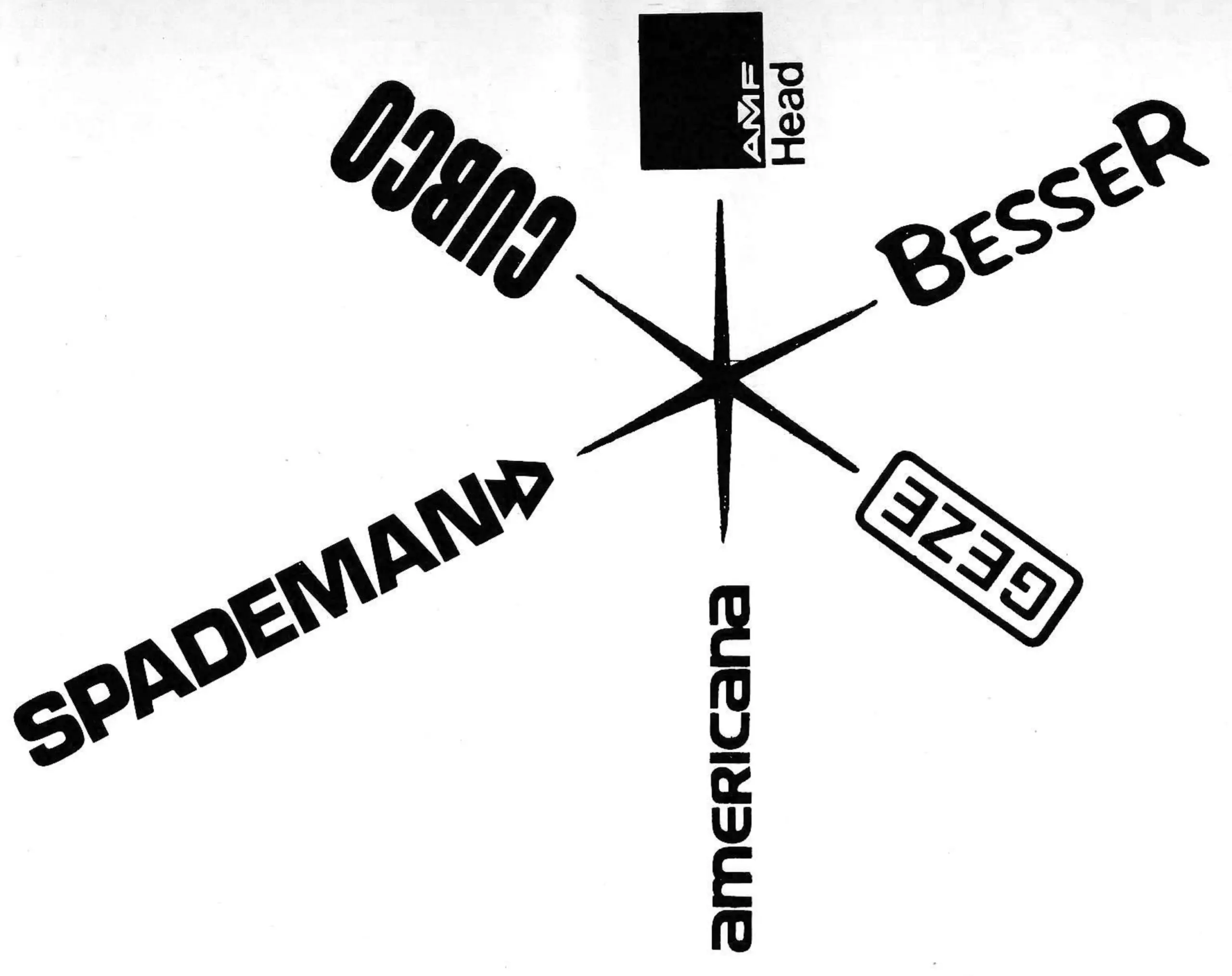
The predominant plate-type or quasiplate bindings available now are Besser, Gertsch, Geze, Head, Americana, Spademan, and Cubco. Of course, many new plate systems are coming on the market, and the appraisal I’m about to put forth will necessarily be outdated within a matter of months. However, it may be helpful in providing means with which you can develop your own analysis of future bindings that you might consider when adding to or upgrading your inventory.
In addition to selecting a rental binding which does not require an interface between the boot and the release mechanism, I also recommend bindings with backward fall release capability. These two criteria are based on the fact that the vast majority of your customers will be beginner-novice type skiers who know the least about proper maintenance and use of bindings, anti-friction devices and boots, and who may benefit most from a backward release potential in addition to the basic three releases, right and left lateral and forward. This spells plate-type bindings with multiple release directions. In addition, the plate systems offer these advantages:
- Compatibility with virtually all boots on the market.
- Built-in anti-friction means.
- Ease of pre-mating boots to plates.
- Interchangeability of plates with mounted hardware on the skis.
- Storage of plates with boots attached.
- Less concern about dirt on the boot sole affecting release.
- Usually a single release adjustment with fixed ratios of forward, lateral and backward releases.
- Easy for customer to get in and out of bindings in most cases.
The chart below evaluates the current plate-type bindings from two viewpoints. One concerns items affecting shop operations and the other is made up of items affecting skier use and safety. The rating system gives point values for each item: 5 is the highest score and 1 is the lowest score. Each rental shop manager can weigh the importance of these items according to his own geographic and economic considerations.
Ratings of Plate-Type Rental Bindings
| Head | Besser | Gertsch | Geze | Spademan | Americana | Cubco | |
|---|---|---|---|---|---|---|---|
| Items affecting shop operation: | |||||||
| 1. Minimum parts mounted on ski and boot | 3 | 4 | 4 | 4 | 3 | 4 | 1 |
| 2. Minimum boot fitting adjustments | 2 | 3 | 3 | 3 | 5 | 4 | 5 |
| 3. Minimum release adjustments | 2 | 4 | 4 | 4 | 5 | 4 | 2 |
| 4. Adjustment sensitivity to short skis | 5 | 4 | 4 | 4 | 4 | 2 | 3 |
| 5. Need for separate anti-friction device | 4 | 4 | 4 | 4 | 2 | 5 | 1 |
| 6. Concern for boot sole adaptibility | 4 | 4 | 4 | 4 | 1 | 4 | 5 |
| 7. Minimum operations to change for boot sizes | 2 | 3 | 3 | 3 | 5 | 3 | 1 |
| Items affecting skier use and safety: | |||||||
| 1. Multiple release directions | 4 | 4 | 4 | 4 | 5 | 2 | 3 |
| 2. Torque adjustment sensitivity to ski length | 5 | 4 | 4 | 4 | 4 | 2 | 3 |
| 3. Minimum sensitivity to inadvertant release | 5 | 3 | 3 | 3 | 2 | 1 | 1 |
| 4. Minimum sensitivity to forward weight lateral friction | 4 | 4 | 4 | 4 | 3 | 5 | 3 |
| 5. Maximum safety when walking in lodge | 5 | 5 | 5 | 5 | 3 | 5 | 3 |
| 6. Minimum sensitivity to dirt on boot sole | 5 | 5 | 5 | 5 | 3 | 5 | 3 |
| 7. Ease of reentry after release on slope | 5 | 4 | 4 | 4 | 5 | 3 | 4 |
In addition to the criteria listed on the chart, each of the bindings has strong points to consider:
The Head plate binding has a pivotal axis under the tibia bone making it the most discriminating binding offered. By discriminating I mean it best differentiates between torque that injures and side force that doesn’t injure, but causes inadvertant release.

The Besser, Gertsch and Geze plates have pivot axes behind the tibia which provides a margin between actual leg torque and your calibrated torque when tested by machine for initial adjustments.
The Spademan has the greatest potential for release under all load conditions, but does require good effective anti-friction under the ball of the foot.
The Americana is the least sensitive to friction in forward twisting falls but has a pivot axis ahead of the Tibia making it sensitive to ski length and more prone to inadvertant release.
The Cubco is most adaptable to all boots, has minimum fitting adjustments and the Skidder is a very effective anti-friction device.
All of these bindings are good, viable rental shop systems. Furthermore, the end in plate bindings is yet to come as more and more manufacturers get into the act.
News From The Trade Shows
This article, of necessity, was prepared before the introduction of several new bindings at the Ski Industries America trade shows. As I mentioned, changes and improvements are constantly being made and it seems only fitting to add a last minute review.
Americana has made a number of changes for the better. The use of Lexan (to avoid electrolytic corrosion), a low profile, dual spring cassette with rectangular piston and a toe release capability have been added. Geze has a new wire boot hold-down at the toe which is self-adjusting for fit. That should please a rental operator. AMF Tyrolia has a new plate this year. K2 has introduced a new Marker plate that has great promise in my view, because it has a tibial axis pivot. It is also a true step-in plate. Miller has joined the ranks with a plastic plate binding. Spademan and Cubco each have added a full plate modification to their systems. Besser has a new toe wedge system that adapts to all boots quickly and easily.
—J.P.