
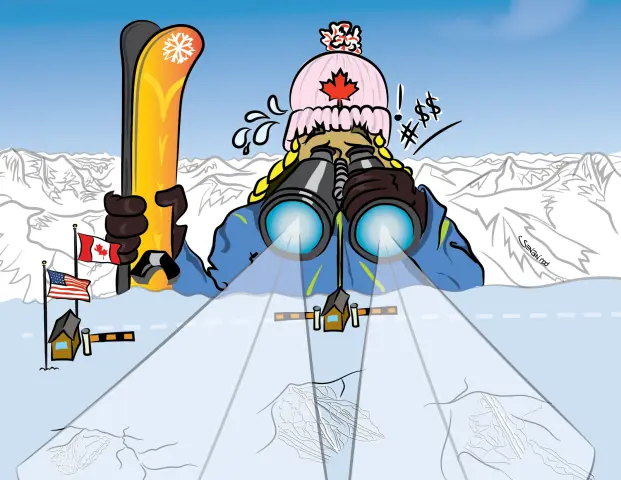

The gasoline shortage hurt, but not as long and not as many as had been feared. Eastern Canada had a very fine snow season (Eastern Townships excepted) and had no gasoline shortage at all. One informed observer thought it possible that there might be more lifts built in Canada this year than in the whole U.S., so healthy is the industry there.
The following reports do not pretend to constitute a complete national roundup; rather, they highlight what happened in five of the nation’s ski regions, as reported by our correspondents.
PACIFIC NORTHWEST
A Great Snow Year
by JOHN HOEFLING
Probably the biggest news of this 1973-74 season must be the quantity of snow that fell in the Northwest. Record snow depths were recorded in numerous ski areas. Timberline Lodge, Oregon’s Mount Hood was the leader with 311 inches. That’s 26 feet. Anthony Lakes received 98 inches, a new record for them. Other areas were from 120 to 300 inches. The quality of snow was also tops. Washington’s Mission Ridge Manager Walt Hampton probably sums it up best for all areas when he commented, “This is one of the best snow year’s we’ve ever had.”
Adequate gasoline supplies were a problem in the middle and late stages of the season. But the hard-core skiers were willing to wait in line, sometimes for hours, to get enough for a round trip to the mountains. Some areas more than a tank-full away from major metropolitan areas did suffer. A number of areas guaranteed their skier customers enough gas to get home, if needed. Car pooling and public transportation alleviated the problem in many cases. Late spring skiing was not affected, as gas again became plentiful in late spring.
As far as actual business conditions are concerned, reports ranged from “best season ever” to “a good year.” Mt. Bachelor, Oregon.
President Bill Healy said “this was the best season we ever had in our 15 years of operation.” Surviving the gas scare, Bachelor had a record 23 feet of snow to help initiate their two new chairlifts.
At one of the Northwest’s largest and oldest areas, Snoqualmie Summit, owner-operator Webb Moffett said that this was “an excellent year for us. The gas shortage didn’t hurt.” Snoqualmie actually is the closest area to Seattle, Washington. The Seattle municipal bus system ran buses on weekends. During the week Moffett started the E-Z Rider ski buses, a promotion that really helped midweek business, he said. A $4 fare also included a 50c discount on a lift ticket, plus a 25c credit ‘for a beverage of the skier’s choice.”
Moffett reported the area’s second earliest opening in history — November 10. (In 1955 it was on October 28.) “We usually open December 1,” he said, “but our record-tying 20-foot snow depth helped give us the early start.” Snoqualmie Summit is in operation seven days, and seven nights, a week. A new triple chair to be installed this summer will open up the steepest slope in the area.
On the slopes of Oregon’s highest mountain, Mt. Hood Meadows, General Manager Norm McKinnon said it was “a very good year, with business up significantly.” Some cold weather and the deep snows were responsible for a decrease in night skiing, he felt. But an increase in day and swing shift skiing crowds made up for it. McKinnon reported a top of 300 inches of snow for this six-year-old resort.
Mt. Hood Meadows was one area promising gas to motorists needing it to return home. “It really wasn’t a problem for many,” he added.
The Northwest’s newest ski area, 49 Degrees North, is in its second year of operation. According to Area Manager Al Voltz, “it was a good year, with super snow.” Gas supplies were a problem in this northeastern part of Washington state. Much carpooling, among both skiers and area employees, was evident according to Voltz. 49 Degrees North had no extreme weather conditions, according to Voltz, but there was a record 10½ feet of snow on the top of Chewelah Mountain.
All in all — the Pacific Northwest had few problems it could not live with. McKinnon perhaps summed it all up when he commented, “Gas was no problem. Toilet paper, yes.” Which is another story in itself.
THE SIERRAS
A Very Good Year
by BOB LOCHNER
It was another normal ski season in the Sierra Nevada, in this case “normal” meaning “up.”
Despite gas shortages and an uncertain economy, snow was plentiful, and skiers continued to flock to the 20 or so resorts in northern and central California and Nevada in record numbers. Nearly all ski areas said they were considerably ahead of last year through the end of February, then the gas situation and stormy weekend weather combined to cause a fall-off in business.
Gas was still relatively easy to obtain in the mountains and in the smaller towns, but the crunch came in the immediate Bay Area, where skiers suddenly found it difficult to get enough fuel to leave home.
By the end of March, however, the problem had disappeared, setting the stage for a big Easter Week. And the snow was still there. Sugar Bowl, for example, had a 15- to 19-foot base on April 1 after picking up nine feet the previous week, and its seasonal total at that point, 601 inches, was the third highest in its 35-year history.
Most resorts ended the season between 10 and 20 percent ahead of 1972-73. A few will show an even bigger gain, while a couple dropped.
A few specific cases, as of early April:
Squaw Valley is “substantially” ahead of last year, meaning 20 to 25 percent, according to PR director Hans Von Nolde. These figures refer to income, about 10 percent of the rise being due to an increase in lift-ticket price from $9 to $10. Season-ticket sales were also up.
Heavenly Valley was 30 percent higher in attendance over 1972-73 through the end of February, but managing partner Hugh Killebrew said the first three weeks of March were down, so the final figure would be a bit lower. Attendance rose despite a lift-ticket price increase on weekends to $10 just before Christmas.
Bear Valley‘s gross income was off slightly, but Mt. Reba general manager Maury Rasmussen said the resort’s net was greater thanks to improved cost controls. The difference was due mainly to Thanksgiving—superb conditions in 1972 attracted a record four-day crowd, while the season didn’t really get underway until a week later in 1973.
Kirkwood exceeded the forecast for its second season in mid-March (with a month or more still to go), and its all-time peak attendance of 3300 came February 18 on the Washington’s Birthday holiday.
Dodge Ridge, which has been operating since the 50’s, had its biggest season ever, $100,000 ahead of last year, and nearly all of the gain was attributed to midweek business by general manager Earl Purdy.
Alpine Meadows, which turned a loss situation around four years ago, was again up considerably under the guidance of president Ray Johnson.
Considering the problems, it was something Frank Sinatra could sing about, “a very good year.”
THE ROCKIES
Good Snow—Good Business
by LOIS BARR
The ski season went well in the Rocky Mountains this year with most ski areas in Colorado, Utah and New Mexico showing increases in net lift revenues and skier days. The energy crisis did not appear to have affected business at any of the areas.
Only one area, Taos Ski Valley in New Mexico, showed a decrease in business for the year. Ernie Blake, Taos principal, said he expects the resort to be down 30 per cent in revenues from last year. He attributed the decrease to a lack of snow which prevented Taos from opening until Jan. 1—after the middle of November, he said.
“Since Christmas we have received plenty of snow,” Blake said, “and we are up 26 per cent over this same period last year. However, this increase doesn’t make up for the Christmas and Thanksgiving holidays.”
Other resorts in the Rockies attributed their increases to more and better marketing, good snow conditions and a lack of snow in the East.
Colorado suffered from a lack of snow early in the season which threatened to jeopardize holiday business. However, the snows came just before Christmas and, as Betty Farson of the Aspen Skiing Corp. put it “it didn’t quit snowing for a month.” Conditions at all areas generally remained excellent right through scheduled closings.

Vail reported skier days to be up 2 per cent and lift revenues up 15 per cent through the end of January. Revenues and skier days also were reported to be up through mid-March, but figures won’t be available until after they are released to stockholders (probably around mid-June).
Business was slow during the early weeks of December because of lack of snow, Parker said, but noted that many out-of-state skiers still thought it was good. “Coloradans are spoiled,” he said.
Copper Mountain, one of Colorado’s newest ski resorts, had a phenomenal season with increases of from 75 to 85 per cent reported for the months of January, February and March. R. Garrett Mitchell, marketing vice president, said the area did more business the first 17 day of March than for the entire month last year. Business increased 75 per cent in January, 80 per cent in February and from 75 to 85 per cent in March.
Mitchell said the increases were due to good snow conditions, the fact that more people know about Copper this year, its second season of operation, and additional lifts and improvements in the base village.
Steamboat also reported a 43 per cent increase in business over last year. In fact, Steamboat reported an all-time peak day Feb. 23 of 6,169 skiers. The peak day last year was 4,456 skiers during the Christmas holidays. The area was expecting a total skier day figure of 350,000 compared to 244,000 for last year.
An area spokeswoman attributed the increases to more families coming to this Colorado resort and spending one to two-week vacations. Other reasons were poor skiing in the East and more marketing efforts concentrated on the South.
This season Steamboat received record-breaking snowfalls (more snow than the rest of the state) and reported the snow to be six inches above an all-time record set in 1950.
One Colorado area which made an amazing recovery to post a profit this season was A-Basin, which suffered a 42 per cent decrease in business during a 30-day period in December and January when Loveland Pass was closed due to heavy snows. Jeff Mills, marketing director, said skiers didn’t realize they could go through the Eisenhower Tunnel, then backtrack on to A-Basin.
Since the pass was reopened, business at A-Basin has picked up to the point where A-Basin now is ahead 14 per cent in business over last year. Encouraged by the increased skiers, the area is planning to install a triple chairlift for next season.
Also showing increases this season was Crested Butte, located in Southern Colorado. Cal Queal, marketing director, said lift ticket revenues are 25 per cent ahead of last season, even though the area opened eight days later. Queal said the area also received a lot of snow had had 284 inches during a peak day.
Utah areas apparently did not suffer from a lack of early snow as did Colorado. At Snowbird, Jill Whitesides, information director, said the skiers and revenues are up about 8 per cent, mainly because “there have been more places for skiers to stay this season.” She was referring to the completion of the 160-room Cliff Lodge. By next season still another lodge, with 181 rooms, will be open. The area had sufficient snow, she said, but not as much as last season.
Park City, now in its 11th season of operation, experienced an even more dramatic increase in skiers this season. An area spokesman said that, as of mid-March, the resort is up from 30 to 35 per cent in skier-days.
He attributed part of this increase to Colorado’s early snow problems which brought more skiers to Utah and the fact that Park City had “plenty of snow for Christmas.”
The area wasn’t affected by the gasoline shortage, he said, because it is only 30 miles from Salt Lake City — easily reachable on one tank of gas.
THE MIDWEST
Not So Bad—Not So Good
by DON DOOLEY
Even though the midwest suffered less than other sections of the country from gas shortages, most ski area operators reported poorer business in the 1973-’74 season.
Poor weather hurt the most, but there were other villains including the fuel shortage and even the flu. Said Dave Lundberg, who runs Whitecap Mountain in northern Wisconsin, “We’re mainly a family area, and the flu that hit this winter was the kind that made one member of the family sick one week, then the second and on down the line, keeping families home every weekend.” Nevertheless, Whitecap ended the season (early) down only slightly from 1972-’73, its best in six years.
Logic, it seems, would force the assumption that ski areas close to metropolitan areas prospered because big-city skiers stayed close to home rather than drive many hundreds of miles to ski, but it didn’t always work that way.
Wilmot Mountain, on the Wisconsin-Illinois border, is an example. It is only 60 miles from Chicago, but John Stopa, vice president of the ski area, repored that Chicago skiers stayed home in February when the gas shortage finally struck the windy city.
“People got paranoid about gasoline,” he said. “There was a noticeable slackening of attendance in mid-February.” A 10 to 20 per cent drop in business up to that point worsened to a 50 per cent drop, he added. On top of that, it was a short season, starting in mid-December and closing March 3. “It would have been our all-time best year if it hadn’t been for the gas shortage,” Stopa said.
In contrast, Mount Telemark in northern Wisconsin was “not affected one iota” by the gas shortage, according to Tony Wise, the proprietor. He said that his prime market, the twin cities of Minneapolis and St. Paul, had few gas problems. He noted that gas stations did not close on Sundays in his corner of the state. His small drop in business was caused only by bad weather, he said.
Buck Hill, near the Twin Cities, had “an off again, on again, up and down season,” according to operator Stu Campbell. The best he could say was that “it could have been worse.” Campbell said there was little natural snow and tremendous temperature fluctuations, with 25 below zero during Christmas week (following a holiday rainout the year before), then heavy rains.
Glenn Riggs, manager of Holiday Park, 45 miles north of Chicago, said, “I’d like to have another season like it,” acknowledging that the gas shortage probably helped his business.
Said Fred Cimino, general manager of Alpine Valley, near Milwaukee, Wis.: “The fact that we skied 23,000 more skiers than last year tells us that the gas shortage did not hurt that much . . . In fact, it helped more than it hurt.” Cimino said that Chicago, his main market 85 miles to the southeast, sent hordes of skiers to swell attendance to 4,300 on Lincoln’s birthday, a school holiday in Chicago suburbs. Alpine’s best season was 1970-’71 with 183,000 skiers, compared with 160,000 this season and 137,000 the year before.
Valley High ski area, in Ohio, had its best year in four seasons. Said Bud Taylor: “The gas shortage had something to do with it, bringing in more local people from Columbus and Dayton who might have travelled farther west, north or east in other years.”
Paul Karow, president of the Central Ski Areas Association, and manager of Indianhead Mountain in Michigan’s upper peninsula, said. “In my discussions with others in the midwest, it seemed that those areas in the southern region had a pretty good season because people stayed close to home . . . Our season was less than we wanted it to be, first because of the weather and then the gas shortage (In-