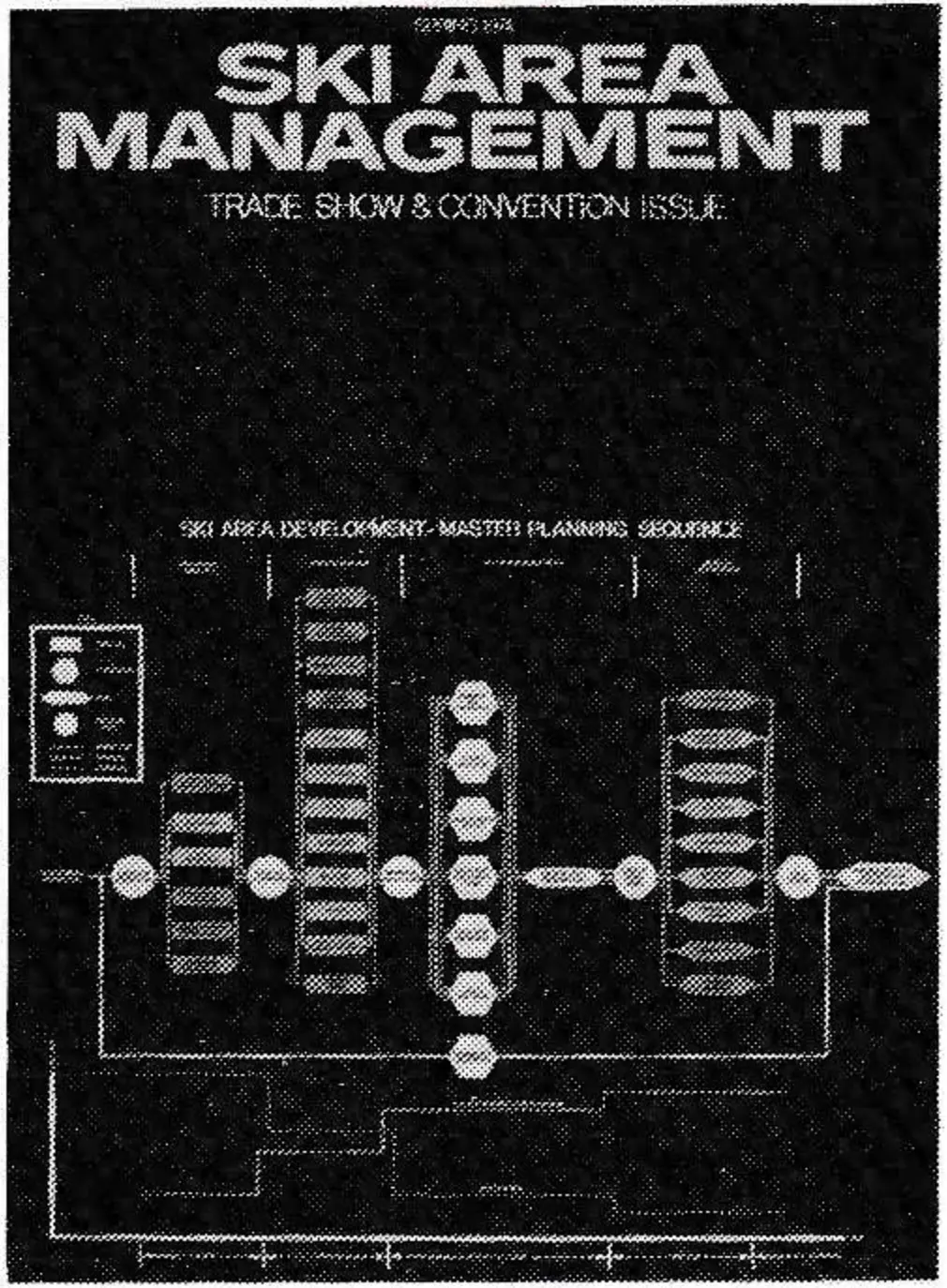
The illustration on the cover of this issue of Ski Area Management is a graphic interpretation of Sno-engineering’s approach to the Master Planning process. Master Planning, by its very name sounds overbearing and imperious — but in truth it is not. It is an essential sequence of thought and action and a logical arrangement of fact so that an informed decision can be made relative to almost any given situation. The Master Planning sequence does not relate only to land, ski development, or major geographic consideration, but is a process which can be applied in almost any decision making situation.
As Sno-engineering sees it, Master Planning is not a magical undertaking to be formulated by god-like creatures from lordly vocations with long and prestigious pedigrees. Rather it is a down to earth business-like process of: (a) identifying all of the forces which act on a given situation (no matter how large or how small) (b) analyzing these forces (c) testing alternatives (d) evaluating possible results and (e) selecting of the planning sequence or system which most appropriately meets the stated goals for the project.
Mountain resort planning, of course, is somewhat different than flat land or urban and suburban planning. There are no text books, few published guidelines, and many “first-time” pitfalls in mountain planning. However, most problems can be pre-identified and resolved or circumvented if the Master Planning Sequence as set forth on this cover is followed.
Any development situation starts with an idea and commences through a series of steps (sometimes helter-skelter, sometimes well organized) to the point where implementation (construction) of the idea or concept can commence. In Sno-Engineering’s Master Planning Sequence the “idea” is identified on the left as Development Motivation. It then proceeds through four stages of study and analysis to a point of Final Review, which, if affirmative, results in a workable, “doable” physical and economic plan identified on the right side of the sequence as the Master Site Plan and Definitive Economic Plan.
In any planning process the sequence of action moves from (1) analysis of fact to (2) identification of constraints, to (3) formulation of a plan, and finally to (4) a decision to proceed (or not to). Basically, the information analyzed is of a physical, financial (economic), or marketing in character. All these factors are identified by geometric shapes and color in the key on the upper left of the diagram.
In order to keep risk and cost in a reasonable state of controllable balance, the planning process is broken down into the four sequential stages identified above with enough information being developed in each separate stage to justify a “go or no-go” decision relative to moving on to the next, more sophisticated, level of study. The first level of study is the Preliminary Analysis. In this preliminary investigative step such basic considerations as identification of concept, site and map study, development strategy, preliminary economic feasibility and capacity analysis are performed. Any blatant problem areas should be identified here. If all looks well at that level of study, a reasonably informed, but still intuitive, judgment can be made to proceed.
The next level of study is Detailed Analysis, with an in-depth investigation of many more precisely defined elements of the program, such as environmental considerations, economic and financial requirements, engineering problems, marketing influences, etc. Based on the outcome of the Detailed Analysis an empirical or “probably valid” decision can be made to proceed (or not to). At this stage almost all possible questions should be basically resolved and uncertainty reduced to a minimum.

The next step is a Review of the impact of all forces thus far identified in the light of their interrelationships with other aspects of the project. This triggers a program of internal Adjustments to bring the whole process into balance. This part of the Master Planning Sequence is basically a recognition of constraints imposed on the study as a whole by certain inherent limitations in each of the basic components of the program. For instance, environmental restraints may dictate a different form of land use, which requires a different utility configuration which in turn, affects cost, marketability, and legal considerations.
In any case, the review and adjustment process should result in a generalized project description to the degree that a workable “Program” evolves and specific Agreement to the refined Concept is reached. This is the “Design Freeze” point. From that decision point the planning sequence moves to the drawing up of Detailed Plans and Specifications for all aspects of the project including physical design, economic and financial programs, engineering requirements, marketing concepts, and service oriented functions. Final Review of these detailed specifications then takes place to assure that the “plan” satisfies the intent and objectives of the developer, falls within a realistic financial framework, makes optimum use of the land, is environmentally compatible, preserves and enhances community relations and answers a significant social need. If all of these factors prove positive, the Master Site Plan and Definitive Economic Plan are ready for implementation.
During this step-by-step planning process, the owner’s risk must be balanced against dollar costs. Thus, in Step 1, Preliminary Analysis, planning costs (green line at the bottom) are relatively low but risk (red line) is high since only very basic information is developed. The decision to proceed with Detailed Analysis is a significant dollar committment, but risk should be greatly reduced as a result of the previous study, and further master planning work should move smoothly from then on. In essence as risk is reduced, planning becomes more sophisticated and requires higher budget committments.
Time is always a consideration in planning, but it is very difficult to generalize as to the rapidity with which a project can move through the entire sequence, especially in the light of todays complex environmental, financial, and governmental restraints. Thus it is foreseen that timing could span from one and a half months to four years for developments of various sizes and complexions.
In the final analysis it should be pointed out that the best plans will evolve if creative decision makers retain an open mind, stay objective and on track, and not allow themselves to be forced to a preconceived position by the emotionally-based pressures of someone intent on “making something happen.” As Edmund Burke wrote in 1774, “Your representative (consultant) owes you not just his industry, but also his good judgment; and he would be betraying instead of serving you if he sacrifices it to your opinion.” Using the basic elements of the Master Planning Sequence as a checklist can help to reduce extraneous influence and keep the project on target, on time, and on budget.