


Photo by Mike Polito
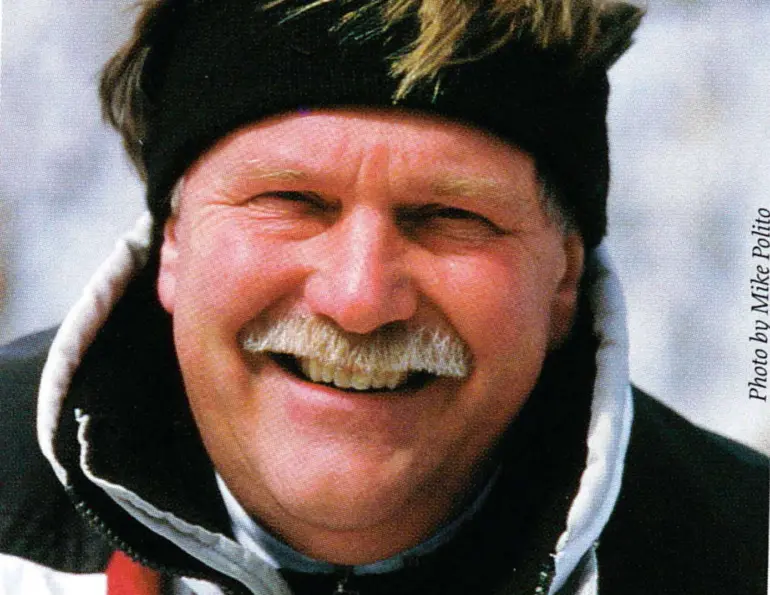
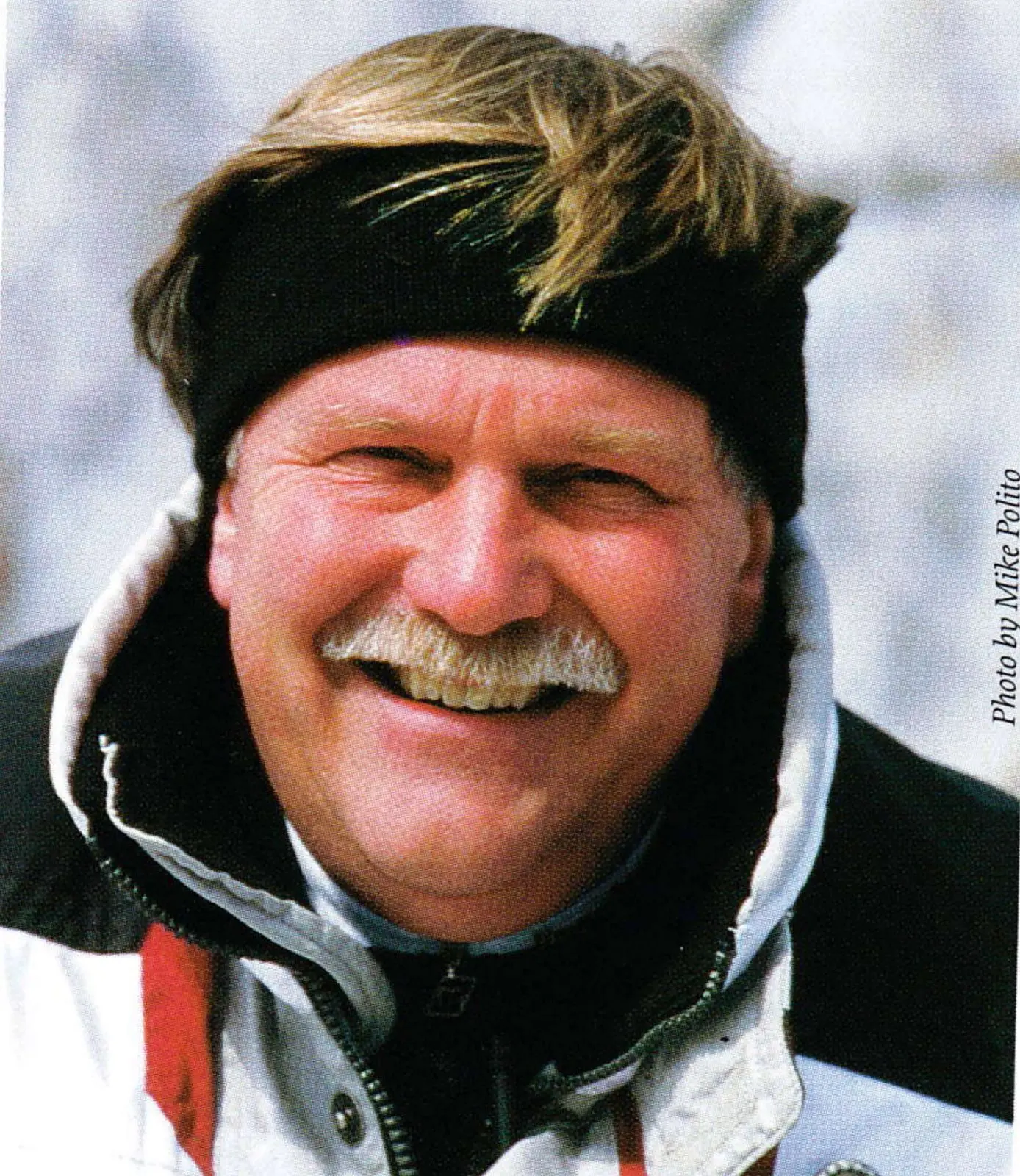
This is the man who bought his near-by competitor, Brodie, just a year ago; this is the man who put together and is the activist leader of the 21-area Mountains of Distinction (MOD); this is the man who, as the new chair of NSAA, is harnessed in tandem with Michael Berry, president, to drive the new industry Growth Model; this is the man who is about to launch and market Universal Vortex—what Fairbank feels is a new breakthrough in snowmaking; this is the man who, with a small group of fellow entrepreneurs, is launching a new beer with state-wide distribution, Widow White’s, named for a new peak he recently developed at Jiminy. This is diminished energy?
Right now, Fairbank feels very comfortable in his role as NSAA chairman. He points out that at various times over its 39-year life, NSAA has had different priorities and that he is passionately (a favorite word of his) committed to persuading the ski area industry to get on board the association’s current one, its Growth Model. “When elected, I found myself already in the same canoe and paddling in the same direction as Michael Berry,” he says. For his part, it is clear President Berry welcomes the articulate, fervent, almost evangelical support he can count on from Fairbank.
Fairbank had identified the “leaky bucket” problem the industry has in its low retention rate among entry-level skiers and two years ago aggressively moved to improve the beginner’s learning experience at Jiminy. Sold on the potential of the new designs of short skis for accelerating the learning process, he developed “Get Skiing!” a structured learning progression using a ski designed by Elan. After working out the kinks at Jiminy, Fairbank persuaded most of the other members of the MOD group to buy into the program.
Now, Fairbank is determined to help Berry implement NSAA’s Growth Model and its “6 and 1” mantra—increasing trial by six percent a year and increasing conversion by one percent a year. Conversion implies bringing the beginner past the dicey point of trial, through the possibly tentative stages of repeating and thus into the ranks of comfort and confidence and conversion to a core skier. “Core” doesn’t necessarily mean “frequent,” Fairbank insists, though he senses there is a link between acquired skiing skills and frequency.
Fairbank also urges the industry to concentrate on conversion rather than on efforts to increase trial. “If we go after acquisition first, we’re going to fail. We’ll burn the customer.”
But, he admits, it’s not going to be easy to get this cultural shift on management’s radar screens throughout the industry. “Look at it: Say an area has $2 million in revenues, of which maybe $150,000 is beginner revenue, or about 7 percent. But to get those numbers up is going to take 20 percent of management’s time and energy.” He understands this reality makes his message a tough sell.
“What we’ve got to do this winter,” says Fairbank, while acknowledging that each area will do it differently, “is to get that $150,000 revenue figure up to $240,000, and areas will find that half of that extra $90,000 is going to come as earnings.” And then, he points out, with the program continuing in years two and three, the magic of compounding takes effect, because those converted skiers that seemed to cost so much at first, are returning each successive year as core skiers, and areas can bank the yield.
“If, in the next 20 months,” avows Fairbank, “we can improve the numbers for every ski area in North America and get conversion on all their radar screens—no, if we can just get it on 50 percent of their radar screens, I’ll feel I succeeded in making a contribution to the industry I love. Michael will have to carry it much further, and get to the stabilization mode when he can develop whatever programs are needed for acquisition of beginners.”
In addition to growth as an NSAA priority on his chairman’s watch, Fairbank says that safety and environmental issues remain as key focal points. “All three are critical for the industry over the next two to three years and we have to deal with each in very proactive ways,” he says. For instance, that part of the sport’s image that results from 42 snowsports deaths in a season affects the comfort zone of our customers, says Fairbank. Obviously, reducing such numbers is always a priority, as will be the responsible handling of the helmet issue as it continues to play out.
On the environmental front, Fairbank says NSAA is very much on the right track with the Environmental Principles it developed and adopted, though he admits “it should have happened 10 years ago.” But he thinks in the long run, if the industry buys into the process and builds on it, we will develop the recognition and stature as environmental stewards that can carry us through whatever twists and turns there are on the road ahead.
But Fairbank is a non-ideological realist. “Look,” he says, “we’re dealing with issues of growth. No matter how hard we try, there are always going to be some tree-huggers who don’t believe in compromise. But what are our choices? We can ignore things or we can get involved.” Referring to the charter, Fairbank concludes, “The process has to start somewhere and it’s better to have started something than not to have started at all.”
To get a better idea of what Fairbank brings to his NSAA leadership, it is best to get a glimpse of the young Brian as he developed his passion for the sport and for the business he was determined to get into. (His future father-in-law, a physician, tried to dissuade him from pursuing such a limited future. “Why don’t you become a dentist?” he suggested. “You’re not bright enough to be a doctor, but you could make a good living as a dentist.”)
The skiing skills that would later land him a slot on PSIA’s Eastern Demo Team were largely acquired at Glenwood Acres, an area with 350 feet of vertical about 35 miles from Buffalo, in western New York. One of his major role models was his uncle Perry, who had made a financial success running an imaginative, multi-programmed ski school concession at the area. “He was like an older brother to me. He loved the sport and he loved doing what he did for a living: skiing. He had a major impact on my life.”
Early in his career, Fairbank became one of five members of a dynamic team doing business as Ski Management Systems. They specialized in contractually taking over management of troubled ski areas and one of their early success stories was Jiminy Peak, where a bottom line in the red of $40,000 in 1968-69 was reversed in two seasons. With 23-year-old Fairbank at the helm, the gross doubled, while yielding an after-tax profit of $29,600. Brian Fairbank never left Jiminy and by 1985 he had parlayed a small grub stake into a 50/50 ownership with Joe O’Donnell, head of a major food concession company based in Boston. There was no looking back.
Today, O’Donnell, who heads the 11,000-employee Boston Concessions Group, calls Fairbank “the perfect partner. I call him Captain America; he can do everything. He knows every facet of the ski industry. Sometimes I’ll be in touch with him five days in a row; sometimes it will be weeks between conversations.”

O’Donnell, in obvious awe of his partner’s mastery of every technical discipline at a ski area, likes to tease Fairbank about his costly pursuit of excellence. “Brian has forgotten more about the ski business than I’ll ever know, but I do know the food business and I understand the food business. So here I am at Jiminy one day and Brian has this idea about putting barn siding on a big Coke machine. ‘C’mon,’ I say to him, ‘we’re trying to sell Cokes, so why do you want to hide the machine?’”
O’Donnell also describes Fairbank as a “very sensitive” employer who treats his employees fairly and with consistency. “He does things you’d want your best friend to do for you.”
Today, Jiminy is not the little Berkshire day area it once was, nor even the little Berkshire day area with pretensions that some said it became. It has arrived and is on the cusp of its greatest leaps forward. Jiminy and Brodie combined will welcome 300,000 skier/boarder visits this season—”perhaps more,” gleams Fairbank, and is a major destination complex, currently with 1,500 pillows that are projected to grow to 5,000 in the next three years. During the week, 80 percent of customers are from Berkshire County and the skier-rich capital district of New York (Albany, Schenectady, etc.), but on weekends, 75 percent are from Long Island, a three-hour drive away. As such, the two-resort complex (“two Berkshire mountains four miles apart, one family-mecca resort,” as Fairbank likes to describe it) competes directly with Windham and Hunter Mountains in New York State and with the southern tier of Vermont resorts like Stratton, Bromley and Okemo.
As Fairbank ponders his expansionist vision of the future (expansionist within what he’s got now, not through acquisition, he insists), he thinks maybe he should re-christen the pair to better describe the recreational whole he envisions. “Maybe we need an umbrella name that would reflect that vision and reflect the way our customers will think of us.”
Fairbank wants to apply his most recently acquired wisdom to his evolving mecca. The epiphany came at a recent conference on the future of resorts organized by ski resort consultant, Jack Johnson, where facilitator Steve Mulvany suggested a tough criterion for a resort to succeed and last: it has to develop a “right to exist for the long haul.” As Fairbank sees it, this involves many things, most especially insuring balance. He says a resort can enjoy a great initial real estate play, but unless the developer provides a reason for people to come and return there—to come for more than just the skiing, to provide involvement for all members of the family—it may not be able to thrive long in a world where consumers have lots of choices.
Fairbank cites a startling number: “From the fourth of July through the third week in October, we enjoy 83 percent occupancy; during the winter it’s 53 percent.” Jiminy does a million dollars in conference and association business—a million-and-a-half if you include food, Fairbank explains. This, plus $400,000 in summer recreation business, starts to yield the balance he seeks. And the balance is not just in revenues, but in what is offered. This winter, for instance, Jiminy will cater to the teenage market by providing a room with 15 computers, where a kid, accompanied by an adult, can pay five bucks for half an hour to play interactive video games or access the Internet.
Fairbank’s vision is of his two areas as one all-season resort. He sees Brodie as a facility that complements Jiminy in providing a broad array of attractions and services that will match anything else in the Northeast. “We’re in a man-driven industry, but I want to develop with an eye to what women want,” he says. “They’re the ones making the family decisions on three-day getaways. And we’ve also got to pay attention to what teenagers want. It’s not easy because they usually don’t know what they want.”
At Brodie, Fairbank foresees the development of a spa in the next two to three years , where all members of the family will find a diversity of feel-good services. He sees the possibility of a year-round equestrian facility, developing, perhaps, some sort of water attraction, adding snowshoeing in winter. Long-term success, he says, requires not only diversity and balance, but a rooting in the old real estate mantra about location, location, location. With his proximity to the greater New York market, he feels he is very well situated, and this is being borne out in his time-share successes which, Fairbank says, seem to be on the verge of even greater acceptance.
Another of Fairbank’s guiding principles is that momentum and critical mass play important roles. He predicts there are developments that will fail to meet the “right to exist” hurdle because they lack one or more of these ingredients, perhaps by missing the “location/location” target, or by failing to study what customers will want, or by claiming to have a village when they’ve just put in three or four stores where 15 or 18 are needed to provide the critical mass without which the public will feel short-changed. “When it all comes together,” he concludes, “there are all sorts of synergies involved and that’s what we’re setting out to build.”
What about the stand-alone ski area in this age of mountain recreation where skiing and boarding are increasingly seen as mere amenities in a winter theme park? The normally effervescent Fairbank knits his brow. If an area, no matter how modest its dimensions, is located where it can deliver an excellent product to a large market, it’s going to go on succeeding as long as global warming allows it to make snow. “Places like Wachusett and Nashoba that serve the Boston market with superb operations will go on forever,” he predicts. “But,” he cautions, “a serious problem lurks for a number of them and many don’t recognize it.” He describes these as the ones without a nearby natural market to draw on, especially those with aging lifts and inadequate base facilities. With today’s lifts costing what they do, these areas face enormous problems of financing what they need to remain competitive or, as Fairbank says, “Their infrastructure creates a capital structure problem.” He also cautions that today’s customers know what they want and can be unforgiving if they don’t get it. Time is precious to them and they don’t want to waste it.
But for Brian Fairbank, as he looks at his gleaming new Garaventa-CTEC six-pack and fires up the Jiminy snowmaking arsenal—more than 130 guns capable of converting 4,000 GPM to snow with a 3-to-1 ratio—there are few worries about an aging plant. Just concerns about too few hours in the day to carry out all his resort plans, not to forget the challenge (“the biggest of my life”) of bringing NSAA members under the tent in the cause of conversion—beginner skiers to core.
Fairbank’s plate may be full, but he’s not complaining. He would have it no other way.
