
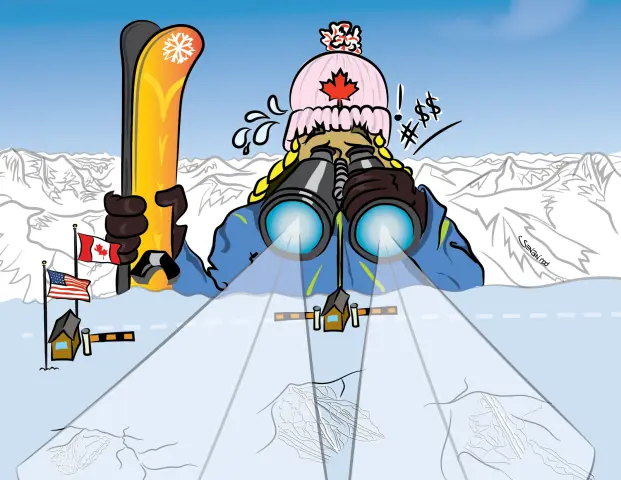


In recent years, area operators have watched in dismay as a growing percentage of their clientele pulled into the parking lot, took skinny skis off their cars and slid off into the woods, without pausing to leave money at the ticket window. The $2 use fee initiated at Ted Ryan’s new Aschroft-at-Aspen touring complex might stem that tide. Elsewhere, tourers have not paid such fees, but they nevertheless have asked for—and gotten—marked and maintained trails, rescue service and access to restrooms and cafeterias.
The explosion of cross-country skiing, on terrain in and around ski areas, raises some basic questions. Does it hurt or help the lift owner? How can the owner make a profit from the phenomenon, or, at least, not lose money because of it?
So far, areas from Maine to California (and in Canada and Europe, too) have found ways to derive indirect income from touring by:
- Selling lift tickets to tourers who are not adverse to taking a shortcut uphill.
- Selling lessons to first-timers, via the area’s regular ski school.
- Selling excursions, picnic trips, moonlight trips, etc. as part of the school’s touring facilities.
- Selling and renting Nordic equipment through the area ski school.
- Cooperating with lodges, shops and guides who conduct touring operations in the vicinity and who thereby enhance the area as a destination for weekend and vacation visitors.
The ideas above are not to be discounted, as we shall see, but they are not as promising as the new element added by Ted Ryan in November, 1971, when ski tourers, for the first time in recorded history, paid $2 to use trails prepared and organized specifically for them in the “touring park” opened by Ryan’s Ashcroft Ski Tours Unlimited about 30 minutes from downtown Aspen.
In the 1940s, this land, near the ghost town of Ashcroft, had been earmarked by Ryan and fellow investors for development as Bavarian Highlands, conceived as Colorado’s first resort for the newfangled sport of downhill skiing. Came World War II, when the land was used for training by the forerunner of the Tenth Mountain Division, and the move came to develop skiing on Ajax Mountain, in downtown Aspen. Ryan, a grandson of financier Thomas Fortue Ryan, held on to the acreage while back in Connecticut he simultaneously pursued careers as a raiser of Angus Aberdeen cattle and Republican national committeeman and state senate minority leader. When he passed the age of 65 (he is nearing 68 now) he decided it was too late for him to launch a major resort complex at Ashcroft, but perhaps it was just the right time for him to use that broad valley for a sport he had recently become involved with, ski touring. He called in Sno-Touring Associates, the specialized arm of Sno-Engineering set up in 1969.
The New Hampshire consultancy firm’s chief touring expert is Sven Wiik, former Olympic coach and proprietor of one of the country’s most successful inn-based touring operations, Scandinavian Lodge in Steamboat Springs. Wiik found the Ashcroft terrain ideal for touring—rolling rather than steep or flat and free of excessive bedrock or surface drainage. He laid out 12 miles of marked trail. Not only was this a major touring enterprise but it had to operate independently of income-producing lifts. Further, it was far away from public traffic and there would be no possibility of sizeable income from restaurants or shops unrelated to touring. Sno-Touring put forward the concept, new to touring, that the cost of privately owned recreational facilities be paid for by the user.
Ryan ran an informal survey to establish the use fee. He dispatched assistants to various Aspen street corners to ask passersby how much they would be willing to pay to tour on groomed hills. The answers ranged from “nothing” to “10 dollars,” so Ryan averaged the responses and decided on $2.
Locally and nationally, the publicity drums beat. Slowly tourers trickled out to Ashcroft, despite the competition of the four big downhill areas plus intensive touring programs operated by Snowmass and by Chuck Fothergill’s sports shop. January brought more paid admissions than November and December combined. By March, Ashcroft was averaging 40-50 tourers a day, about one-third of whom bought lessons or group excursions. The others ran the trails on their own.
By season’s end, Ryan’s experiment had brought in enough to cover his seven-man payroll, plus. In addition to money from rentals, lessons and use fees, there was even income from the hot lunches served at Halfway House, which can accommodate 12 people each noon. The tab is $2.75 and reservations are required. Ryan had hoped there would be more interest in long overnight trips utilizing some of the huts on nearby peaks, but the turnout for such rigorous mountaineering was small.
For 1972-73, the $2 use fee continues although the trail network has been enlarged. The big innovation is Ashcroft’s participation in Aspen Highland’s packaged ski week. Skiers can exchange one Highland’s ticket voucher, the equivalent of a $9 lift ticket, for a day’s touring at Ashcroft, including equipment rental.
While the Ashcroft cash register is being oiled for its second season, how have other entrepreneurs fared? At the end of the 1971-72 season, a number of inns that had transformed themselves into touring centers could point to increased overnight and meal business. Yet, some of these expressed the same disappointment that certain ski area operators did: “If business gets much better, we’ll go broke.” Their touring revenues were up, but so were their costs of maintaining and promoting services.
Membership or use fees, rarely mentioned by area operators as being on the horizon, were frequently mentioned by the sports shops and inns. Such prestigious Vermont lodges as Trapp’s in Stowe, the Sugarbush Inn in Warren and the Woodstock Inn in Woodstock, are experimenting with use fees for people not staying at their accommodations. Sven Wiik’s Steamboat establishment was an exception to this reaction, but then Wiik can count on such special attractions as a four-day Ski Touring Education Workshop and a three-day Thanksgiving clinic as well as a bustling lodge business from downhillers.
In general, the inns and shops have been more aggressive than the area operators in getting revenue by merchandising excursions. The semi-autonomous touring operation at Snowmass is one of the exceptions. Its line of packaged excursions illustrates the possibilities. Lars Larsen and a staff of seven are kept busy giving classes, guided tours, half-day trips, fishing expeditions, moonlight jaunts, dinner trips, cook-outs and overnights. Prices start at $6 for a half-day tour and $10 for a full-day tour with lunch. They can even handle a complete touring vacation: for $167, they arrange seven overnights at a Snowmass lodge, with breakfasts and dinners plus six days of lessons and equipment use.

Another source of revenue is Nordic Nastar. In 1970, three areas launched cross-country equivalents of the handicap giant slaloms for recreational skiers. Last year, there were 20 Nordic Nastar areas, compared to 80 Alpine Nastar areas. For 1972-73, the third year, Bob Beattie’s World Wide Ski Corp. hopes to have 50 areas, and to latch onto a national sponsor. Meanwhile, the revenue has been pegged to each operator charging a $2 entrance fee (the same as that charged participants in Alpine Nastar events) to compete on a 2½ kilometer course. Nastar gets half the revenue, the operator the other half. Flags and banners are provided by Nastar. This year, the event may be enhanced by adding a distance competition. Last year’s locations ran the gamut: clubs, shops, inns and ski resorts, including Mount Snow, Vt.; Indianhead, Mich.; Waterville Valley, N.H.; Sugarloaf, Me.; Mission Ridge, Wash.; Bend, Ore.; High Country, N.M.
Some lift operators felt touring had grown to the point where it represented heavy competition to lift ticket sales. Most of the area managements surveyed, however, felt that touring paid off even if it represented an outflow of dollars.
Steve Reischl, who heads the touring operation of Vail’s ski school, points out that the Colorado resort attracts many vacationing families whose number include non-skiers. Touring, as he sees it, shakes money loose from people who were not going to buy tickets anyway. He says the skiing members of the family often try touring, too, but they are people who usually have prepaid their lift tickets.
Vail is one of several resorts that is merchandising a Touring Ski Week in conjunction with the airlines as IT (inclusive tour) packages which are commissionable when sold by travel agents. Boyne Country, Mich., which is leaping into touring in a big way at both its Boyne Mountain and Boyne Highlands complexes, is planning to sell a tourer’s ski week, and so is the Bretton Woods, N.H. resort starting operations this December. Big Sky, the Chet Huntley-Chrysler enclave in Montana, will have no lifts up this season, but it is featuring (as it did last year), both cross-country and helicopter skiing on an IT package, together with accommodations at the Lone Mountain Guest Ranch which already existed on its property. In Europe, some resorts and carriers offer touring packages. The Paris-based Club Méditerranée, which operates a “serious skiers’” hotel in St. Moritz, offers each package-buyer a choice of Nordic or Alpine instruction, letting him make the decision on the spot each day.
Some managements are sitting out the boom because their terrain is unsuitable. This is true at many Utah resorts (but not Sundance or Park City) and at areas in the Sierras and Cascades.
Getting rental equipment has been a stumbling block for some areas. Last year Park City was one that could not launch its projected program because beleaguered manufacturers could not deliver skis or boots. Those that did get merchandise, report that sales were brisk on specialty items as well as basic gear. One sign of the times is the emergence of the non-downhill mountain shop. Gigantic Aspen has two, but even tiny Crested Butte can support one such emporium.
At a time when area managements’ thoughts are increasingly attracted to the subject of real estate development, one of the most meaningful reasons for a plunge into touring is suggested by Sno-Engineering’s president, James Branch. Pointing out that sales of on-site land and apartments are enhanced by providing “trickle trails” that promise the purchaser the opportunity to ski to and from his home, he said “These runabout trails cannot be steep and should not use wide strips of land. Why not make them touring trails?”
Branch further suggests that the lift system and touring trails be integrated. “Then you can control the flow of ski tourers. Sell him a $5 lift ticket for four rides instead of $8 for all day. You have him in line four times instead of 20. You are, in effect, expanding your capacity, and you are selling tickets even to novices who might not need downhill lifts. In a cross-country class, your instructors can handle twice as many pupils as they can in a downhill class. Your rental income might be $5 instead of $8, but your investment has been $40 for skis instead of $100. Get your tourers on day trips. Sell them lunch and dinner. Get them away from your base. Touring is your best chance to get money from all those people who just spend the day in the cafeteria.”
The Bretton Woods development, guided by Sno-Engineering and its touring affiliate, expects to debut in December 1972 with greater emphasis on its 25 touring trails and competitive facilities than on its Alpine terrain. The vacationer is being offered a ski week for either discipline, or for both. Half of the touring trails will start from the top of the mountain. Thus, be he tourer or downhiller, the customer is a good prospect for chairlift tickets.