


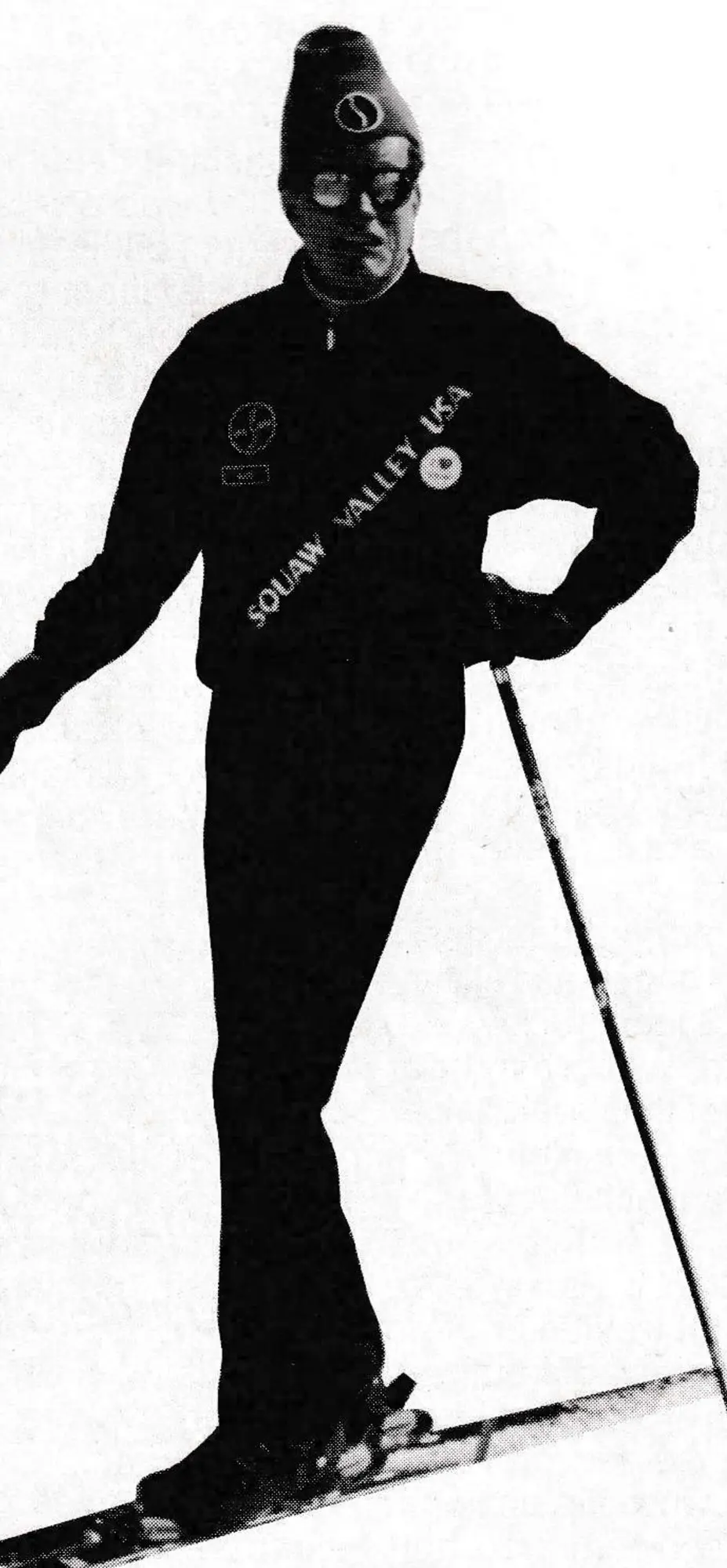
You could call him the Howard Hughes of the ski resort business, except that from behind the reclusiveness, the lust for power is mostly absent. He seems to ski as often in Europe as at his own California resort which he built from the ground up. His management, seen from the outside, appears in occasional turmoil. He rarely gives a press interview, but when he does, he’s as open as a book and as charming as an aging fraternity brother you haven’t seen in years.
After all, this is the same Alec (Alexander) Cushing who waltzed the likes of Avery Brundage and Walt Disney into the 1960 Olympics, still hailed as the best Winter Games ever held.
By his own confession, Cushing says the Olympics represented a high point for Squaw Valley and that conditions at the area slipped for a number of years. Then, in 1983, at the age of 70, Cushing found renewed vigor, “a second childhood.” Having cleared Squaw Valley’s books of indebtedness, he suddenly decided to take the plunge again. He borrowed more than $20 million, by his account, to refurbish the 35-year-old Lake Tahoe mountain where as many as 15,000 Californians come to ski on a Saturday or Sunday.
Last summer, I interviewed Cushing at the apartment of his wife, Elizabeth, in Manhattan, having failed to meet him at Squaw Valley. (He was en route home from still another trip to Europe.) He is as urbane as ever, and the carefully cultivated potatoes of Long Island society still manner his speech. Cushing was spending time in the summer at residences in Glen Cove, L.I., and in Newport, R.I. He plays tennis regularly and regards himself as a “compulsive reader. I never travel without 20 books.” Graham Greene, Somerset Maugham, John Updike are among the authors he likes.
Most people assume that Cushing was born into the ease and wealth of high society, but that belies the man. His inheritance was $100,000 and he says he put all of it into the original Squaw Valley development. The fact is that his father—an established Boston painter whose oils hang in New York’s Metropolitan Museum—died when Cushing was only a year old. His mother was chronically ill, and Cushing went to “a sort of pre-boarding school until I was seven.” He attended Groton and went on to Harvard where he took law. He also spent a year in 1935, traveling to China and the Pacific. In 1939, he worked in Washington as a special assistant in the Anti-Trust Division, and became the youngest lawyer to appear before the Supreme Court. On behalf of the attorney general, he argued that trade unions should be subject to the antitrust laws. Recalls Cushing: “The Court voted against it, eight to nothing. Maybe they were trying to tell me something.”
In World War II, Cushing flew back and forth to Washington from all over the world, with the Naval Air Transport Service, making essential supplies move to the front lines over the barricades of governmental bureaucracy.
Following the war, he was invited by Thurman Arnold, Abe Fortas and Paul Porter to join their new law firm in Washington. But he decided against both Washington and a budding legal career on Wall Street.
“You don’t want to get into a business,” recalls Cushing today, “where the other guy likes it better than you do. I observed that some guys liked the law better than I did. But if they like it better than you do, forget it, because you can’t compete with them.
“On the other hand, if you get into something that you like, then you don’t know when you’re working and when you’re not working. That’s what the ski business became to me.”
On terminal leave from the service, Cushing traveled the country searching for a mountain to develop. At Aspen, he lost a friend in an avalanche that narrowly missed Cushing and a patrolman named Peter Seibert. Then he looked at Mineral King with railroad heir Cortland Hill. At Jackson Hole, Cushing told Laurence Rockefeller that the place had no future as a ski resort, and subsequently talked Rockefeller into becoming the largest initial investor in Squaw Valley.
One day, Cushing found himself not far from Squaw in the company of a Sun Valley instructor, Wayne Poulsen who, with Marty Arrouge (husband of movie actress, Norma Shearer) had purchased land there.
Cushing recalls, “Someone asked Poulsen where the best skiing was. He answered, ‘The best skiing in America is about a half-hour from here.’
“I piped up and asked if I could accompany him there. After we saw the place, a friend of mine commented that you could fit a couple of Sun Valleys in it.”
Squaw Valley opened in 1949, on a $400,000 investment which Cushing leveraged to borrow the money he needed to build.
“We were broke the day we opened,” he recalls. “We’ve had a policy ever since we started: every cent of money we make goes back in the business. The stockholders have never gotten a dividend. My salary was $5,000 annually for 30 years. We own all 5,000 acres of the mountain, one of the few areas outside of Park City not on leased land.
“When we started, Wayne Poulsen said we could buy the whole valley for $50,000. But the last thing I wanted to do was go into real estate, a business I don’t understand. I wanted to be in uphill transportation, and I raised the money on that basis.
“In retrospect, I’d say that was the world’s stupidest decision. But I couldn’t have got the Olympics if I had owned all the land. The Russians and other opponents of Squaw Valley were saying it was all a land promotion. I answered, ‘Well, it may be a land promoter’s dream, but I don’t own any of the developable land.’”
Cushing says most of his stockholders are rich people, interested in capital gains, not income. “Maybe they’ll leave it to their grandchildren. It’s going to be worth a helluva lot of dough at some point in time.”
Cushing owned 51 percent of Squaw Valley for years, but has given a lot of it away to his children in the form of a trust, he says. A key trustee is Tom Richardson who was president of Aspen Skiing Co., left there in the change of Aspen ownership, and was wooed by Cushing to run Squaw. Richardson demurred, but Cushing retained him as a director and, “I still hold him in the same high regard.”
Cushing is vague about who would actually own Squaw Valley, were he to pass away. He talks of a self-perpetuating trust in addition to whatever it is that Richardson represents. Cushing’s daughter, Lily, is married to Jan Kunczynski, head of Lift Engineering in nearby Carson City. Since Kunczynski is in the ski business, “Wouldn’t he be the one to take over the area if you were gone?” I asked Cushing.
“No, we’ve got the company set up in such a way that I’d like to keep it going. I don’t want to sell it. I’m expecting to work hard at it in the next 10 years. Work gives me energy. I would expect the present management to stay in place. Jimmy Mott is now president (after a year as general manager) and only 36 years old. He’s a quick learner, yet he’s been with us for 17 years. In fact, the average age of our eight managers is 30 and their average length of service is nine years.”
Cushing refers jokingly to himself, John Buckman (a former manager) and Bill Boardman (a PR man) as an aging Politburo (average age over 70). He’s enthusiastic about the younger Mott’s entry on the scene. Mott’s predecessor was Hans Burkhardt.
“Burkhardt did a great job on the mountain, but I had to leave him alone. I knew him for 18 years. He said to me once: ‘Alec, the biggest favor you can do me is to get on a slow boat to China.’ So I left him alone. Now, I’m reverting to form in affirming what it is I want done, and Jimmy is very good at executing. If I’m there one week in three, you see, between Jimmy and myself it’s working.”
Burkhardt, says Cushing, quit three years ago over a dispute about who should build Squaw Valley’s new gondola lift. Burkhardt favored Doppelmayr while Cushing wanted to gamble on a gondola built by Lift Engineering and Von Roll.
“Burkhardt thought it was too big a gamble,” said Cushing. “It was essentially a prototype, the most advanced lift of its kind in the U.S. The things that Hans saw going wrong in the first year unfortunately persisted in the second year.”
Now, after failing to perform to “the stringent specifications” of operating speed and wind resistance which Cushing demanded, the gondola is being dismantled. “It was a prototype,” says Cushing, “and it should not reflect badly on the people involved that it didn’t turn out to be the super gondola we expected.” Cushing declined to comment on how he has settled the matter with Lift Engineering, run by his son-in-law. (See SAM May, 1985, page 30 for further explanation.)
Meanwhile, Burkhardt was retained last winter by Cushing to investigate the replacement lift. By spring, Cushing had reached agreement with Poma of America (president, Tom Richardson) to install a new six-passenger gondola, using the existing terminal buildings.
The gondola is part of the costly refurbishing of “a badly run-down Squaw Valley” which Cushing laments and attributes to his ill-conceived joint operation with Mainline a few years ago. Mainline went belly-up; now Cushing is making up for lost time.

“When you run like hell as hard as you can,” says Cushing, “there are still a lot of other people running like hell as hard as they can. So you can wind up just where you are. What we’re doing is playing leapfrog.”
Leapfrog for Cushing has meant rehabilitating the base lodge ($2½ million); renovating High Camp; creating seating for 1,000 skiers at Gold Coast, the top-of-the-gondola building (including a new top floor restaurant “Oasis” and 45 women’s toilets); the conversion of Hofbrau to a club-like place with, eventually, 2,000 lockers for skiers; and tearing down the remains of the Olympic ice arena (now parking facility). The latter two represented land acquisitions. (See SAM November, 1984.)
Squaw is in the midst of replacing its Siberia lift with a new detachable quad. Also being built by Poma of America, it will not require storage of the chairs . . . they can hang on the cable, detaching to allow boarding.
Meanwhile, Olympic Valley Associates completely upgraded Olympic Village Inn, selling time shares. Now developer Tom Dempsey has just broken ground under the aerial tramway for an eventual 340-unit condominium hotel—to have underground parking, tennis courts and a gymnasium. Cushing says 90 units will be ready this coming winter. Dempsey has built at Mammoth Mountain and Sun Valley.
An admirer of Deer Valley in Utah, Cushing sees himself as an arbiter of taste and promoter of excellence in the rejuvenation of Squaw Valley.
“I’ve got very competent young people to do things, and I don’t want to interfere. But I do intend to see that only the best is built. I’m deciding on things like the color of buildings and standards for how things should be done.
“In the past, before all the work we’ve been doing, I was never much interested in advertising Squaw Valley because I thought the product wasn’t sufficiently good. I don’t think that’s true any more.”
Cushing says he has plans to build seven or eight more lifts in addition to the 27 he already has, even though Squaw now operates with as few as 2,000-3,000 skiers on weekdays.
“It has nothing to do with the need for lift capacity,” he says. “It has to do with raising the quality of the skiing experience. When that gets better and better, we believe the lift capacity will eventually get used up.” Nevertheless Cushing is concerned that the ski industry will one day price itself out of the market.
Squaw also acquired 16 Pisten Bully snow groomers at $150,000 each. The machines work a double shift, 4 p.m. to midnight and midnight to 8 a.m., in an attempt to groom almost the entire area on a daily basis.
“The machines on the upper slopes alone burn 250,000 gallons of gas a winter,” Cushing remarks painfully. “But the results are fantastic. Our snow may fall as ‘Sierra Cement,’ but we till it now in such a way that when combined with our California sunshine, it creates something entirely new in skiing. It’s really a revolution. We’re creating a snow to match Colorado powder.”
More than a quarter century has passed since the Games, yet Cushing has retained the trimness of form and much of the panache that he had in 1960. The lantern jaw frames a happy smile, the hair is still curly, the facial skin chapped as if opposed daily by wind and rain. He talks intimately about Squaw Valley, yet he has a puzzling detachment from skiing. I asked him why he would have permitted the soft core porno film, Hot Dog, to be filmed at Squaw Valley in light of the ski industry’s distaste for aerial freestyle stunts.
“I didn’t even know it had been shot, and I don’t know anything about the freestyle controversy. Nick (Ed note: Nick Badami is Cushing’s neighbor at Alpine Meadows and now president of the National Ski Areas Association) wrote me about it.
(“I’m a great fan of Nick’s and I asked him to be a director of our company. He served on the board for a short time, but resigned. He didn’t like certain marketing techniques we were using, and I fully understand.)
“Nick feels very strongly about the freestyle thing, but frankly I haven’t paid any attention to it. I suppose the idea is that it sets a bad example for young men who will go out and break their necks trying to do some of these things?
“If somebody wants to ski that way . . . I suppose . . . anyway, we always have something going on here. I believe in that. In most places, races are a curse, but not to us. And the same with freestyle.
“I saw the movie, Hot Dog. I think I’ve seen several X-rated movies that were in better taste, but there were some good ski shots in it.”
Someone who has observed Cushing’s style over many years said that “he’s a dilettante . . . in an out . . . committed one moment, remote the next . . . charming, but often cold to people in the effect of his decisions.”
An apt description of Cushing’s management style is this comment on marketing: “I don’t know a lot of what our marketing people do. I don’t know whether they have any ability. They’re doing a lot of nuts and bolts things which they should be doing. But I’m going to set the theme for our advertising, what we’re doing now.”
Cushing says that he developed some of his philosophy of running things from his extraordinary experiences in World War II. As a 30-year-old, he became involved in critical decisions affecting hundreds of millions of dollars in engineering and materials.
“I was trained as a lawyer, and here I was with technical people discussing engineering problems and airfields all over the world. I didn’t know a thing about it. But I found that with a certain kind of brain and ability, you can listen to two guys argue a point and without knowing anything about the subject, you know which one of them is right. I could do it.
“So it gave me a certain amount of confidence. Frankly, I never would have embarked in the ski business if it hadn’t been for that experience. My wartime travel also led me to the ski business. It made me realize there are a more exciting things to do than sit in a law office on Wall Street.”

