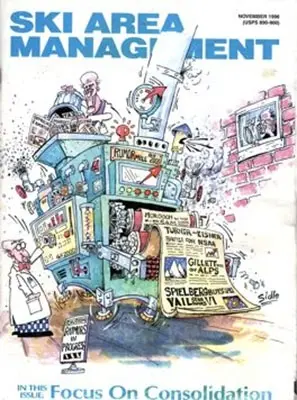
The simplistic, universal answer to the big question about meaning is that it’s all about making money, economy of scale, synergy and adapting to change. The other simplistic observation is that consolidation is going on around us in virtually every field, from the turbulent, fast-changing health care industry to banks to the funeral industry.
As American Skiing Company’s grand consolidator, Les Otten, puts it, “We operate under tenets common to the rest of the American economy. Because you’re in this business called skiing doesn’t mean you’re somehow removed from marketing forces and how you motivate people to do things and buy things.”
One of the key concepts, whether dealing with hospitals, banks or ski resorts, is that of critical mass. When it is achieved it can provide access to new thresholds of capital, attract strategic partners, give purchasing leverage and generate marketing torque. Critical mass is usually not a definable amount or level; rather, it is recognized by judgment or instinct; it can also be recognized after the fact on the basis of its results.
How does the existence of these agglomerates with critical mass affect the rest of the industry that lacks it? To get at this one must look at the separate outcomes of critical mass.
- Access to capital—Financial analysts seem to agree that there is a lot of capital nowadays chasing opportunities. But there also seems to be consensus that critical mass—at least in our field—must exceed $100 million to catch the attention of serious investors. Above that level, the packages can be creative and flexible (see Otten interview, Page 58), and the fact that the investment community today can find some interesting opportunities in the ski resort field is a positive development. Without that threshold of critical mass, however, an area is probably dealing with conventional bank financing where they have the unfortunate custom of wanting to amortize, and harbor the stingy notion of wanting their money back within six or seven years.
The deals being made these days are based on multiples of various factors. If it is skier visits, the multiple is now around $60 to $80, so a ski area with 500,000 skier visits might be expected to sell for between $30 and $40 million. But that considers operations and has to be modified by any upside real estate potential, just as it might be lowered if the condition of the assets warrants. Another indicator is of gross revenue, and most deals today go for a multiple of between 1.25 and two times that figure. The most common multiple used is of EBITDA (usually pronounced “eebit-dah”)—standing for Earnings Before Interest, Taxes, Depreciation and Amortization. It is a more precise way of expressing the concept of net cash flow, or NOI (net operating income). Most deals are coming through between five and eight times EBITDA, with the median around six, which is clearly financeable.
Such calculations of multiples are reality checks more than anything else, or a sort of shorthand to justify a deal—or not, as the case may be.
- Attracting strategic partners—The world of sponsors—their recruitment, care and feeding—has become fiercely competitive. No longer is it some ill-defined exposure offered in return for a juicy check. Sponsors demand and get a lot of quid for the quo they supply. So, the ability of a resort company to offer a soft drink company exposure at a whole string of resorts, for instance, or do a bank card deal, is powerful “stuff.” There is critical mass that allows the partner to design a whole integrated program, rather than a tentative scattershot deal.
- Marketing leverage—Joint marketing programs with the strategic partners is an attractive and efficient option that vastly increases the reach of a marketing effort. In addition, the ski consumer can be attracted by pricing incentives to ski within the company’s family of resorts where they can also offer the consumer a variety of experiences and ambiances at different resorts, while funneling the revenue stream into the same corporate coffers.
- Buying leverage—”You’re going to have to do better on your proposal at our XYZ operation if you want to be considered for our expansion at ABC.” In one form or other, the buying power of a multi-resort company is exerted at the supplier level. That’s the real world.
So, does all this leverage—all these advantages that accrue to multi-resort companies with critical mass—mean there is no hope for the rest, the independents? Should they be scared?
“I don’t think ‘scared’ is the right word at all,” says ASC’s Otten. “But I hope it is a big wake-up call. I think there are some real opportunities ahead.” And George Gillett echoes the thinking, with the word “opportunity” becoming almost a mantra.
The rationale is that the big players are going to be re-energizing the sport—”fevering it up,” to use Otten’s expression—as they reach out to get new participants with literally tens of millions of promotional clout, creating awareness and a desire to participate. Independents, the argument goes, are inevitably going to benefit from all this positive exposure of the fun of the sport. Their opportunity is to piggy-back—to hustle to develop exciting, unique programs of their own to catch the wave.
Another strategy for independents is to form alliances with other areas and thereby develop some of the benefits of joint marketing and buying. The first such alliance to form was Mountains of Distinction, a grouping of eight mid-size areas from Pennsylvania to Vermont that also negotiated a special relationship with Vail. They have retained marketer Kathe Dillmann to administer their joint efforts. There could well be more such alliances, with one reportedly being discussed in Colorado.
Will there be more consolidation? Yes, almost certainly. Is that bad? Probably not. The multi-resort owners of Jay Peak, Vt., for instance, are deliberately putting that resort on the block on the assumption it will look attractive in today’s acquisitive marketplace. And to those who play the speculation game, a trophy like Heavenly in California looks like an appetizing target now that it has its major permitting in place to expand into a new year-round operation with awesome potential.
But is this piecemeal building of ski resort conglomerates the endplay or is it foreplay? To use the imagery of a seventh grade natural science course, is the industry undergoing metamorphosis, perhaps just now finishing up its larval stage and reconstituting as pupa so that we can realize our destiny as something quite different?
Are we being absorbed and in time will be seen as one asset in an entertainment portfolio in much the same way that, say, Time magazine, once the powerful flagship of a publishing empire, has become a simple asset of a giant entertainment company called Time-Warner?
The jockeying of the big players—Intrawest, Apollo Group, American Skiing Company, Gillett’s Booth Creek Partners and others—can be seen as the fashioning of bite-size chunks of business that will be packaged for profitable sale to corporate entertainment entities down the road.

Who knows whose corporate umbrella we might be under one day, but for the sake of example, think of Disney Enterprises in the role. Let’s say they decide on an expansion strategy that involves building an international travel-related network of hotels, travel agencies and golf, ski and island resorts. Everett Kircher’s Boyne USA, with its mix of choice golf and ski resort properties, might become a Disney target, as might Apollo Group’s Vail Resorts and Les Otten’s American Skiing Company. The process would supply exit strategies for these and other packaged properties, and Disney would end up with a critical mass that would produce a healthy cash flow for that division— and they would have it all for a fraction of what they spent to buy Capitol Cities/ABC.
The above is purely speculative, but if some sort of scenario like it did start to play out, what would be the impact on all the remaining independents? There is no computer model to turn to for answers, but logic would suggest that an even brighter array of opportunities would open up for the alert and nimble. The giant new players would have an ever-greater need to keep the pipeline of participant winter sports enthusiasts full, and ski areas offering convenient, attractively priced, basic snow-sliding fun should be able to thrive.
Our industry may yet come out of our pupal cocoon as a precious, exotic butterfly of great worth—the prize asset in the greatest entertainment portfolio of them all.
6 Biggest Multi-Resort Groupings and What They’re Doing
The six principal consolidators in the ski resort field are (listed alphabetically): American Skiing Company (3.0), Booth Creek Partners (1.5), Boyne USA (1.2), Intrawest (2.6), Powdr (1.2) and Vail Resorts (5.0). The numbers represent an estimate in millions of skier visits of what their announced properties might be yielding. (Some acquisitions were not final at presstime or were subject to Department of Justice (DOJ) review.)
American Skiing Company—What was one Maine resort, Sunday River, just three years ago is now a seven-resort grouping with the second largest skier visit volume. Though currently positioned as a northeastern regional power, ASC’s owner, Les Otten, is prowling the country. He has been talking to Squaw Valley’s Alex Cushing and has shown interest in Hunter Mountain, N.Y. He has promised “some surprises before the year is over,” and he seldom disappoints on his promises.
Booth Creek Partners—George Gillett heads up a family enterprise consisting of his business-savvy wife, Rose, and four sons. They picked up two New Hampshire resorts spun off by ASC as required by DOJ, and bought the three California resorts owned by Fibreboard, which itself was up to that point a fast-track acquirer of ski resorts. The Gilletts are looking for more ski operations with expansion potential. Claiming underdog turf, Gillett looks forward “to having fun nipping at the heels of the big conglomerates.”
Boyne USA—Veteran ski area builder, Everett Kircher, whose fortune was made as a major GM car dealer, has been putting together a far-flung grouping of ski resorts and golf courses, with his Michigan resorts, Boyne Mountain and Boyne Highlands, as the hub. Also with sons in the business, Kircher made an unsuccessful run at California’s Kirkwood last year, losing out to Telluride owners. He was also a finalist recently in New Hampshire before losing out to Gillett on Waterville Valley and Cranmore Mountain. Boyne USA recently agreed to buy Crystal Mountain, Wash.
Intrawest—A dynamic, publicly traded Canadian company that has picked up resort properties in all four corners of North America, from Quebec and Vermont to California, from West Virginia to the Canadian West. Though their emphasis is perceived as real estate development, their strategy calls for strong resort operations. As a company, Intrawest is constantly in the acquisitive mode and is currently negotiating with Alex Cushing (Squaw Valley, Calif.) and talking to Maurice “Hank” Greenberg (Stowe, Vt.).
Powdr—The most enigmatic of the six, Powdr is run by the father/son team of Ian and John Cumming. After originally buying Nick Badami’s properties of Alpine Meadows, Calif., and Park City, Utah, they added California’s Boreal in 1995. They do not seem to be in the chase, but could join at any time.
Vail Resorts—At least for now, the biggest and arguably the grandest. With Vail, Beaver Creek and Arrowhead, they have serious mass; add Breckenridge, Keystone and A-Basin and it becomes critical mass. The question is whether or not DOJ allows the purchases to stand. Investment entrepreneur Leon Black, whose Apollo Group acquired Vail/Beaver Creek out of the 1992 bankruptcy of Gillett Holdings, cashes in this fall with the sale of some Vail stock in an IPO. But he still controls, and some predict he will nurture the asset only to the point where it is irresistible to some other player in the overall big-time recreational or entertainment field.