There is an ever-increasing need to develop simple methods of analyzing the true cost of operating various types of snowmaking equipment. Many areas employ the latest state-of-the-art software and hardware, but very few have used all the technology to its full capability, especially when assessing the true impacts of equipment changes on performance.
Instead of simply assuming new equipment will produce more snow and increase efficiency, operators can use reasonable analytical tools to look at the real picture. In addition, knowing how different systems compare on total energy consumption can lead to even greater possible cost savings on the mountain.
Snowmaking systems and related equipment come in an almost limitless selection of cost and productivity packages that can make it extremely difficult to decide what design and hardware combination will be the most effective. However, without being overly technical, you can make system comparisons of varying complexities.
There are essentially three different methods of analyzing systems and equipment. They are three valid approaches and are separated into the following broad categories:
- Individual equipment volumetric (flow) performance (air flow in scfm and/or water flow in gpm) as a function of wet bulb temperature. This is described as the snowgun or hydrant method.
- Total system volumetric (flow) performance as a function of wet bulb temperature.
- Total system volume plus energy use as a function of wet bulb temperature.
The simplest way to understand the three types of system comparisons is to first understand the impact each method has on the three generic types of snowmaking equipment (air-water, low air-flow tower gun and electric fan).
| Snow Gun Type | Wet Bulb F | H2O Flow | Air Flow | kWh/ac-ft | $/ac-ft | $/100 ac-ft | Mythical Mtn 1,000 ft. elevation: kWh/ac-ft | Mythical Mtn 1,000 ft. elevation: $/100 ac-ft | Bypass Water: $/100 ac-ft |
|---|---|---|---|---|---|---|---|---|---|
| Air Water Snow Gun Ground | 28 | 22 | 473 | 10,181 | $1,018.10 | $101,801 | 10,887 | $108,868 | $112,058 |
| Air Water Snow Gun Ground | 25 | 27 | 421 | 7,540 | $754.04 | $75,404 | 8,246 | $82,461 | $85,652 |
| Air Water Snow Gun Ground | 20 | 34 | 360 | 5,303 | $530.34 | $53,034 | 6,009 | $60,092 | $63,283 |
| Air Water Snow Gun Ground | 18 | 38 | 330 | 4,452 | $445.23 | $44,523 | 5,158 | $51,581 | $54,772 |
| Air Water Snow Gun Ground | 13 | 48 | 263 | 3,020 | $301.97 | $30,197 | 3,725 | $37,254 | $40,445 |
| Air Water Snow Gun Ground | 9 | 58 | 216 | 2,235 | $223.52 | $22,352 | 2,941 | $29,409 | $32,600 |
| Air Water Snow Gun Ground | 5 | 68 | 168 | 1,675 | $167.48 | $16,748 | 2,381 | $23,806 | $26,997 |
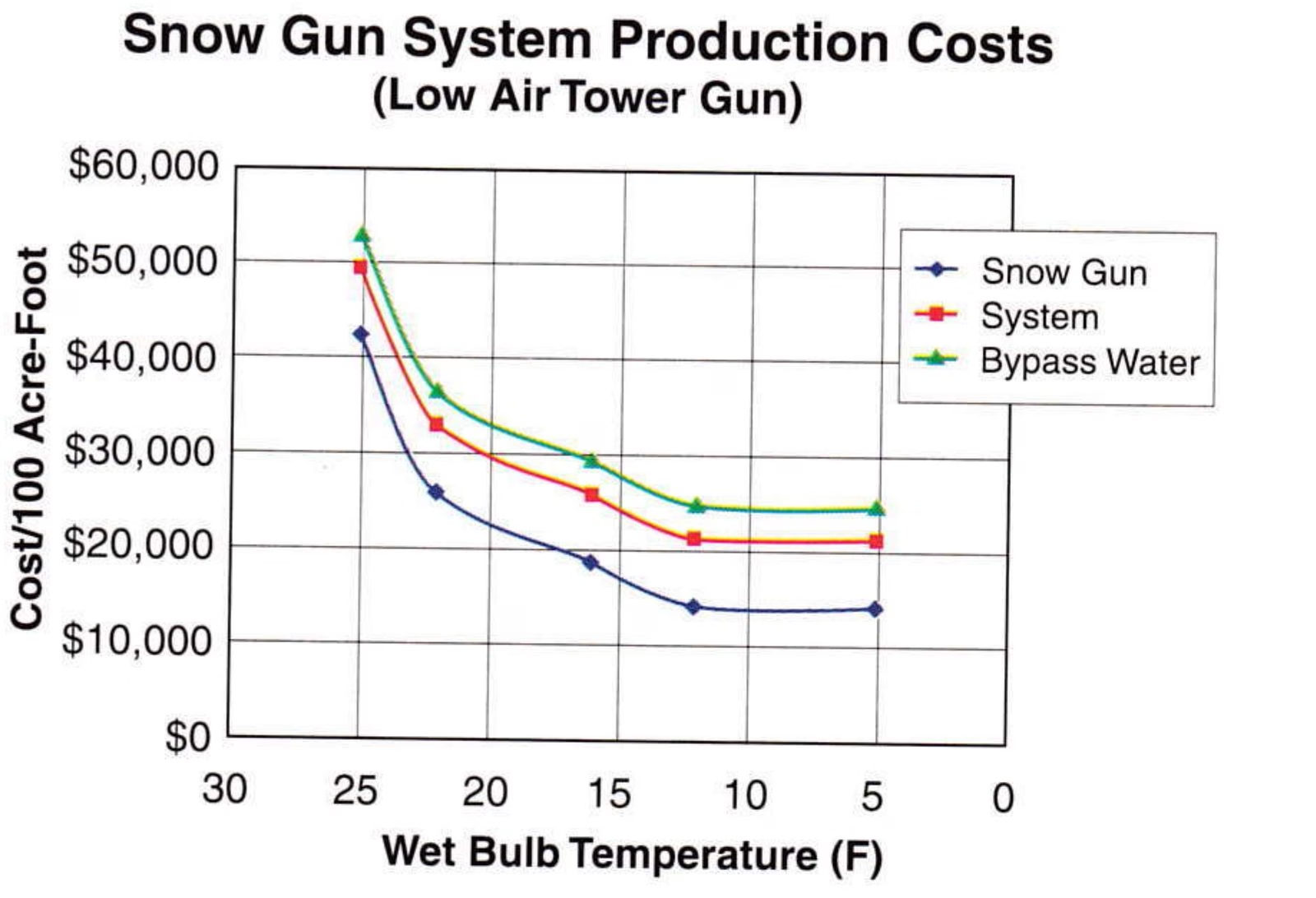
| Low Air Tower Snow Gun | 25 | 13 | 100 | 4,234 | $423.37 | $42,337 | 4,939 | $49,395 | $52,787 |
| Low Air Tower Snow Gun | 22 | 24 | 100 | 2,592 | $259.21 | $25,921 | 3,298 | $32,979 | $36,371 |
| Low Air Tower Snow Gun | 16 | 38 | 100 | 1,877 | $187.73 | $18,773 | 2,583 | $25,831 | $29,223 |
| Low Air Tower Snow Gun | 12 | 60 | 100 | 1,428 | $142.80 | $14,280 | 2,134 | $21,338 | $24,730 |
| Low Air Tower Snow Gun | 5 | 60 | 100 | 1,428 | $142.80 | $14,280 | 2,134 | $21,338 | $24,730 |
| Electric Fan Snow Gun Ground | 28 | 22 | 20 | 4,126 | $412.62 | $41,262 | 4,832 | $48,319 | $51,510 |
| Electric Fan Snow Gun Ground | 25 | 35 | 20 | 2,805 | $280.55 | $28,055 | 3,511 | $35,113 | $38,303 |
| Electric Fan Snow Gun Ground | 20 | 55 | 20 | 1,993 | $199.28 | $19,928 | 2,699 | $26,985 | $30,176 |
| Electric Fan Snow Gun Ground | 16 | 85 | 20 | 1,491 | $149.08 | $14,908 | 2,197 | $21,966 | $25,156 |
| Electric Fan Snow Gun Ground | 12 | 110 | 20 | 1,282 | $128.16 | $12,816 | 1,987 | $19,874 | $23,065 |
| Electric Fan Snow Gun Ground | 5 | 110 | 20 | 1,282 | $128.16 | $12,816 | 1,987 | $19,874 | $23,065 |
To demonstrate each method we invented three types of snow guns: 1) The air-water snow gun is a ground version (less than six feet high) operating at a constant water pressure of 350 psig and air pressure of 75 psig. 2) The tower snowgun is a 25-foot model operating at a constant water pressure of 400 psig and an air pressure of 100 psig. 3) The electric fan snow gun will be a four-ring, multiple-nozzle model mounted on a trailer operating at a water pressure of 350 psig with a total electric load (fan motor, compressor and heat) of 35 horsepower. These snowguns will all have performance comparable to commercially-available snowmaking equipment.
The snowguns are used in several different, and subsequently more complex, situations. Each of the snow guns is first evaluated according to its hydrant performance before being tested at Mythical Mountain Ski and Snowboard Resort. Mythical has 1,000 feet of vertical, never experiences friction losses in its pipes, has perfectly operating pumps and compressors, always has a constant wet bulb temperature from top to bottom and it has perfect, variable wind conditions. At Mythical Mountain the snowguns always operate at their assigned water and air operating pressures, which are summarized in the accompanying table. The labor variable has been removed.
1. Individual Volume Performance
The first method is the simplest, yet most limited, means of comparison—no data gathering or sophisticated computers are required. All this method requires is a graph of the flow parameters as a function of wet bulb temperature for the snowmaking equipment being considered. This type of information is typically available from the equipment manufacturer.
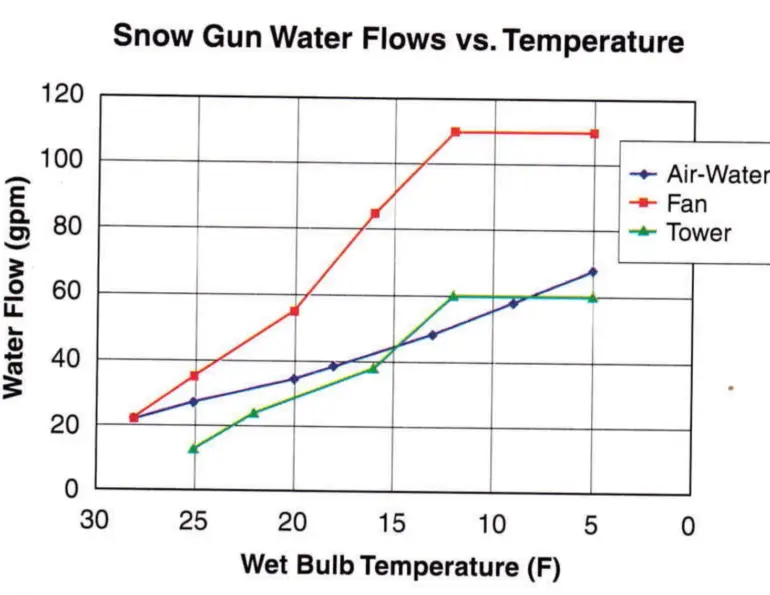
A comparison using this method (showing water flow versus the wet bulb temperature) is depicted in Fig. 1. (The more detailed flow parameter values are presented in the table.) Comparing different curves is a simple method of determining flow rates delivered from the water hydrant to the snowgun. Using these numbers assures a 100 percent conversion efficiency, which does not reflect losses from wind draft and unfrozen water, for example.

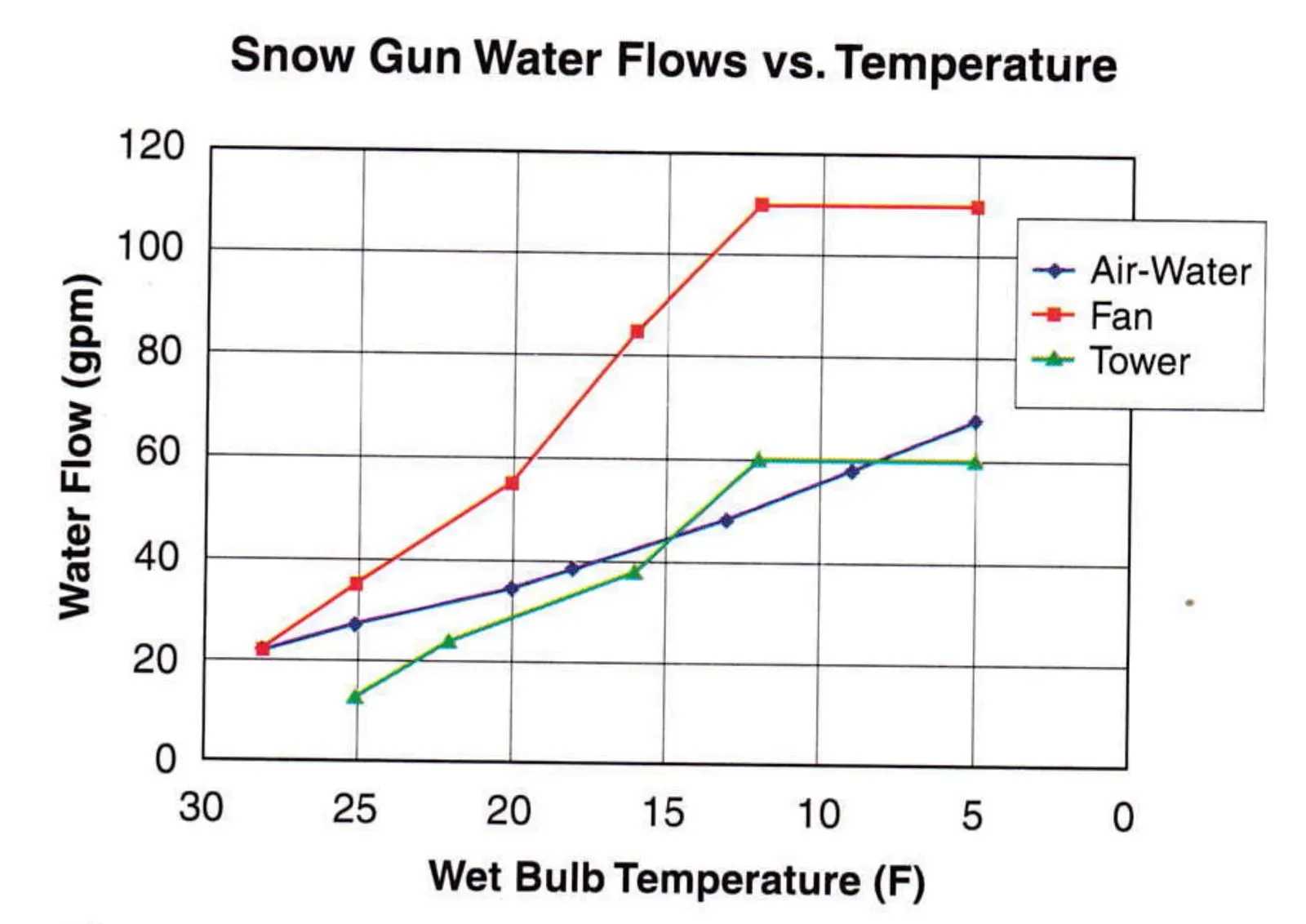
An alternative way of comparing the performance of snowmaking equipment is to convert flow data into an electrical energy or cost equivalent. The values are measured in kilowatt-hours per acre-foot of snow made using a baseline of 180,000 gallons of water for one foot of snow per acre of trail area. (See table for specific values.) This provides a handy means for comparisons, calculations and costing. Calculated values are depicted in Figure 2 and can be readily converted to dollars per acre-foot or dollars per 100 acre-feet by using your actual electrical cost ( say $0.10/kWh). Again, this analysis uses only static information at the hydrant and is not useful for comparing the dynamics of a working snowmaking system.
2. Overall System Performance
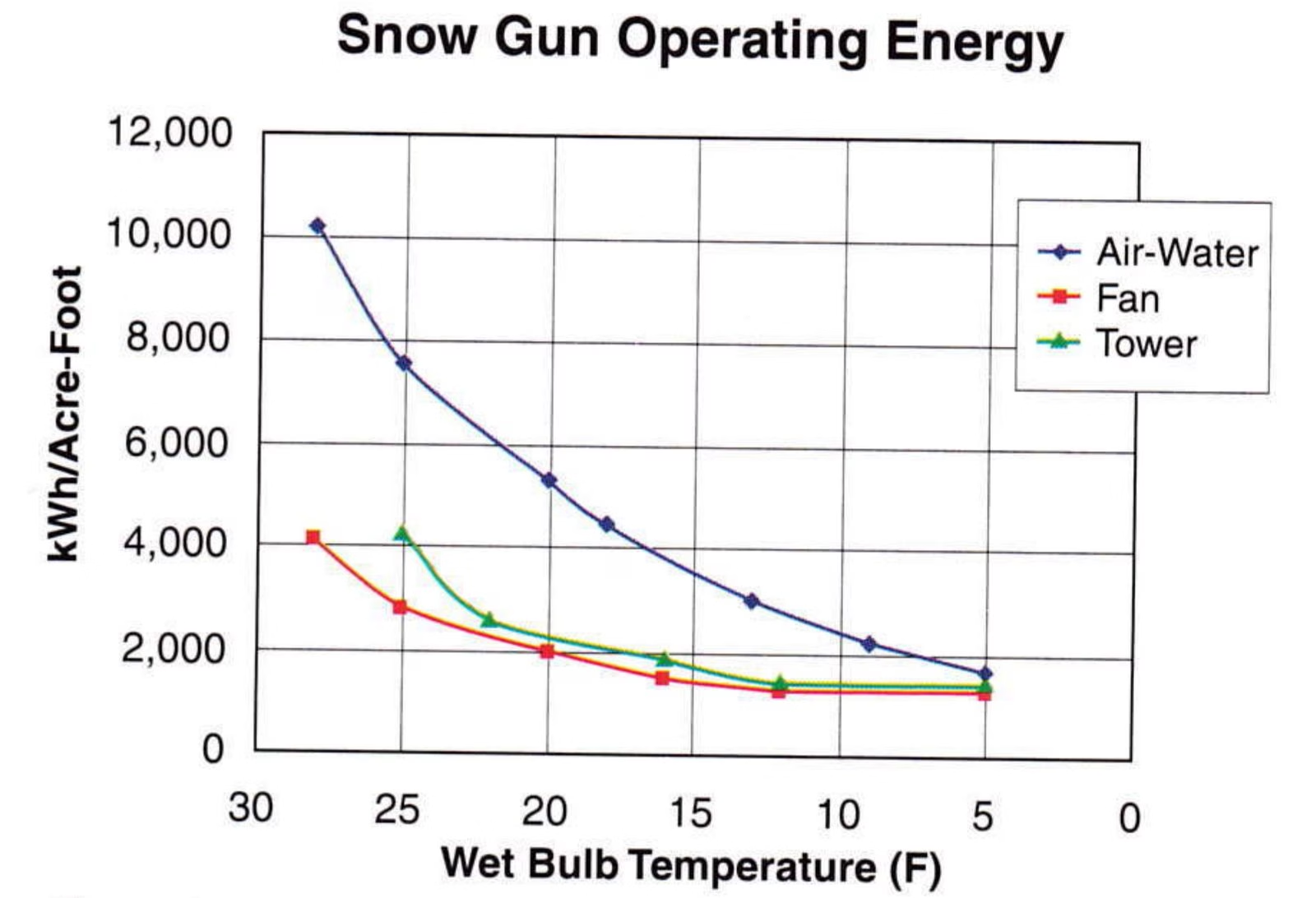
The second method of analysis makes the comparisons at system level. Using our Mythical Mountain example, we now add water pumping power to the individual snowgun flow parameter. Remember, in this analysis, water output is not affected by elevation. For this example we assume that the temperature, humidity and flow are measured. The system performance is depicted in Figure 3 and shows a substantial improvement in the snowgun energy values for the amount of snow produced.
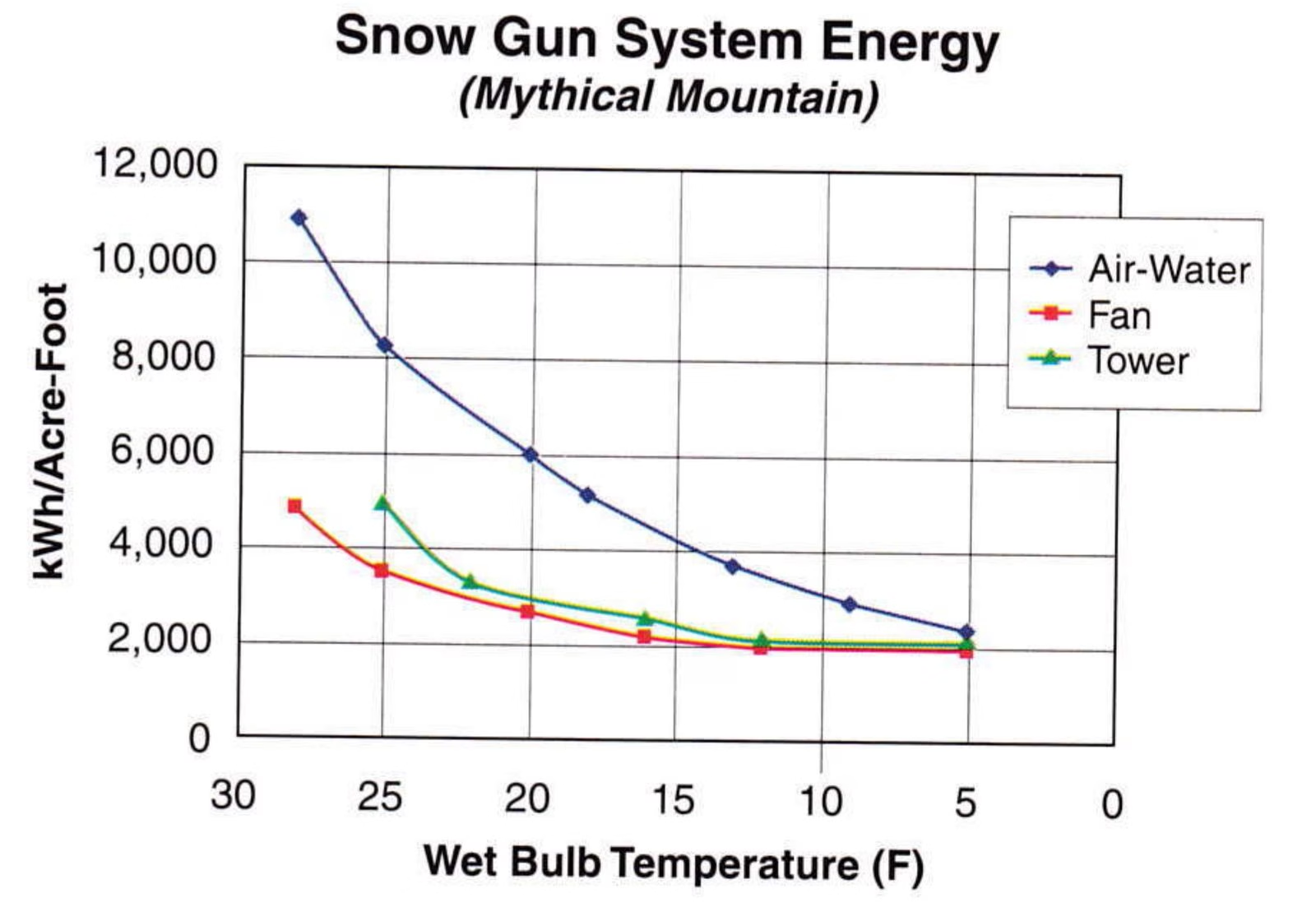
In many instances, water distribution systems include overflow and water bypass controls that decrease the amount of pumped water that is available to make snow. These non-productive water flows are often overlooked or not measured. This common oversight actually increases the true snowmaking production costs. Figure 4 depicts the increase in tower snowgun energy performance values taking into account a 20 percent system water bypass flow in combination with the previous two examples. This curve is presented in dollars per 100 acre feet. It is clear from this example that each additional system parameter substantially increases snowgun energy costs. (The actual values are listed in the table.) As a result, the total Mythical Mountain system energy costs reflect a closer reality than the simplified example of Figure 2. This method can be further extended by including water transfer pumps, water booster pumps and other equipment to estimate the total snowgun energy requirements for a given snowmaking system. However, this method of analysis does not complete the picture for real-life performance and is somewhat limited in its overall usefulness.
3. Water Volume and Energy Use
The third and final method of analysis is a real-time method that takes into account all the above information and combines them with actual electrical power requirements for the total system. This method requires a sophisticated data gathering system and dedicated instrumentation because it measures all the major parameters such as water and air flow, temperature, humidity and power consumption. The results of such an analysis are site specific for each snowmaking system. The mix of snowmaking equipment operating over any given time span yields a data curve showing maximum and minimum cost values that are approximated by correlating with the tabulated bypass water values (Figure 5).
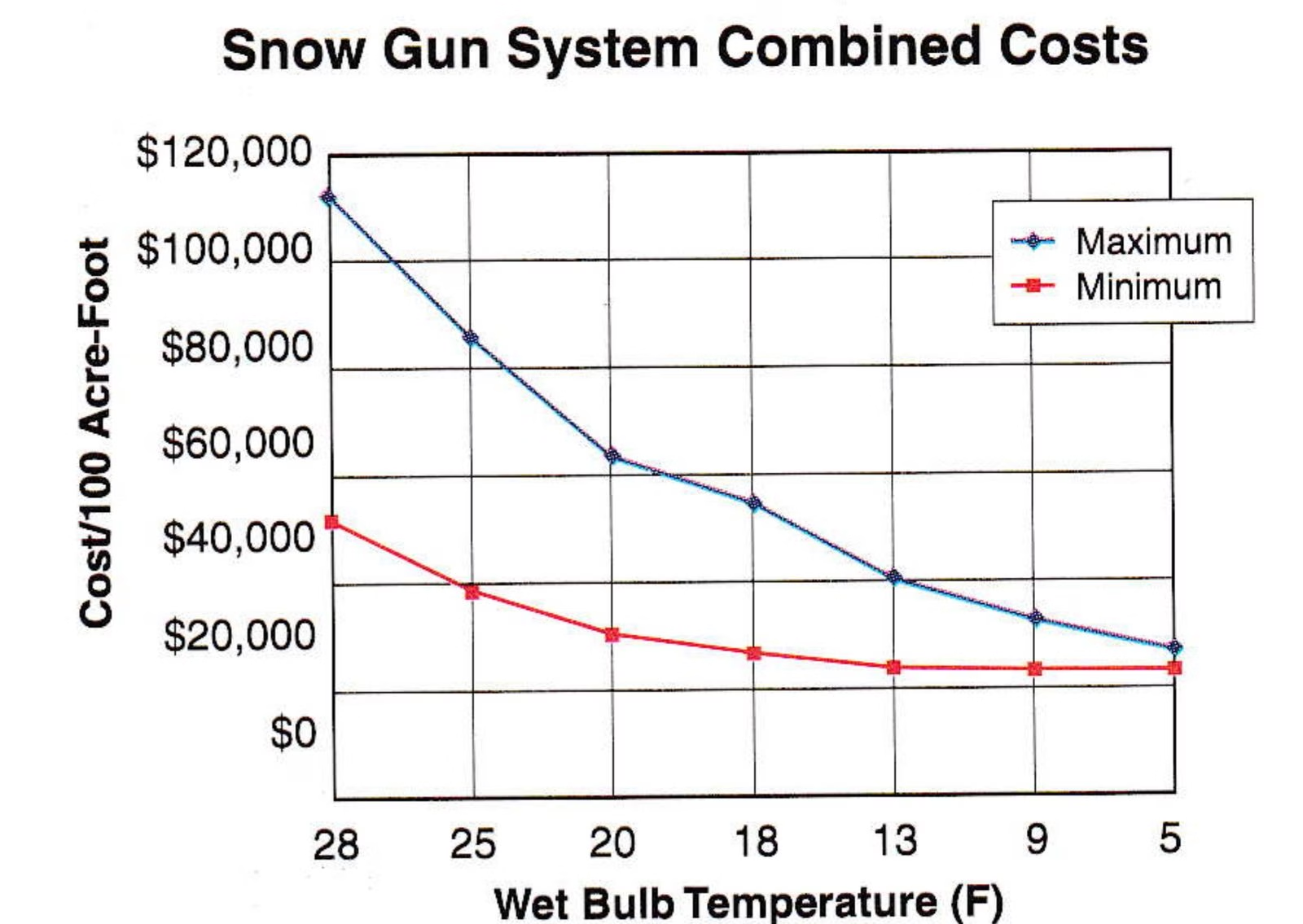
This example projects a range of snowmaking system performance costs (the area on the graph between the minimum and maximum curves) that can be anticipated with a mix of snowguns. For a system using only one type of snowmaking equipment, the cost range between curves will generally be narrower because a mix of snowmaking equipment, plus other system variables, complicates the evaluation.
Real-world snowmaking systems are inherently more complex due to a multitude of variables associated with equipment, manpower and operating environment. Each mountain presents the snowmaking designer and resort operator with a unique set of conditions, which will dictate what snowmaking equipment and system design is best suited for their site.
The comparison between the three methods demonstrates the importance of obtaining accurate and objective snowmaking system information. Without it, making sound and informed decisions about critical planning and financial matters will be difficult at best.