

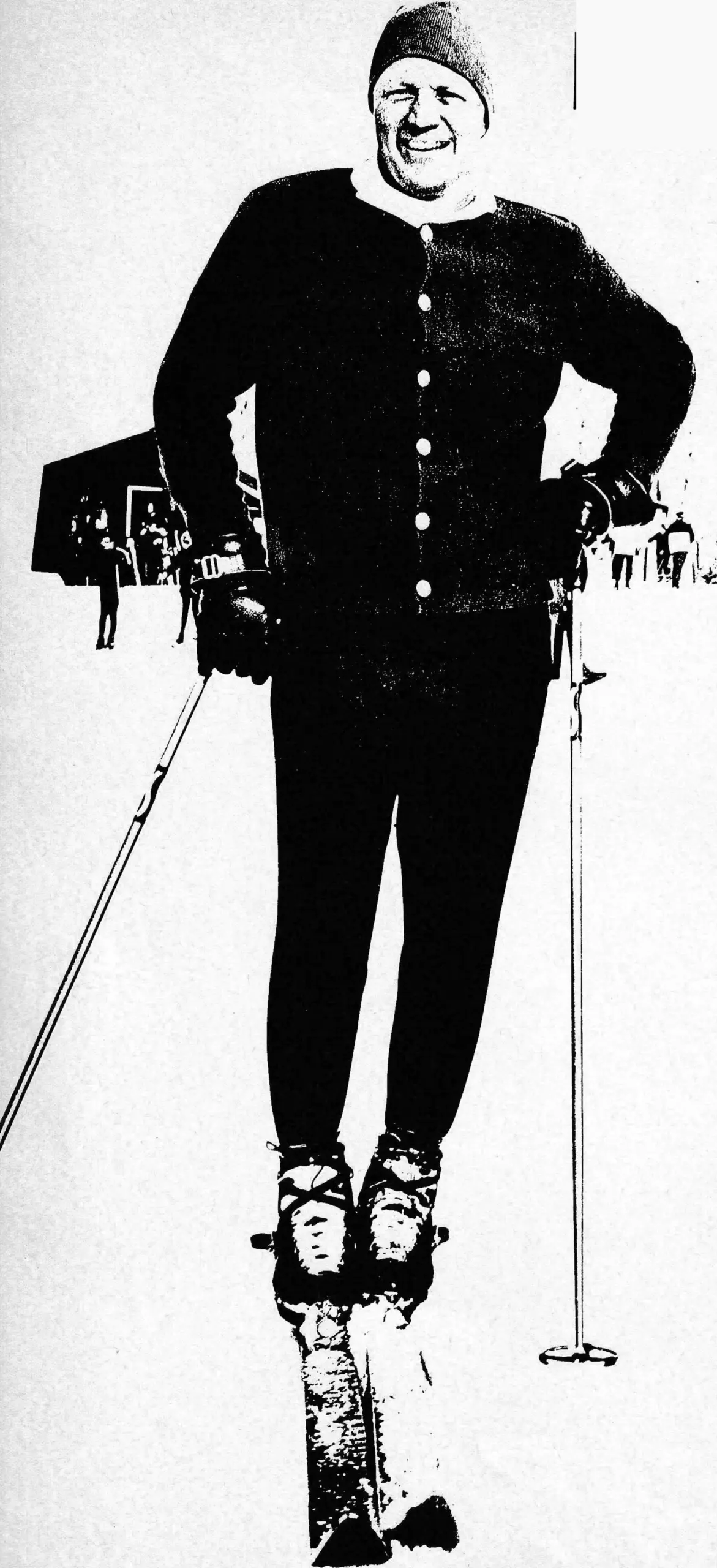
Depending on the season, you’ll find his hand on a sloop’s helm, at the working end of a ski pole or bracing a palette of paints. New NSAA president Frank V. Snyder, a Stamford, Conn., marketing executive cum singer-writer-carpenter, is a multidimensional man. He cuts the perfect template for an NSAA chief.
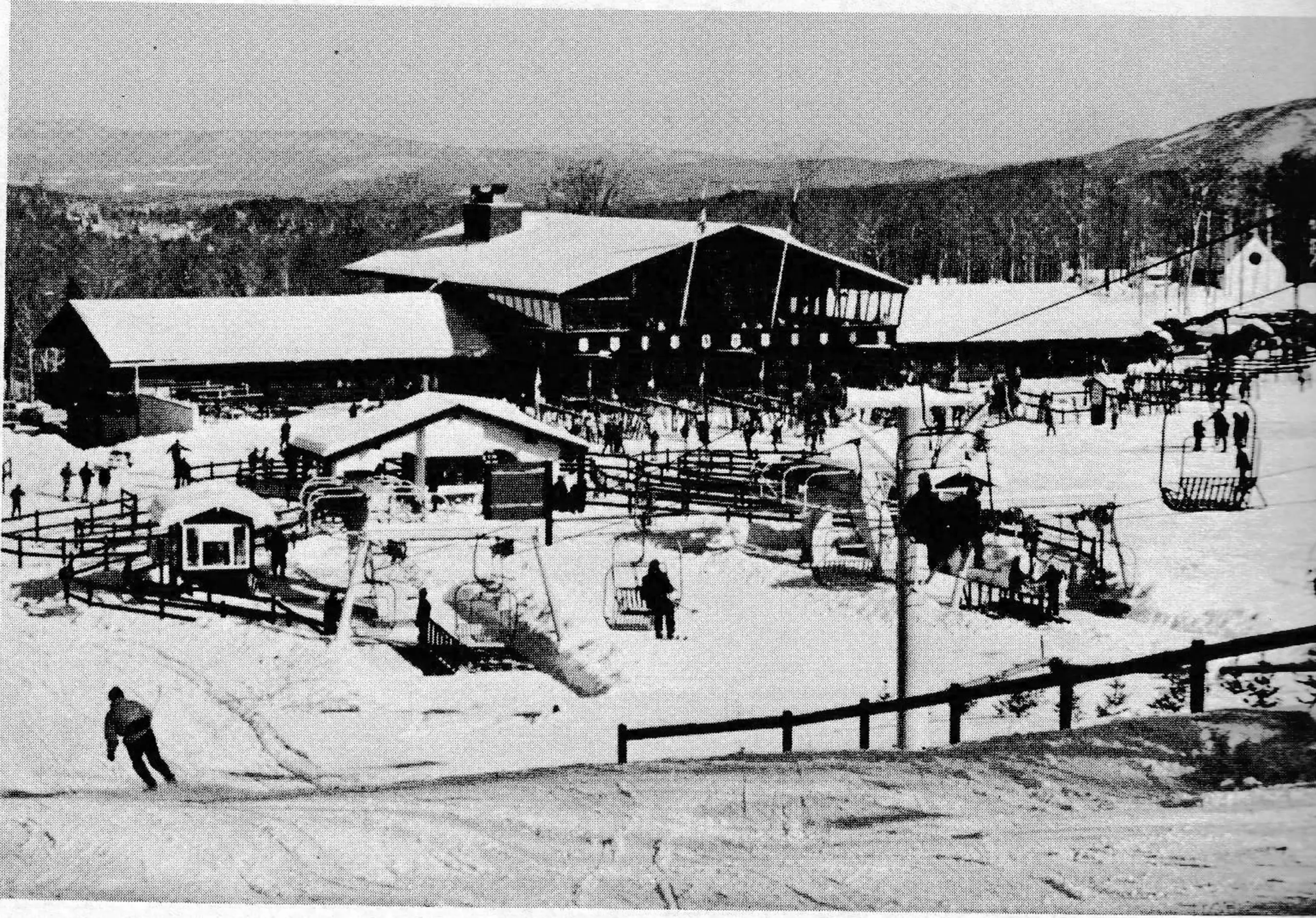
Case in point: Vermont’s Stratton Mountain, the 4,000-acre area that Snyder, now Stratton Corp. board chairman, co-founded 12 years ago and has been developed into one of the most successful skiing operations in the country. How? “We planned thoroughly and capitalized properly,” says Snyder. It shows. Gross sales have bounded by $200,000-300,000 every year since Stratton began operations in 1959. By the ’69-70 season sales had soared to $2,876,000 and last year topped $3,100,000.
To further brighten the corporate picture, the area’s long-term debt was reduced by a record $227,600 last year. And, as a sweetener for the area’s owners (publicly held, the Stratton Corp. has 200 stockholders), net earnings for the ’70-71 season again increased 10 per cent, to an estimated $250,000.
(You might say Stratton’s corporate health was forecast in 1959 when Snyder and a group of investors had negotiated $1,650,000 in equity/subordinated-debenture financing into a dollar-for-dollar commercial loan committment. “This gave us access to $3,300,000 before we had even begun construction,” Snyder reflects. “The area cost just under $2,000,000 to build, so our backing was ample.”)
So good have times been for Stratton that there’s been little need to advertise the area. Explains Snyder, “We merchandise ourselves primarily through attending the ski shows, by visiting area clubs, through our own newspaper and by direct mail. We don’t feel we have to promote that heavily. Stratton draws for the most part on high-income families from Westchester (New York) and Fairfield (Connecticut) counties, Hartford and New York City. Our most effective publicity has been word of mouth.”
So much for Stratton’s financial posture—what about the mountain? Says Snyder, “Sel Hannah once said that there are four factors crucial to building a successful ski area: 1) accessibility to major population centers; 2) vertical drop; 3) terrain—How challenging is it and how easy is it to develop?; and 4) snow—How much do you get? We chose Stratton because it scored high on all four. It was a natural mountain.”
A natural mountain is also a natural for skier crowds, and Stratton, having carried nearly 300,000 skiers on its six chairlifts and two T-bars last season, has had its problems handling them. Result: Stratton’s Board of Directors resolved last December to limit attendance “sometime in the future.” Says Snyder, “Just when is uncertain. The question that remains is how you go about limiting tickets. Do you simply close down the windows when you’ve reached your maximum? Do you reserve tickets? We’re approaching the whole idea very carefully, but I feel we’re going to have to limit ticket sales soon—probably this coming season.”
Sewage, or the state’s perennially changing view on how it should be controlled, has posed other problems. In April, Stratton had requested a district hearing before Vermont’s Environmental Control Commission to build another 50 acres of trails and two new chairlifts. Three hearings and 18 hours of testimony later, approval finally came in mid-July, too late for Stratton to order new lifts for the season ahead.
“Besides,” says Snyder, “the approval was laced with conditions—the need for further approvals, for instance, from state and local authorities before a tree could be cut or a foundation poured. As a result, all capital expansion at Stratton has been shelved for 1971.”
Opposition at the hearings centered around the question of water purity—specifically, the adequacy of the area’s sewage plant. In 1962, Stratton installed a 30,000 gallon-per-day secondary disposal plant that met all of the state’s then-existing specifications. Five years later, in 1967, Vermont’s Department of Water Resources notified the area that its plant no longer met state requirements, which had just been revamped. Stratton was therefore forced to dismantle its unit—“one of the finest in the country,” claims Snyder—and build a new one.
There has been no argument as to the quality of the plant’s design. The problem, says Snyder, is that “once again, the state has upgraded its requirements by filing new water quality standards with the Environmental Protection Agency in Washington, D.C., a procedure that all 50 states must now go through in order to qualify for federal aid in the construction of municipal sewage facilities. Some 30 other states had already filed, but Vermont’s standards appear to be the most stringent of all—particularly one clause which requires a ratio of at least 30 gallons of stream water to 1 gallon of effluent.
“No permits for ski areas to discharge effluents have been issued by the Department of Water Resources since the adoption of the new standards in June. We don’t yet know how the state will rule, and we can’t think about expanding our operations until they do. We could be required to rebuild our sewage plant again—a costly and discouraging prospect.”
“I feel that other operators should be aware of the problems facing us in Vermont, because their states will soon be adopting similar water purity regulations. These areas may be required to overhaul or replace their existing sewage plants. The result may very well be the slowing down of ski area expansion in some states and the expenditure of much time, effort and money simply to keep up with these bureaucratic regulations.”
If expansion in Vermont is restricted, it’s likely that ski-area developers will start prospecting other areas in the Northeast. Says Snyder, “Vermont owes a large part of its success to its easy accessibility from metropolitan areas in New York, Connecticut and Massachusetts. But people are more willing to travel today—and there are some fine mountains in Maine, New Hampshire and New York that haven’t yet been touched.”

Stratton, in one way, is a microcosm of the industry . . .
Stratton, in one way, is a microcosm of the industry. “Our headaches,” says Snyder, “are endemic to all ski areas. You build a lot of very expensive equipment that you run only four or five months out of the year, and that huge capital investment stands idle the rest of the time. In the East, almost every ski area is in serious financial difficulty. There are several areas for sale because their stockholders realize they can’t get a decent return on their investment. You simply have to recoup your investment, and every lost day of weekend hurts.
“The summer trade, no matter what your attractions [Stratton—with its music and arts festivals, 18-hole golf course, Arnold Palmer Golf Academy and facilities for tennis, swimming, hiking and fishing—has a few of its own], will never be enough to occupy six, eight or 10 chairlifts. Your investment simply has to be recovered from skiing.
“Many have tried real-estate sales, the so-called savior of sick ski areas. But this tack is just unrealistic. When you have a large capital investment in a village, watch out. Some areas hope that inns and shops located on close-in real estate will stay open in the summer. But if you don’t have the attractions to draw the trade, you won’t get the tourists, your merchants won’t stay open and the whole operation grinds to a halt.”
Other industry problems? “Profitability—let’s say the lack of it for most,” says Snyder. “One answer is higher prices, and though few operators say they favor this approach, it seems to be the direction they’ll have to go. Another is lower operating overhead. But how do you accomplish this in an inflationary period? Everything—personnel costs, interest rates, the price of equipment—is skyrocketing.
“Then there’s the matter of safety. We have to find ways of reducing skier injuries. Boiling it down to the basics, uphill we need better equipment, downhill we need better grooming.
“Finally, the U.S. Forest Service’s newest proposal for extracting land-use fees from ski areas will, if adopted, cause real problems. They’ve recommended a graduated-fee system under which an area would be assessed on the basis of a ratio between its lift revenues and gross fixed assets—the closer the ratio, the greater the assessment—a proposal that the NSAA has so far been able to forestall. This system would have the effect of penalizing the efficient operator who builds for less and it would hurt older ski areas that were built with yesterday’s dollars. The NSAA’s proposal—that the fee be based on a flat percentage of sales—seems the better answer. Under this arrangement, everyone would be using the same reporting method. With the graduated-fee system, it’s a simple matter of cooking your books to come up with a low assessment figure.”
The NSAA’s ability to lobby effectively, as in the battle over the USFS proposal, is, Snyder feels, one of the organization’s most important functions: “NSAA provides a forum in which the areas can get together, collectively examine their problems and, where necessary, take their case before Uncle Sam.”
A deep-water sailor capitalizing on his navigational know-how, Snyder will be putting NSAA’s sails in trim before charting any new courses.
“A major part of my job will be working with Dick Garis on the administration of NSAA. So much of our success depends on the effectiveness of the organization’s day-to-day operations. Our primary function is communication, keeping our members up to date on what we’re doing and what others in the industry are up to. And we’ll be focusing on the NSAA newsletter to do that.
“Judging from remarks at the Hyannis meeting, the seminar idea is a good one. It’s an approach that we’ll be continuing for future NSAA meetings. The tips that our area managers can pick up from the pros both within and outside our field bring invaluable new thinking to ski-area management.”