
When the single passenger chair lift was developed in the United States in the 1930’s, capacities soared to 600 skiers per hour. It was logical, then, that hourly capacities would double with the introduction of the double chair lift in the 40’s. And, when two-passenger chairs were followed by lifts that had chairs to carry three passengers and even four passengers, the design capacities reached 2400 skiers per hour. However, the real capacities fell short of this geometric progression in most cases.
Area operators found that it is difficult enough to get two skiers to pair-up to ride a double chair lift, but this difficulty increases with the triple and the quad configurations. So, it is apparent that the design capacity of any lift must be weighed against the actual operational capacity, and as the number of passengers per chair increases, the ratio of actual capacity to design capacity drops. Furthermore, operation during mid-week when the number of skiers is reduced can be a problem on a quad chair, because when less than three skiers ride in a quad chair, proper distribution of the skier’s weight is essential to avoid excessive tilt or swinging.
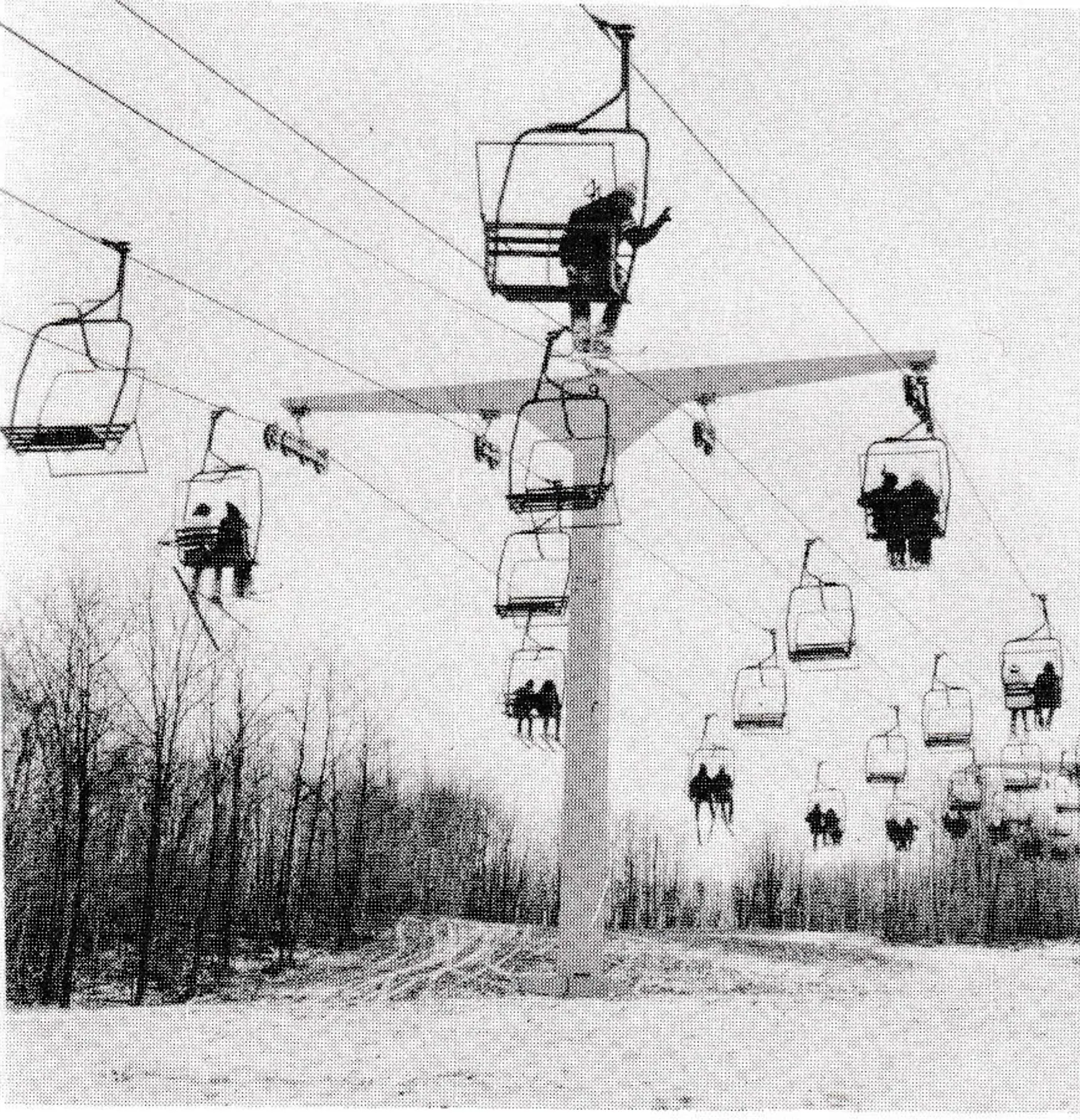
Most recently the search for higher lift capacities and higher operational efficiencies has led to the use of dual chair lifts. In the simplest sense, these are two parallel chair lifts using the same line towers. The concept is not new; surface lifts have been constructed in this manner, as have rope tows. Even the gondola lift at the 1964-65 New York World’s Fair (The Swiss Sky-Ride) was a dual configuration. Records and sources available indicate that the first dual chair lift became operational last year at Jack Frost Ski Area, Blakeslee, Pennsylvania. This is a dual double chair lift featuring both bull wheel loading and bull wheel unloading. Each lift has an hourly capacity of 1200 skiers giving a total capacity of 2400 skiers per hour.
Dual chair lifts can have two types of general arrangements. The arrangement used at Jack Frost has both lifts terminating at the same summit area, making both the left and right lifts nearly identical except for direction of rotation. The second arrangement uses a common location for the lower terminal and employs common towers for both lifts on the lower section of the dual lift, but one lift is terminated before the other, resulting in two separate unloading areas, and using conventional single lift towers from the lower unloading area to the upper unloading area.
What are the advantages of the dual chair lift arrangement? Let’s first look at what this arrangement doesn’t do. It is not going to result in lower cost of lift materials as supplied by a lift manufacturer. The same materials go into the dual system as are required for two separate lifts except for the line towers. These towers to accommodate the two lifts are naturally sturdier than those used for a single lift, and with the wider cross-arms the system can result in even a more expensive tower from the ground up. The dual lifts are not going to reduce the operational manpower either. Each lift is operated separately, and requires the normal operator and attendants(s). So, it is apparent that the lifts are not going to be a bargain to buy or to operate.
The advantages of the dual system start with arrangement. It is good ski area design practice to utilize the lift line as a down hill trail, and more and more areas are doing this. Area operators realize that the line must be cleared for both construction and for maintenance of the lift towers, and this line might as well be used for skiing, providing double usage for this cleared area. The dual lift offers an advantage in this trail design because it reduces the number of line towers that are on the ski trail by half, and, despite the larger size of the towers, this requires less surface space.
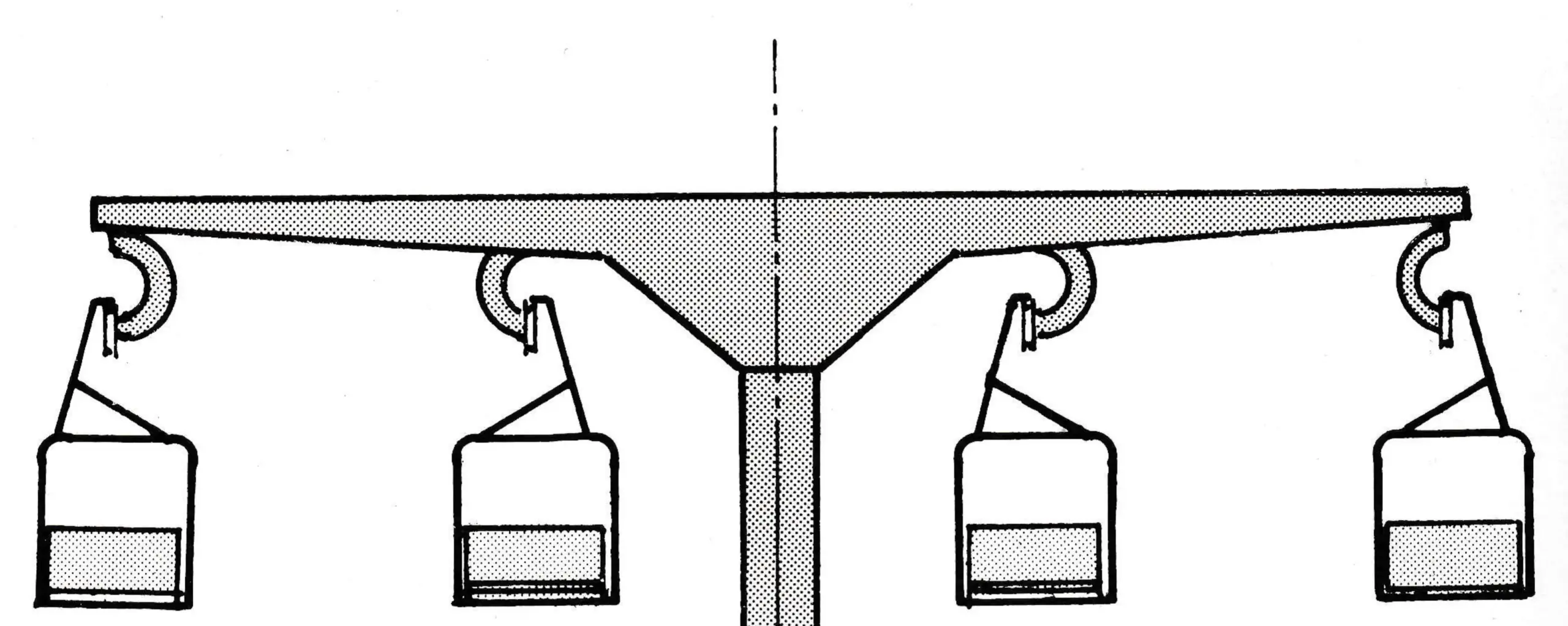
The dual lift system is more economical to install than two distinct lifts. One large footing for a tower costs less than two smaller conventional footings, and one heavier tower is erected at less cost than two lighter towers. Even the lift designer has less work in making the lift line layout. Terminals, when combined at one location, are less expensive than separate terminals, and the lower terminal is usually under one roof. The electrical safety systems and telephone lines can be combined into one group from terminal to terminal.
Operationally, the dual lift arrangement offers advantages. First, any malfunction of one lift resulting in downtime does not close down the entire lift system. For periods when the maximum capacity is not required (mid-week), one lift only can be operated and skiers still have access to the same trails and slopes served by both. This arrangement permits scheduling of maintenance and service during the normal operating day.

A second operating advantage is that with the arrangement of each lift on one side of the line towers, greater clearances are obtained between up-going and down-coming chairs, because no tower structure is between these chairs. Under conditions of high cross winds, the lift located to the leeward side can be operated when a similar lift with tower tubes in the center would be subject to shut-down due to empty down-coming chairs striking the towers or guards.

In selecting a location for a dual lift certain considerations are required beyond the normal lift location factors. The base area, comprising two side-by-side terminals must provide sufficient space for skiers to leave the trails and slopes and enter lift waiting lines. While these requirements are not substantially greater than that required for triple or quad chair lifts, some cross-milling of skiers must be anticipated. The use of bull wheel loading with the resulting rear entry of skiers to load, solved some of this problem at Jack Frost.
The lift line must generally follow the fall line of the slope. Cross slopes have a more pronounced effect on clearance beneath the chairs on dual lifts than on single lifts. The up-going chairs are about 16 feet away from the tower centerline, so a 20 percent cross slope can result in one up-going chair having over six feet more height than the opposite up-going chair.
When the two upper terminals share a common location, the arrangement must permit skiers to have access to all downhill trails and slopes regardless of which lift is used. At Jack Frost with bull wheel unloading, skiers can exit the lift, ski down an earth-built ramp to a broad flat where crossing does not present a hazard.
As with triple and quad chair lifts, the dual lift system must have sufficient downhill skiing trails and slopes to safely accommodate the skiers when the lifts are at maximum capacity. A single trail exiting from such an arrangement presents major problems. A dual lift having an hourly capacity of 2400 skiers can unload 16,800 skiers in a seven-hour operating day.
In summary, the dual lift system is certainly not the solution for all uphill transportation problems for ski areas and it is not a big dollar-saver initially. However, for locations where a realistic high capacity is required at peak periods and slope and trail configurations are adaptable, the compactness and operational efficiency offered by the dual lift system has distinct advantages. In this first season since Jack Frost’s introduction of the dual lift, several dual lifts are under construction at other ski areas. Some will have only one lift installed on the dual system initially, permitting a second lift to be added to complete the dual system at a later date.