

In any discussion on snowmaking, the inevitable question always arises: airless or conventional? Also, where snowmaking expansion or modification is required, should the design of the existing installation be changed or should the technical continuity of the system be maintained? Which system represents the best installation for the area; and what method of measurement should be used to gauge this relative efficiency? Where a new snowmaking system is being considered, what will it cost? Where expansion or improvement is being considered, what will these changes cost? What economic benefits will result from the installation or expansion of your snowmaking system? Finally, how long will it take these benefits to pay for the costs of installation or expansion?
Though accurate answers to these questions would be invaluable in the daily operation of a ski area, most area operators are not in a position to answer them, for they simply don’t have the technical or economic data that is necessary. With data that has been collected under operating conditions, of course, it is much easier to cast answers into meaningful economic terms.
All manufacturers of snowmaking equipment claim they can accurately predict the costs to be expected for their systems. These figures, of course, are subject to field verification. On the other hand, ski areas that have existing snowmaking operations are more concerned with making snow than with the involvement in cost analysis. However understandable this may be, cost information is important and recording doesn’t need to be a painstaking procedure.
Regardless of whether an area has an airless system or conventional compressed-air system, it is relatively easy to measure certain variables under daily operating conditions. And the accuracy of these measurements will have a direct bearing on the effectiveness with which an existing snowmaking operation may be optimized, modified or expanded.
The ultimate measure of snowmaking efficiency, as with anything else, is related to dollars and cents. Any technical variable which costs money should be accurately measured and recorded daily. At the end of the season this information can be correlated and studied to evaluate the variable’s effectiveness in the overall snowmaking system.
For example, it is generally a simple matter for a ski area operator to estimate the total cost for snowmaking over one complete season. Take a hypothetical example where an area operator indicates that his snowmaking operation cost $27,000, broken down as follows:
Hydro $10,000
Water $3,000
Labor $10,000
Maintenance $4,000

This data is typical and can generally be supplied by most ski area operators. However, it is much more difficult to evaluate the relative effectiveness of the various inputs in this breakdown. For example, does the $10,000 labor cost represent $10,000 of productive labor? Within this overall cost, what percentage of labor was expended relocating equipment? What percentage was expended thawing out frozen valves? Is the system using more air than it should be, with a resultant increase in hydro costs? Is the maintenance cost in line with the expected average for a system of this size?
Answers to these questions would allow the operator to make modifications to eliminate the problem areas. And to record and correlate the data necessary to arrive at the answers, tabulated forms, such as the two shown below, provide an instant picture of an area’s snowmaking operation on any given day.
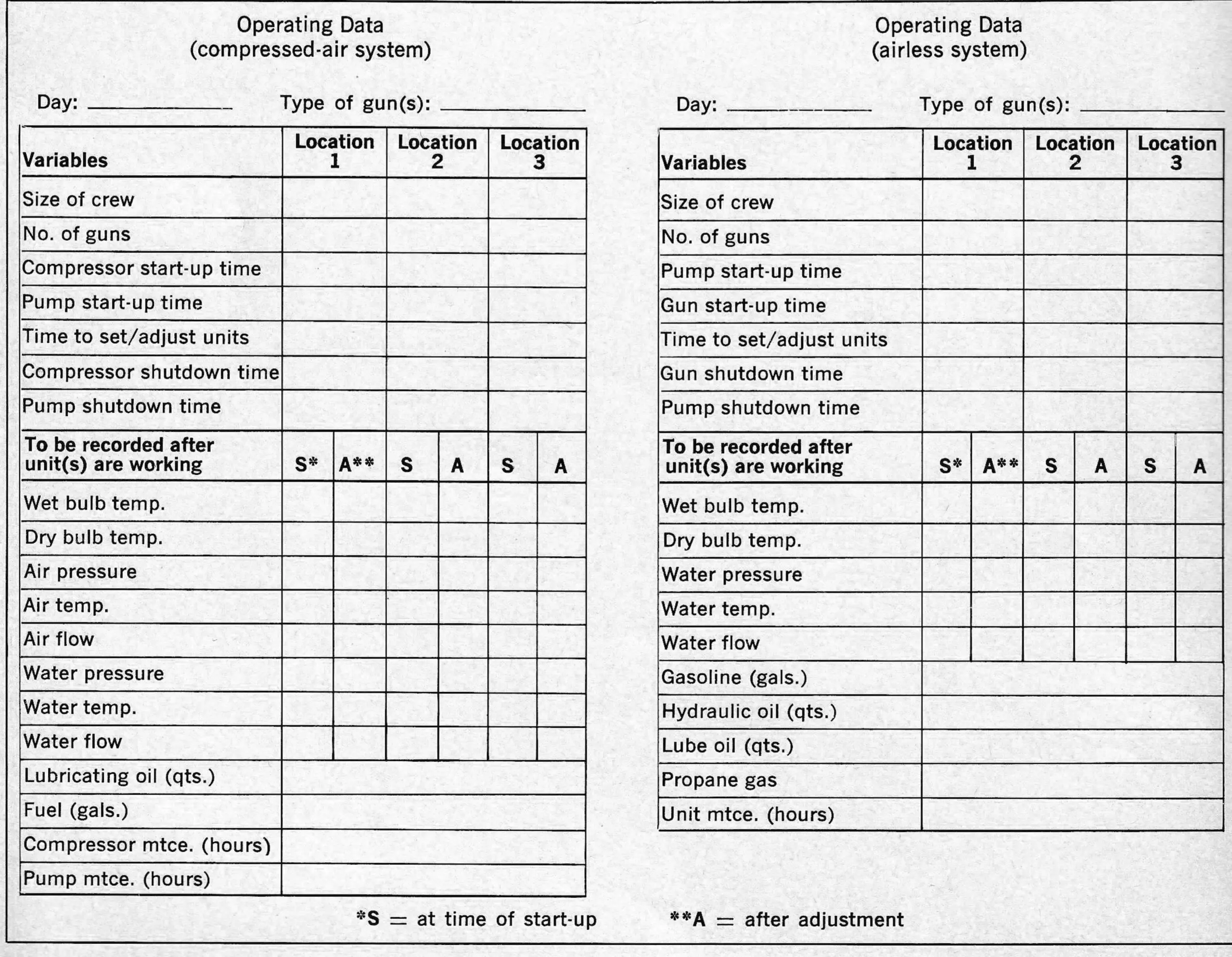
It should be emphasized at this point that there is no general rule applicable to every snowmaking system. Some variables are more important to some systems than to others. As a preliminary tack, however, the area operator would do well to make copies of whichever form applies to his particular installation and begin recording data on those variables which are applicable to his installation.
At the end of the season these data sheets can then be used to compile technical cost information that will make it easier to evaluate a system’s relative effectiveness.
These data sheets are by no means all encompassing. The operator may find it more to his advantage to use a consultant in examining his system and laying out data sheets tailored to measuring his specific snowmaking variables. The costs for such a study are modest, and the savings that are realized will generally pay for the study in a very short period of time. The data sheets shown here, however, will provide a start, and the area operator should make whatever changes necessary to them to fit his own snowmaking operation. The important thing is to realize that this is an area of potential savings. The measurement and recording of data is the first step to evaluating the efficiency and performance of a snowmaking system.