

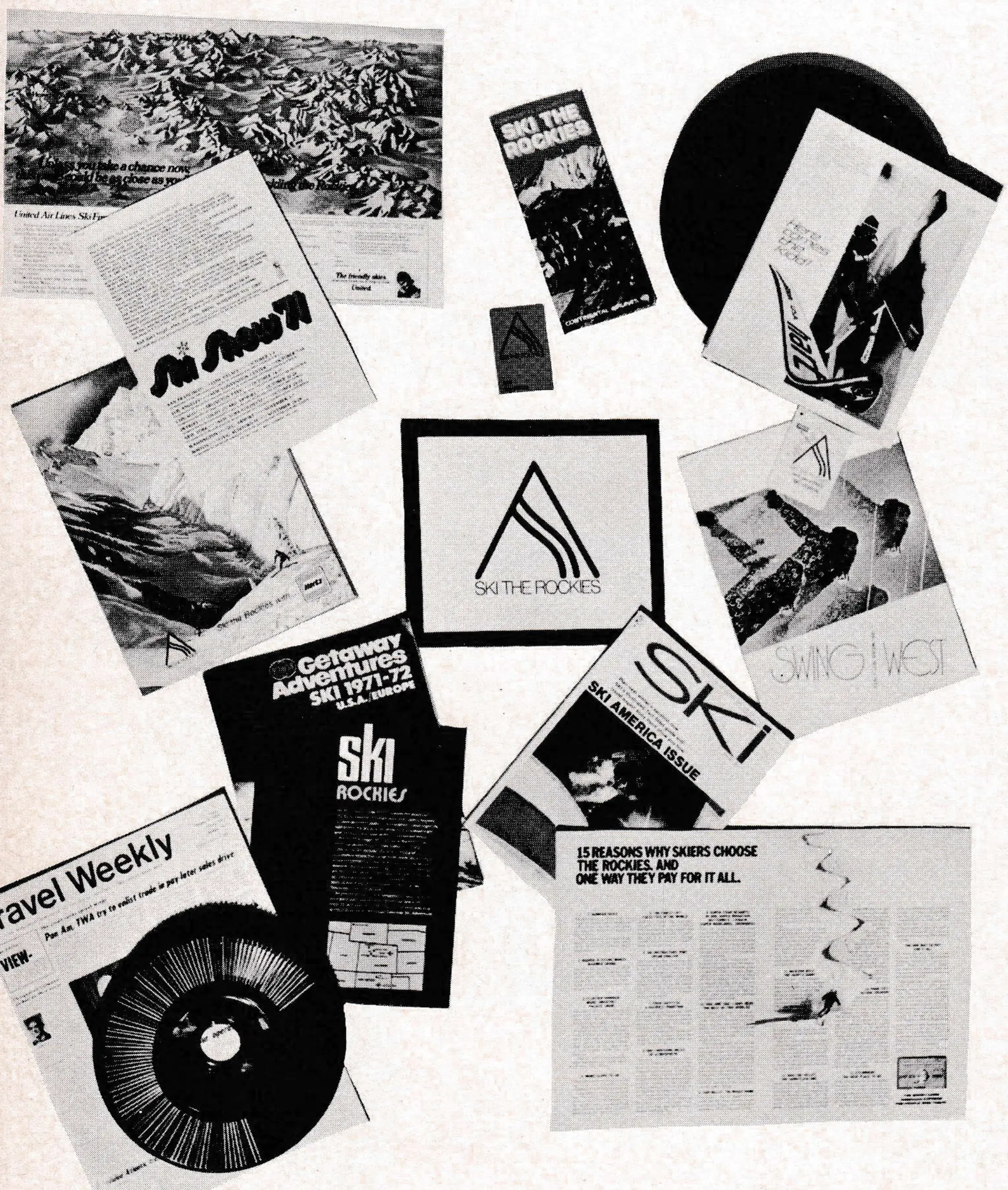
 Travel Weekly agent seminars, TWA package, Hertz travel agent manual cover, Ski Show ’71 exhibits.” class=”wp-image-36961″/>
Get out and help your competitors sell because the whole of an effort is greater than the sum of its parts—that’s the message the industry can draw from the nine-resort marketing alliance known as Ski the Rockies. The group’s second message is that the American travel industry—travel agents and carriers—constitutes a nationwide sales force for ski areas.
If an Aspen or Vail feels unable to woo today’s customer singlehanded, then it figures that weekend and metropolitan areas have even more need to pool promotional resources. Smaller areas might not be able to utilize the Ski the Rockies group’s full range of vacation-selling techniques, but they can adapt the basic philosophy.
The nine allies are Aspen, Breckenridge, Jackson Hole, Park City, Steamboat Springs, Sun Valley, Taos Ski Valley, Vail and Winter Park. About once a month, their marketing directors meet at a different member resort.
The host marketer chairs the meeting. The group has no permanent chairman, no staff, no war chest. Expenses used to be split nine even ways as they came up. This year each area has put a flat sum into the kitty; the amount is slightly under $5,000 apiece.
The funds don’t go for staff, but for out-of-pocket expenditures involved in such projects as preparing a nine-area sales manual for travel agents, participating in an airlines TV special and promoting documentary, appearances of area representatives at seminars for travel agents and airline personnel, combined exhibits at the ski shows and coordinated advertising and promotion material. The group even offers a special $750 all-area, all-season pass through Neiman-Marcus’s Christmas catalogue.
In actual practice, Bob Parker, Vail’s vice-president in charge of marketing, is the group’s dean and ramrod, but each of the nine adds unique talent and experiences. Breckenridge’s Dave Lowe, for example, was formerly a top ad agency exec, and Jackson Hole’s Buzz Bainbridge has worked with the airlines. Rounding out the group are Herman Kretschmer of Taos, Park City’s Roger Haran, Mix Beauvais of Steamboat Springs, Ed Hunter of Winter Park, Sun Valley’s Jerry Jones and Curt Burton of Aspen Skiing Corp. Aspen per se has no special status in the alliance, although it represents four mountains.
“Nobody’s riding our coat tails,” says Burton. “Aspen alone couldn’t deal with the travel industry the way the nine can jointly. They can’t play off one area against the other if we speak with a single voice. We each have separate marketing problems, too, but we take more out of the group than we put in.”
The alliance grew out of a 1967 attempt by Western Airlines to do with ski resorts what it had done with Hawaiian hotels, by setting up a program of roadshows for agents and airline personnel. With Western paying the expenses, 15 resorts made joint presentations to the trade. A year later, Aspen and Vail went out together to meet with travel people concerned with selling Denver as a destination. The next year, the duo expanded into the Super Six, but by mid-summer 1970, when the campaign really took off, the group had grown to the current nine.
No other applicants have been accepted yet. Parker describes the criteria as “being a destination resort with major facilities and an established reputation, which is sold actively through the travel industry.” A “destination resort” is one that people buy public transportation to reach and then stay there. (Bustling Hunter Mountain is not a destination ski resort but tiny Taos is.) “Sold through the travel industry” means selling a substantial number of lift tickets and beds through travel agents, tour operators and carriers. It also means paying them the customary commissions.

The nine’s first goal was to lure Eastern vacationers away from Europe and out to the Rockies. Now they see the benefits as being broader. Says Parker, “We are competitors but we have a huge community of interests. Back at our own resorts, each of us has to work with nonmarketers. At any monthly meeting, we can exchange ideas with guys who see skiing from a marketing point of view. It’s exhilarating—and profitable.”
Does it sell tickets? Parker says that data is lacking but that Vail sold 100% more vacation deals in 1970-71 than it had in 1969-70. Most of the other areas had similar gains.
Last year, the group’s main action was a series of 80 seminars for airline and agency personnel in 15 cities. The areas’ representatives took turns narrating a factual but hard-selling slide film and answered questions on travel technicalities (commissions, land transportation, air routings). Says Parker, “It was the first time the ski resort industry presented itself to the travel industry. Before, carriers used to chase down each lodge. We were delivering resort-wide systems, with uniform procedures and centralized management.”
“Now, the group has increased leverage in the market place,” Parker points out. “When we walk in as an entity, our power is multiplied. Together we can do things at costs far below those we would have individually. The fact that other areas want in is another sign of our effectiveness.”
As the season unrolls, the industry and the public will see Ski the Rockies launch a six-pronged promotional attack (see box). By then, the group will be deep into its plans for the 1972-73 season. As anyone familiar with the U.S. ski scene knows, this advance perparedness is an important innovation.
In order to get their ski week pitches into the carrier brochures, air tour manual and other industry channels, the group finalized prices by last May. Another advantage was the group’s skill in Tom Sawyering the costs—using an airline’s money to launch the seminars, for example, and a car rental company’s money to dress up the tour manual, and so forth. Perhaps the most sophisticated element in their approach is their shrewdness in using the paraphernalia and procedures of the travel industry. Carriers and agents are selling the nine resorts, not because they get paid extra for doing so but because Ski the Rockies makes it easy for them to do so.
Coalition fever is spreading. Colorado Ski Country USA has launched its first inter-area marketing committee (chairman, Bob Parker). Ski Canada West, a coalition of eight destination areas and a dozen smaller ones, has launched a major sales drive to get Californians to Alberta and British Columbia. Ski 93 in New Hampshire, assorted Vermont couplings, the off-and-on assemblage known as the High Sierras—the parade has begun.
What Ski The Rockies has planned for 1971-72
- A detailed nine-resort manual is being distributed to travel agents and airline personnel, providing the specifics they need to complete package sales. (TWA and United have tour manuals covering many areas, including the nine, but these cover only each line’s own wares and are not usually available to feeder lines.) Cover for the manual has been supplied by Hertz.
- United Airlines had film maker Roger Brown create an hour-long color TV special, filmed at each of the nine areas (plus Heavenly Valley, to plug the carrier’s Reno and San Francisco services). Entitled SKI BOOM, the film is being distributed through major markets this Fall. United has bought some of the commercial time on the program to offer a kit of brochures. (The non-United minutes will be sold by individual stations.)
- A spin-off from the TV special is footage that has been made into a “Ski America” film. TWI, a subsidiary of Mark McCormack’s International Management, Inc. is handling the deal. Hart Ski Co., Chevrolet and Dannon Yogurt are expected to be involve in this film, too.
- Ski the Rockies has a dominant position for a big joint booth on the ski show circuit this season.
- With United, a series of seminars for travel agents and airline personnel has been set for major cities September 15-October 15.
- A Ski the Rockies all-area season pass will be offered through the Neiman-Marcus Christmas catalogue for $750. The object is not so much to sell tickets as it is to make news.