In many ways, the history of the ski industry is the history of ski lifts and vice-versa. Indeed, dates, such as the first documented rope tow in the U.S. (1934 at Woodstock, Vt.) and the first single chairlift in the world used for skiing (1936 at Sun Valley, Id.), are the beginning of that history.
As the sport grew and ski areas sprang up like snow bunnies across the North American snow belt, lift building was both the workhorse and the enabler of the growth. From that first installation in 1934 through 1964 more than 240 new, non-rope-tow-lifts were built, and in the decade from 1955 to 1965, no less than 580-plus new ski areas came into being. (The Ski Area Management statistics count all transportation by wire rope, aerial and surface, but exclude rope tows, wire rope tows and rope tow areas.)
Looking back over the past 60 years with the perspectives that this long a continuum gives, it is fascinating to see how customer demand ultimately impacted the evolution of ski technology. For instance, ski area development began with arm-stretching, high-speed fiber rope tows that eventually gave way to an incredible flood of Pomalifts, which for many areas represented a first investment in uphill transportation, such as at Taos, N.M., where the Pomalift up Al’s Run was the beginning.
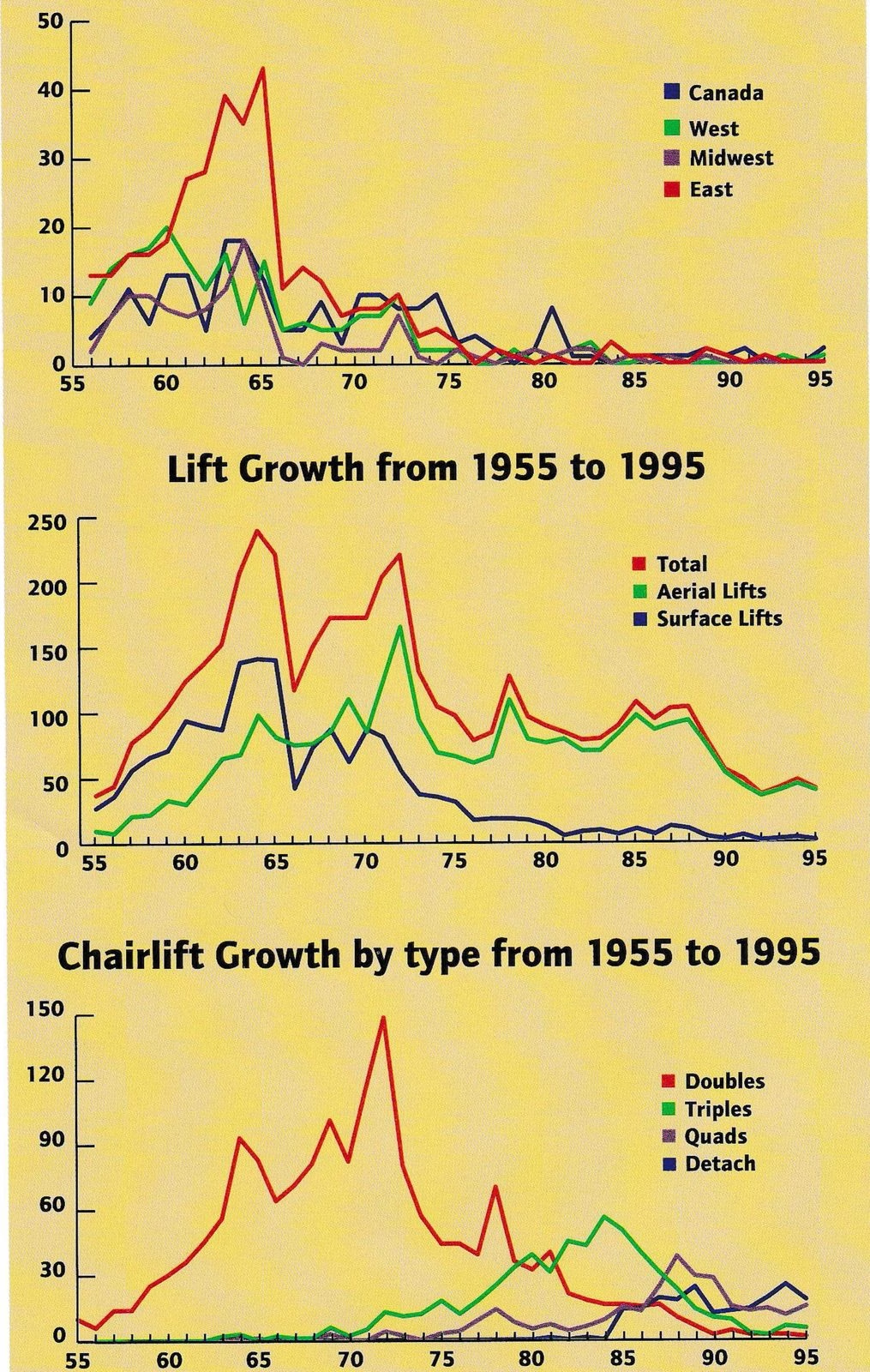
Eventually, the dominance of these surface lifts gave way to aerial lifts, which were typically single chairs at 250 pph and 50 horsepower. It wasn’t long before the singles were replaced by doubles, the first being a Heron bi-cable, which opened in 1947 at Berthoud Pass, Colo., with 590 feet of vertical and a capability of 480 pph.
There was a tentative start, 16 years later, of the triple with a Riblet at Boyne Mountain, Mich. This configuration came to dominate 1970’s chairlift construction. The same thing happened again during the late 1980s with the quad, which also got its start at Boyne Mountain in 1965. (We record also that Boyne got the first six-passenger chair in the U.S. in 1992, but world honors go to Mont Orignal in Quebec for a six-pack installed in 1991). Ultimately, lift buyers could purchase 33 percent more uphill quad-lift capacity, from 1,800 pph to 2,400 pph, for as little as a 12 percent premium.
By 1992, the more user-friendly (and more expensive) detachable chairlifts dominated construction, though the first was a Doppelmayr quad at Breckenridge, Colo., in 1981 that measured 5,860 feet and had a capacity of 2,800 pph.
The full and fascinating history of earlier detachable lifts will be told in a later issue. It involves a number of unusual lifts in the Farwest in the 1950s and also an early detachable constructed at an Eastern ski area in the 1960s.
Our presentation here summarizes the heavy committment and involvement by, not only ski area owners, but also by manufacturers.
Then there were the early engineers (some were skiers) around whose technical genius great strides were made. In the U.S., names like Tony Sowder, Bob Heron, Boris Vilhar and Victor Hall will never be forgotten. Doppelmayr, Stadeli, Pomagalski and Mueller, spring to mind in Europe.
This is just the first of what will be a continuing investigation of the history of uphill transportation at ski areas in North America (and indirectly, the world ski industry). We invite the participation of readers who can help — correcting us when we err, filling in the gaps and recalling important (and unimportant) details.

One final note: During our compilation and verification process for this and future pieces, numerous ski industry personnel assisted us with the volumes of data and the hundreds of pages of text, donating hours upon hours of their time and expertise. We thank our major contributors to date: Bob Heron, P.E., Chuck Dwyer, P.E., Doug Sowder, P.E., Frank Neeld, P.E., Bill Alsup, Bob Enzel, Werner Wagner, Fritz Schmutz, Ski Magazine and all the U.S. manufacturers. In addition, previous compilations prepared for Ski Area Management by Bill Tanler (1965) and John Henry Auran (1993), were of immeasurable importance. We are indebted to you all.
A Look at the Chart
What began as a simple listing of all ski lifts compiled by SAM during the past 40 years has turned into an in-depth look at the growth of the ski industry. From the mid-1950s through the early 1970s, anywhere from 25 to 85 new areas were being built in North America every year, and these areas played host to 50-plus different lift manufacturers. Some are still in existence, but most are gone. Names like Miner-Denver and Stearns-Roger in the West and Roebling and Goforth in the Midwest and East (as well as St. Lawrence, Cosmos, Brandle and Mohawk) will not be soon forgotten. Many companies were bought and sold, forming what are presently the major players. And then there are those current manufacturers that have been here from the very beginning. Witness the incredible number of lifts Riblet is responsible for over the past 40 years!
So, how many new lifts (excluding rope tows) have been installed in North America since the first T-bars in the late 1940s? While there are no precise numbers, by counting only new lifts reported in various publications since 1947, it appears that the total (including gondolas and trams) is slightly over 4,500.
More incredible, was the rate of growth during the 1960s and 1970s of these installations. As early as 1966 there were already 1,500 lifts in operation, 26 of which were cabin-type, 489 chairlifts and 981 surface lifts.
By the end of 1975, an additional 241 surface lifts and 513 chair lifts had been added. In 1988, an all-time record in VTFH (Vertical Transport Feet per Hour) was set at 156,000 with only 103 lifts.
Looking at this 40-year chart, the highs and lows seem incredible, but they don’t show the real story. Comparing the years 1965 and 1995, it is obvious that the total number of lifts differ greatly, with 1965 besting 1995 by 223 to 42. However, the difference in VTFH is minimal with 74,900 in 1965, as opposed to 79,900 in 1995. What this means is that the amount of carrying capacity per lift (and related total horsepower) has increased dramatically. For example, it is not unusual today to replace several older aerial lifts with one new detachable quad that has the same VTFH as the older lifts combined.
As of 1993-94, the “White Book of Ski Areas” reported that the following lifts are still in operation in North America: 29 gondolas, 10 trams, 132 detachable quads, 244 fixed grip quads, 549 triples, 1,257 doubles, 4 singles, 454 T-bars, 47 J-bars and 185 platters. Thus, the total existing wire rope lifts is slightly over 2900, a number which falls short of the 4,500 installations we found. What happened to the other 1,600 lifts? Some have been resold and relocated without any record of the transaction and some have simply been phased out of existence. —The Editors