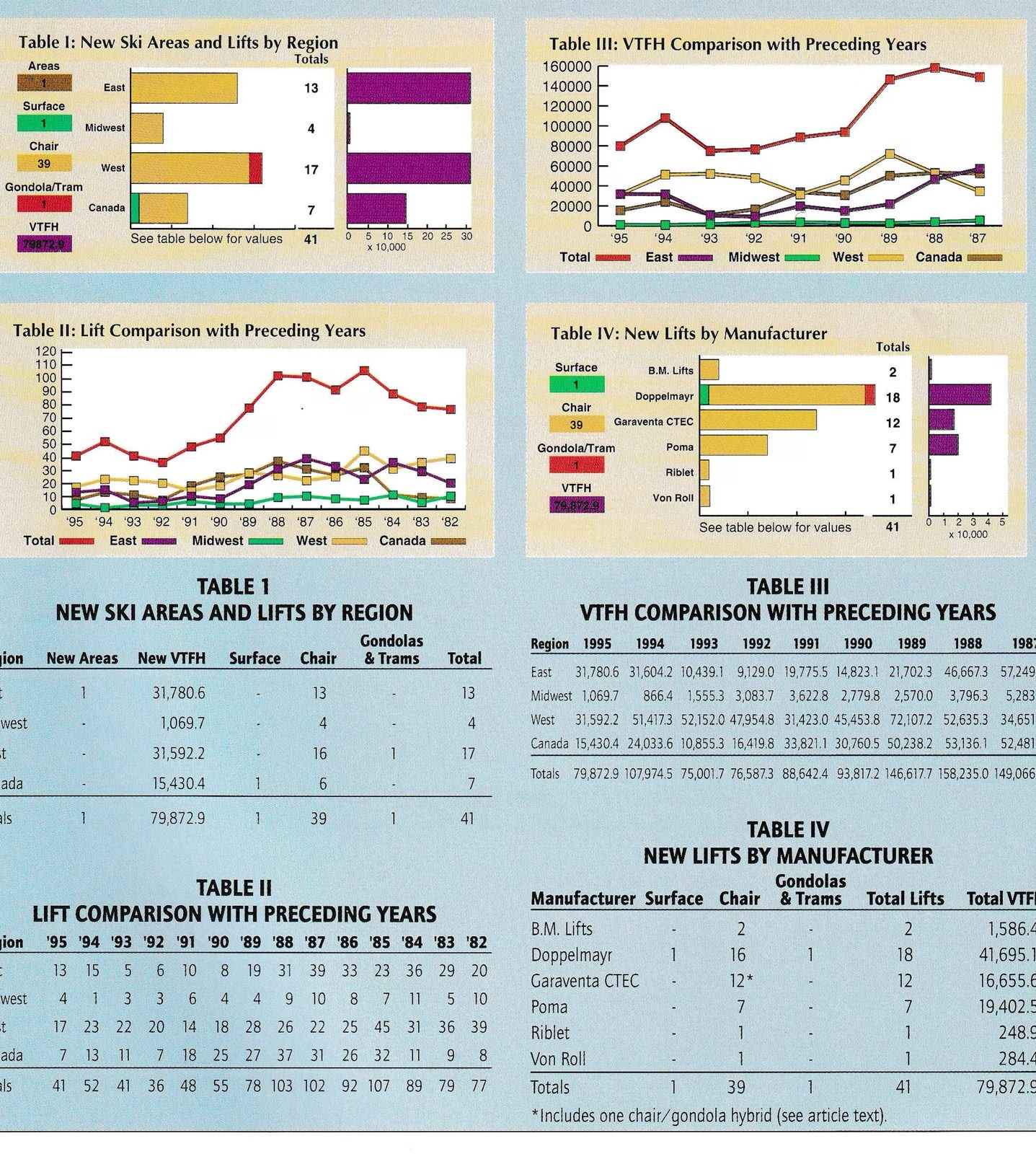
Total new lifts built in North America in 1995 was 41, of which 39 were chairlifts, one a gondola and one a surface lift—a platter at Blackcomb, B.C. This total tied with 1993 as the second lowest total in the 35 years SAM has been keeping score. (Lowest on record was in 1992, when 36 were recorded.)
By any measure, it has been an oddball year in new lift construction. In the old days, the totals for any one year in a region pretty well reflected the sort of winter that region had enjoyed (or suffered) the previous season. This is not necessarily so these days, and probably hasn’t been for a while.
Take the East, for instance. Last season was pretty crumby. Not disastrous, but well down. Yet, lo and behold, the East ended up with the lion’s share of North America’s new VTFH for the first time since 1987.
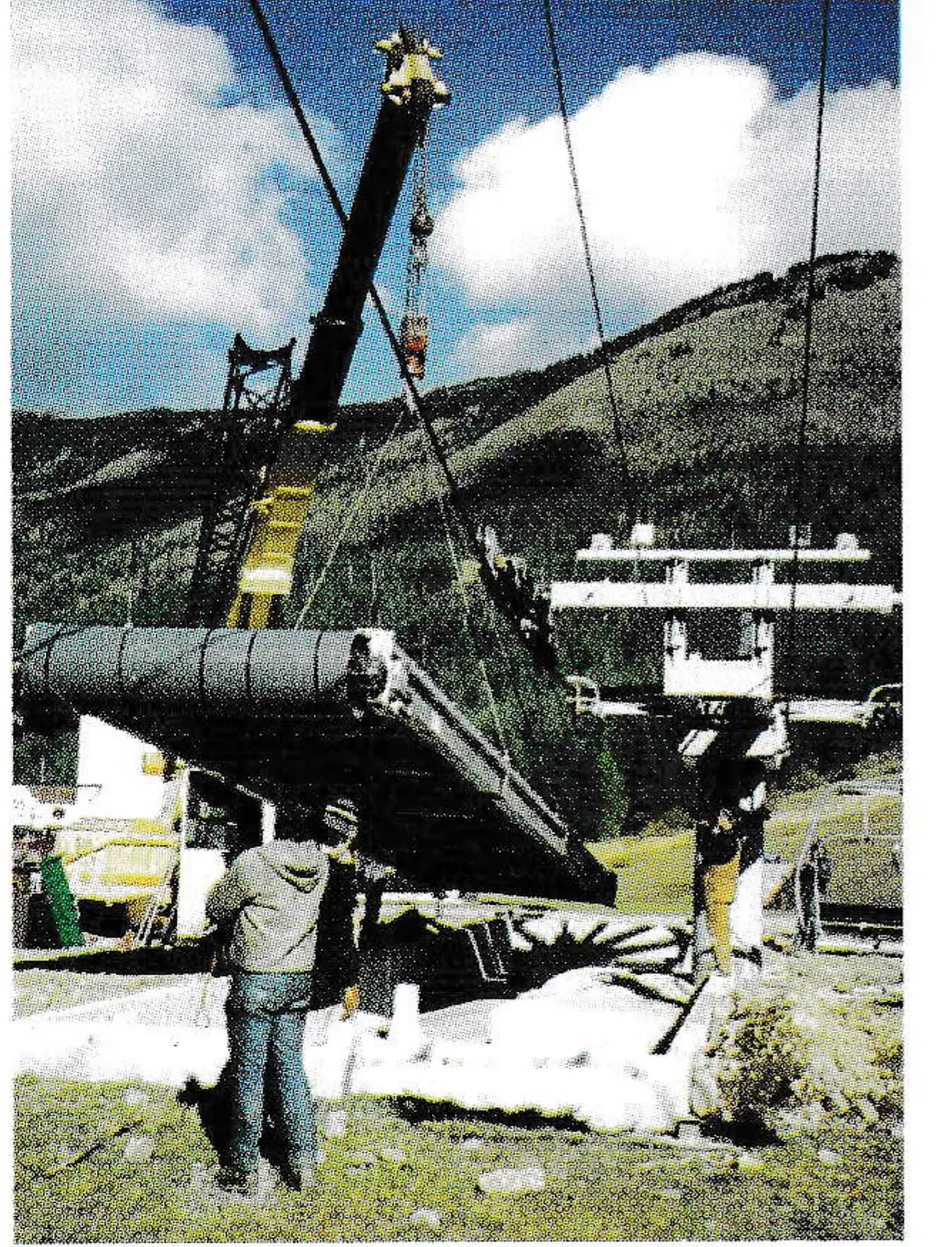
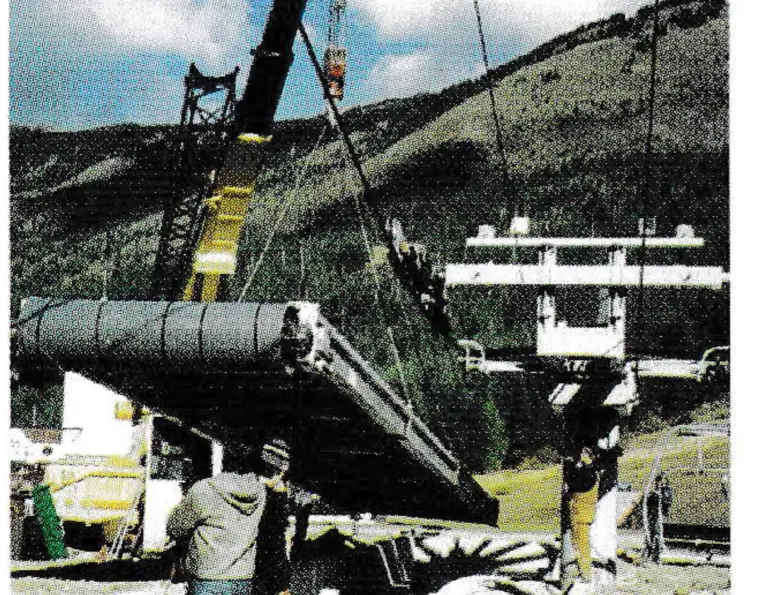
Photo by Hubert Schriebl
Dutifully, we remind readers that VTFH, or vertical transport feet per hour, is a measurement that was first used by SAM’s original technical editor, the late, great Bob Kinney. It is an indicator of both the bang and the investment bucks of a lift, and is the number of people the lift can transport 1,000 vertical feet in an hour. It is simply calculated by multiplying the capacity of the lift in skiers/hour by the lift’s vertical rise in feet and dividing by 1,000.
A closer examination of the lift totals shows that nowadays, lift construction in Canada is the most volatile factor in the North American totals. In the past six years, the U.S. totals have varied only from a low of 30 to a high of 39, whereas in Canada it has yo-yoed from a high of 25 to a low of only seven, which was the score twice, including 1995.
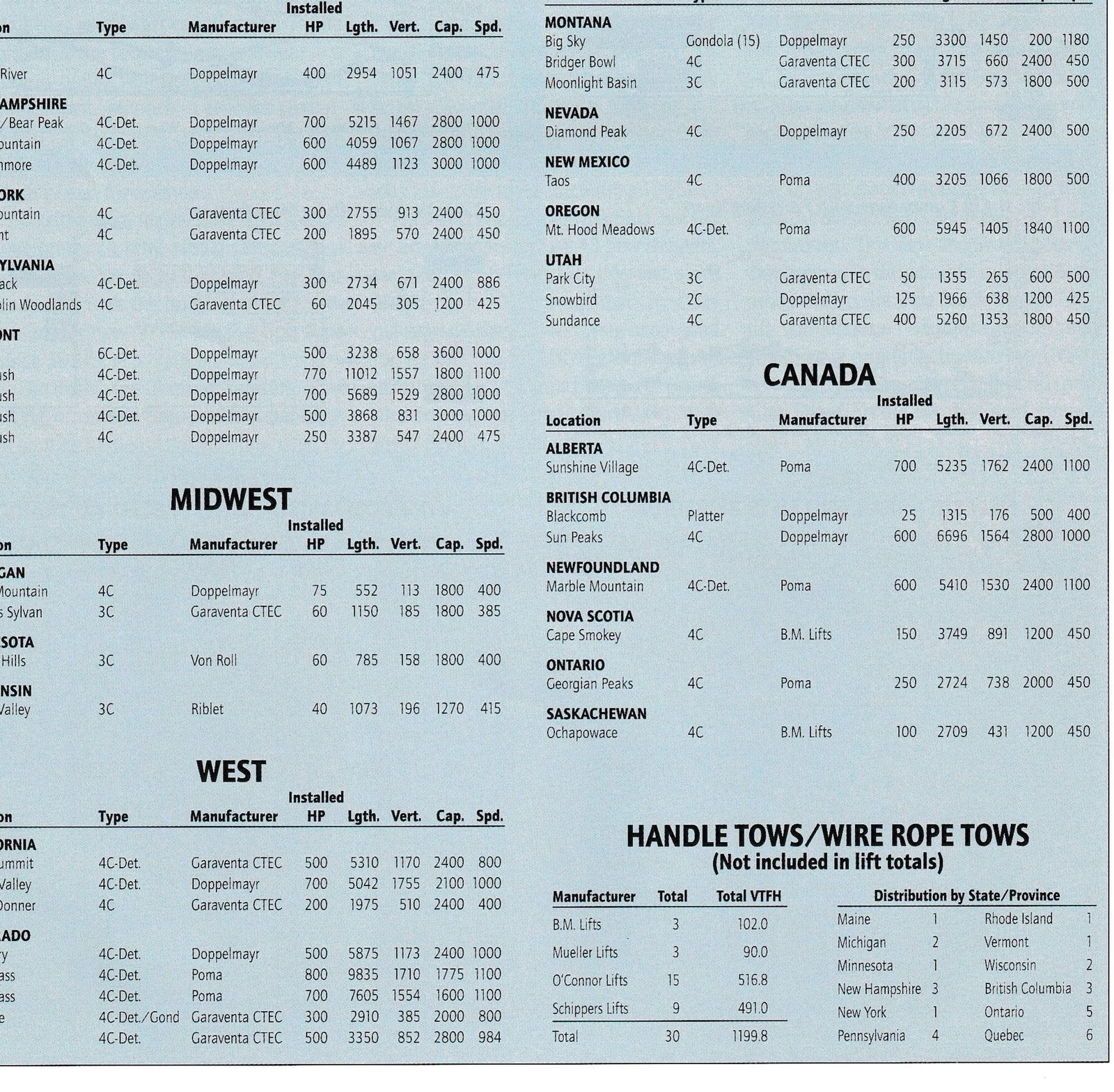
Focusing in again on the East, we see an extraordinary picture: 13 new chairlifts, yielding 31,780 in VTFH (highest since 1988), with 10 of them built by Doppelmayr. Of these, seven were accounted for by one buyer, LBO Enterprises, for installations at Sugarbush, Vt. (four), plus one each at Sunday River, Me., Attitash/Bear, N.H. and [Vlt. Cranmore, N.H.
For Doppelmayr, which at presstime was still on schedule with a mind-boggling timetable for completions and load tests, these 10 eastern lifts represented 62 percent of their North American total. As noted in an earlier issue, the LBO contract, which included some relocations and re-engineerings in addition to the seven new lifts, was negotiated on a winner-takes-all basis.
Among the suppliers, Doppelmayr had the most new lifts (18), accounting for more than half the new VTFH (41,695). Garaventa/CTEC was second in number of new lifts (12) and Poma was second in new VTFH total (19,402).
Almost every year, data for a creative new lift application appears at SAM that tests our simple VTFH application of standardization. This year, the award goes to Doppelmayr’s detachable quad at Sugarbush called the Slide Brook Express. This lift connects two separate mountains, which were originally built in the 1950s as two distinct ski resorts, Sugarbush and Glen Ellen. This detachable quad is more than two miles long (11,012 feet) and is billed as the world’s longest. More important than this and other superlatives given to it is the fact that it will fundamentally change the way these two mountains are skied.
The conundrum for SAM is that VTFH does not measure length, only passengers carried up a certain vertical rise per hour, nor does it allow for system friction. Therein lies the rub. Because most chair lifts can be counted on to lose about 25 percent of their horsepower to friction, on average, the real work remaining is climbing the vertical. However, the so-called vertical (bullwheel to bullwheel) for the Sugarbush lift is only 382 feet.

Then why, you might ask, does it require a 770 horsepower motor? As Russell Roselius, lift engineer responsible for the design, explained, the lift actually goes up and down three distinct peaks. If the uphill sides of each peak have loaded carriers (in both directions) the total vertical being climbed is over 2,700 feet. (But, SAM has never counted passenger travel in both directions, even though it does exist on many lifts.) Thus, in order for SAM to provide a fair representation of the true size and power requirement for the Slide Brook lift, we developed an equivalent lift with similar characteristics including the design operating horsepower of 680 (starting horsepower exceeds 1,000). We allowed for travel up the three peaks in the steepest direction, or 1,557 feet of vertical.
Another interesting installation is Garaventa/CTEC’s “chondola” at Telluride, Colo. It is a detachable quad (and that is the category into which we assigned it), but with every fourth carrier a four-passenger gondola.
This year’s only pure gondola, at Big Sky, Mont., is of special interest to gearhead readers, and is the subject of a separate article on page 72.
The breakout of this year’s crop of chairs is worth noting also, to the extent it continues and underscores what has been the trendline for several years. No less than 32 out of the 39 chairlifts are quads, and one (Stratton, Vt.,) is a six-pack. There are three triples, all in the Midwest, and only one double. Clearly, this is an age of groupiness.
Of the 39 chairs built, 18, or 46 percent, were detachable. This is about average for the last three years.
Bigger is not always better as is evidenced in the continued success of handle tows and wire rope tows. This year 30 of these smaller lifts were built in North America. More than 53 percent (16) of the wire rope tows installed are exclusively for tubing, an increasingly popular activity at ski areas.
We again record that SAM‘s annual lift accounting does not include the many relocations and re-engineerings of existing lifts, which often represent major dollar investments and which play a vital role in providing services to the skiing customer.
This, of course, explains why SAM‘s totals differ from the promotional claims of “new” lifts made by areas to excite the public. A lift that is new to the area is “new” to the skier, but that still doesn’t make it a new lift. In this connection, readers may want to browse in the historical section on pages 47 to 52 to get a big picture of new lift construction over a 40-year continuum. The consistency of SAM‘s reporting is what makes such a presentation possible.