
While Berwick was pondering this dilemma, she attended a lecture about work incentive programs conducted by John Mullen, a management consultant. Using this information, Berwick conceived a work-incentive program for lift attendants that would challenge them to reach specific attendance and work performance goals. To be certain that the employees felt they were a meaningful part of the program, she had the lift attendants establish the initial criteria and categories, but, said Berwick, “The employees set very tough criteria and I had to downgrade it.”
Beyond that, once a year, lift attendants review the program’s criteria and suggest changes, employees attend a meeting with Berwick every two weeks to discuss the program and their evaluations, new lift attendants receive a copy of a sample evaluation stating what is required to obtain a 100 percent bonus and employees can meet with her individually to discuss their evaluations.
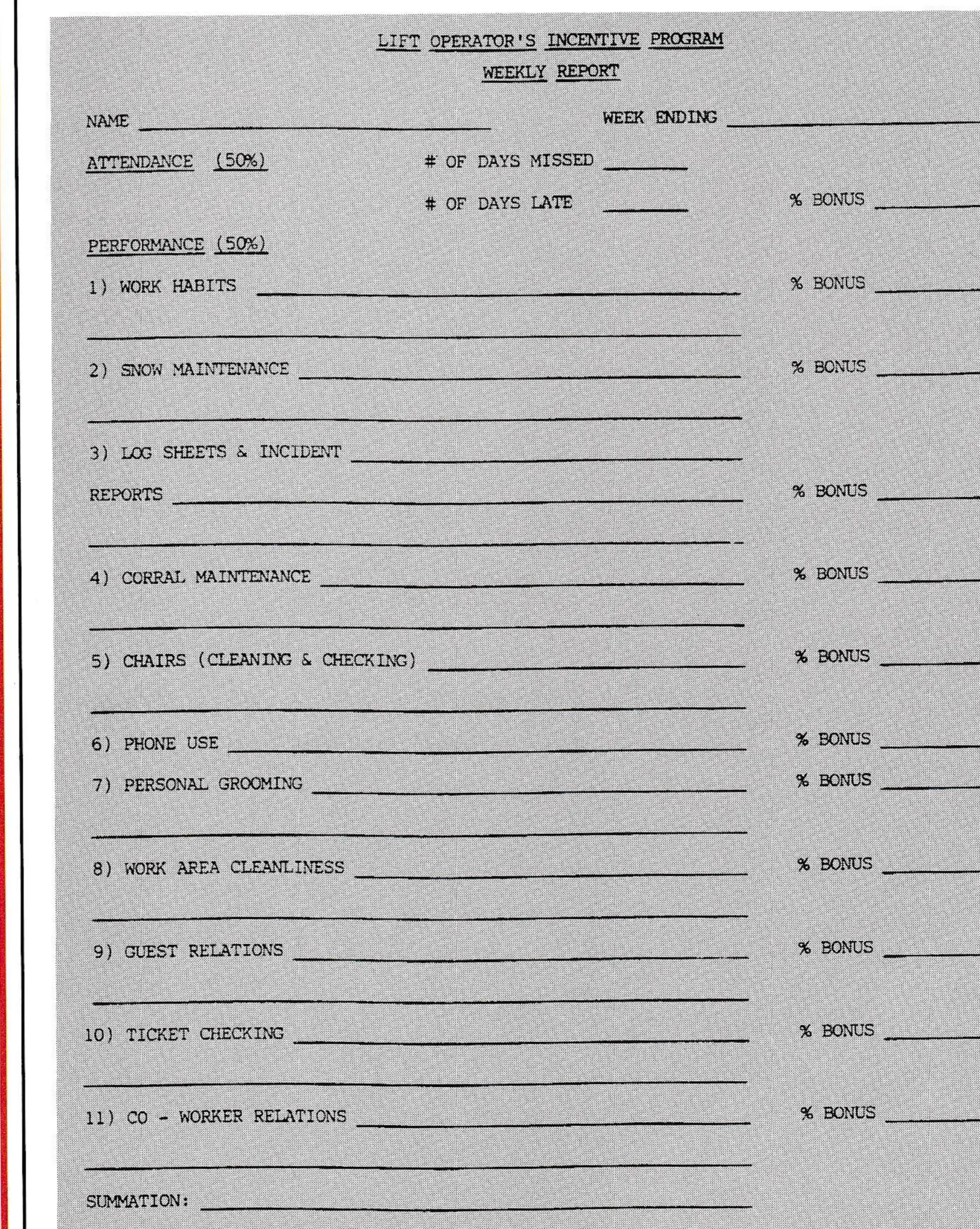
The mainstay of the program is a written evaluation form that Berwick completes once a week. The form is divided into two categories: attendance and performance. Each category counts 50 percent.
The attendance category has two sections: the number of days late and the number of days missed.
The performance category has 11 sections: work habits, snow maintenance, log sheets and incident reports, corral maintenance, chairs (cleaning and checking), phone use, personal grooming, work area cleanliness, guest relations, ticket checking and co-worker relations.
Berwick writes a grade of 0%, 25%, 50%, 75% or 100% in each of the 13 sections based on criteria that specify exactly what level of performance is required for each grade. In addition, she writes comments in each performance section.
Once a week, Berwick computes each lift attendant’s average grade. At the end of the season, she averages the weekly grades and this final average grade determines the amount of each lift attendant’s end-of-season bonus: 100% equals 10% of gross pay, 75% equals 7.5%, 50% equals 5.0%, and 25% equals 2.5%.
Employees who are frequently absent are issued a warning stating that they will no longer be allowed to participate in the program if they are absent again. Once they are removed from the program, they are issued a warning stating that another absence will result in their termination.
Berwick says if employees are removed from the program, they become very conscientious about attendance.

Berwick spends about five hours a week completing the program’s paperwork: reviewing log sheets and attendance records, computing the weekly scores, photocopying and filing evaluations and placing a copy in an envelope for each lift attendant.
Has all this hard work paid off? According to Berwick, the program increased employees’ loyalty, morale, communication skills, and, most importantly, attendance. Here are four examples of how attendance improved:
- In 1986-87, 25 employees quit or were fired and an additional 25 employees required 1,125 hours of training; whereas, in 1991-92, 10 additional employees were hired and they required 450 hours of training.
- In 1986-87, 15 out of 75 lift attendants (including new hires) returned the next season; this season 26 out of 60 returned.
- Absenteeism is also down from nine out of 75 employees absent 10 percent of the time or less in 1986-87, to 23 out of 60 employees absent 10 percent of the time or less in 1991-92. “People who used to be late would just not show up,” said Berwick. “Now they show up because there is a greater penalty for not showing up than just being late.”
- In 1986-87, roughly 10 employees were absent on a typical weekend; in 1992-93, on most weekends none have been absent. “Now all employees show up because they realize they are severely penalized for not showing up on the weekend,” says Berwick.
The real proof of the program’s success is evident in the workers’ enthusiasm for it.
“Before this program I wasn’t aware of what was important — like talking to the public — but now I’m aware of what the customers need and want,” Theodora Cline said. “I will say ‘good morning’ and ‘how are you doing,’ and I know that makes them feel good, rather than just putting them on the chair and sending them on their way.”
“I accepted the program because it was made up by lift attendants,” said Adriene Lujbli. “If one of the supervisors had started it, I would have resented it. It was a challenge to get 100 percent. It keeps me from being sloppy.” Lujbli noted that the program encouraged her to increase her snow and sign maintenance, and to communicate more frequently with other lift attendants to ensure that the log sheets are perfect.
“Before (the program started) it was just a job, but this makes it a lot more fun to work here,” said Ford Risley. “Now we’re more of a family and the employees work harder, and I care about Hunter more. Instead of just doing what I have to do, now I go out of my way to work with my co-workers, to deal with the public and to do a good job.” He also noted that the program encouraged him to clean the chairs during storms, to maintain snow in the corrals and to speak with the public, which “makes the job much more worthwhile.”
Berwick is very pleased with the program’s results. “I instituted this program to encourage workers to improve their attendance and work performance,” she says, “and the program has accomplished this, which makes my job easier.”