


Photo by Sam Geise
After three years of monitoring user patterns and analyzing the growing demands skiers placed on the aging Quicksilver SuperChair at Breckenridge Ski Resort, Colo., resort managers decided to replace it with the first double-loading six-passenger lift in the U.S. The $4 million Poma-designed lift, dubbed the “Quicksilver Super6,” replaces the world’s first high-speed quad, introduced in 1981, at the base of Peak 9.
Though it has a design capacity of 4,200 pph, the double-loading six-pack is expected to operate at 3,600 pph during its inaugural season, still the highest-capacity chairlift in the country. The key is a “switch rail” allowing empty chairs coming into the bottom terminal to leave the cable on alternating paths to pick up riders in two separate, side-by-side loading areas. Once loaded, the dual queues of chairs are fed back onto the cable in the order they came off.
“The lift can disperse people from the highest concentration of lodging to a point on the mountain that is great not only for beginners and ski school, but for helping more advanced skiers get to Peaks 7, 8 and 10,” says Jon Mauch, lift manager at Breckenridge, who directed the new lift’s installation.
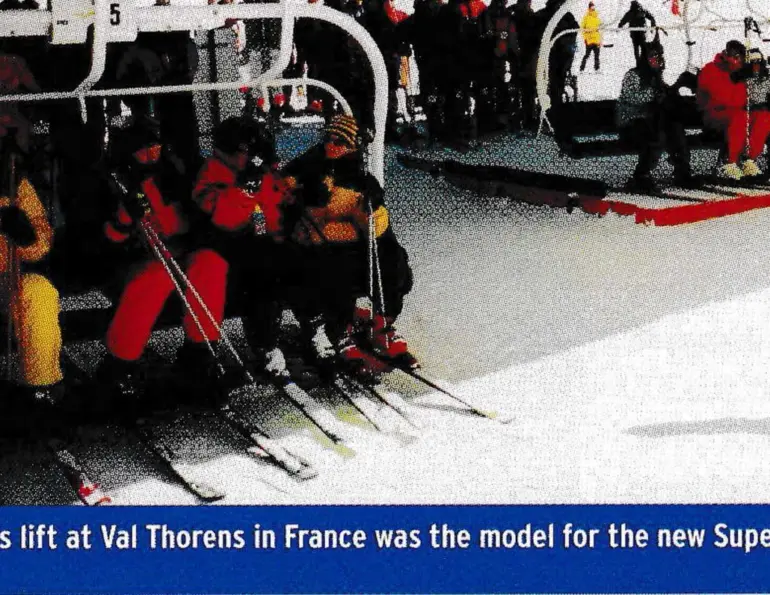
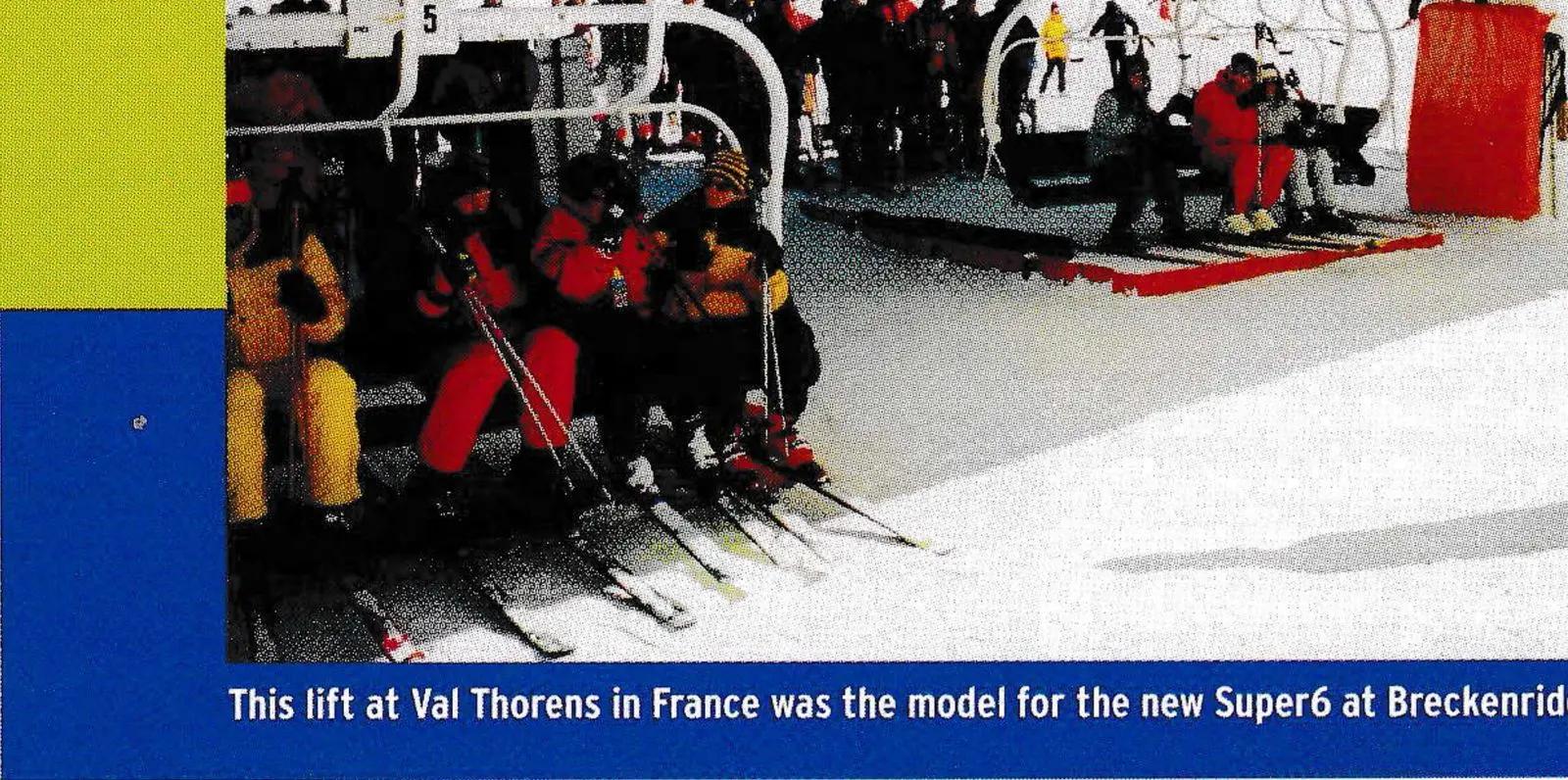
Mauch says he “imported” the technology from the immense Val Thorens ski resort in France, where four such lifts serve millions of skiers each winter in the Trois Valleés region. He was one of several Vail Resorts officials who made a trip to France last season to investigate Poma’s engineering firsthand. He said that while the technology is certainly a marvel, the most impressive thing about the double-loading system (DLS) at Val Thorens is its ability to move vast numbers of people while keeping the loading experience stress-free. He saw that as the key for Breckenridge’s high-traffic Peak 9 base area.
“The Breckenridge Super6 is adjacent to thousands of slopeside beds, a block off of Main Street and near several bus stops,” Mauch says, “so improving capacity was paramount. That’s why we had to rule out a gondola—it simply wouldn’t have the capacity the double-loading six does.” And because the chairs are separated into two loading queues, the interval between chairs in each load area is twice that in most detachable liftlines. “This gives us the capability to increase capacity and keep the human aspect comfortable.”
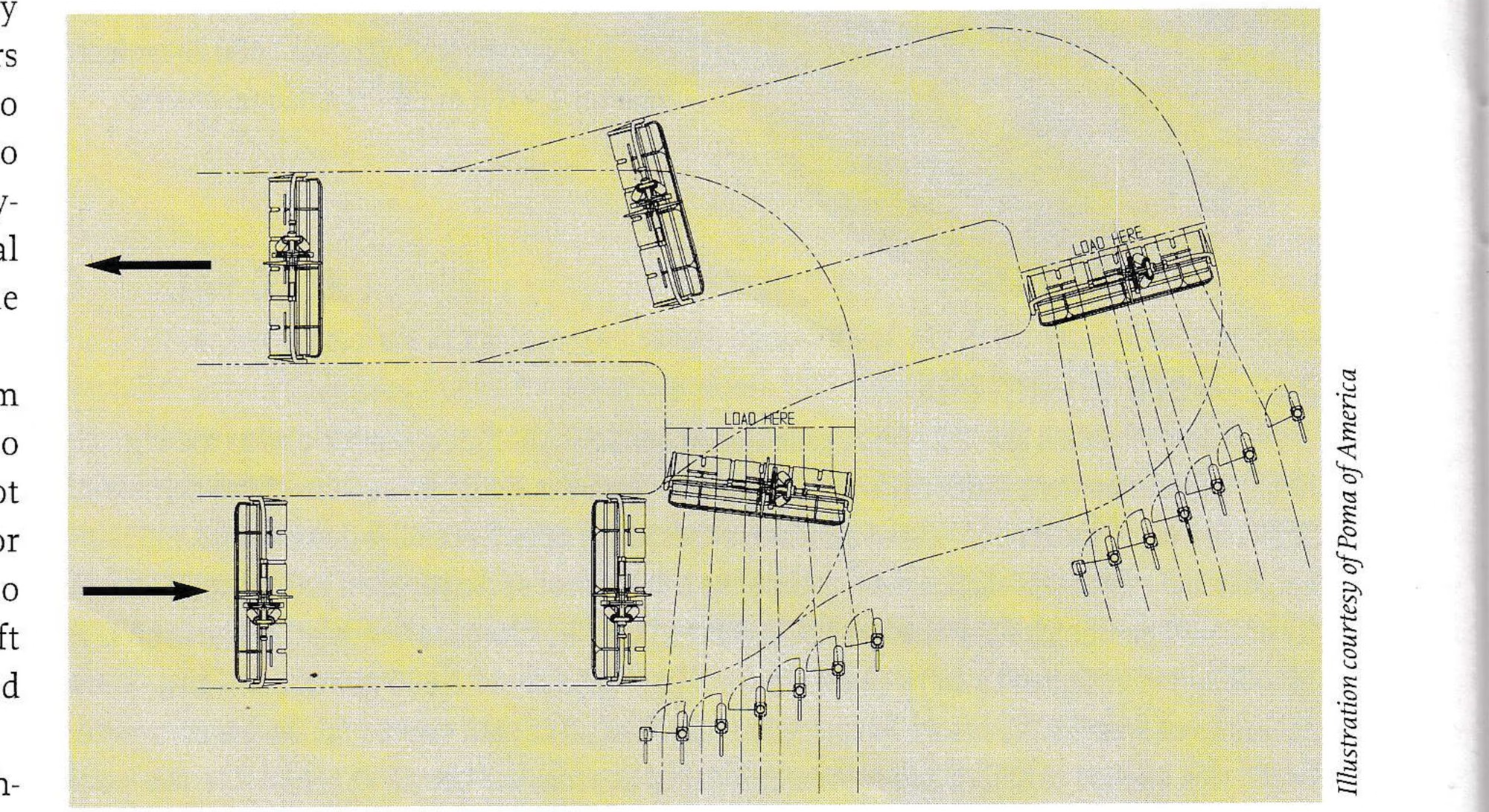
Illustration courtesy of Poma of America
In order to make the new Quicksilver even more skier friendly, Mauch’s crew brought the 2,770-square-foot loading terminal 450 linear feet closer to foot traffic than the original quad’s terminal. The new, lower terminal will save skiers several hundred steps up a gradual hill through the lift maze. To place the bottom terminal adjacent to the west side of the main portal of The Village at Breckenridge—the slopeside property that Breckenridge owner, Vail Resorts, purchased in the summer of 1998—15,000 cubic yards of earth were removed and carried up the mountain by heavy haulers making almost 200 trips.
The earth and rock were then used to shape the base of the 2,176-square-foot top terminal located within a few hundred yards of the new $6 million TenMile Station restaurant. As a result, hungry skiers can take advantage of a gentle 9-degree downhill pitch from the terminal to the restaurant. The configuration will also allow easy summer access to the TenMile facility for conferences, mountain bikers and other summer users.
How it works
“The double-loading lift works by dividing the chairs as they arrive at the lower terminal into two separate loading zones positioned side by side,” says Mauch. The two queues of chairs are swung on two separate ellipses, the outside queue swinging wide so two rows of skiers, six abreast can load in comfort. Loading takes place at 90 degrees to the direction of the lift going up the mountain and the loaded chairs then continue to turn around the back of the terminal before lining up to be reattached to the haul rope. “Separating them allows for twice the normal loading time,” says Mauch. This also means the chairs can be paired very close together because the outside chair will not interfere with the inside loading interval.
Mauch points out that, while true double-loading intervals occur in the outside load queue, the inside loading interval is 1.5 seconds slower because the outside chair has to move a greater distance and passes by its paired inside chair. In order to pair the chairs, the contour conveyance tires are powered by seven gear motors controlled by individual variable frequency drives. This allows for changing the speeds of the chairs throughout the contours all while the haul rope moves at a constant speed. During an anti-collision stop or during an emergency stop the conveyance tires will stop more quickly than the rest of the lift system, meaning greater control of the closely spaced paired chairs.
“In any such event, this means the chairs in the loading contour area will become ‘misspaced’ or bunched,” Mauch explains. “When the lift receives a start command, those chairs will first be reordered and properly spaced by the gear motors before the lift begins to move.”

Because of the complexity of the anti-collision system, with seven conveyance gear motors and two switch rails, Poma chose the powerful Allen Bradley Control Logix 5550 to handle the additional functions. Mauch says it has the capacity to handle variations in the anti-collision system, like changes in chair spacing, speeds and the ability to re-order the chairs to their normal positions, before sending them to the launcher. Two stepper motors provide accurate alignment and speed control of the switch rails used to move the chairs into their load areas. The switch rail that brings the chairs back into line prior to launching onto the haul rope, carries loaded chairs, translating to a total carrier weight of 1,900 pounds. A back-up generator assures consistent power, which is solely electricity.
“The design team at Poma of America were J.F. Mugnier, Jeff Smith, Brian Kelly and Nelson Tusberg,” says Mauch. “They’ve done a phenomenal job of developing this system.”
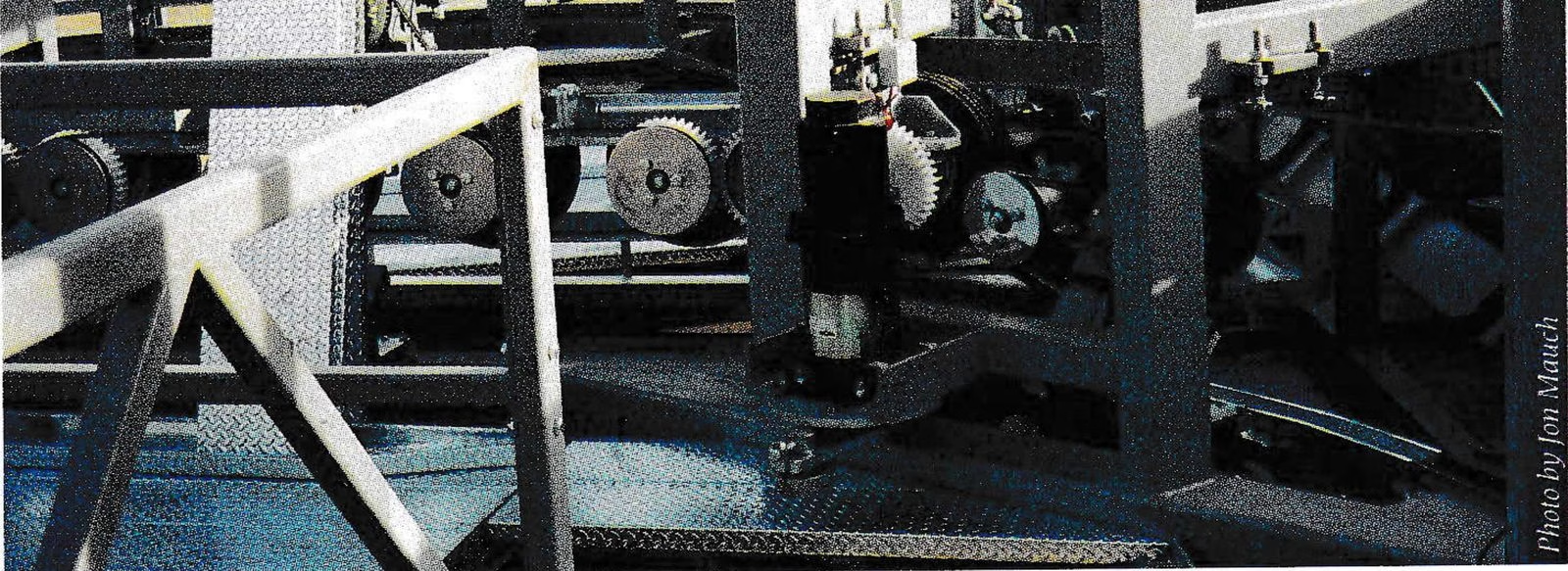
Photo by Jon Mauch
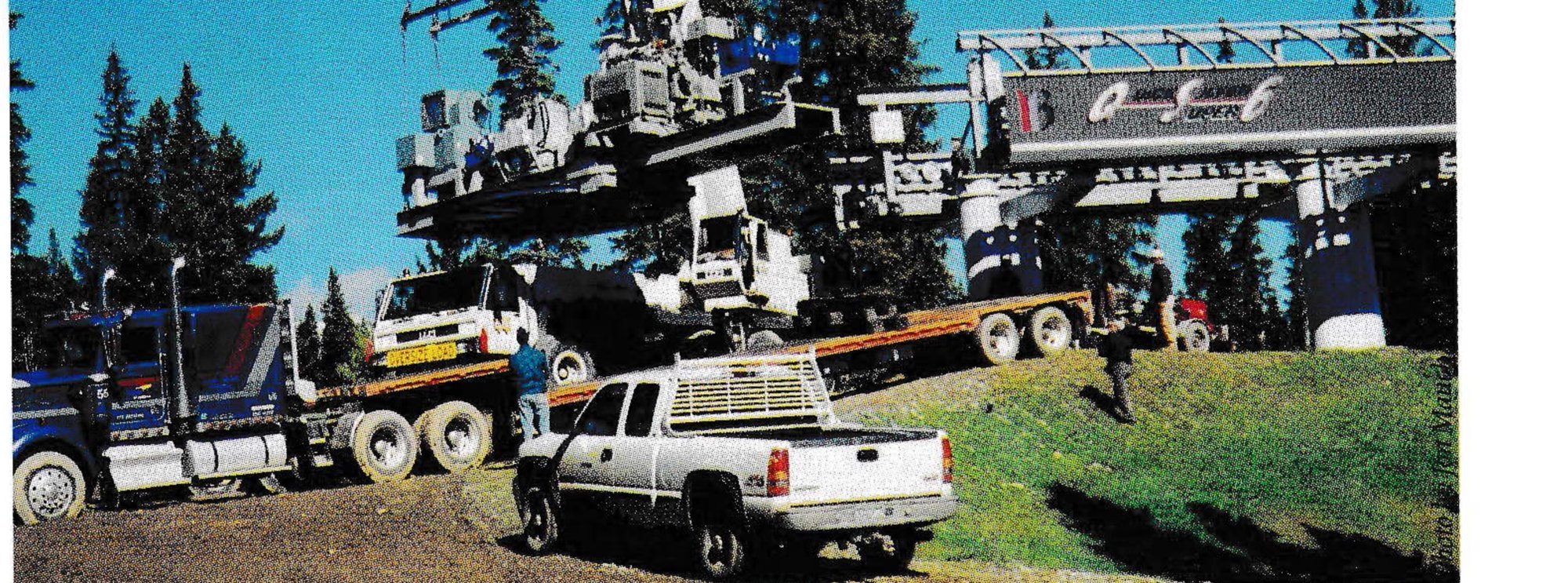
Crews removed the old quad’s lift towers and replaced them with 17 new units following a new alignment. Each tower foundation uses between 7.5 and 15 cubic yards of concrete. The crossarms are slightly wider than those used on a gondola and are fitted with 450mm wide-nested sheaves.
In order to drive the chairs along the 5,601-foot linear route that climbs 632.5 vertical feet, a 700 horsepower General Electric motor was installed in the top terminal. And, to handle the extra demands of the high-capacity lift, a 42.5 millimeter wire rope was pulled off a 65,000-pound spool October 3. Mauch says the new chairlift should be ready to open on Thanksgiving with 108 chairs for a VTFH of 2,277.
One of the added benefits of the new double-loading system is the interval between chairs on the loading platform, according to Mauch. He says the intervals will be about 12 seconds, slightly more than double the interval on standard high-speed quads, a side effect that should be most appreciated by the 400 to 500 never-ever skiers expected daily at the new lift as well as those participating on the adaptive learn-to-ski programs offered by the Breckenridge Outdoor Education Center. “The BOEC has routinely taken thousands of monoskiers and outrigger skiers through the Quicksilver as an introduction to skiing on the mountain,” says Mauch. “The Quicksilver Super6 should greatly improve their first on-hill, on-lift experience” by making getting on the chairs much easier.
“Given the capacity of the lift, we need to assure that we’re getting as many people loaded as efficiently and comfortably as possible,” says Mauch. “Loading gates are essential to managing rider flow onto the new chair.”
But despite the staffing needs, the technology shouldn’t require any changes in maintenance or operator training. “The construction and engineering is not radically different from anything else we have here,” Mauch says. “The switching mechanism is the innovation that leapfrogs anything else in the U.S. We will focus some additional training for that component.

