


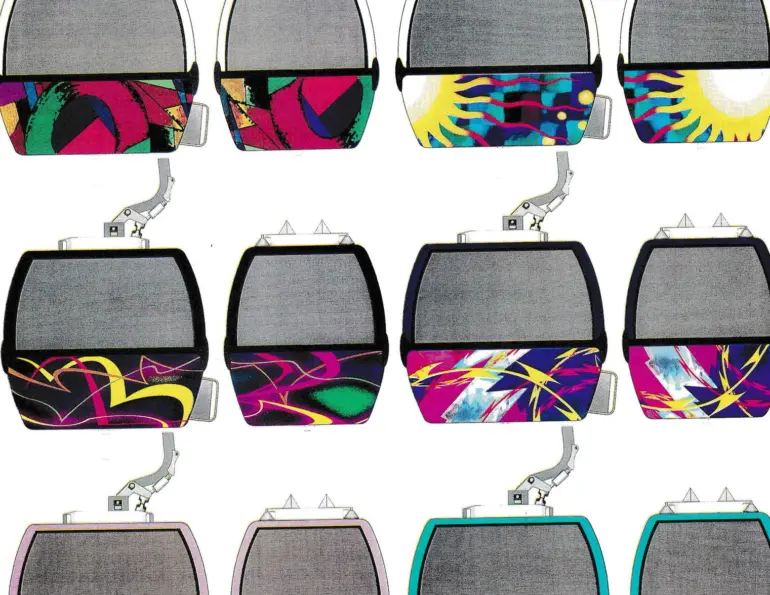
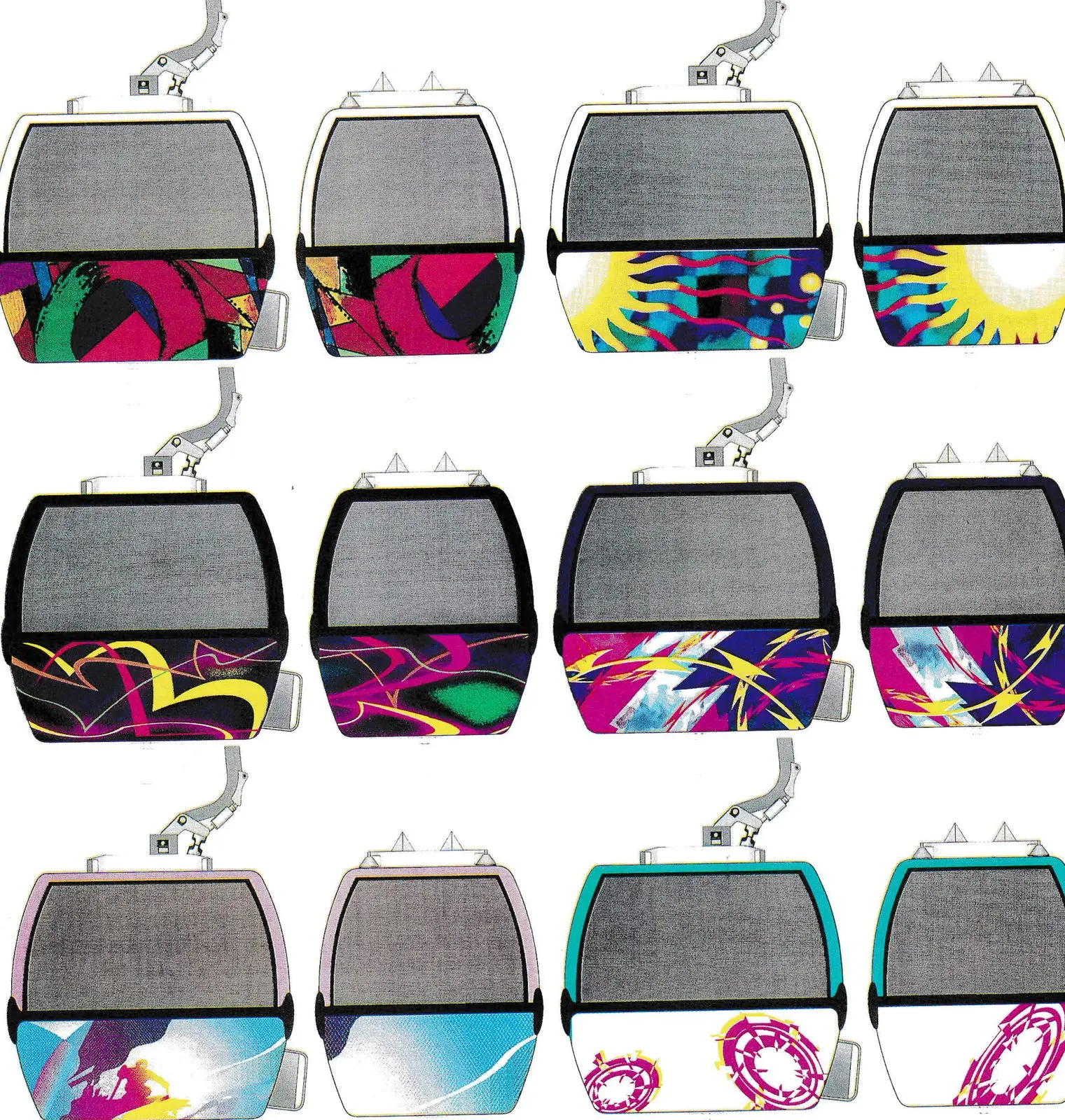
“State-of-the-art” is a term routinely used in describing a new lift installation. But whose art is it a state of? In the case of Killington’s new 2.5-mile-long, 8-passenger gondola, it will not only be the state of Poma’s art as lift builder and of CWA’s art in designing each cabin to be self-heated; but it is also a jubilant expression of art as art. To put it mildly, we are not dealing here with any assembly line paint job.
For 25 years, Killington’s four-passenger gondola reigned as their flagship lift. When it opened to the public in 1969, all 3-1/2 miles of it, it was hailed as an engineering marvel, and remained the longest aerial lift in North America. It was the resort’s symbol, featured in every winter brochure the resort put out over that quarter century, even still adorning the company stationary.
But lifts do not last forever, and on April 10 the workhorse lift was retired after accounting for over 20 million passenger miles. Considering its historical significance to Killington’s identity, the decision to replace it with another gondola might seem obvious; however, the cost of such an installation today, versus a series of high-speed quads, virtually doubles the price tag, creating a dilemma in any analysis of cost-benefits.
After three years of market research, including focus groups, in-depth interviews and extensive surveys, the verdict was clear: skiers like gondolas, and Killington skiers would have been unhappy with anything less. In fact, when given a choice of 10 significant alternative capital improvements—including better snowmaking, more grooming, new base lodges, mountain-top restaurants and high-speed quads—a new gondola was clearly the top choice. The 8-passenger cabin choice was largely based on economics and trail capacity.
The underlying reasons for this were also clear: speed and comfort—more specifically, a quick ride to the top while being sheltered from the cold. Taking the comfort factor to new levels, the new Killington gondola will have the first heated cabins in the world, with each cabin housing a self-contained heating unit capable of producing up to 6,000 BTU’s. The heaters, which burn kerosene, are externally vented and circulate cabin air over a heat transfer system via battery-driven fans.
Preliminary tests show that the unit will have no difficulty maintaining 50° temperatures inside the cabins, even on those legendary Vermont bone-chillers. Each heating unit is built into a self-contained cabinet under the cabin floor, hidden and inaccessible to skiers, but easily removed and replaced as a full unit to allow for bench maintenance.
In addition to the creature comfort of warmth, the cabins will feature sound by way of a radio which will pick up a signal from a low wattage cable that runs the length of the lift. It’s called a “leaky cable radio system,” and passengers will get either local radio or pre-programmed music or skier announcements. Obviously, there is both entertainment value as well as a risk management feature.
The Vermont Tramway Code limited Killington’s response to the request by skiers for speed. As it is, the Poma gondola system will be the fastest allowable by code, covering a total distance of over 2-1/2 miles in just 12 minutes. The lift will be built in two sections. (The old gondola had three and continued to the summit terminal, while the new one terminates at Skye Peak, which Killington today considers the heart of its skiing. The new configuration was dictated by the logic of fitting in with the extensive trail and lift systems that had been developed in the past 25 years, as well as with long-term plans for future interconnects.)
With comfort and speed considerations addressed, the Killington planners started thinking of how their new installation might meet the deeper, inner needs of the skier.
“The true benefit of skiing,” says Killington’s marketing director, John Clifford, “is experiencing heightening emotions, and it is the function of art to create emotion.”

With this in mind, it was decided to use the exteriors of the gondola cabins as a medium for artistic expression—to “create the design concept around vivid colors and contemporary images,” as Clifford puts it.
A design and advertising firm from Newton, Mass., SIRGE, developed a series of exterior cabin designs that will result in dazzling, eye-popping visual variety. In addition to four “signature cabins” that have been commissioned from world-renowned artists, (and which are not illustrated here) there will be 14 basic design concepts, each translatable through CAD technology into a number of different versions.
The first cabin produced will be designed by artist George Schnyder. It is being unveiled during the opening cocktail party at the NSAA convention in Marco Island, May 22.
Technical Fast Facts On Killington’s 2-Section Gondola
Transfer Station (Northbrook)—Gondola system utilizes two separate cable loops which will operate completely independent of each other, or totally synchronized. There is a 38° angle at station where cabins are transferred by “V”-belt driven tires. Under normal or full usage, skiers load at the Return 4 Station and ride to Skye Peak without changing cabins; doors will stay closed at mid-station to retain cabin heat.
Cabins can be loaded onto, or removed from, each section at the same time via separate storage rails connecting each section to the storage building. Section II can be operated alone for early and late-season skiing. Also, one section can operate alone for a portion of the day, and the other section can be activated and automatically integrated for full two-section, bottom-to-top operation.
Special Lift Features:
- Poma’s patented nylon gears will power the cabins in turnarounds;
- Power for acceleration and deceleration will be transferred directly from the cable to the Goodyear tires by cog belts;
- Each cabin will be attached to cable with two single-position Poma TV grips for added security and lower individual maintenance costs as compared to a single grip arrangement;
- Each cabin hanger is equipped with dual action springs and shock absorbers for maximum stability in cross-wind conditions;
- Only the grips, cabins, gearbox and cable are European; everything else is either purchased from U.S. suppliers or manufactured at POA in Grand Junction, Colo.
CWA cabin features:
- Heating units are 6,000 BTU Eberspaecher hot air heater with battery-powered blower system;
- Cabin weight is 430 kgs (with full fuel tank).
| Item | Specification |
|---|---|
| Lift manufacturer | Poma of America |
| Cabin mfg. and type | CWA/Omega S |
| Slope length | 2.5 miles |
| Vertical rise | 2,520 feet |
| Initial capacity | 2,400 pph |
| Design capacity | 3,000 pph |
| Line speed | 1,200 fpm |
| Electric HP | 900 GE(2) |
| Diesel (aux) speed | 800 fpm |
| Diesel (aux) HP | 800/700 /Cummins |
| Diesel (evac) speed | 150 fpm |
| Diesel (evac) HP | 177 (2) |
| Number of cabins (initial) | 133 |
| Number of towers (design) | 50 |
| Cable diameter | 1-5/8 (41 mm) |
| Cable type | 6×25 compacted |
| Drive location | Top |
| Tension | Base/hydraulic |
| Gearbox | Poma/Kissling |
| Drive type | ABB/Poma |

