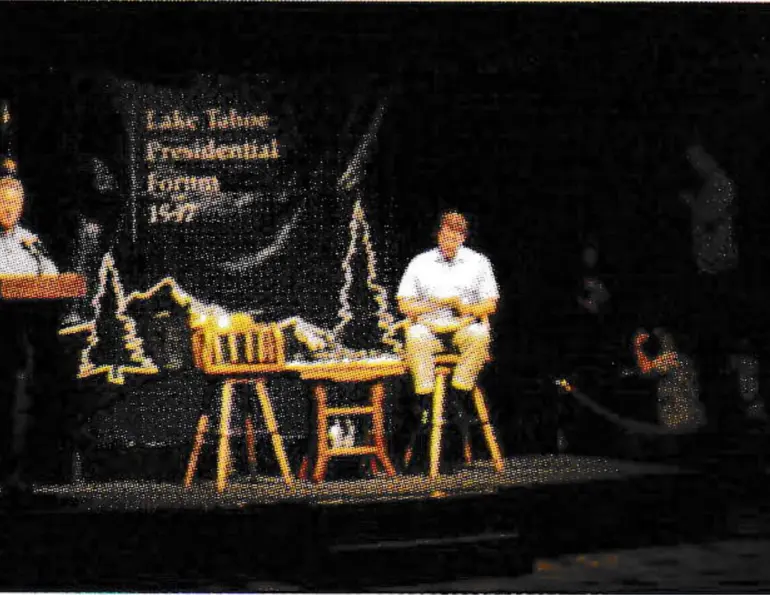
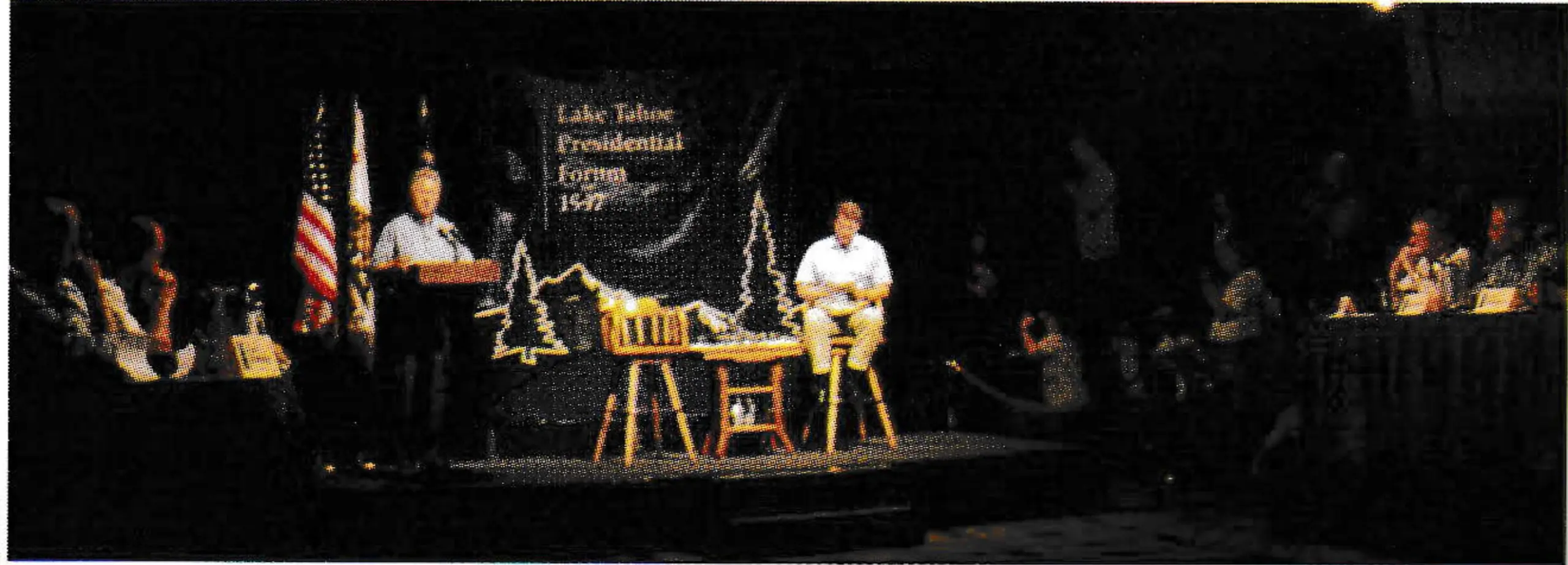
Photo by Ken Castle
The comments were about the Lake Tahoe “summit conference” in late July which saw the ski area industry in the forefront of a meticulously scripted tableau involving every conceivable local and regional power-person, the heads of three cabinet-level federal agencies with assorted deputies, all four Senators from California and Nevada, three California Congressmen and two from Nevada, the Governor of Nevada, Vice President Gore and President Clinton. (The only absentee from the power people was the Governor of California, Republican Pete Wilson, who was publicly having a really bad political hair day.)
And what was this all about? The specific focus was Lake Tahoe and its water quality, which was seen to be in decline. But the real focus was the environment and how the business community and its needs can be made, not only to accommodate environmental priorities, but actually to advance the cause of air, water and forest health.
The key message was that confrontation, cynicism and anger were not the way, but, as expressed to the President by Heavenly Resort’s Stan Hansen: “Through our experiences, we believe Lake Tahoe can serve as a national model for collaborative planning and issue resolution in support of merging economic and environmental issues.”
In support of this claim, Hansen could have cited Heavenly’s recently approved master plan, an incredibly complex document weighing in at over 22 pounds and seven years in the writing, which was approved without a dissenting voice. (See accompanying feature. See also Hansen’s commentary in Speak-out.)
The quality of Lake Tahoe’s water may have been in the cross-hairs, but the larger target was the whole Lake Tahoe Basin, which includes Heavenly and three other ski resorts. What was significant for the ski area industry was that it was they who have been in the leadership role in recent years and full partners in Tahoe’s future.
No more were the ski areas to be lumped in with rapacious timber barons as the environmental blackhats. It was the ski resorts, with confident, quiet networking, that wore the white hats, coming to the table as regional business leaders who were as committed as the environmental community to preserving the quality of the lake. After all, any player in the tourist economy—whether ski area, pack-trip operator or gaming-resort owner—knows the lake itself is the crown jewel that sets the whole region apart.
Summit Background and Planning
More than 20 years ago, Congress established the Tahoe Regional Planning Agency (TRPA), to oversee the well-being of the Tahoe Basin, with a mandate to coordinate the many agencies and entities, public and private, having vital interests in the region. Eighty percent of the land that is TRPA’s responsibility is federal, but much of the funding has come—and will continue to come—from California and Nevada. In addition to the $400 million already spent, the more than 400 projects identified by TRPA as being needed over the next decade, both to undo past damage and to encourage further healing, are costed at over $900 million.
Much of this results from myriad mandates, many federal, to meet thresholds for air, water and forest health. The problem has been not only funding, but also overlaying jurisdictions that need streamlining.
In the summer of 1996, the idea of inviting the President to the region was floated by Senator Harry Reid (D-Nev.), an activist for the TRPA agenda and the various channels for making this sort of thing happen were activated.
By April 1997, word was received of the President’s acceptance of Reid’s invitation and everything moved into high gear. The Lake Tahoe Steering Committee of 12 individuals metamorphosed overnight into the Presidential Steering Committee, with Heavenly’s Hansen as co-chair and Tom Tuchmann, Western Regional Coordinator for the Department of Agriculture, assigned to the organizers to provide liaison with the administration. Tuchmann brought experience from the recent Presidential logging conference in Portland, Ore.
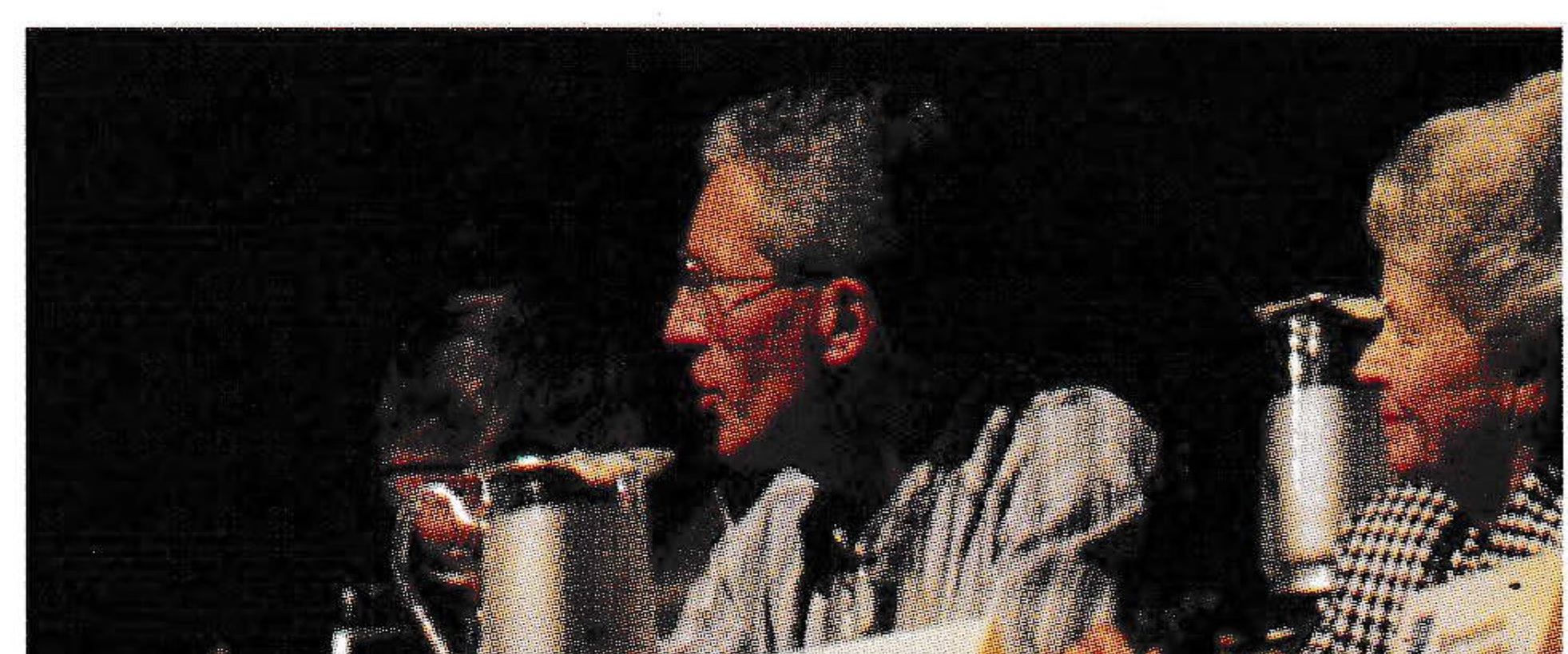
Photo by Ken Castle
Plans were made to get input from two public hearings, one on the south shore, one on the north. At the same time, the administration called for three high-level workshops: one to be organized by EPA Administrator Carol Browner on water quality; another on forest health by Interior Secretary Bruce Babbitt and Agriculture Secretary Dan Glickman; and the third workshop on transportation issues by Secretary of Transportation Rodney E. Slater. These three workshops, held respectively on the north shore, south shore and in Reno, took place in June as building blocks for the Presidential Forum on July 26.
Planning for POTUS and VPOTUS
The endless planning and detailed scripting was in place and it was now show and tell time for the President and Vice President of the United States—acronymically POTUS and VPOTUS on the cue cards. And these were preceded by armies of advance people, including, of course, as described by Bob Roberts, “the phalanx of young men in short haircuts, wearing lumpy sports coats and all apparently hard of hearing.”
The first summit convocation was Vice President Al Gore’s on July 25, which involved his receiving reports from the three workshops as well as other situation summaries. One of these was on tourism and recreation and it was on this subject that Julie Maurer, marketing executive for Booth Creek and long associated with Northstar-at-Tahoe, played a role.
She had moments of panic approaching the security point where her car had to be poked, inspected and sniffed for bombs. No problem normally, but she was in a borrowed car that day and what else that she might not know about, she wondered, might those dogs be able to sniff?
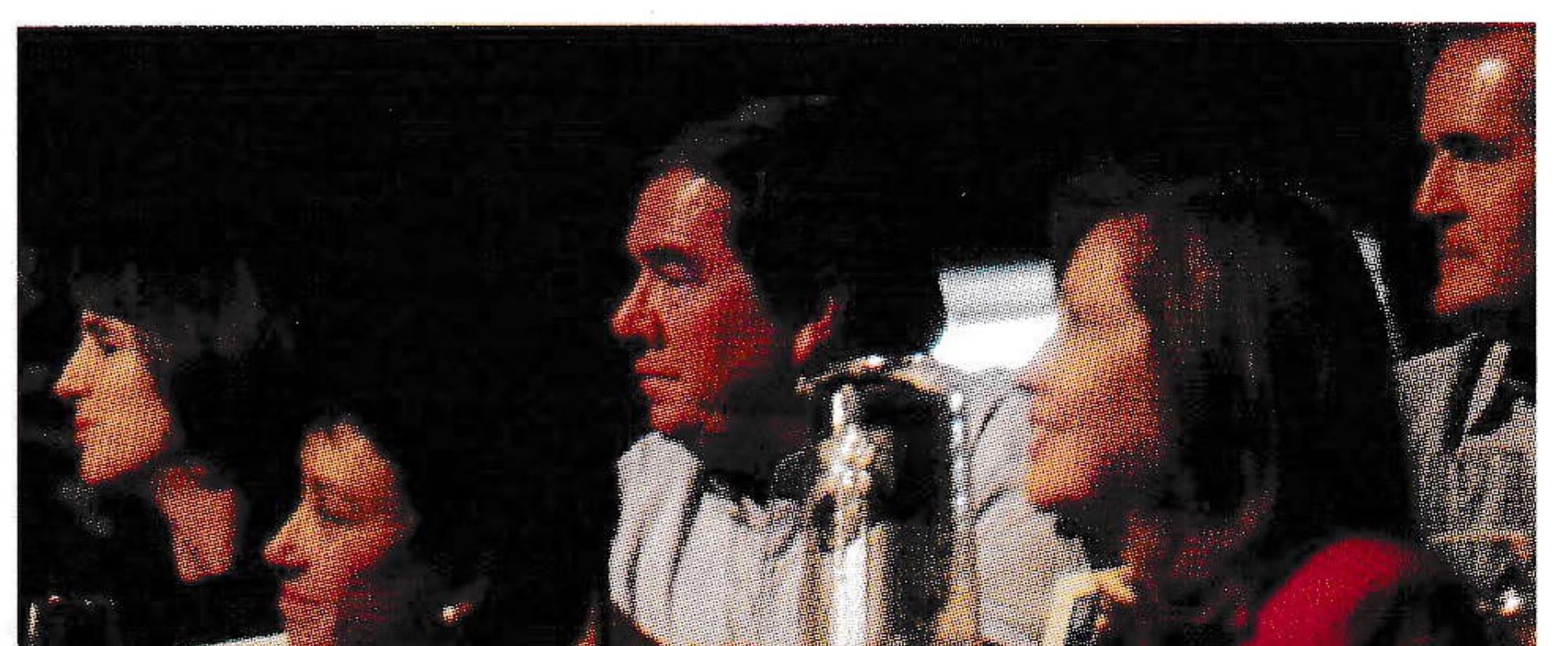
Photo by Ken Castle
The next momentary panic came when Gore departed from the scripted question that she had rehearsed answering and asked a more general one. Maurer winged it effortlessly, getting a good laugh to boot with her regrets that the dress code didn’t allow her to follow her marketing instincts by covering herself with logos in such a public, photo-op situation.
Gore was masterful, according to Maurer. Not only did he have a command of the environmental science involved, but also of the very sensitive business health and environmental health juxtapositions. It may all have been, as the press liked to pontificate, a grand political launch for Gore in 2000, but the participants in the summit saw his performance as vital for their purposes—including the ski resort interests.
The Presidential Climax
On a sparkling, sunny day that underscored the urgency of protecting the matchless beauty of the Tahoe Basin, the summit finally took place at the Lakeside Ballroom of the Hyatt Regency in Incline Village, Nev., site of Diamond Peak Ski Area. Bob Roberts describes the scene:
“Clinton and Gore sit in wooden Captain’s chairs on a raised dais in front of a large, sky-blue backdrop emblazoned “Lake Tahoe Presidential Forum.” On either side of them, seated behind long tables on two levels, are the 30 participants. Half are local civic leaders, half are the heavyweight federal politicos. The program has been well choreographed.
“Each participant presents, responds, implores. Clinton listens, questions, takes notes and empathizes. As m.c., Gore moves the program along briskly. The ski industry representatives are impressive. Stan Hansen reaches eloquence as he describes the evolution of cooperation between environmentalists and the business community.
“Werner Schuster of Alpine Meadows is supposed to answer a scripted question, but the President departs from the script with a different question—one about transportation. Would the ski industry really be willing to put restrictions on private transportation and provide some public substitute, the President asked with a tone of mild skepticism? Schuster responds there is no choice when the skiing public faces clogged roads and the lake faces further degradation in quality. It’s more than an environmental problem, he says, it is an economic one—the survival of the tourist business. The President picks up on Schuster’s thoughts.

“Clinton’s summation is evocative. He now understands the needs, he says, and his administration will do its part. He will go forth and hold up the Tahoe model of cooperation. ‘When others tell me it can’t be done, I’ll say Nonsense! I have seen it work at Lake Tahoe.’
“The applause is thunderous.”
The formal part of the affair is complete. There is not a participant who has not been caught up not only by the theater, but by the reality of the raw power of what they had been a part of. Hansen, Schuster and Maurer each use words like “awesome,” “thrilling,” “impressive” and “memorable” to describe the events.
After six hours in the region, the President is ready for the departure scene on the lacrosse field behind the Hyatt Regency. Bob Roberts continues:
“The air is festive. Large speakers belt out baby boomer rock standards to the crowd that has swelled to 5,000 by the time the convoy of sports utility vehicles and minivans carrying the President and his entourage snake their way to the small stage.
“His remarks are brief. He reiterates the summation and receives another roaring ovation. Then, for 45 minutes, the President and Vice President ply the trade they know so well—working the crowd, posing and shaking hands with an enthralled public.
“Lift-off caps the drama. The two gleaming Blackhawk helicopters, emblazoned with the Presidential Seal, hover and maneuver 30 feet off the ground. Then, like a scene out of Apocalypse Now, the speakers blare out “Coming to America” and Marine One swoops over the crowd and out over the very lake that had given purpose to the gathering. The crowd roars its approval again.”
The Meaning
What did this all mean? To Lake Tahoe? To the ski and recreation industry?
As Roberts reports, “Local cynics observed that the President spent more time on the links with L.A. Mayor Riordan than he did schmoozing Tahoe. They would have one believe that the exercise was driven by the need for a photo op at a mountain lake to balance the golf cart shot with Michael Jordan in Vegas.
“And conservative conservationists pointed out that Lake Tahoe’s environmental fix will cost more like $300 million and that the $50 million over two years pledged by Clinton is probably less than the ski industry alone will spend.”
But cynics are rarely impressed. And the ski area players were unanimous in feeling good about the whole exercise. They felt good about being in the forefront of a community and regional effort that successfully energized the most powerful federal attention possible on their problems.
Bob Roberts summarizes for the California Ski Industries Association: “The presence of both Senators from California and Nevada, such key Congressional members as Vic Fazio, George Miller and John Doolittle, to say nothing of Secretaries Glickman and Babbitt and Administrator Browner, provided the industry with both access and credibility. And Jim Lyons, long a supporter of the ski industry, was there to help.
“During the receptions and events surrounding the President’s visit, representatives from California’s winter sports industries were able to demonstrate their stewardship and communicate their issues. Never have we been able to talk to so many key political leaders and their senior staffs in such an effective manner. Washington lobbyists would have killed for this opportunity.
“Who benefited from Clinton’s visit? The winter sports industry did!”
Tahoe Summit Out-takes
When you transplant so much of the Washington political power structure, many Beltway turf wars travel right along with it. For instance, ongoing spats between two of the big federal landlords, the National Park Service and the Forest Service, took new shape with regard to naming the summit. Interior’s John Garamendi, a high-profile Californian, wanted to call it something inclusive like the Sierra Summit, because the Parks Service doesn’t manage any land in the Tahoe Basin. But Jim Lyons of Agriculture wanted and got a Lake Tahoe focus, “Lake Tahoe Presidential Forum,” to match the heavy Forest Service involvement in the region. So take that! Nyah!
…Or what about the Secret Service operatives, sweeping the Tallac Trail before Gore climbed it and encountering a mama bear and her cubs? Like, people may respect a yellow control tape, but it doesn’t mean squat to an indignant bear. And how would it look for a conference honoring the environment to have gun-toting security operatives harassing some cuddly little bear cubs? Potential PR from hell, but here, happy endings. —D.R.