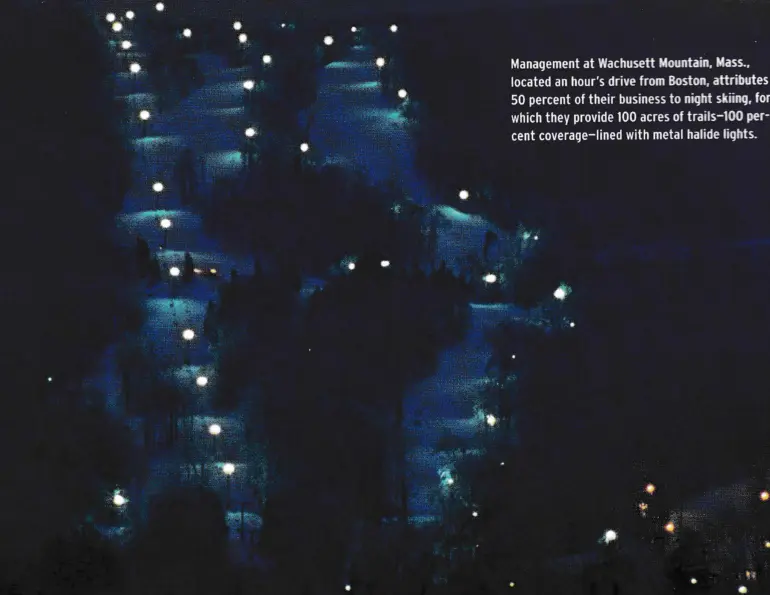
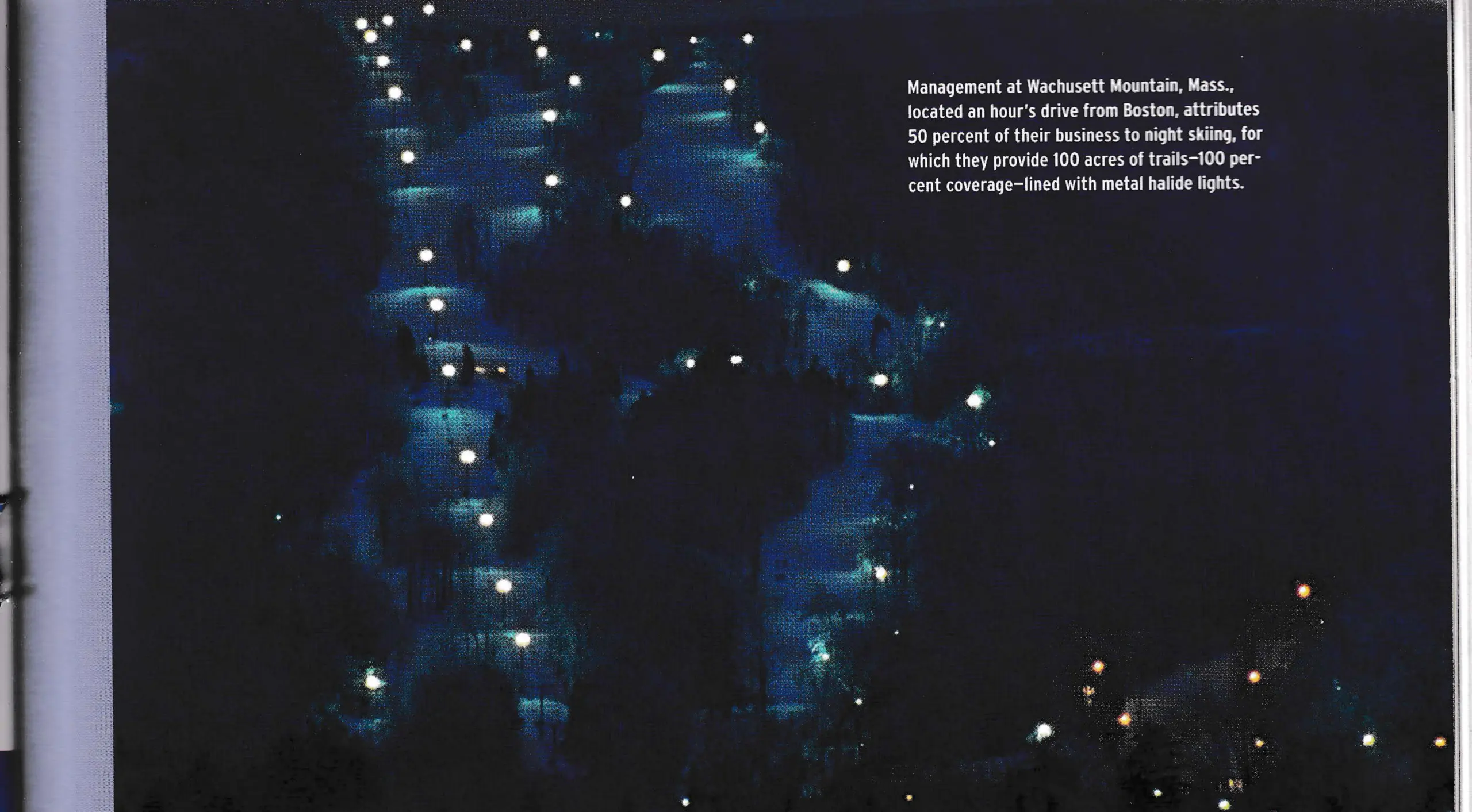
In this article, SAM revisits the ski slope lighting standard developed by NSAA’s night lighting committee—spearheaded by LeRoy Schultz—almost 15 years ago. Nowadays, more people than ever are skiing at night. Management at Wachusett Mountain, Mass., attributes 50 percent of business to night skiing, while Midnight Madness reigns all night long on weekends and holidays at Mad River ski area, near Columbus, Ohio. In another growing trend, ski areas are hosting an increasing number of activities on the slopes in general, including tubing, skiboarding and snowboarding, with the requisite tubing parks, terrain parks and halfpipes.
Despite all these changes, the lighting standard developed by NSAA 15 years ago has not changed and, in fact, accommodates these diverse activities without modification. Here is an updated explanation of the standard, as well as a look at current technology and trends in night lighting. —Ed.
In the 1960s and 1970s, the Illuminating Engineering Society of North America (IES) wrote a standard for ski-slope lighting based on requirements for general sports lighting. Unfortunately, the IES standard did not take into account the unique variables involved in night skiing. NSAA—with the technical assistance of IES—formed a night lighting committee in the 1980s to investigate these variables and measure light levels in use at ski areas around the country in order to establish a realistic and effective standard for ski slope lighting. The standard developed by NSAA, first published in SAM in 1984, was accepted by the IES in 1989 and is still in use for ski slope lighting today.
The variables studied te the NSAA committee are mainly related to weather conditions, including reflectivity and glare on snow. The depth of snow on a ski slope also affects the light and varies from month to month and year to year. In addition, the requirements of the activity itself differentiates skiing from most other sports in terms of lighting. Most sports lighting is designed to light a flat playing field, not only for participants but also for spectators—rare occurrences in skiing. Lighting for skiing is designed for participants traveling downhill who need to see an irregular, bumpy snow surface, not a ball flying through the air.
Another variable generally not encountered in other sports lighting is that the “playing field,” a ski slope, is on an incline, which also affects illuminance (light levels). Ski slope lighting works according to the inverse square law: doubling the distance results in one-fourth as much light. Moving downhill increases the distance from the light source not only horizontally, but also in elevation, which reduces illuminance faster than on a flat playing field.
Illuminance Criteria
Illuminance is the amount of light on a specified surface area measured in foot candles. The ski slope lighting standard recommends an average maintained vertical illuminance of 0.5 footcandles. This average is calculated using a number of light level measurements that can range both above and below the recommended illuminance. No single measurement, however, should be lower than the standard’s minimum vertical illuminance of .20 footcandles—about 10 times brighter than full moonlight.
Because the dominant direction of play for skiing and snowboarding is downhill, parallel to the slope, vertical illuminance is the primary consideration rather than horizontal illuminance. Horizontal illuminance is the primary factor in, for example, loading and unloading areas, where skiers may be looking straight down at the snow surface rather than ahead and downhill.
Maintained illuminance is a function of the light loss factor—also known as the maintenance factor—used in calculating illuminance over time. The light loss factor includes temperature and voltage variations, dirt accumulation, lamp depreciation, maintenance procedures and atmospheric conditions, covering most variables related to skiing. Although it takes into account the fact that lights burn out and lenses get dirty, maintained illuminance assumes that proper maintenance is regularly performed on lighting systems, which also means that mountain managers should log maintenance procedures.
The standard next addresses lighting uniformity. Uniformity controls modeling, which is the ability of the lighting system to use light and dark areas to reveal all three dimensions of an object. On ski slopes, this means using lights to define the shapes of moguls, bumps and other terrain features. Nonuniformity of lighting is required for the most effective modeling, but it has certain limitations because the human eye takes time to adapt from one light level to another. How much time depends on the difference between light levels: it can take minutes for the eye to adjust from full darkness to full daylight, but only a few milliseconds if light levels are close—for example, within a tenth of a footcandle.
The criteria for uniformity ratio was determined after the committee’s studies indicated that skiers’ eyes can easily adjust to a light ratio—target illuminance to minimum illuminance—of 3:1. This ratio of lighter to darker areas also provides good modeling, revealing all three dimensions of ski slope irregularities.
Most light fixtures of the type used for ski slope lighting are designed for maximum efficiency at a mounting height of approximately 25 feet, the height recommended in the standard. IES engineers working on the standard with the NSAA committee emphasized the importance of pole height, both for efficiency and in determining longitudinal spacing of fixtures.
Ski lifts, particularly loading and unloading points, have specific standards for lighting. These standards are outlined in ANSI B77.1, Safety Requirements for Passenger Tramways.
Design Considerations
The next part of the standard gives the designer general guidance in laying out ski-slope lighting. But the standard does not deal with lamp types—i.e. mercury vapor, high pressure sodium or metal halide—not with color, which is a function of the type of lamp. Each type of lamp has advantages and disadvantages, but all can be used alone or together to meet the standard.
Although the primary focus of ski slope lighting is the downhill trajectory, a ski area cannot have vertical illuminance without horizontal illuminance if lights are mounted on poles, because some of the light will shine straight down. Lights are aimed downhill and across the ski slope to correspond to the general direction of skier and snowboarder movement down and across the hill. Because the lights are generally aimed in a vertical direction, the vertical illuminance will be much higher than the horizontal illuminance.
In general, too much uniform illuminance can be more of a problem than a solution because it reduces the modeling effect that reveals slope irregularities to skiers. Skiers must be able to see irregularities on ski slopes in order to negotiate them by controlling speed and direction. High illuminance and bright uniform light from all directions can cause irregularities such as moguls or bumps to flatten out, becoming virtually invisible to skiers, just like a flat light day caused by fog, low cloud cover or falling snow. (On flat light days, turning on the night lighting system can bring back surprising amounts of shadows and modeling.)
It’s a good idea for a mountain manager to occasionally ski at night with a light meter for spot checks to see if any lights need adjustment. Also check the lights during a variety of weather conditions to make sure that there is good modeling. Field measurements and general system evaluations should be carried out on clear nights for the truest measurements when no light is reflected back down onto the slopes by clouds or falling snow.
The last design consideration, pole spacing, is determined using a variety of data. Light manufacturers prepare photometric data sheets for each light fixture and lamp type that outline the reduction in illuminance corresponding to distance from the fixture as well as the light pattern it casts. (For example, a spotlight is represented by a small circle, while a large, irregular round shape may represent light cast by a floodlight.)
Lighting designers use this data plus a layout of the ski slope and light fixture mounting heights to determine longitudinal spacing of poles that allows the edges of the light cast by each fixture to overlap light cast by adjacent fixtures.

Although the height of the pole above snow is recommended to be no less than 25 feet, the effective pole height that is used to determine longitudinal spacing includes, not only the pole height above snow, but also the snow depth and vertical differential between the base of one pole and the next.
Special Lighting Situations
Many ski areas have race clubs and school teams that practice at night. Racers often say they prefer night skiing because they can see the terrain features better and ski faster under the lights than they can in bright sunlight.
Night lighting for snow tubing, halfpipes and terrain parks raises other questions. For tubing parks, loading and unloading areas—where riders walk towards and away from the tow—need fairly good horizontal light levels so the walking surface is clearly visible. While evaluating night lighting of ski slopes the committee determinded that a horizontal value of 1.0 footcandles at loading and unloading areas for lifts worked well; the same should work equally well for loading, unloading and walking areas around tubing operations. Because a rider does not steer a tube while going down the slope, light levels equivalent to that recommended for ski slopes should be more than adequate for tubing runs.
Halfpipes lighted the same as ski slopes appear to work well, because there is no real difference as far as lighting is concerned between skiing a ski trail or riding in a halfpipe. Problems such as flat light or overly dark, shadowed spaces can be corrected by re-aiming the fixtures because most halfpipes are relatively small compared to ski slopes. Here again, modeling is important for the lighting system.
In lighting terrain parks, one important factor to consider is the modeling of the hits and the landing areas. Hits are generally larger than moguls and bumps found on a typical ski trail, so light aiming is more critical, particularly in modeling larger hits and landing zones.
Types of lighting for ski slopes
by Howie Lowden, President, Athletic Lighting
There are three basic light sources used for ski slope lighting today: high pressure sodium, metal halide and halogen quartz. Of these, the high intensity discharge (HID) light sources—high pressure sodium (HPS) and metal halide (MH)—are the most widely used. Halogen quartz is rarely used due to its low efficiency, high power consumption and low lumen output, as well as high maintenance factors. Mercury vapor or incandescent lights are still in use at a few areas, though most have replaced them with more efficient light sources.
The use of an HID light source will generally result in power savings the first year because they produce more lumens per watt, resulting in greater efficiency. Quartz lighting generally produces 20 to 25 lumens per watt, MH will produce 120 lumens per watt and HPS will produce up to 160 lumens per watt.
HID lamps produce a light by an arc discharge between two electrodes located at opposite ends of an arc tube within the lamp. This arc gradually glows brighter and brighter. The ballast, a small transformer in the lamp, provides proper starting and operating voltage and current to initiate and sustain this arc, as well as providing the proper current to the lamp once the arc is established. Most HPS lamps require an additional high voltage starting pulse created by an ignitor.
Each wattage lamp has a different socket voltage and current flow. As a result, different wattage lamps should not be interchanged. Although sometimes a larger or smaller wattage lamp will ignite and strike, longevity is compromised. The lamp might last two hours or even two months, but there is the risk of ruining the existing ballast, capacitor and ignitor—big bucks in replacement costs.
Which one is better? There are pros and cons from both an actual skiing performance standard and from an operational standpoint.
Normal HPS has the advantages of more lumens per watt (less power consumption), starts easier when cold, strikes at a lower temperature and has a quicker restrike capability. On new slope applications, less power to get the same amount of coverage means less wiring and fewer poles, which equals lower construction costs. Lighting efficiency—defined as maximum lumens/watt—is slightly higher for HPS than MH. HPS can be almost 155 lumens/watt, while MH is nearer to 120 lumens/watt.
One disadvantage of HPS is that it is lower on the color rendering index than MH, giving less true color reproductions compared to normal daylight. Though the yellowish light of an HPS system may give a feeling of warmth, MH gives truer color reproduction when equal color temperatures are compared. In addition, HPS costs a few dollars more per luminaire than MH.
Lighting designers have recently started getting better lighting results from using a combination of MH and HPS on the same pole—a combination which includes all the color temperature ranges for truer color reproduction under the lights.