


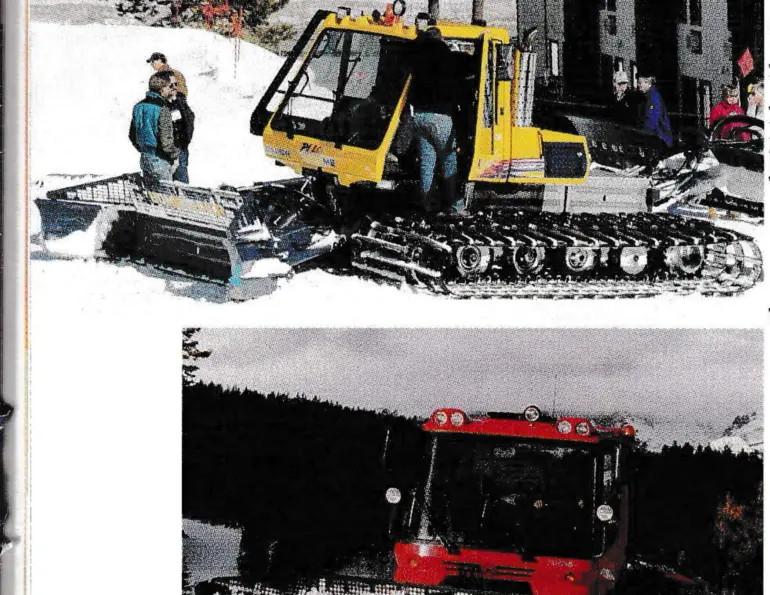
In the 20 years since SAM‘s first “Over-Snow Vehicles” review appeared (Spring 1979), snow groomer designs have undergone exciting—and expensive—evolutionary changes. That first article listed vehicles such as Bombi, Imp, Spryte 1200, Sno Cat 1342, Packmaster 2100, Prinoth Jr., Ski Dozer SV302, Kool Cat, White Trail Boss and the Hydromaster. Some of them have had name changes and others—such as Kool Cat, Trail Boss and the trend-setting Packmaster—have been driven to the big snow fields in the sky. Just to refresh your memory, winter trade shows that year were held at Waterville Valley, N.H., and Alpine Valley, Wisc., where Valley Engineering showcased its three-gang Powder Maker. “Gargantuan price tags” of $35,000 to $42,000 had been eclipsed by the emerging hydrostats at a whopping $55,000.
Since then, 20 years of constant improvements have been necessitated by an ever-increasing level of sophistication and expectation of the end user: today’s alpine and nordic skiers. Another important influence on change is the fact that alpine grooming equipment manufacturers also supply a large number of vehicles to the utility sector throughout the world. For some, alpine grooming tractors comprise only a small percentage of total sales.
Here’s an overview of improvements each manufacturer is focusing on for the near future:
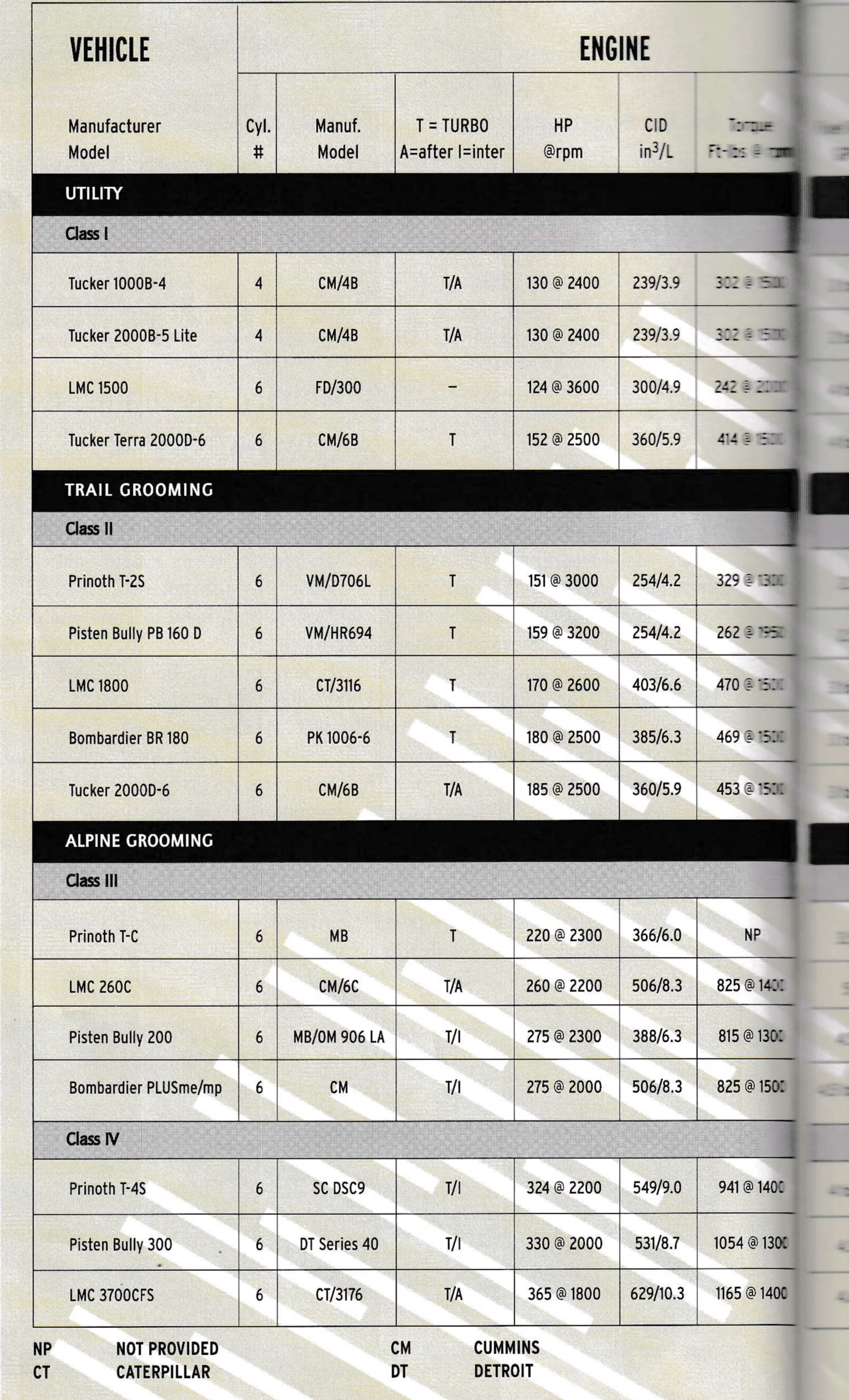
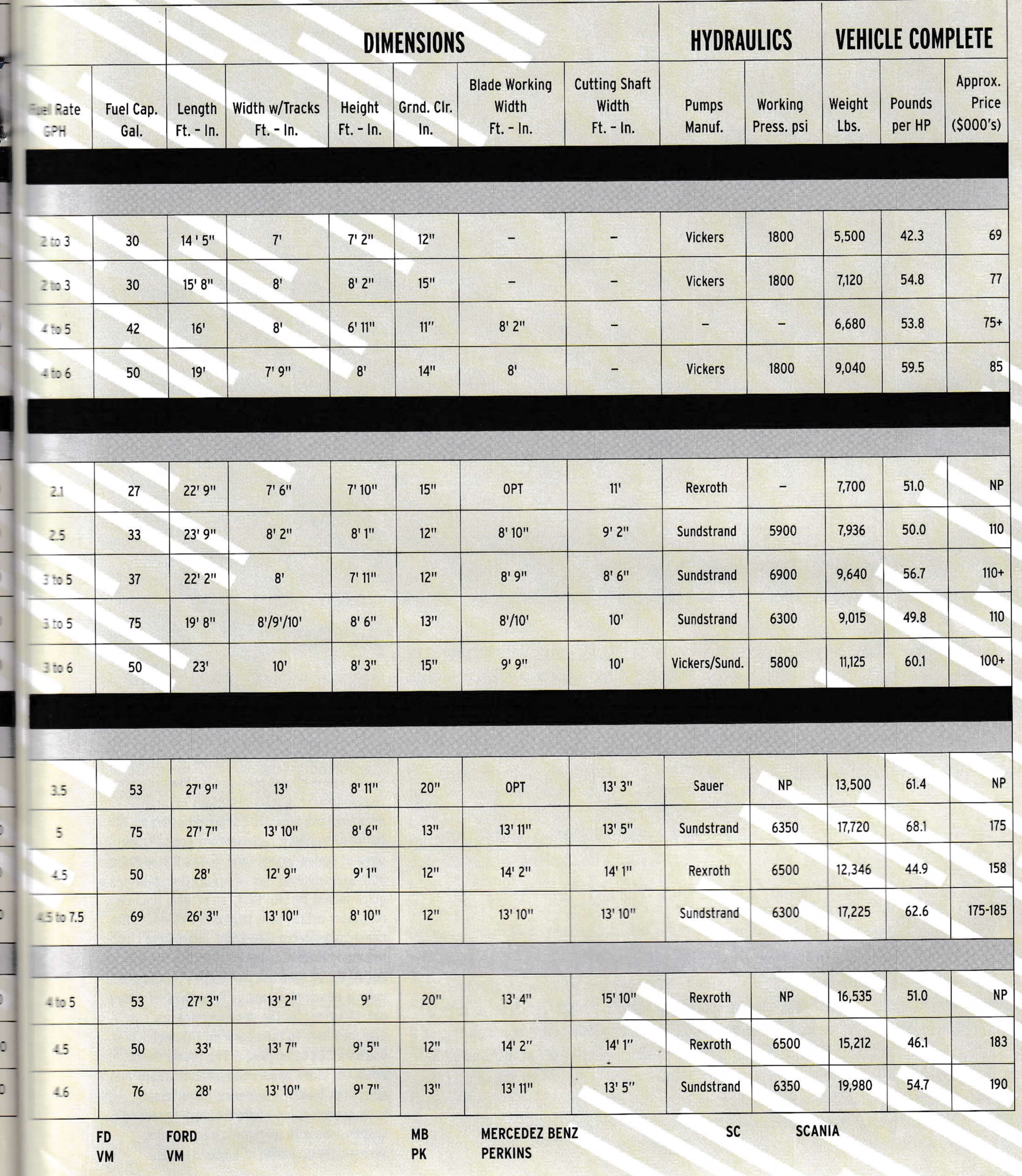
LMC will provide more heated glass, a thermostatically-controlled engine clutch fan and improved switch location for the TriFlex wings on its center-cab, 100-percent mechanically-steered 260C. The high horsepower 3700CFS is available for those who crave power. LMC sells most of its 1500 model twin-track units to the gas and electric utility industry, while the 1800 is preferred by snowmobile and Nordic clubs. Low-impact full rubber tracks are now available for both models.
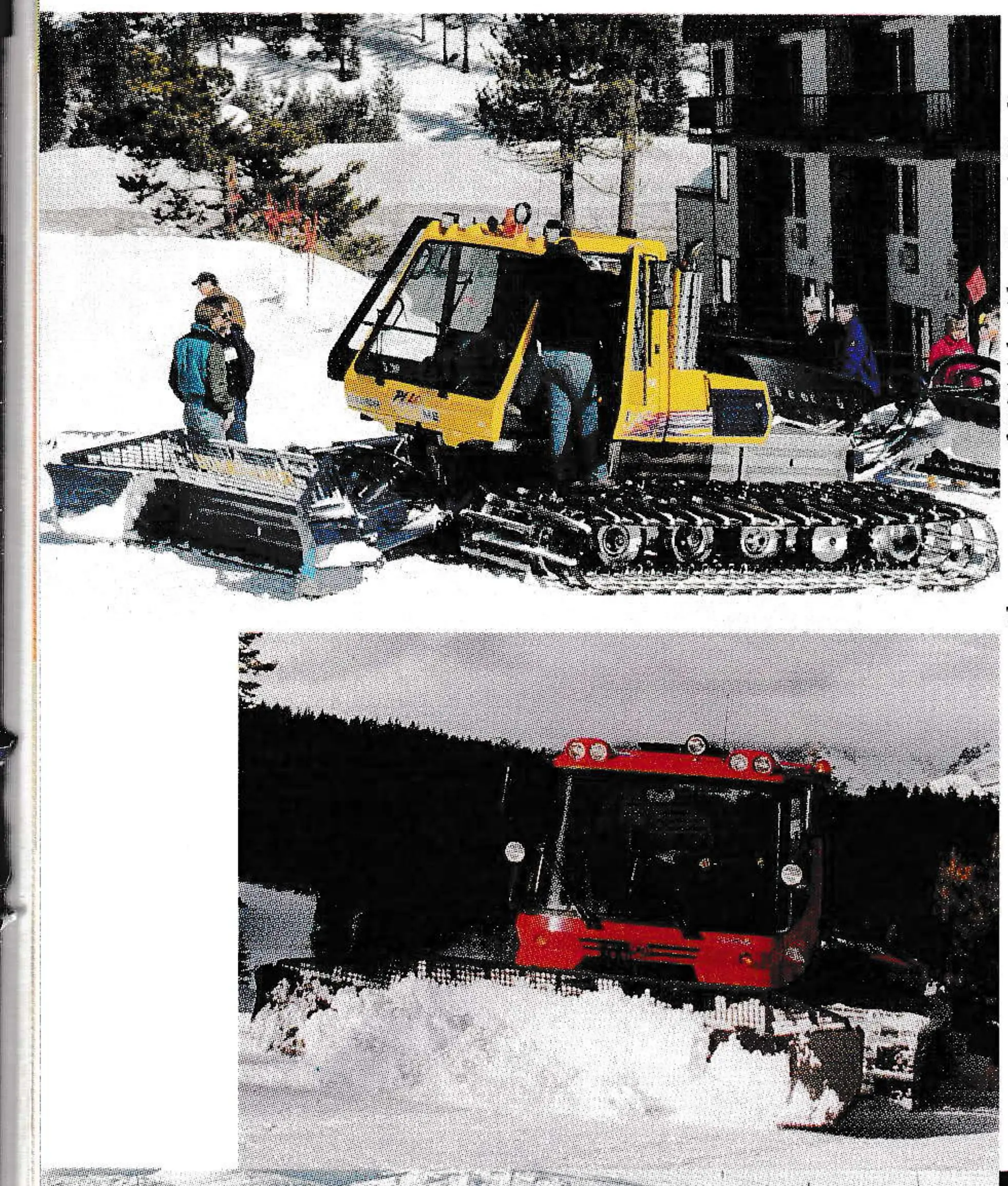
Photo courtesy of NSAA by Alan Huestis/Studio 404
The aggressive climbing ability of Prinoth’s T4S was recently enhanced with a stretch frame and the addition of two more grousers under each track. New steel tire guides have reduced unnecessary flexing of older units and have increased reliability. Hydrostatic pump efficiency has taken a giant leap, which leaves more horses for pushing and pulling. For the future, from-the-cab snow depth measurement is being reviewed at the home office in Italy.
Bombardier customers prefer the MP (microprocessor) machine—three to two—over their simpler and slightly less expensive ME. One big advantage of the MP is the stream of data available from the on-board computer that allows management to better utilize grooming assets. Larger resorts are tracking idle time, tilling time, distance covered and winch hours and are discovering, according to Bombardier management, that up to 40 percent of engine hours can be non-productive (no more long coffee breaks). The small BR110 is being discontinued while the recently introduced BR180 has new engine specs with torque goosed up to 469 ft-lbs at 1500 rpm.
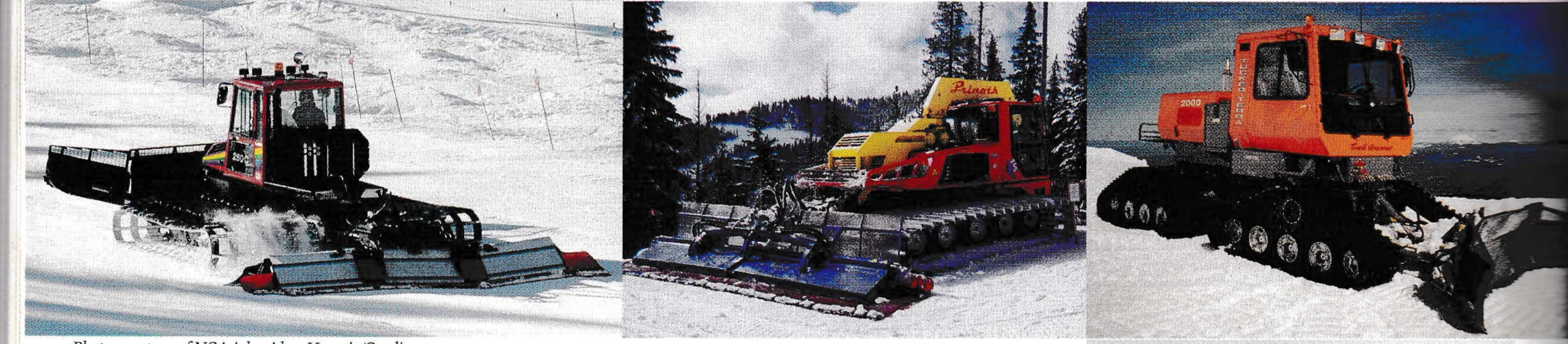
Thanks to the 1998 Olympics, snowboarding has reached new heights (11.5 feet on the halfpipe wall in Nagano) and groomer suppliers are hot on the trail of the pioneer, Pipe Dragon. Bombardiers’ HPG (halfpipe groomer) weighs under 2,000 pounds and mounts to the front push frame. Made in Finland, it consumes as little as 15 hp and costs about the same as a winch. Blade tilt and lift allow for fine tuning of surfaces at twice the speed of other models.
Kässbohrer’s Pisten Bully lineup is experiencing major changes. First, the Kässbohrer name is being sidelined, with Pisten Bully spelled out on all models except for smaller 160D. The Cummins-powered PB280D is being replaced by the totally new Pisten Bully 200 that was introduced this year. Mercedes furnishes the new electronically-controlled diesel with a whopping 815 ft-lbs of torque out of a meager 388 cubes (6.4L), compared to the Cummins—803 ft-lbs from 504 cubic inches (8.3L) at 100 more revs. Traction is provided through time-proven steel grousers and a new, compact, higher-efficiency drive line. To suit different preferences, both steering wheel and manual levers are available.
Ski area operators facing the problem of over-tilling might want to demo the new PB on-demand, front-mounted snow cutter (renovator). It sits comfortably between the blade and quick-mount system and can be lifted when not in use. While shopping, check out the Pipe Shredder for halfpipe maintenance. Introduced this year, it was developed through collaboration with the famous track-setter folks at Baechler. It is a front-mounted, hydrostatic unit that conforms to all current FIS standards.

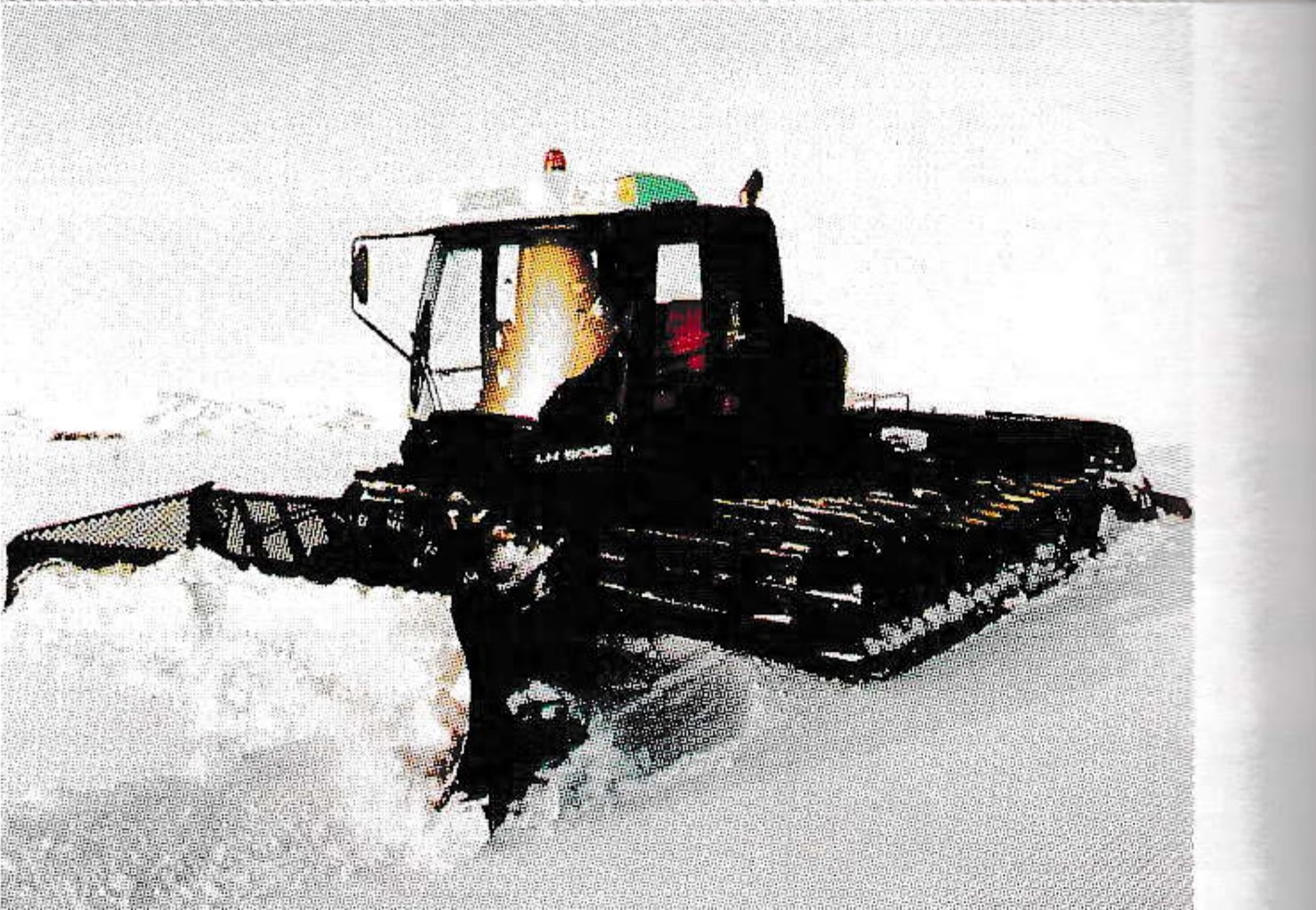
Approximately 40 percent of Leitner’s total 1997 production of snow groomers were winch cats—model LH500W. Normal trail grooming can be accomplished without removing the winch, according to Leitner representatives, due to the hydropneumatic suspension of the 500 series machine. Except for the removal of the 500E unit from the lineup, there are no other changes expected in Leitner vehicles for the upcoming ski season.
The all-terrain Tucker Terra-Cat can travel at speeds up to 15 mph, which makes the recently-introduced vehicle popular with search and rescue operations, Alaskan mining camps and sand dune management. For snowmobile (40+ units per year) and Nordic grooming, the 10-foot tiller on the 2000 can easily be trailered as a complete unit, while the wide-track 1600 can handle deep snow as a groomer or eight-passenger transport machine. The automotive simplicity of the steering wheel, transmission and final drives coupled with prices under $100,000 makes Tucker equipment popular not only as military postal vehicles in Turkey, but also as work horse tractors used by the British in Antarctica and ski areas in North America.
Is it possible to continue this upward trend of enhancements? Yes, but not at the same level as in years past. Manufacturers will continue refining the utilization of advanced technology, but no major mechanical or structural changes are on the horizon. Economy of operation and productivity are still key.
Increasingly sophisticated electronics will control the engines and monitor output. Global satellites in geosynchronis orbit are already being used to track cross-country truckers and now, snow groomers. Snow tillers will continue to be augmented and modified to reduce snow destruction. However, even the best intentions, technology and designs can’t replace properly trained and compensated operators and maintenance personnel.
Table Headings
Definition of selected column headings is as follows: Engine Manuf/Model – manufacturer abbreviations are shown at the bottom of the table; model designation is from engine supplier. Turbo-charged engines are now commonplace in grooming vehicles. They differ mainly in the type of cooling that is employed to remove heat from combustion and friction. Noticeable improvements in horsepower and torque can be attributed to either After-cooling or Intercooling. The horsepower listed is uncertified SAE (Society of Automotive Engineers) at the flywheel, including fan load. CID – is total cylinder displacement in cubic inches and liters. Torque – is a direct indication of lugging power and at lower rpm’s than horsepower ratings. Fuel Consumption – represents average claimed fuel use during work cycle. Length – includes blade and tiller (if available). Width – with tracks normally supplied but without blade or tiller. Ground clearance – the least dimension between the undercarriage and the snow surface with track belts resting on the snow. Working Blade Width – is with wings closed and measured to outside of moldboard. Tiller Drum Width – is total cylinder length without finishers or box. Hydraulics Pressure – highest system pressure anywhere in vehicle. Weight – includes blade, tiller and all fluids and standard accessories. Pounds per HP – an indication of the power-to-static load factor. Approximate Price – the price of a complete vehicle with blade and tiller, unless noted otherwise.
Winch Cats
| Vehicle Manufacturer/Model | Winch Type | Total Weight (Lbs.) | Rope Length (Ft.) | Rope Diam. (In.) | Line Pull (Lbs.) | Spool Speed (FPM) | Least Height (Ft.-In.) | Cost Installed ($000s) |
|---|---|---|---|---|---|---|---|---|
| Bombardier Plus TW | Capstan | 3,200 | 2,300 | 7/16 | 6,620 | 660 | 9′ 7″ | 40 |
| Kässbohrer PB 300W | Capstan | 2,300 | 3,445 | 7/16 | 6,750 | 710 | 10′ 9″ | 42 |
| Prinoth T-4SW | Capstan | 3,200 | 2,300 | 7/16 | 6,620 | 660 | 10′ 5″ | 40* |
| Leitner 500W | Drum | 3,900 | 2,300 | 3/8 | 7,700 | 675 | 11′ 7″ | 40* |
| Bombardier Plus TW | Drum | 4,300 | 2,100 | 1/2 | 10,500 | 820 | 8′ 10″ | 50 |
Winching equipment is expensive. Operation can be tedious and, at times, dangerous. Technique and mechanical aptitude are more desirable traits in operators than advanced education and proper dress. Plus, a little craziness can be a real asset in an operator running a winch cat on 50 to 75 percent grades, at night, alone. As little as four years ago, up to 20 percent of alpine grooming vehicles were outfitted for winching chores. Today, the North American winch cat market has matured into mostly replacement vehicles at around 10 percent of total sales. In this issue of SAM, the winch cats were extracted from the standard vehicle roundup table to provide more focus on this grooming specialty, listing the basic criteria involved in the selection process. Please refer to the main table for vehicle performance figures.
Three more items for fellow gearheads…
- Check out the April issue of Road & Track magazine for an out-of-sight test review of Kässbohrer’s Pisten Bully 300 (See The End Page). Zero to 60 in how many seconds? Definitely a must-read-and-keep issue.
- Want to convert cubes to liters? Divide by 61 (60 is close enough). Just remember, the popular Ford 300 inline 6 is 4.9 liters or the 305 is 5 liters.
- Last, why does my 300 hp, 4WD, 8.0 liter pick-’em-up truck (eat your hearts out) develop less torque, 450 ft-lbs, than a 260 hp 8.3 liter Cummins 6CTA at 825 ft-lbs? Fuel type is only part of the answer. More on that particular topic later.
