It was creative, rude and so tasteless it was over the top: Mussolini as TV ski industry spokesperson, extolling the virtues of—what else?—Freeze Magazine in an ad run frequently on the Resort Sports Network this past season. Other than the best example of Fascist marketing the ski industry has seen since World War II, the ad seemed symbolic of the revolutionary changes the media has been going through lately. The status quo isn’t holding up so well.
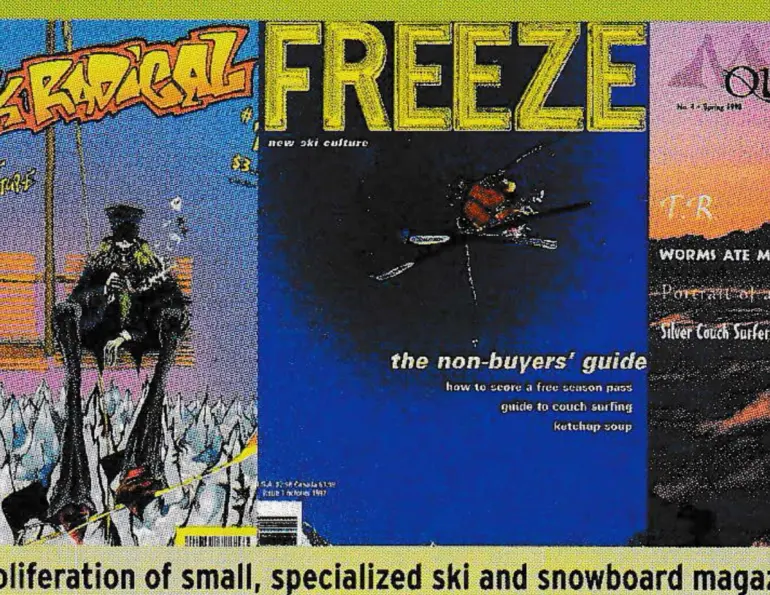
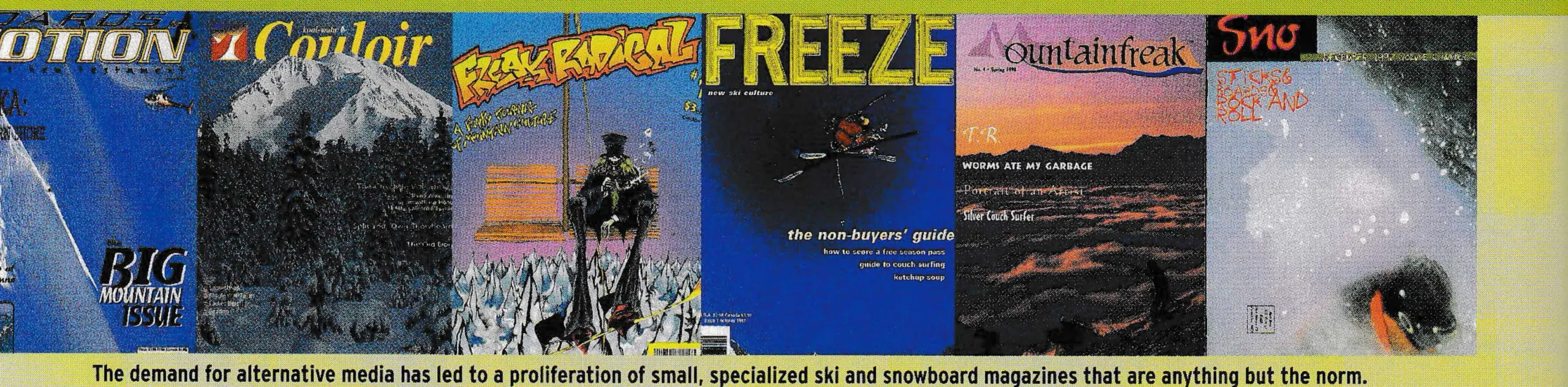
Freeze is a comfortably financed effort of Times Mirror, the good folks who bring you Ski, Skiing and Transworld Snowboarding. And it seems as suddenly as it has appeared, it has competitors in Couloir, Vertical, Freak Radical and Boards in Motion. Even a conglomerate like ASC has checked in with Sno. Many of these publications celebrate the backcountry and all show a young, hip ski culture—the guys at Freeze describe their book as a snowboarding magazine for skiers. All are into the “new ski culture,” while none is much concerned with “service journalism,” the how, where and what to buy formula.
It’s revealing that Freeze is selling subscriptions on cable TV on a resort-based network that pushes its affiliation with the internet (with its innovative resort cams showing real-time snow conditions), to a targeted audience, probably hanging out just before or just after skiing and snowboarding. It’s targeted synergistic marketing of a sort that has never before been possible.
What’s the big change? In a word: Information. We are deluged with it. We have instant access to all previous knowledge and all current trivia, just a click of a button away on the internet. The trick is to sort it all out.
If you don’t become hooked on meaningless news (being well-informed can become addictive) there’s a sense of freedom about the media changes because they allow other media, magazines for example, to go beyond mere information and get back to exciting the soul. The tools are there now to motivate the market in a dynamic and economic manner that was only a dream a few years ago.
Here are the key trends:
➢ The internet: In less than three years, according to survey information from the National Skier/Boarder Opinion Survey, the internet has risen from statistically nowhere to be the No. 2 influence by which consumers gather information to make ski and snowboard vacation decisions.
➢ Examples from America Online (AOL), the 900-pound gorilla among online services, USA Today and CNN online services show significant trends in how Americans are changing their television network viewing habits.
➢ There are now affordable and promotable marketing possibilities on cable for snow industry companies. A proliferation of cable channels is making television less of a mass medium and more of a specialized or “vertical” medium. This is a very positive trend for the ski industry, as marketers can seek out ski area Management the same targeted audiences that these specialized shows attract, at a very economical price.
➢ Specialty ski and snowboard magazines are slicing and dicing their audiences into increasingly smaller demographic and psychographic segments. At the same time, there is a creative tension developing between magazines and the Internet as their editorial vitality is being challenged by the Net, in many cases by the very online products the magazines have created.
With change comes opportunity, and never has there been more opportunity in the snow sports industry. But it’s opportunity that is coming and going at warp speed. And it’s not going to slow down any time soon.
Internet: Overhyped but Potent
Right now, the Internet is second only to brochures as a key source of information, but Jim Spring, president of Leisure Trends (which produces the survey) feels that the Internet may soon be No. 1.
“There’s a good chance that the Internet will exceed brochures this year because it is so easily accessible,” Spring told the Denver Post.
Here are other important Internet trends:
➢ About 70 percent of skiers/boarders surveyed had computers and access to the Internet, 50 percent of those at home (a lot of Internet use is during work hours on company or university lines). Skiers and boarders as a group are as well wired as any special group of consumers anywhere.
➢ About 40 percent of skiers/snowboarders had gone online during the past season to get information about their ski trip.
➢ Nationally, we are approaching the figure of 30 percent of American households being “wired” for the Net. About 20 years ago, the cable TV industry was eyeing this 30 percent mark as an important “saturation point” for the penetration of the cable business.
These numbers are nothing new. We have been having stuff like this thrown at us all the time at seminars during industry conventions for a couple of years. If anything, the Internet has been over-hyped while under-performing financially.
In an article, “The Digital Bubble,” from a recent issue of the New Yorker, Kurt Andersen observes that it’s mainly two groups that are finding the Internet so exciting and essential—journalists and Wall Street traders and analysts, both hungry for fresh facts and financial data daily—in effect creating a feeding frenzy of hype:
“What journalists and financial professionals haven’t understood, however, is that almost no one else finds computers and the Internet quite so essential,” Andersen writes. “And as a result of this improbable accident of history—giddy journalists and giddy money managers enthralled at the same moment by the same gadgetry—the technology now sits at the center of a speculative frenzy of religious intensity; a financial mania; a bubble.”
Which is to say that Internet operations are not particularly profitable, although they have attracted big investments. For example, the market evaluation of the online Internet guide Yahoo! is $2.7 billion, or 160 times earnings.
Why is this going on like this? Warren Buffet, in an interview with The New York Times, tried to explain such lack of rational thinking with what he termed the “institutional imperative”:
“Any business craving of the leader, however foolish, will be quickly supported by detailed rate of return and strategic studies prepared by his troops; and the behavior of peer companies, whether they are expanding, acquiring, setting executive compensation, or whatever, will be mindlessly imitated,” Buffet said. The New York Times thought this was why the networks paid such nutty sums of money to get or keep NFL football on their schedules, but it also seems to fit what’s happening with the financial hype with the Net.
Nonetheless, although profits online are elusive, the Net is there and American media habits are changing.
These changes are going right to the core of media and journalism practices.
Print, Broadcast Media Go Online
Many media outlets are doing their own Net pages. Not surprisingly, among the best are USA Today, The New York Times and the Wall Street Journal. Moving to the other side, broadcast entities are going online in a big way, namely ESPN and CNN.
All these companies are doing brand extensions into the Internet, stretching their news-gathering resources and name recognition into another medium. Because these ventures share the same-day nature of their parent media and because these online products are marketed to advertisers—selling the audiences who use them, numbers that are legitimately impressive—they are becoming successful. There were $7 billion in transactions last year on the Internet and the industry looks for $27 billion by the year 2002. Advertising has hit $900 million online, with $8 billion projected by 2002.
What has been less financially successful—with the exception of America Online, which is following a cable television strategy—has been the created-for-the-Internet products, which have had to both build content from scratch and establish a brand-recognition factor at the same time.
| Oct. 1996 | Oct. 1997 | Difference | |
|---|---|---|---|
| Total Visits | 8,075,748 | 20,075,684 | 149% |
| Average Visits/Day | 260,508 | 647,603 | 149% |
| Total Pages Viewed | 52,499,465 | 106,553,966 | 103% |
- Male/Female: 69%/31%
- Age 35-54: 52%
- Medium Household Income: $71,950
- Attended College: 87%
- Professional/Managerial: 63%
- Average reading time (paper): 41 min.
- Average time on website: 12:08 min
Note: These numbers are close to the demographics of the ski industry.
The CNN and USA Today sites are very similar, which is interesting because one is an extension of a newspaper and the other is an extension of a cable television channel.

Traffic on ski resort home pages, sees a timely spike (during office hours) late Wednesday or early Thursday, looking for weather and snow conditions to make a weekend ski decision.
Where is this time online coming from? Well, in addition to goofing off online while at work, it seems to be coming at the expense of television viewing, which is down among heavy Net users, according to an AOL survey.
Making “Narrowcasting” Work
All the major TV networks are seeing their shares erode. This is why it should not have been a surprise that ratings were down for the Olympics. Ratings are off for the National Football League, which made the huge sums paid for future TV rights all the more ridiculous. Remember that $1.3 million—about the annual marketing and sales budget for a fair-sized ski area—being paid for one 30-second ad on the Super Bowl? It may never happen again.
ABC, CBS, NBC and Fox have seen their collective prime-time market share fall from 68 percent in 1992-93 season to 59 percent in 1996-97, a drop of 13 percent. Meanwhile, cable channels rose collectively from 24 percent to 34 percent, a gain of 41 percent.
Most of the shift came from viewers age 35 and older who tuned into services such as the Family Channel, TNT, Lifetime, Discovery and A&E.
I live in the woods in Warren, Vt., never to be confused with the media center of the universe. Two months ago, we received a number of new cable channels on our system and I now have four— count ’em four—all-sports channels from which to choose: ESPN, ESPN2, Fox Sports and the Outdoor Life Network. Almost every day of the week I can find some skiing or boarding to watch, which I think is great.
This is “narrowcasting”—as opposed to broadcasting—at work. This is targeted programming for targeted audiences, which also means smaller audiences at lesser cost to reach. Network television is now not out of the question for limited budgets.
Each of those ski and snowboard “event” shows represents an opportunity to promote the sport in general and specific ski resort products in particular. Not for hundreds of thousands of dollars, but for tens of thousands, prices competitive with ad rates for the ski books.
Specialty Sliding Magazines
Snowboarding seemed to take the ski publishing industry by surprise, as a number of snowboard magazines successfully hit the market. Snowboarding magazines—like the attitudes of the sport’s young participants—were fundamentally different from the ski publications. They featured a different lifestyle, a different view on the world, a different culture. Now, in recent months, the new ski pubs have picked up on these differences, transcending the “equipment” specialization.
The established magazines didn’t screw up by not covering snowboarding; they missed an opportunity because they lost sight of the passion and lifestyle of the sport. The kids editing these ragged magazines out of their living rooms are giving us back that passion.
Vertical magazines have been important elements in the marketing process of the ski industry. But now the Net has taken some of the teeth out of the cogs. There’s creative tension—and worse—between print publications and Internet operations.
The Net is a superior way to get consumers solid buying information— such as snow reports, weather, the latest in package deals, equipment testing data, ratings of ski resorts, availability of hotel rooms, airline bargains, etc.
Thus, this is ending the era of Service Journalism in magazines. And it marks the beginning of the New Service Journalism, if the publishing companies change their communication mix properly. Now magazines are free to be magazines again—slick graphic products with compelling and inspirational features—if they make the move and market themselves accordingly.
It also is changing the paradigm for the marketing process in the industry. With the wedding of magazine to Internet operations, we may begin to see an almost seamless process of inspiration through purchase on the part of the consumer. The ski or snowboard enthusiast will have every need fulfilled, right up to buying equipment and booking airfares (at a bargain!), room and lift tickets. The vertical ski or snowboard “magazine” will become part slick printed book, part Internet service and part affinity discount card.
How to Market in the New Media
Next time you do a strategic marketing plan, start with a clean sheet of paper. Focus on your customers or on the specific customers you desire. This is a select group. How can the media deliver your targeted customers to you, in the greatest number at the least cost?
Be careful before you act: you may not know enough about your own customers and your first step may have to be to research who they are and what they respond to and how they respond. You can’t do things the traditional way, because the traditional way of making buying decisions in this industry has changed radically.
Look for measurable links between customer communications and buying decisions. Be it ads, direct mail or the Internet, or a mix of all, don’t promote anything that can’t be measured through actual sales. The tools are there.
Here are some specifics:
• Although there’s an avalanche of new advertising and promotional opportunities, your ad budget is finite. Cut mass media print ads to make room for an aggressive presence on the Internet.
• Redesign your Internet page to be more than an online brochure. Make it interactive, changing and capable of closing the sale with a booking mechanism. A great example of this is the home page designed for Winter Park by Digital Frontier, which also has produced state-of-the-art sites for Jackson Hole and Stowe.
• Look to cable television—not only as an advertising medium, but as a way to promote your resort through a special event. An excellent example of making this work at a reasonable cost is the partnership Crested Butte has forged with John Sandy Productions (JSP) in developing the U.S. Extreme Skiing Championships, now in its 7th year. JSP is one of the leaders in producing mountain sports events for television.
Remember, that the ski industry always has been more sales-driven than advertising-driven and that’s why these changes in media are so exciting. In particular, remember that the Internet, with its interactive nature, can be the perfect sales tool for closing the deal. And if you forget, your competitors won’t.
Bob Gillen has edited magazines in the tennis, ski and travel markets and has served as marketing director at ski resorts in the East and West. He is the publisher of the Ski Industry Letter and the owner and executive director of the Recreational News Wire (www.recnewswire.com).