


At Suicide Six, Vt., we are not expecting a Japanese suitor anytime soon, but last year we developed a ski instructor Quality Inventory. The idea was to make a qualitative measurement of our ski instructors.
After one season of use, we found the Quality Inventory helpful in identifying strengths and weaknesses of existing staff as well as evaluating potential new-hires. Basically it equates numbers to quality traits that most ski school directors like to see in their instructors.
The results are best used to give an overall picture of the ski school staff, but a secondary use is in the training process. As a management analysis tool on an informal or formal basis, it can point out where improvement is needed and give direction to future goals.
The Inventory has given us a clearer sense of direction in pre-season hiring practices. When there is a guide of this type available in personnel offices, administrators without skiing backgrounds can make informed screening decisions and save the ski school directors valuable interviewing time.
Another practical application of the Inventory is in the daily lesson assignments. Realizing the importance of retaining rank beginners, for instance, we can glance at the inventory, note the scores and send our top guns out with “A” level classes. A 17-year-old new recruit can apprentice by shadowing the master instructor and assisting with returning rank beginners to an upright position. After training, the young instructor can be evaluated with the Inventory.
Although the quality of instruction given by a master or skimeister is a major factor in keeping beginners in ski school, top instructors often leave. After they develop a certain skill level, we lose them to bigger ski schools, but the bottom line is: they stay with skiing as a sport.
Ironically, the great skimeister Hannes Schneider taught skiing to the Japanese in the 1930’s. Sixty years later, America looks to the land of the rising sun for lessons in quality.

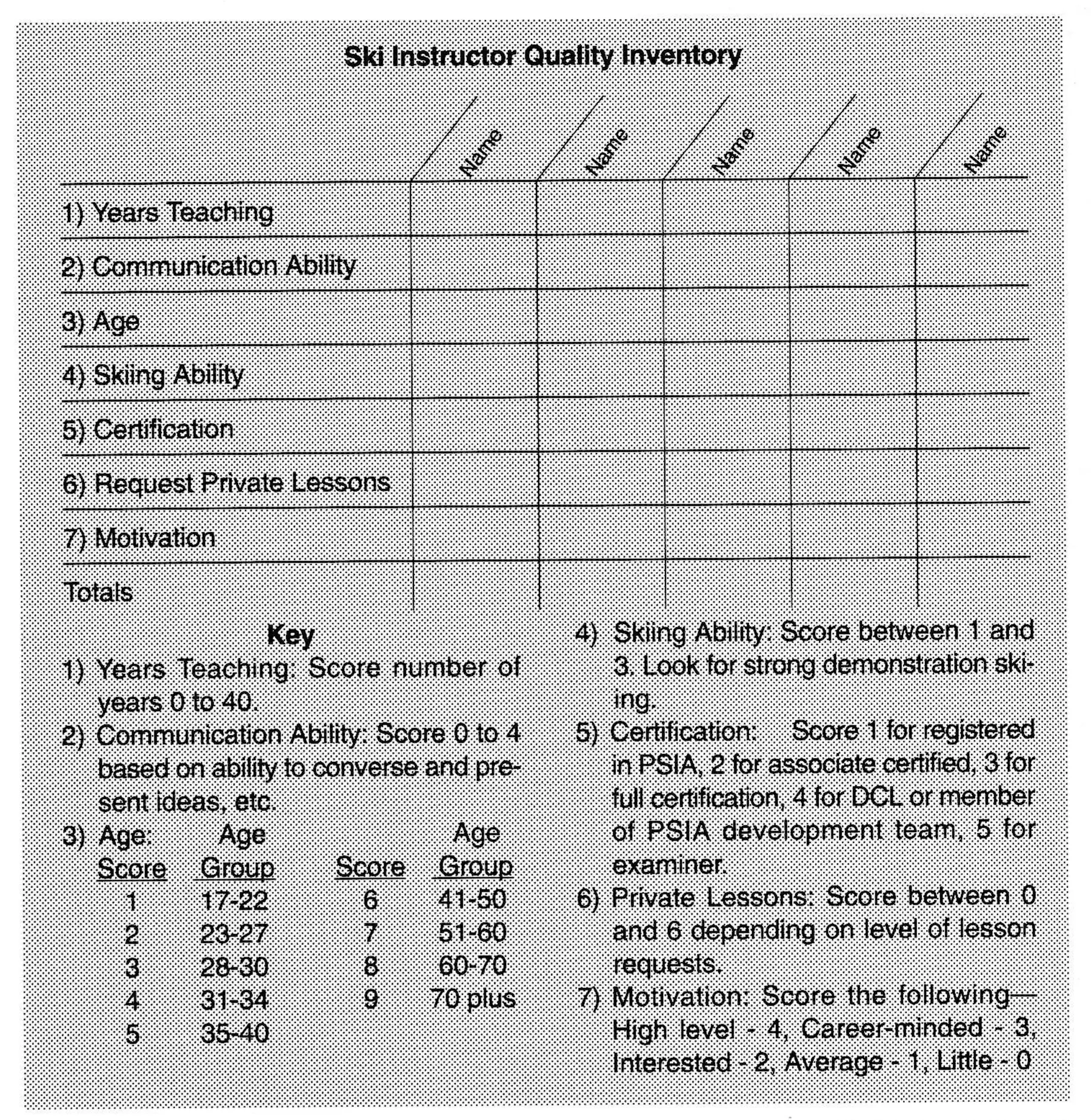
The Inventory criteria presented is based upon our experience with a diverse alumni of ski instructors.
The Quality Inventory can be used as published here or modified according to the values, needs and opinions of individual ski school directors. The numerical scales can be modified and categories can be added to enhance the overall picture created.
We look for a minimum score of 10 for new-hire trainees without prior experience. For the existing staff, a score of 22 or more is an acceptable standard. A score of 30 or more places the instructor in the master-of-the-craft category.
Averages for the ski school as a whole are virtually useless because each individual lesson is equally important. A ski school average of 25 is meaningless if one instructor teaching scores only 9 and turns away future business.
Each instructor’s score is vital to the health of the ski school on an individual basis, similar to a subcontractor’s performance to the overall success of a building project — if the electrical work is faulty so is the entire project.