


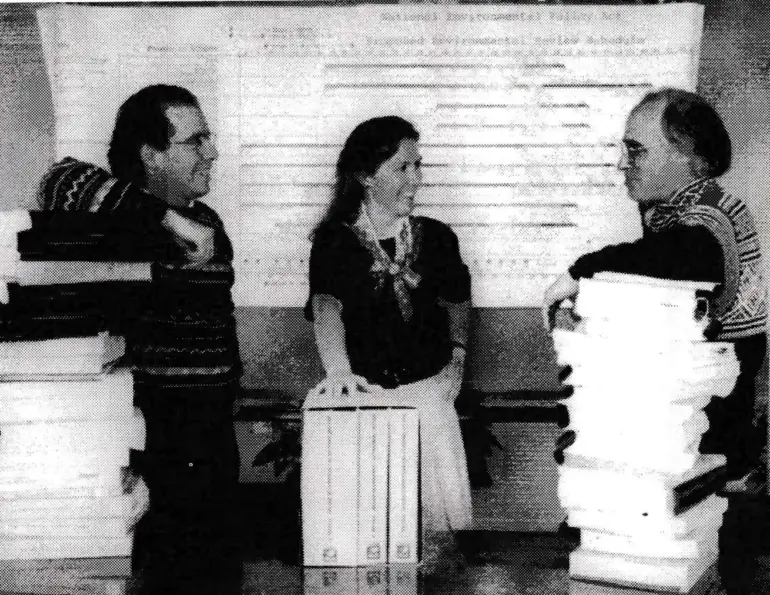
Over the past twenty years, the National Environmental Policy Act (NEPA) has spawned millions of pages of environmental analysis, thousands of lawsuits and more than a few gray hairs for ski area managers. They bemoan it as costly and confusing; environmentalists often praise it as a tool for informed decision making and public involvement; and agency officials, while defending NEPA publicly, often criticize it privately for consuming their limited resources. The reality is, it exists; there are ways to cope.
Although NEPA itself is straightforward, its application has grown complex and cumbersome. As some ski areas have learned to their chagrin, the process can take on a life of its own:
- At the proposed Early Winters ski area in Washington State, the NEPA process is now in its seventh year and has included the preparation of draft, final, and supplemental environmental impact statements (EISs) and a lawsuit that reached the Supreme Court;
- At the Loon Mountain ski area in New Hampshire, the NEPA process for a proposed expansion is now in its third year, and thus far has included preparation of draft, supplemental draft and revised draft EISs; and
- At the proposed Lake Catamount ski area in Colorado, the NEPA process lasted four years and culminated in a 500-page EIS that is currently the subject of eight different appeals.
Key NEPA Requirements
NEPA requires federal agencies to consider the environmental impacts of their decisions. It applies only to federal actions, not those of state or local governments, or those of private parties. Actions that trigger NEPA include:
- Decisions to permit the development or expansion of a ski area on federal land;
- Decisions to trade federal land for private land;
- Decisions to withdraw federal land from certain uses, such as mineral development; and
- Decisions to issue federal environmental permits, such as point-source discharge permits under Section 402 of the Clean Water Act, and dredge and fill permits under Section 404 of that Act.
The environmental impacts to be considered include direct, indirect, and cumulative impacts, and range from wildlife to water quality, cultural resources to transportation and vegetation to housing.
For NEPA purposes, every agency action falls into one of three categories: (1) actions that are categorically excluded from further NEPA review; (2) actions that require preparation of an environmental assessment (EA); and (3) actions that require preparation of an Environmental Impact Statement (EIS). Actions are categorically excluded if they neither individually nor cumulatively will have a significant effect on the environment. Examples include renewing a special use permit for an existing operation on national forest land; authorizing routine operation and maintenance actions; and replacing existing structures and facilities.
An EA is prepared where a proposed action has not been categorically excluded and will not have a significant environmental impact. EAs range from a few to several hundred pages in length, take anywhere from a few days to several months to prepare and are usually subject to little public participation. Their format is flexible, but is often similar to, albeit shorter than, an EIS.
An EIS is prepared where a proposed action may have a significant environmental impact. Unlike EAs, EISs are usually several hundred pages in length, take six months to several years to complete, and are subject to extensive public participation, including consultation with various federal, state, and local agencies. By law, they must include descriptions of:
- The purpose and need for the proposed action;
- Reasonable alternatives to the proposed action, including a no-action alternative;
- The local environment;
- The environmental impacts of the proposed action and alternatives; and
- Possible mitigation measures.
It is well established that NEPA does not limit an agency’s ability to approve a proposed action; it merely requires the agency to comply with the environmental disclosure requirements outlined above. Nevertheless, project opponents can — and often do — challenge the agency’s compliance with these requirements, alleging that the agency has failed to consider certain alternatives or impacts, or has prepared an EA where significant environmental impacts may result. Although an EIS will generally be upheld if it represents a good faith, objective, and reasonable presentation of the information required, litigation can delay development, increase costs and endanger financing.
NEPA in the 1990’s
During the 1990’s, there will likely be three key NEPA issues for ski area: analysis of alternatives, analysis of cumulative impacts and mitigation. Each has been a source of controversy within the Forest Service and the courts, and each has the potential to complicate and extend the NEPA process for ski areas.
Alternatives Analysis
The linchpin of the NEPA process is the requirement that agencies study alternatives to a proposed project. Generally, this will be considered adequate where a “reasonable” range of “reasonable” alternatives is studied. But how many alternatives must be studied, over how broad an area, for the analysis to be “reasonable”? Where a permit application is involved, must the agency consider alternatives that are unacceptable to the applicant or alternative locations for which there is no applicant?
The law on this subject is far from crystal clear. Generally, agencies must consider both public and private purpose and need in selecting the alternatives to be studied. In practice, this has led to curious results:
- The EIS for the proposed Early Winters ski area was found deficient by a federal appellate court because it failed to address the alternative of expanding a small regional ski area located about 100 miles away and because it did not identify with enough specificity the market and geographic pool of skiers targeted;
- A draft EIS for an expansion of the Loon Mountain ski area briefly addresses the potential for expanding other ski areas within the National Forest, despite the fact that those areas are not currently seeking to expand their operations; and
- The draft EIS for the proposed Adam’s Rib recreation area in Colorado was criticized for not analyzing other potential development sites on an 11 million acre area.
Note that in the Loon Mountain EIS alternative locations are briefly considered and rejected as ineffective, speculative and infeasible. The EIS then proceeds to analyze in detail those alternatives that are available at the project site.
Down what path will alternatives analysis meander in the 1990’s? We believe that federal agencies will be looking to expend their limited agency resources analyzing a limited number of alternatives that truly meet the same need and serve the same purpose as the proposed project. Project proponents, particularly ski areas, may shape the extent of alternatives analysis by providing the Forest Service, Corps of Engineers or other appropriate agency with the necessary specifics of skier demand and capacity.
Cumulative Impacts Analysis
NEPA requires that an EIS discuss the direct, indirect and cumulative environmental impacts of a proposed project. Cumulative impacts are the impacts on the environment of a proposed action plus past, present and reasonably foreseeable future actions, regardless of who is undertaking them. For example, in studying the wildlife impacts of a ski area expansion, the Forest Service could consider the loss of winter range in an adjacent area due to unrelated residential resort construction.
This kind of analysis is in many respects inherently speculative and may drive the NEPA process on a detour. But cumulative impacts are high on the priority list of those seeking to expand the scope and role of EISs, and are an important part of NEPA’s goal of describing and understanding the “big picture.” The more a project proponent is able to provide the agency and the public with a clear vision of the project and the surrounding community or geographic area several years down the road, the more efficient and realistic the cumulative impacts analysis of the project will be.
Mitigation
If there is a motif running through nearly all of our environmental laws and regulations, it is the concept of mitigating environmental impacts whenever possible by replacing or regenerating environmental features or creating protected areas of environment to offset the loss of others. Mitigation is an integral part of the NEPA review process, and there are several mitigation issues or strategies that ski areas will want to keep abreast of in the coming decade.

First is the proactive strategy of incorporating mitigation measures in project planning. A project that mitigates its own impacts may result in a finding of no significant impact and thereby escape the need for an EIS. It is generally accepted that in determining whether a project will have a significant environmental impact the applicant’s mitigation commitments should be considered.
During NEPA’s early years, agencies often limited their environmental review to an EA. During the 1980’s, however, more and more projects have been the subject of longer and longer EISs. Given the budgetary and resource concerns noted above, we may see the pendulum swing back towards the middle ground — with mitigation measures used to justify the preparation of an EA as opposed to an EIS.
Second, mitigation of off-site impacts is, and will likely remain, an area of controversy. These impacts often involve private land and are usually subject to state and local regulation. Traditionally, the Forest Service has declined to require the mitigation of these impacts, limiting mandatory mitigation to the “green land” and leaving private land to state and local authorities. In the Early Winters case, the Supreme Court upheld this approach. Nevertheless, some local governments and project opponents will almost certainly continue to push the Forest Service to condition permitting and development decisions on off-site mitigation.
Finally, NEPA requires that mitigation measures be discussed in an EIS in sufficient detail to substantiate that the agency has taken a hard look at the environmental consequences of its action and has considered how they might be minimized or avoided. However, the Supreme Court confirmed in the Early Winters case that NEPA does not require that a mitigation plan be formally adopted as part of the EIS process.
Guidelines
While many ski areas have had their plans bog down in the NEPA process, others have come through relatively unscathed. While there are no magic formulas, the process can be a productive and efficient one for ski areas, agencies and the public. The following guidelines can be thought of as techniques for grooming the slope of the NEPA process.
1. Make the NEPA process a part of your thinking from the outset. Retain the assistance of attorneys, planners and consultants who have expertise in this area. A focused and professional approach will be welcomed by agency officials who are strapped for time and resources.
2. Focus your statement of project purpose and need. Alternatives analysis is probably the most significant aspect of the NEPA process that project proponents can influence, and this influence is best accomplished by defining the purpose and need for the project as narrowly as is appropriate under the circumstances. Overly broad descriptions can lead to overly broad analysis of alternatives.
3. If possible, “tier” to, that is, rely upon, a prior EIS that addresses some or all of the issues in question. This can minimize the need for data collection and expedite the NEPA process.
4. Ensure that the EA or EIS is evenhanded. This means that it should accurately portray the beneficial impacts of the proposed action, such as increased recreational opportunities and new jobs, as well as the future growth and environmental impacts that would result even under the no-action alternative.
5. Think mitigation — as early and as often as possible. Mitigation is the trend of the future. Incorporating a mitigation strategy in your expansion plans is not only a way to demonstrate environmental sensitivity, but may also help you to avoid preparing an EIS.
6. Be proactive. Ensure that the agency dots its i’s and crosses its t’s in going through the NEPA process. Work with environmental and community groups to define potential issues and seek to enlist their support, or at least their acquiescence.
A NEPA Glossary
- FONSI — Finding Of No Significant Impact; means that an EIS need not be prepared.
- EA — Environmental Assessment; a concise document that analyzes the environmental impacts and determines whether they are significant.
- EIS — Environmental Impact Statement; a lengthy study that is performed when a proposed project may have significant environmental impacts.
- CEQ — Council on Environmental Quality; the federal executive office that oversees NEPA compliance and issues guidelines and regulations to govern the NEPA process.
- scoping — The process for identifying the significant issues relating to a proposed action and for determining the range of actions, alternatives and impacts to be addressed in the EIS. A public meeting is often part of the scoping process.
- tiering — The process whereby an agency prepares a broad, programmatic EIS for a major plan, program or policy with significant environmental impacts (e.g., a Forest Service EIS for a forest plan) and subsequent, more narrowly focused EAs and EISs for individual projects (e.g., a ski area expansion).
Note: this article is not intended to supply legal advice or solution to individual problems.

