


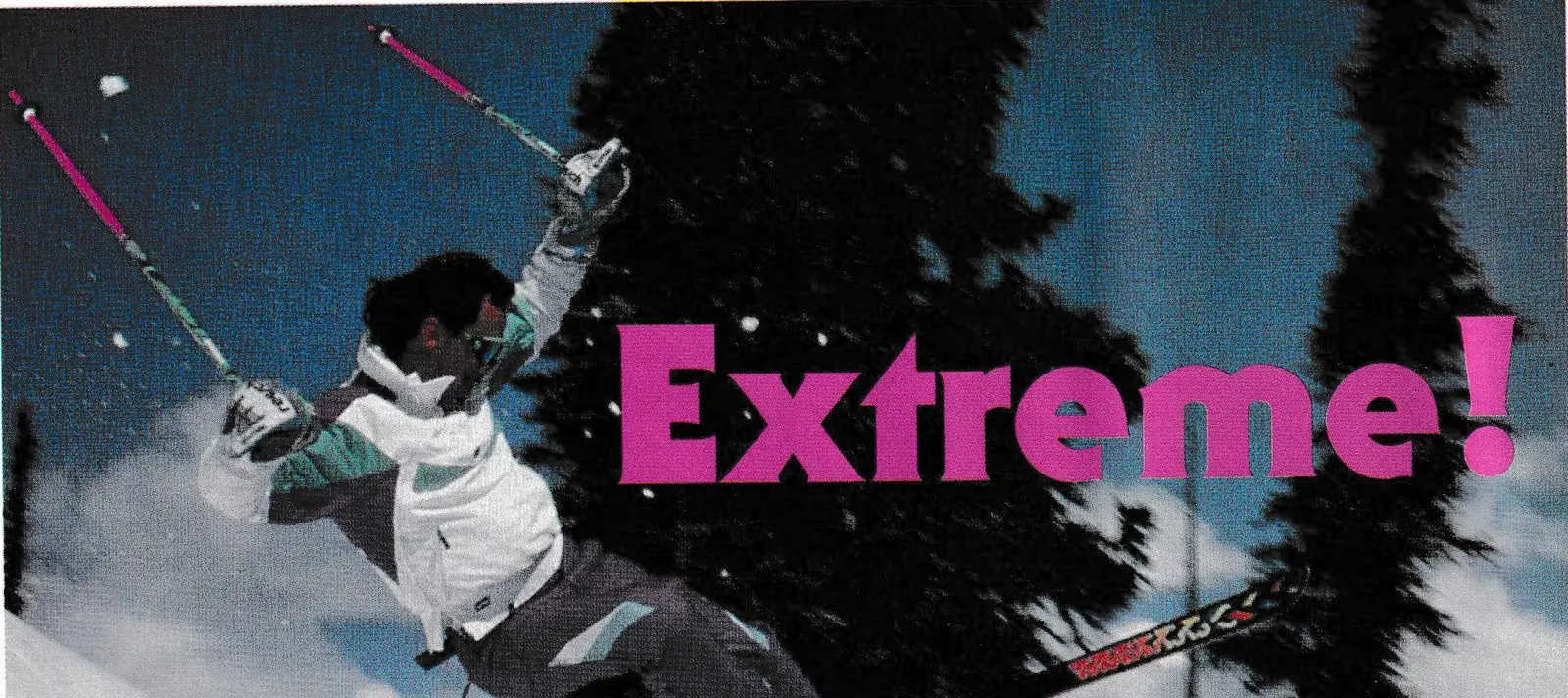
In the last several years there’s been a plethora of extreme skiing movies, an emerging extreme superstar — Glen Plake, not only skiing the extreme but putting on mundane society with his extreme haircut and extreme lifestyle — specialized equipment and ski areas opening up double-black sections called the Extreme Limits, the Extreme Experience or the Outback. This is more than just a fad — indeed, as a fad it’s fading fast — it’s a movement that relates to a need that the ski industry has neglected.
What is extreme skiing? There are a couple of schools of thought. In 1967 when Frenchman Sylvan Saudan skied the 50-degree “impossible descent” of Chamonix’s Spenser Couloir, he kicked off a new kind of alpine sport — making first descents of “extreme” slopes, a blend of mountaineering and skiing. Patrick Vallecant came along and cranked up the new sport another notch, not only skiing more and more outrageously dangerous lines, but thumbing his nose at the mountaineering establishment and attracting gobs of publicity in the bargain.
In a purist tradition arising among a group of calculating and talented daredevils centered in Chamonix, the definition of “extreme skiing” was simplicity itself — if you fall, you die.
The purity of that concept was corrupted in America as the ski film makers featured skiing stars jumping huge cliffs and streaking down steep runs to a rock score like an MTV video. The breakthrough film was Greg Stump’s 1988 “Blizzard of Ahhh’s,” which featured extreme star Scot Schimdt and introduced Glen Plake to an unsuspecting America.
The essential difference between the Chamonix tradition and the nouveau- American extremists is that the Americans fall all the time in their film exploits. They not only live but prosper. The French are not impressed.
Scot Schimdt talked about this in an interview for Powder magazine: “I feel a little uncomfortable when people call me extreme,” Schimdt told writer Chris Noble.
“But I’ve never been able to come up with another title that people can relate to. I’ve never considered myself a Vallencant. What I do is not what Europeans call extreme. . . . Anybody in America who can jump off a cliff or ski a steep run is called extreme.”
In the American public view, extreme skiing has been cranked down yet another notch to mean skiing steep, ungroomed slopes with natural obstacles such as trees, rocks and cliffs. This is true double-black territory, but not life-threatening, as the French would have it.
In essence, a few ski areas have been allowing the general public — with appropriate cautions — to ski the same slopes where the ski movies are filmed. And big air is an option, not a requirement.
It is as if the backcountry has been brought in-bounds with avalanche control work, a minimum of signage and absolutely no grooming whatsoever. In an apparent contradiction to the trend of the last 20 years of making skiing easier for the consumer, a select few areas have been making it more difficult. And the public — not only legitimate expert and advanced skiers, but strong intermediates — has been buying it.
Jackson Hole has long been a haven for strong skiers and Squaw Valley has had its Palisades, a favorite shooting site for Stump and other ski film makers. Blackcomb gained fame with its Sudan Couloir and Vail opened up its backcountry-esque China Bowl.
A few years ago, Crested Butte provided lift service, with a Poma, to its North Face, a section of the area’s Extreme Limits, all challenging double-black terrain that formerly required a 20-minute hike to reach. It was a controversial move, opposed by locals who publicly cited control problems for inexperienced skiers accessing the area, but privately were more concerned about their powder stashes being violated. However, the program was highly successful (the locals were won over on the first big powder day when they got six or seven runs versus two or three by hiking) and this past season, the longest lift lines on the mountain routinely were at the North Face Poma.
Other mountains are moving to open and promote extreme skiing terrain: Copper Mountain with Spalding Bowl and its guided Extreme Experience; Keystone with Outback mountain coming on line for 1991-92; Breckenridge’s Horseshoe Bowl, and Snowmass’ Hanging Valley Wall. Crested Butte, pending Forest Service approval, is adding another 170 acres to its Extreme Limits program with the building of a new surface lift this summer.
This is far too much activity to be explained away by young local hotshots emulating Scot Schimdt and Glen Plake. Clearly, there’s a market out there for aggressive expert terrain.
What’s happening here? Chris Noble writing in Powder, explained it this way: “Three or four years ago, such a hero (Glen Plake) was nearly unthinkable. The U.S. ski industry was in the midst of a liability crisis brought on by a litigious society. Trails were groomed like golf courses; every conceivable hazard was marked and ‘be aware, ski with care’ became the catch-phrase of the day.
“Skiing, which had always been exciting, sexy and maybe a little dangerous, became stagnant, a victim of overzealous risk managers. …
“It didn’t take long for a pent-up demand for something, anything, exciting to break through, and when it did, it was in the form of ‘extreme’.”
You would expect the hip, expert-oriented Powder to advocate such a position, but perhaps the essence of the extreme appeal can be better understood by looking at what happens to a typical terminal intermediate skier. As Warren Miller has been pointing out for years, when a beginner starts out and stares down his or her first bunny slope the adrenaline rush he or she gets is pretty much the same that Schimdt and Plake get staring out over a cliff they’re going to jump. The beginner masters these green slopes, graduates to blue — another thrill — and for years and years makes the same intermediate turn over and over on the same ballroom-smooth runs. Boredom sets in and the skier doesn’t even know why.
Is it any surprise skiing has a dropout problem? If the attorneys won’t accept the explanation that skiing is a risk sport, let’s call skiing a thrill sport. Strong intermediates who are challenged to ski the extreme are born-again skiers, with the same zealous fervor of a religious convert. It’s a kick to get better and to ski more and more of the mountain.

The trouble is, the industry lost track of that and for a decade or so, it stopped being the same sport that fired the skiing boom of the 1960’s and early 1970’s. Skiing began to seem like trying to play golf by always hitting from the fairways, never using the short irons or the sand wedge.
Thanks to snowmaking and grooming improvements, and a missed opportunity by ski schools, the industry raised a whole generation of skiers who could only make one kind of turn on one kind of snow. There was more upside than downside to this, as skiing became easier, more accessible and more popular, but the downside is now affecting the industry with skiers quitting the sport out of ennui.
Not every mountain has extreme terrain, and the lesson to be learned isn’t necessarily to scare the hell out of your regular customers by allowing them to ski stuff that ought not to be open. The lesson is to find ways to challenge skiers to move out of their comfort zones — to develop more than one turn; to chance less than ideal snow conditions, or to try a slope a little beyond their ability. There is a need to communicate with customers and get them to set goals — to ski the gates in an organized race, to ski a bump run in the fall line, to take a helicopter skiing trip — and to master the technique to accomplish that goal.
Two successful programs last season were the Powder Performance Learning Centers and the K2 Women’s Ski Adventures, both staged at a number of ski areas across the country. When these programs were held at Crested Butte, most participants hit the local shops upgrading their gear and made plans for future ski trips before they left, both positive signs of customers becoming enthused.
Even as the fad of extreme skiing fades away to join jet turns or the wet look, skiers increasingly are eager to get more thrill from their lift ticket dollar. That shouldn’t be such an extreme request.
How Safe Is Safe?
The key consideration in opening Crested Butte’s North Face to the general public through lift access was safety: Could that area be adequately patrolled with increased traffic? Would low-level skiers get in over their heads? Would there be an increase in serious injuries?
When these concerns were expressed by local expert skiers — who admittedly were most concerned about tourists poaching their powder stashes — the Crested Butte Ski Patrol began to vigorously defend the development of the lift. The patrol asserted that not only were they capable of patrolling the area with increased traffic, but that the lift made patrol work safer.
With the North Face lift, ski patrollers could do four or five avalanche runs through the terrain, whereas without it — by hiking — three runs was the maximum and that was pushing it. And response time to an injury occurring in the Extreme Limits/North Face could be cut from about 20 minutes to as little as five.
Certainly, there was increased traffic. Much to the surprise of mountain operations, the lift routinely is the most utilized lift on the mountain, carrying a higher percentage of its maximum capacity than any other lift at the resort. Fifteen-minute lines are not unusual on good powder days.
Skier traffic on the extreme slopes is way up — five-, six-, seven-fold — but injuries have increased only slightly by comparison, about doubling. Point of fact, the frequency of injury per skier run declined substantially with the increased traffic. To date, there have been no fatalities or life-threatening serious injuries.
“With signage, advice and free guided tours we let people know they’re skiing in a very serious environment,” said Dan Ewert, director of snow safety for CBMR. “We depend on people’s sense of self preservation — there’s rocks and cliffs to jump, and tight trees and really steep pitches and if people want to try, they can have at it. Or, they can choose another way down. It’s up to them.
“It works. If you set it up properly and explain it, you can rely on good skiers using good judgment,” Ewert said.
The not-so-good and timid skiers are put off by the signage, such as the big billboard-sized one near the base of the lift, which has become a bit of a tourist attraction in and of itself: “This lift serves the world famous North Face, Phoenix and Spellbound Bowls. The terrain served by this lift is the steepest lift-served terrain in North America. Experts only.” The message is repeated in Chinese, German, French and Spanish.
To date the resort has had no Chinese business to speak of, but should the Peking Ski Club show up on the North Face, they’ll know what they’re getting into. — BG

