
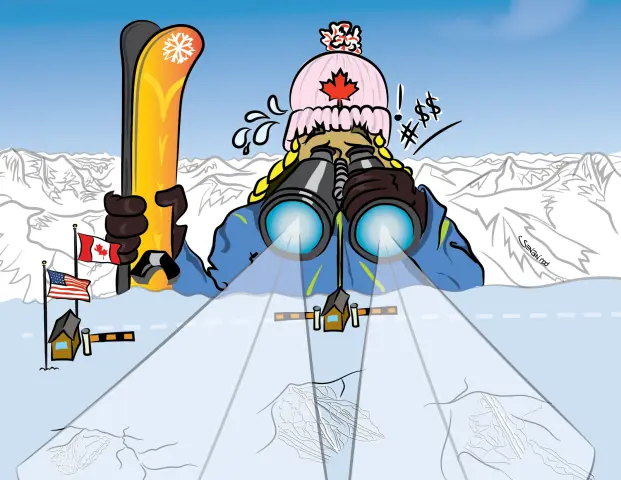

Amazing things are happening over at U.S. Ski Association. By its own choice, and with a mandate from its membership, it is literally tearing itself to pieces and re-building itself into a wholly new organization with new goals, new priorities, new image and new infrastructure. And it is doing it all in a year.
It is perhaps an oversimplification, but not totally misleading, to say that the new name of the game at USSA is skier advocacy—speaking up for the rights and interests of skiers.
Because USSA will frequently, in the future, be battling for the same things our ski area industry wants—at least we hope it will—it is well that we pay close attention to what they are doing and saying. To this end we excerpt first from a news release by Jack Soper, editor of Eastern Division’s newspaper, Skier. Following that we will excerpt from some remarks made by the newly-appointed Director of Public Relations for USSA, T. Mark O’Reilly.
“The board of directors of the United States Ski Association have voted overwhelmingly to reorganize that national sports federation. The board directed the USSA long range planning group to supply a complete plan for nationalization no later than February 1, 1978.
“The planning goals endorsed by the board included a strong, centralized authority for the Association, as opposed to current regional rivalries; centralized collection and management of all income and expenses, as opposed to the 10 independent accounting and budgeting systems; and national governance by proportional voting of all USSA members.
“The plan, as outlined currently by the Association, calls for all overhead functions of the nine divisions to be brought under one roof in a “national service” center. This national office will provide the membership processing and computer services for the entire country, as well as national publications and information services. The national office will collect a uniform dues payment from every member, then disburse dues income to regional service centers according to need.
“The regional service centers will be located where membership participation requires a local office and staff support, not as now in nine locations dictated by a political structure.
“Presenting more of a problem to the planners and to the organization at large is the question of how best to design the structural details of the new USSA, and how to untangle the political snarl which currently hampers the responsiveness of the organization.
“At the board meeting, every director of USSA was asked to comment on the plan as outlined. There was unanimous agreement that something had to be done to get USSA moving as a spokesman for all skiers, and there was strong agreement that nationalization at the expense of divisional autonomy was the correct path.
And now some excerpts from remarks made by T. Mark O’Reilly to the USSA Board of Directors in October, with apologies to him for any stylistic lapses occasioned by our cut-and-paste job.
“Public affairs has emerged in the last decade as an important aspect of corporate public relations. This development is a reaction to the growing scope of government’s involvement in business as a regulator and as a customer, as well as society’s demand tht business participate in answering major social questions. Each of you is aware, I am sure, of the growing influence of government on your personal life as well as your professional life. Skiing has not escaped this trend.
“Traditionally, many businessmen have resisted and resented the idea that business should have any other social responsibility than making a maximum profit for its stockholders. Likewise, many sports organizations have resisted any suggestion that their role should be more than as organizers of competition and social functions. Nonetheless, it has been impossible to ignore the increased intrusion, or perhaps involvement is a more polite term, of government into almost all areas of economic and social activity, including sports.
“Business has discovered that automatic opposition to federal programs or regulations has proved fruitless at the worst, and a delaying tactic at best. Many corporations have adopted the philosophy that the best way to stop government encroachment in the private sector is for business to take the initiative in problem-solving.
“USSA must follow business’ lead. The role of bystander is out of character for skiers as individuals. We pride ourselves on being active participants. USSA must take the initiative in speaking out on behalf of our members to advocate better programs and facilities for the athlete and the skiing public.”
Here O’Reilly went into details of the Roadless Area Review and Evaluation being undertaken by the Forest Service. He pointed out that the USSA had a major stake in this since “roadless areas will be identified on the basis of a more liberal standard than that set forth in the Wilderness Act of 1964 . . . and this will have a major impact on the availability of lands for skiing facilities since a substantial percentage of the nation’s potential winter sports sites could be removed from multiple use classification.
“Why the stampede to reclassify multiple-use lands as wilderness? There seems to be no recognition that skiing facilities are not the ecological equivalent of steel mills or strip mines. The image of a ski resort is not billowing clouds of sulphurous smoke or giant steamshovels gouging holes in the earth. To quote a recently popular song, we are not out to “pave paradise, put up a parking lot”. What USSA might reasonably seek is:
“1. Nordic. Adequate winter access to suitable terrain. Parking and sanitary facilities at trailheads. Trail marking and maintenance. A system of huts for safety and overnight accommodation.
“2. Alpine. Reasonably short liftlines. Slopes which are not overcrowded to the point of being unsafe. Affordable lift tickets. Adequate base facilities and accommodations.
“Neither of these is an unreasonable desire but both of them depend on the development of new skiing facilities to accommodate the nation’s growing population and increased availability of leisure time to pursue recreational .
“Now what? USSA must become a clearinghouse for information and ideas and an effective communicator with the government, the skiing industry, the skiing public, and the public at large. We have to do our homework. We must gather and evaluate the information required to deal with the difficult problems which face us. We must make this information available to those who need it. We must avoid misrepresentation and misunderstanding of our position. And we must interpret USSA’s goals, policies and activities in a way which will gain public acceptance and support. To say that this is a complex task is an understatement.
“In addressing issues of public concern, we are faced with a difficult question. What about priorities? In what order should government consider national defense, education, highways, housing, health care, mass transportation, agriculture, or space exploration? And what about skiing facilities and wilderness? All of us want to be perceived as having a social conscience, but we also wish to have our needs and wants to be given a high priority. But this is the challenge: to defend our values as being compatible with the social good.
“Direct and continuing involvement, while recognizing the risk of controversy or failure, can produce results.”