


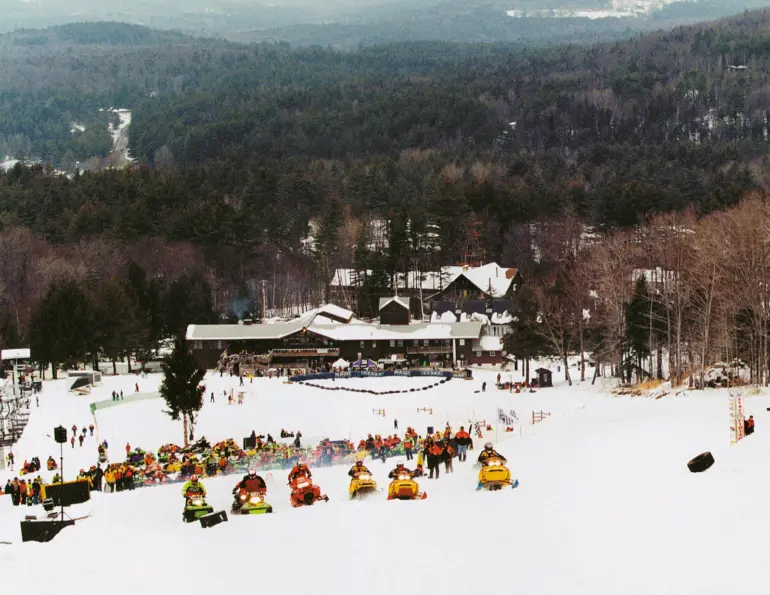
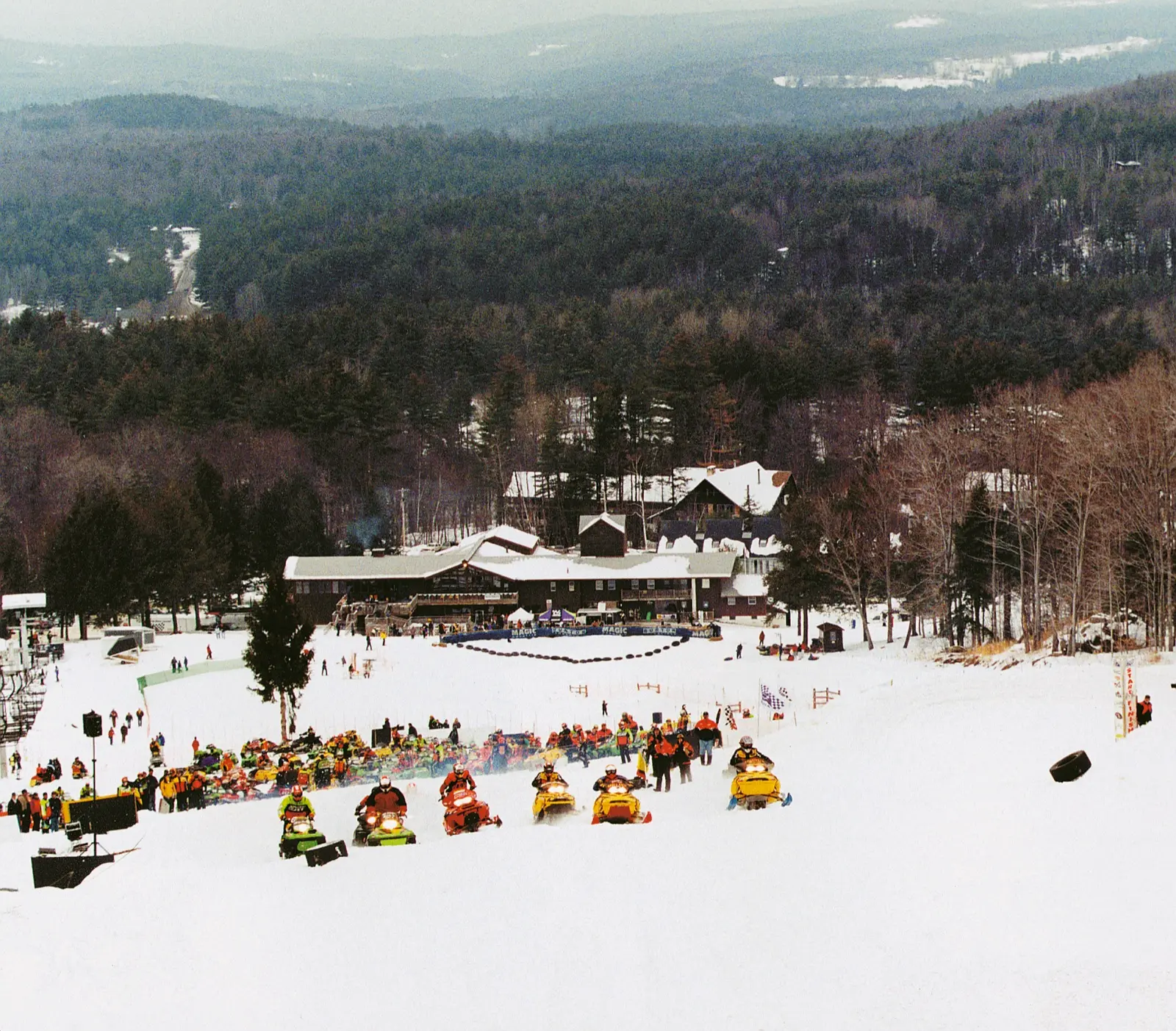
Photos by Pierre Catellier and courtesy of Rock Maple Racing.
Its existence is not new to some, especially residents of the Midwest and northwestern Canada where flat land and frequent snow lends itself to snowmobiling. But for those in the East, West and Rockies, the concept may be relatively new. And among the kids, Snocross is gaining in popularity. At the Winter X Games the past two years at Mount Snow, Snocross was the most heavily attended event, with roughly 10,000 spectators watching each day.
Dave Anderson, director of marketing for Loon Mountain, N.H., realized the limits of the current ski and snowboard population and looked to Snocross. “Many guests came out for an event that would not normally be there at that time.” Loon attracted 3,000 spectators for a race and had over 330 entries. This was during the second weekend of December.
The organizers of the event, Rock Maple Racing (RMR), have been staging Snocross races for 10 years. When RMR comes in, they handle the course layout, design and construction using the area’s snowcats, all of the registration for the event, staffing, race management and the awards. The ski area operates the gate, parking, food and beverage and all prep work with snowmaking. Insurance considerations depend on carrier and state.
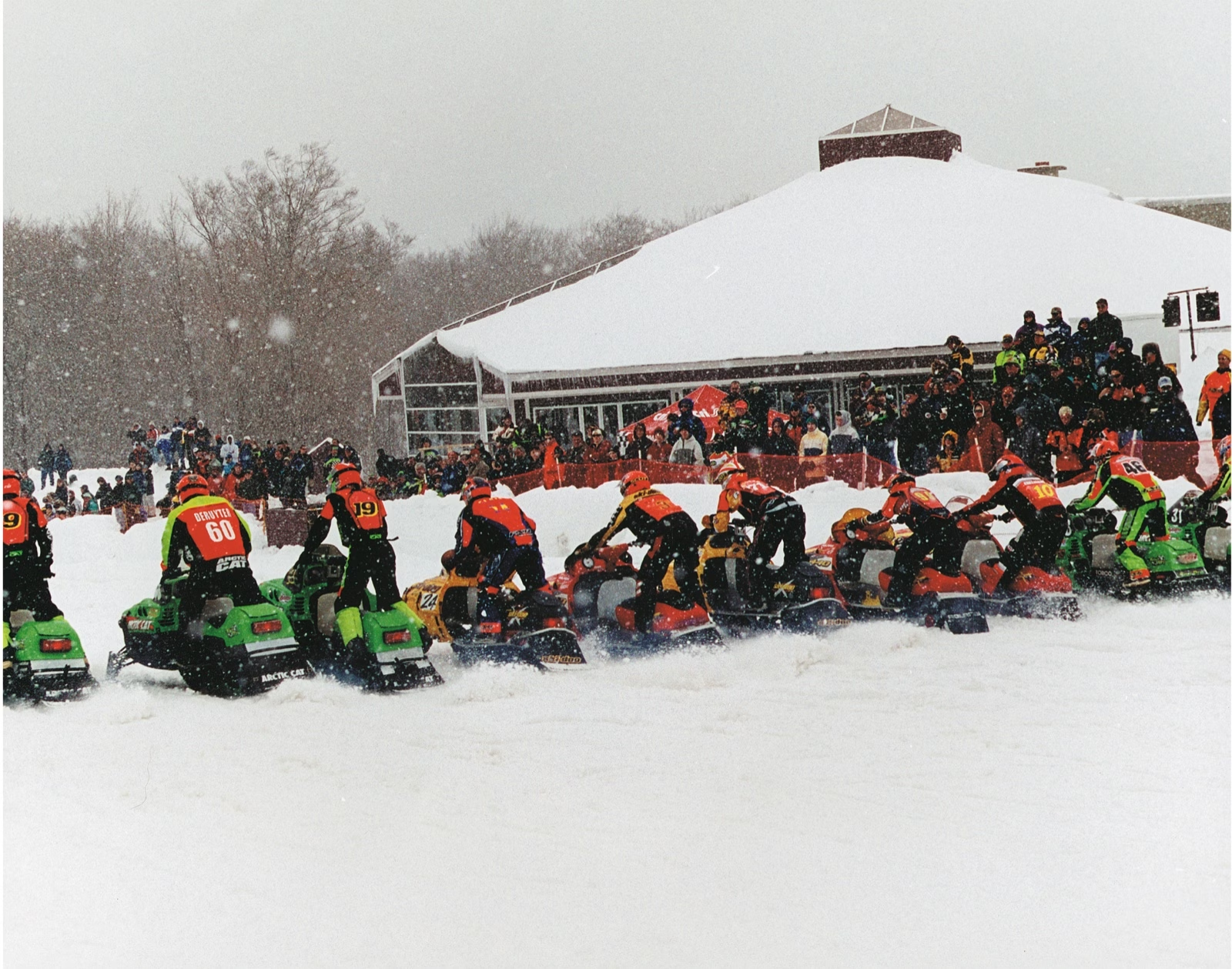
Photos by Pierre Catellier and courtesy of Rock Maple Racing.
For the 2000/01 season, RMR went to ski areas for four out of the 12 stops on their winter tour: Jack Frost, Pa., McCauley Mountain., N.Y., Loon Mountain, N.H., and Haystack, Vt. Each was a Saturday/Sunday event so the following numbers are totals for each weekend. According to Beth Walling, who prepares advertising and site and sponsor correspondence for RMR, Jack Frost had 350 entrants and 1,000 spectators, McCauley had 480 entries and 2,000 spectators (and it rained on Saturday) and Loon had 333 entries and 3,000 spectators. Haystack had two dates: in December the area drew 640 entries and 1,200 spectators (rainy weather) and in March they had 620 entries and more than 3,000 spectators.
Some resorts, like Attitash, choose to organize their own event. “We realize that people do more than just ski and snowboard, and that many of our customers have snowmobiles and some of them even race,” says John Urdi, vice president of marketing and sales at Attitash/Bear Peak, N.H. “By offering them a place to watch or even race, we hope to emphasize Attitash as their first choice for activity and entertainment.” Urdi said that Snocross doesn’t just impact the ski area but the surrounding region, “At the end of the season there is a tremendous amount of down time; restaurants and lodging are at lower capacities. By hosting an event that the whole community can come up and watch and participate in, we are working together to promote the Mt. Washington Valley as a whole.”
Snocross is also a family event. Forty-five percent of RMR’s entrants have a mother, father and brother or sister who also races. In fact, RMR has multiple classes specifically designed to incorporate the family unit. Aside from the normal Sport (novice), Semi Pro (amateur) and Pro (expert) classes, which can total as many as 15 when all the engine-size classifications are added in, they also have five women’s classes, including a women’s legends (which is for women over 40), a masters (for men over 40) and eight kids classes with children as young as five years old racing.
The real profit, however, is not in entries but in the spectators, who paid on average $10 each. Last year’s spectator figures translated to $10,000 to Jack Frost, $20,000 to McCauley, $42,000 to Haystack and $30,000 to Loon. This does not take into consideration the F&B and retail sales the resorts make from the added traffic at the event. Additionally, because the races are two-day events, lodging revenues can also be added to a resort’s bottom line.
If the ski area leaves the organizing to an outfit such as RMR, like any other promoter, they keep all entry fees and sponsorship dollars they bring in. RMR also charges each resort a hosting fee to cover event costs and promotion. But, according to RMR’s president, Dan Finck, as long as a resort draws between 700 to 800 spectators, they will recoup that money. Each area is expected to market its own event, while the organizer (RMR) promotes the series as a whole.

When asked why he chooses to work with ski areas, Finck said, “The resorts are able to offer us as good a guarantee on snow as we could have. The use of their grooming vehicles makes course design and maintenance a snap. But one of the really nice features are the indoor amenities such as bathrooms, office space and shops for those who are not racing. It is also nice to have restaurants for families to go to after the race and, of course, excellent lodging for all.”
This season, RMR will be adding Berkshire East, Mass., as well as Burke Mountain and Mount Snow in Vermont, to the growing roster of resort host venues.
In fact, ski areas around the continent are taking a hard look at Snocross. Rob Megnin, director of marketing for Eldora Ski Area, Colo., is considering several new ideas for his resort this year, including Snocross. In the extremely competitive environment of the front range, Eldora is looking to add value and options for guests. “We are trying to get creative and attract a wider audience,” he said. “Snowboarding is not going to fully replace the rapidly aging ski community that we will be losing in the next 10 years.”
The writing is on the wall—this sport, and motor sports in general, are rapidly gaining in popularity. While it’s not the answer for some resorts, for others, it is yet another opportunity to bring new people to the hill.
For more information on Rock Maple Racing, contact Don Finck at 802-368-2747 or on the Internet check out their Website at www.rockmaple.com

