

Ski area construction is regulated by various county and state codes, the Aerial Passenger Tramways code and at times by the U.S. Forest Service or other public agencies when public safety and effects on the environment are factors. The forest service also attempts to guide ski area permittees into economically-sound situations and provides advice in overall planning. Mainly, however, it is up to the developer, himself, to determine what his goals are and how to achieve them, and any profits or losses will be the result of his planning. Errors and oversights in basic planning are long-lasting, difficult to live with and expensive to cure. Therefore intelligent planning, based on intimate familiarity with the terrain and the weather factors one is dealing with, is of paramount importance, particularly where heavy snowfall is routine and where high winds are frequent.
Avalanche
One of the first concerns of the planner should be to locate fixed facilities, roadways and parking lots so they are avalanche-free under all circumstances. Completely avalanche-free lifts are not always possible, however, the terminals must be located in avalanche-free spots and any line towers unavoidably placed in an avalanche path (even an infrequent slider) must be protected by appropriate barriers or dividers. In most cases tower locations and heights can be adjusted to avoid avalanche paths, but if a lift must traverse a broad avalanche path protection is required.
At any area, first-phase installations should include carefully-chosen facilities that will serve as “storm lifts” for the skiers who will brave the elements under heavy snowfall and high winds. The terrain here need not necessarily include advanced or expert trails. Slope development at these storm lifts should provide natural light and shadow from tree groups so flat light is minimized and visibility, under all conditions, maximized. Wherever possible, lift design and location should provide for minimum avalanche hazard trails so the maximum number of facilities can be operated under any and all conditions, even while avalanche control operations are being performed in the hazardous zones.
Designing for avalanche in this way provides for limited lift operations while avalanche control is being performed in the slide zones, and allows all hands to relax in the lodge, confident of the security of the facilities, when the storms move in with blinding winds and snowfall.
Drift Zones
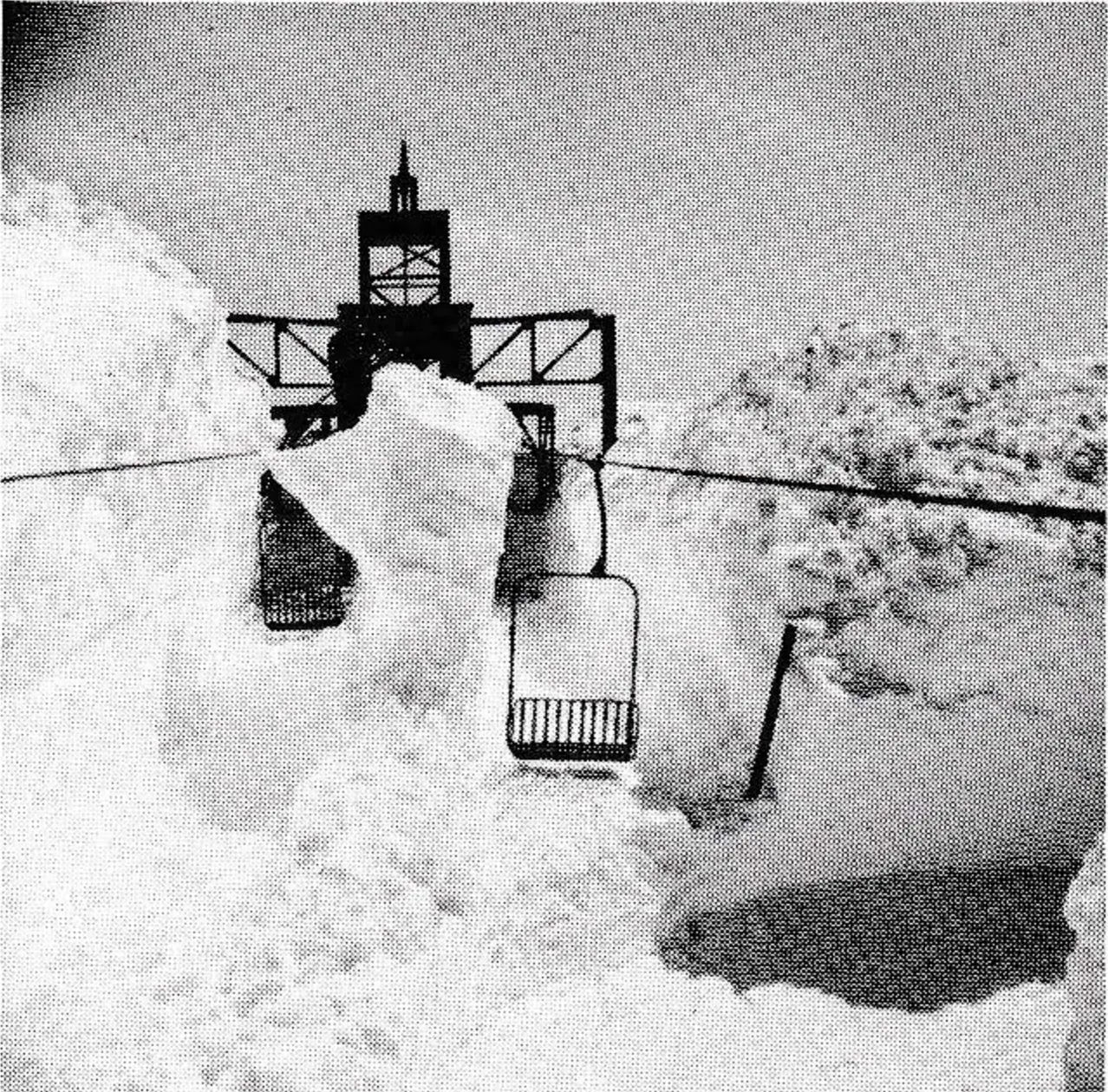
Winds pick snow up here and put it there! They form a cornice on one side of a ridge and leave a bare slope 30 ft. away. They bury a facility on one side of a knob while rocks and brush are showing on the other side. Where and how much are the questions. The “where” is fairly constant, the “how much” varies with seasonal snowfall and the vagaries of the wind from storm to storm.
It is a tough problem. The planner wants to transport skiers from ideal lower terminal A to ideal upper terminal B so that superb slopes C will be accessible. At this point, he must consider wind sweeping and drifting patterns so that terminals will be neither left high and dry on an acre of windswept rubble nor buried in a drift. At the same time, the lift line must avoid deep drifts by changing the lift line or using taller towers. It’s not simple. Moving the lift line requires a move of at least one terminal, and taller towers are undesirable at times for reasons of cost, safety, increased exposure to winds, and esthetics.
Building location and placement of doors should be carefully planned, too. This includes consideration of the effect the structure will have on local wind and snow deposit patterns. There is no point in building a shoveling program into a structure when a slightly different design, orientation, or location can eliminate the need for it.
Wind-Scoured Zones
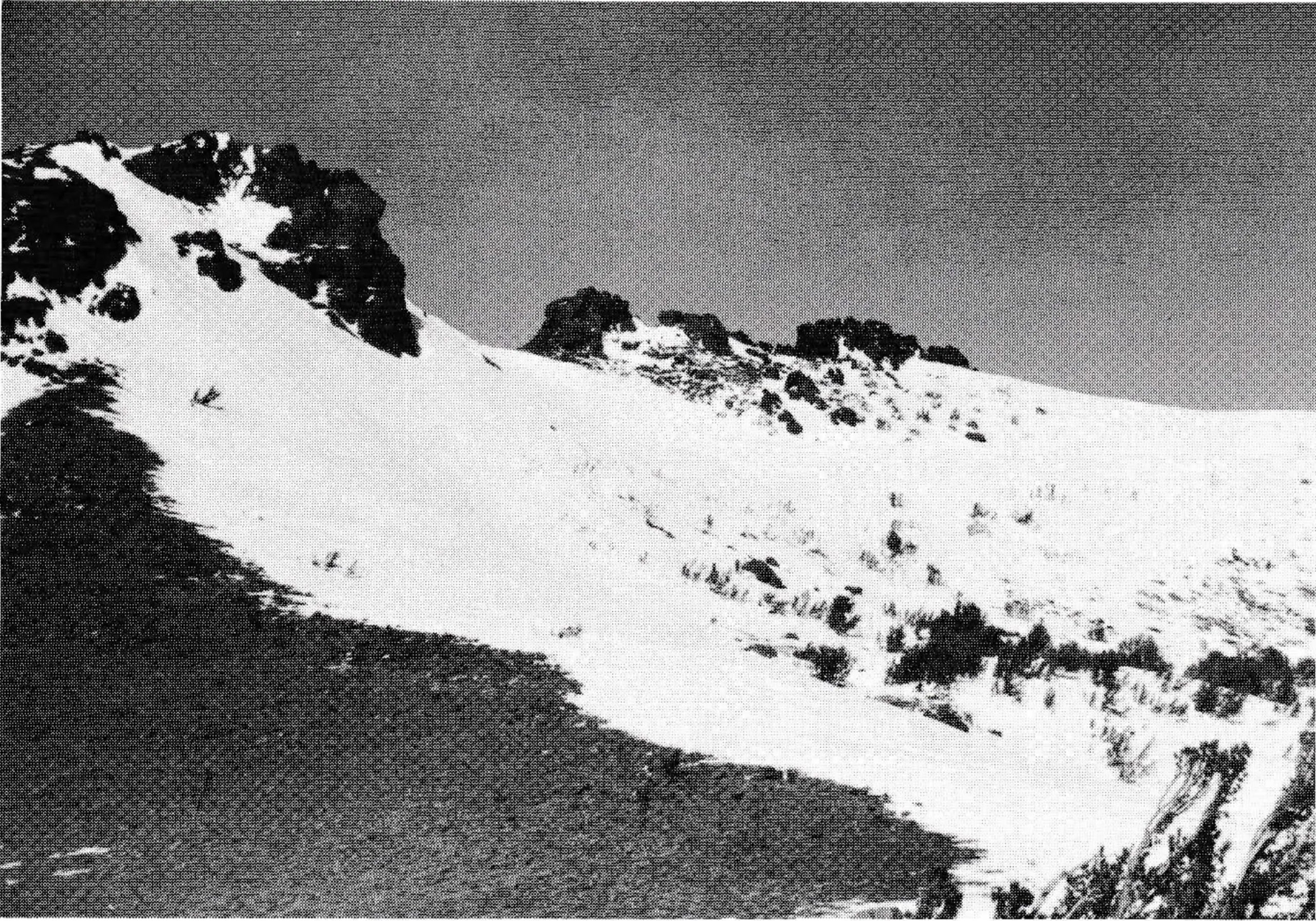
Some slopes are wind stripped to the point that they retain little or no snow at their upper levels. The wind selects these points on the basis of their form and orientation, primarily on what is up-wind of them.
Bare spots on ski slopes are usually taken in stride by skiers. However, if the bare area surrounds an upper lift terminal, or cuts off access to an attractive slope, the objection will be much stronger and will lower the popularity of the lift. The obvious cure is to put the terminal somewhere else or find a better ski slope, but sometimes there is no alternative. A test structure should be erected first, in a temporary, mobile form so that the best type, size, and location can be determined. Then the planner should place the terminal as best he can, to cause the wind to deposit snow where it is needed.
A key slope with wind-stripped upper reaches can be made usable by creating a snow lane through the stripped zone, but some experimentation will be necessary. In the case of extreme wind exposure the snow lane will probably not be more than a passage through an otherwise barren area, but it should be serviceable.
High Winds Affecting Operations
Any lift can be shut down by high winds, but the frequency is determined by the location and orientation of the lift. Again it is not always possible to place a facility to best advantage for all considerations, so some calculated give and take is in order.
Near Lake Tahoe a classic and dramatic comparative example exists. Two lifts of the same make, serving the same ridge line, at the same altitude, lie within three miles of each other. The two lifts are oriented almost 90 degrees from each other. One lift tops out and instantly terminates on the ridge top. The other breaks over a high saddle, parallels the ridge for about 600 horizontal feet, then finally tops out and travels on the crest for some 300 more feet to the upper terminal and idler sheave. The first lift is rarely closed down by wind. The second one is frequently closed down by storm winds from the southwest and by fair weather winds from the east. The problems of the second lift could have been avoided had the builder accepted a bit less elevation, a bit less spectacular view, and a bit less terrain served.

As this example shows, the planner must analyze terrain and weather and fit the facility into an environment where it will be usable under all but extreme weather conditions, even if it falls short of serving a maximum amount of terrain. On a sunny Saturday in February a nonfunctioning, though spectacular, lift is of little value.
High Water
The effects of moving water are an urgent concern of the planner. He must analyze terrain, water courses, and flood plains to fit his installations into the natural pattern. Building in a flood plain or on an alluvial fan will sooner or later result in hip boots in the lodge lobby. Meddling with a water course of any size is unlawful unless it is carefully engineered and authorized by the appropriate public agency, and it can lead to immediate and long-term woes of many sorts if done indiscriminately. Moreover no one wants to face criticism from an ecology-minded public for messing up a stream.
Many ski slopes have been made less attractive, or even unusable, where indiscriminate logging or construction practices have created a gully that nature had not intended. Logs dropped here and there into a stream can cause ponding, followed by a sudden breakout, resulting in downstream damage and erosion from the rushing crest. Another possible result of disturbance of the streambed is damming and sedimentation, followed by significant widening of the streambed or even carving of a completely new channel, should the water find a line of less resistance.
Road layout and drainage should be done with a view to maintaining the natural waterflow patterns. Culverts should be engineered as to diameter and length and properly installed, then maintained and cleared of debris and sediment annually. A natural streambed contains bends, boulders, large roots, waterfalls, and pools that retard waterflow through turbulence and energy loss. Containing a stream in a culvert over a long distance will cause a head to develop that can greatly alter the area downstream of the culvert.
The overall effects of moving water, and of the sediments and debris it transports, are cumulative. Because last year’s record flood did not wash out a road, slope, or lift shack is no cause for complacency. That flood may have laid groundwork for a completely different washout pattern next year.
Preplanning
The planner should accumulate intimate knowledge of his area. Long-term weather and snowfall records are invaluable. Oblique aerial photographs, taken winter and summer, are useful. An intensive program of observation of wind, water, snowfall and avalanche is a must. Intensive observations go beyond installing an anemometer on the peak and a snow stake somewhere. They must include observation of wind speed and directions at proposed lift terminals and lift lines, analysis of snow deposit patterns and experienced, knowledgeable interpretation of avalanche terrain. If inducement of snow deposit is required at certain points or if cornice elimination is needed on a certain ridge, test structures should be erected, evaluated, and refined during the planning stage. The many considerations to avoid being caught in or creating, flood and erosion problems are a vital part of master planning.
Overall planning should be tailored to achieve compatibility with specific situations at specific locations. For example, a long lift, frequently wind-battered at the upper elevations, could be broken into two lifts at a strategic point so that the lower portion would be operable when the upper portion is not, or so that the upper portion could be oriented differently to accommodate wind activity or avoid avalanche paths.
The planner must think of the effects of many other things: underground utility lines; roads and facilities installed on unstable ground; changes in snow deposit patterns from high winds when trees are removed; the power of snow creep; creation of avalanche paths by extensive tree removal; and elimination of rime icing that can shut down lifts.
In summary, study will provide knowledge that many ski areas have come by only through years of trial and error (and some chaos, expense, and customer dissatisfaction) and will allow a realistic development plan, free of unnecessary or self-inflicted problems.