

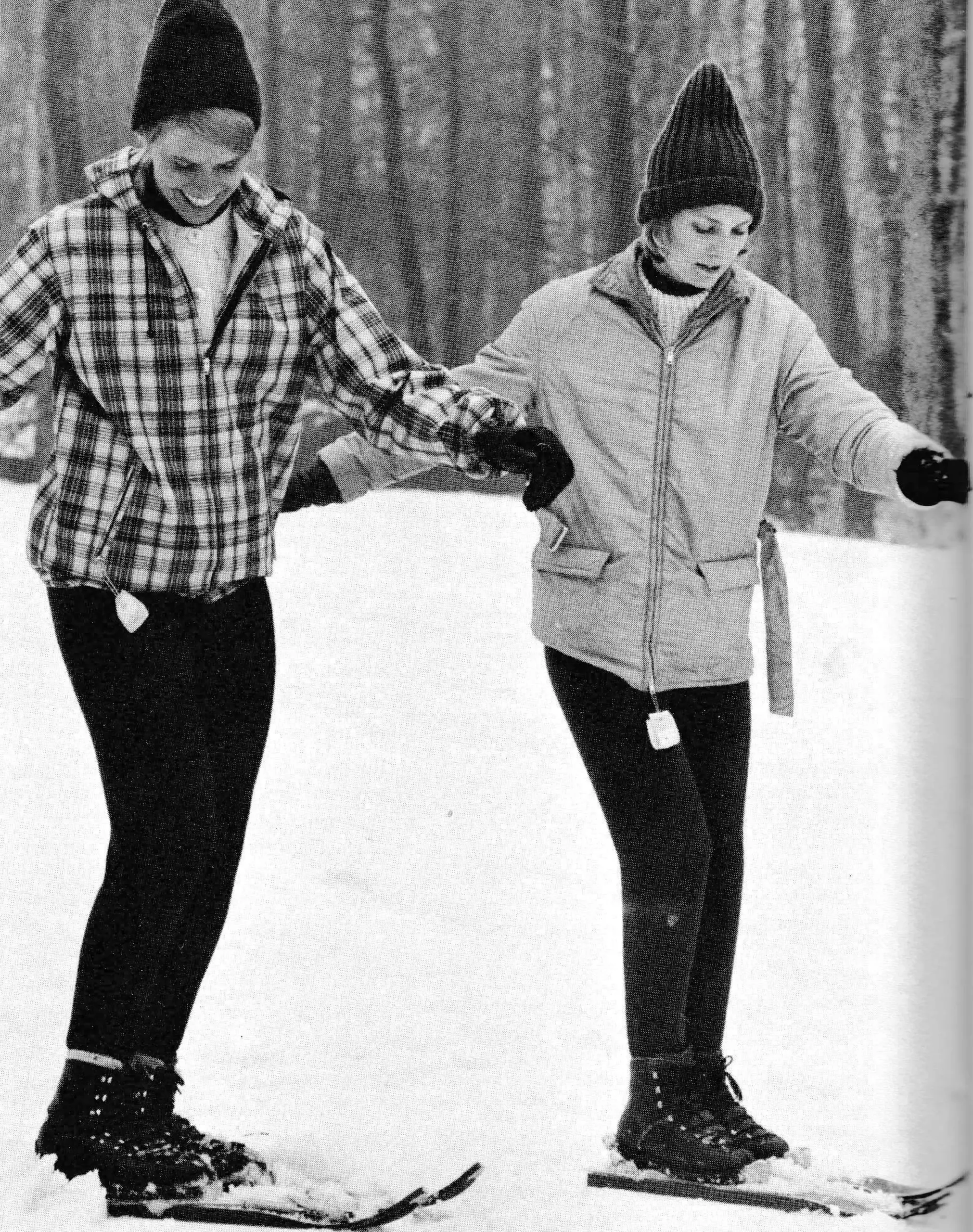
This last season, Head Ski Co. made an historic first attempt (by a manufacturer) to actively promote a specific teaching method, using specially-supplied equipment. In this case, the equipment was Head short skis. The method was called Head-Way, which is broadly speaking a GLM or graduated length method program, utilizing three-foot skis for first-day students.
Queried at length by SKI AREA MANAGEMENT, three sample areas participating in Head-Way reported a highly-successful season.
The three areas cited the following advantages for Head-Way GLM: 1. normally unathletic people were strongly motivated by the Head-Way system to learn to ski; 2. pupils had more fun; 3. injury rates were dramatically reduced; 4. GLM was easier to teach; 5. greater numbers of pupils came back for the second, third, fourth and fifth lessons; 6. ex-students came back later in the season in goodly numbers just to ski; and 7. Head-Way’s local and national promotion programs attracted new customers for the area’s ski schools.
Head-Way grew out of the graduated length method test program run jointly by Killington ski area in Vermont and SKI Magazine in 1965 and 1966. Karl Pfeiffer, head of the Killington school, tested the method by starting pupils on three-foot skis and then “graduating” them to longer and longer skis as they improved. By the end of a week, they were on five-/or six-foot skis. As in the original GLM invented by Cliff Taylor, at Hogback, Vt., students were taught parallel from the beginning, with no stem turns. Pfeiffer soon found that the GLM pupils were doing considerably better than those in his regular long-ski classes in the Killington school. During the course of his tests, Pfeiffer induced Head Ski Co. to make the first metal three-foot ski for GLM for the use of his pupils. Last season, Head hired Pfeiffer to set up Killington’s version of GLM on a national franchise program basis under the name Head-Way to promote the use of Head short skis.
As the program is run now, Head-Way asks participating schools to spend $1,000 on promotion of GLM and, in return, Head-Way “installs” GLM at the school by running clinics for the instructors, promoting the method locally and nationally, and supervising the school’s GLM program during the winter with periodic visits and consultations.
The three schools whose operations were under review by SAM were Sugarloaf, Me., ski school run by Harry Baxter; Big Bromley, Vt., ski school under Herman Goellner, and Northwest Ski Schools, Inc. of Snoqualmie Summit, in association with King Head-Way, of Seattle, a corporation set up to finance the GLM school.
Here, summarized, are the conclusions:
First, GLM motivates pupils. GLM pupils have fun. Pupils got on the lifts in an hour or so, instead of spending days climbing at the bottom of the novice hill, making one snowplow turn, then climbing again. Typical of the comments on the motivational power of GLM: Fred Rogers, general manager of Big Bromley, said, “Lifts weren’t built because people like to climb.”
Rogers found, “almost 100 per cent of any American technique beginning class that we sent out changed over to GLM because the GLM people were having so much fun. The two classes started together on our novice area and within an hour the Head-Way class was going to the top of the hill. The American technique class spent 2½ days before they got far enough along that they could go up, so when they saw that the GLM people were going up the hill, and they weren’t, they went down to the ski shop and swapped over.”
Dropout rates decreased dramatically. Ralph Hemingway, director-owner of the Northwest Ski School at Snoqualmie Summit, where King Head-Way operated, said, “We had very few dropouts. Our regular school had about a 15 per cent dropout rate, with GLM it was two per cent.” And Sugarloaf’s ski school director, Harry Baxter, reported, “We definitely had many fewer dropouts with GLM. By far.”
GLM also produced fewer injuries. Sugarloaf had nearly 5,000 (out of 15,000) students taking GLM in 1970-71 and had only one injury on GLM skis all year. Bromley has had GLM for two years and reported no injuries at all this year on three-foot skis.
GLM was also easier to teach. After some initial resistance, instructors from all three resorts took to the GLM program. Speaking for Sugarloaf, Baxter reported, “The instructors liked GLM much better because they didn’t have to spend so much time walking with the pupils and holding their ski tips while they were trying to snowplow, and that sort of thing. So GLM is a much faster way of learning; it makes an intermediate skier a lot quicker. Once the instructors found out how much easier it was to teach in this program, they all became very enthused about GLM.” Pupils get up the lift sooner and, “even ski instructors like to ride the lift,” as Fred Rogers of Bromley put it.
The King Head-Way instructors were even more amenable to GLM. “The only problem I had with my instructors was getting them to sit long enough to go through a clinic. Once they got on the 100-cm. skis or the 150-cm. skis, off they went to ski the powder. I sat here with a big whip and got them to settle down . . .” said Hemingway, adding, “We re-evaluated the last season with the instructors and all they could do was praise GLM. This is the first time we have started a unique school like this, and yet we have not had a black mark against us, in any way. The instructors made out like bandits. After class, they’d come in with bottles of booze, sweaters and gloves from grateful students. I should have been out there and been a recipient, but I had to stay inside.”
The areas reported unanimously that GLM was especially effective for teaching the unathletic: the out-of-shape person, the older person; the kind of people who might never have learned to enjoy the sport if they had had to learn via the old snowplow approach. “We had no criticism of the GLM program at all. We had many compliments, especially from older people who had tried the other method with longer skis, and then gave this a try,” reported Sugarloaf.
Bromley’s Fred Rogers said, “A guy from a metropolitan area is not necessarily an athlete, or in shape, or capable of handling longer skis. Our GLM allowed him to get in shape as he learned. He was not required to get strong right away.”
Out in Seattle, some of the executives of the King Broadcasting Co. (which was behind King Head-Way’s financing) were taken out in a super-quick, three-day learn to ski week.” Said Ralph Hemingway, “I couldn’t believe it. I couldn’t believe my own eyes. I became a believer real, real quick. I can’t keep these guys off skis now long enough to have business meetings. Here was some guy who had never really gone outside, never really seen the outdoors. He’d sit around at home and watch TV. Now every weekend, he goes to a different area. His wife is sort of ticked off at me because he doesn’t take her. There’s nothing I can do about it. She’ll learn to ski next year.”

The three areas varied somewhat in their handling of the ski ownership problem. At Bromley and Sugarloaf, the GLM skis were handled by the area ski shop. At Sugarloaf, in addition, the ski school invested about $700 and purchased enough GLM skis so each of their instructors could have his own permanent set of three-foot and five-foot skis. King Head-Way in Seattle shared their investment in the GLM rental skis with the King Broadcasting Co. and Northwest Ski Schools Inc. At Snoqualmie Summit the skis were handled right on the slopes by the ski school.
GLM pupils kept coming back to use the skis, too.
The Bromley and Sugarloaf schools both said GLM was bringing more people into skiing and keeping them there. Baxter, at Sugarloaf, said, “It’s going to take the rental shop several seasons to get their money back; they have some $10,000 invested in skis and bindings, but they feel it’s a lot of new income for them. People come up here and take the five-day program and then, of course, we put them on standard-length skis, and they start buying new equipment. So the ski shop is definitely going to get a piece of the action there.” Bromley reported, “We also found that quite a few of the skiers that were skiing on long skis when they came up here would take GLM classes . . . and wind up buying a newer, better and shorter pair of skis.”
The areas, most of all, liked Head-Way because they were getting more people over-all taking lessons. Sugarloaf reported, “We had an increase of over 30 per cent in the ski school. GLM supplied 20 per cent of that increase . . . we will push the Head-Way graduated length method very hard next year.” King Head-Way had 1,100 people; 40 per cent of their lessons were GLM. They expect this to double next year: “We’ll run about 1,000 people through GLM next year. We’re pretty happy about that.” The King Head-Way Seattle shop got calls from as far away as England. “We had people from Texas, Oklahoma, Hawaii and Alaska, from all 50 states. People flew in for a GLM learn-to-ski-week program . . . We had more praise for our ski school than we’ve ever heard before.”
Bromley had a 40 per cent growth over the previous year. They largely credit Head-Way. Their lesson sales forecast for 1971-72 is a 100 per cent increase.
All the ski schools felt they had benefited from the Head-Way local and national program of promotion, because the promotion included city ski shops to recommend Head-Way areas. As Fred Rogers, of Bromley, said, “The people in the ski shops, who are probably the most credible person that beginners have to deal with, can talk about a technique which is credible to the skier, and then can talk about the areas which are participating in the Head-Way program.”
The resorts also found GLM helpful in remedial classes. Putting experienced but badly developed skiers on short skis, Bromley instructors were able to quickly correct bad habits and get them to ski parallel.
“The Head-Way GLM program allowed us to help skiers who had built in bad habits over a period of even 10 or 15 years,” said Rogers, “and these were skiers who still couldn’t do any better than a stem christie turn, or who always relied on leaning on the uphill ski or the downhill stem, or whatever one they had learned.
“We were able to take them on the short skis and give them the feeling early. No one can tell you how it feels to make a correct parallel turn. You’ve got to learn that feeling yourself. The instructors found that they could convey the feeling of a correct parallel turn faster on a short ski.”
Rogers summed up the value of GLM and Head-Way by saying: “We have found that over the last two years we’re receiving a higher number of these people back again and this is really what it is about, the consistency, the number of times that a skier will visit our area. This is it. I really think Head-Way has gone a long way toward this. I think that the ski industry of today would be twice the size that it is had something come along earlier like the short-ski method. . . We at Bromley like to see people ride the lift and enjoy the skiing, that’s the main thing. Our business here is to make skiers and not have dropouts.”
Other areas participating in Head-Way this season were:
- Blue Hills, Mass.
- Bousquet, Mass.
- Don Thomas Ski School, Mich.
- Gore Mountain, N.Y.
- Greek Peak, N.Y.
- June Mountain, Calif.
- Keystone,Colo.
- Roundtop, Penn.
- Seven Springs, Penn.
- Ski Haus, Ohio
- Sugar Mountain, N.C.
- Waterville Valley, N.H.
Karl Pfeiffer, of Head-Way, reported “I was pleased beyond my expectations by the success of the 1970-71 Head-Way program because I never thought it would go as well as it has the first year. The public really went for it. We established that the program is a very successful one at the individual areas, and proved from the teaching point of view that GLM is an easy way to teach. I think with the experience we have had, we will be able to put an even better promotional program together for next year. We look forward to at least 16-20 new areas offering Head-Way in the 1971-72 ski season.”