


Over the past six months, in an effort to stimulate the economy, the Federal Reserve has been lowering interest rates. As a result, the prime rate is currently at its lowest level in 14 years, and many businesses are realizing the benefits of borrowing.
There are, however, early signs of an economic upturn, which could eventually signal a rise in rates. A significant increase undoubtedly would have a negative financial impact on many corporate borrowers. As depicted in the “Prime Rate History” chart, if the prime were to return to its average level for 1989-90, it would rise to almost 10.5 percent, or four percentage points higher than it is now. For loans indexed to the prime rate, that represents an increase of $40,000 per annum per million dollars borrowed.
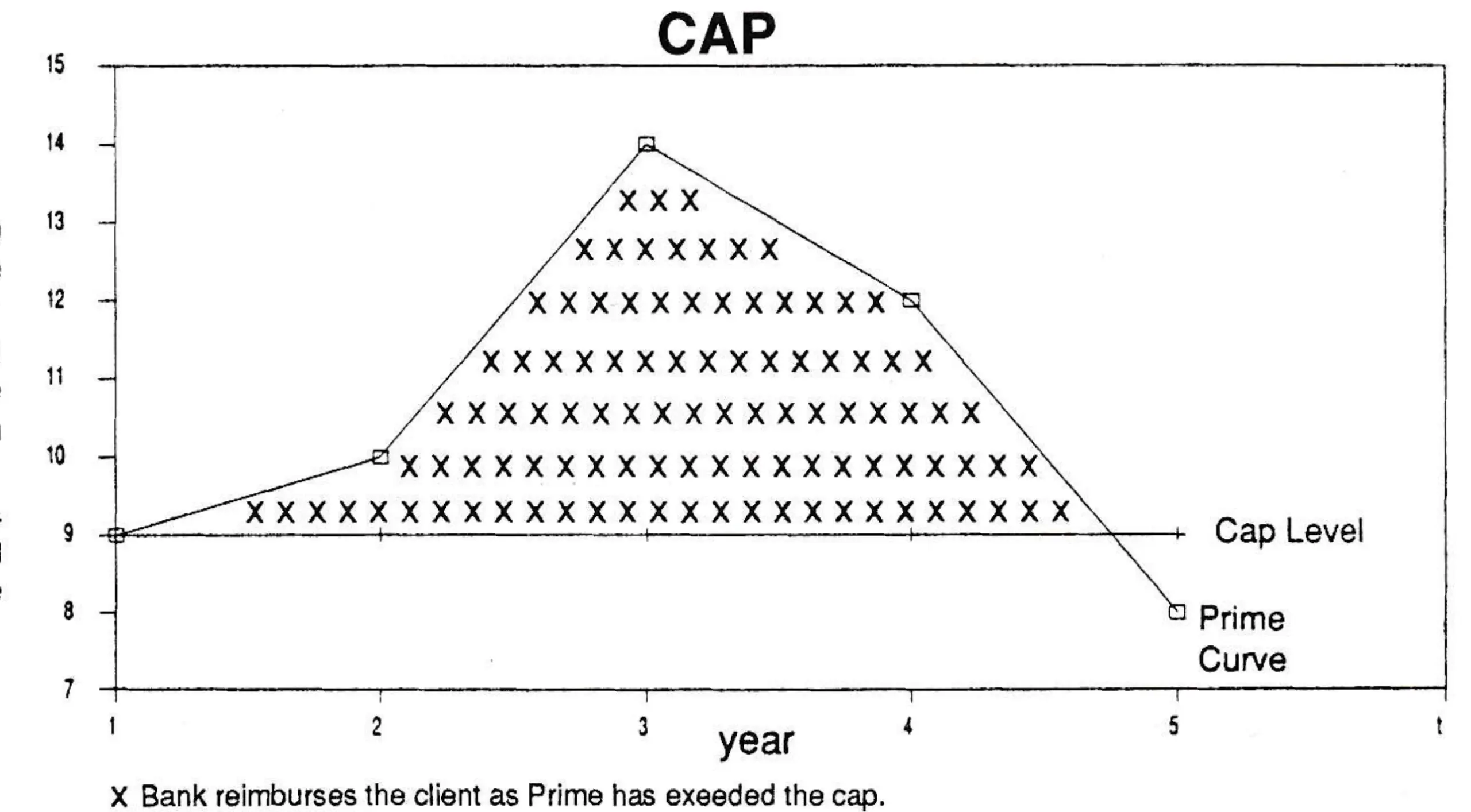
| Period | Forecasted Prime | Cap | Refund to Cap Buyer | Effective Borrowing Rate* |
|---|---|---|---|---|
| 1 | 9% | 9% | 0 | 9% |
| 2 | 10% | 9% | 1% | 9% |
| 3 | 14% | 9% | 5% | 9% |
| 4 | 12% | 9% | 3% | 9% |
| 5 | 8% | 9% | 0 | 8% |
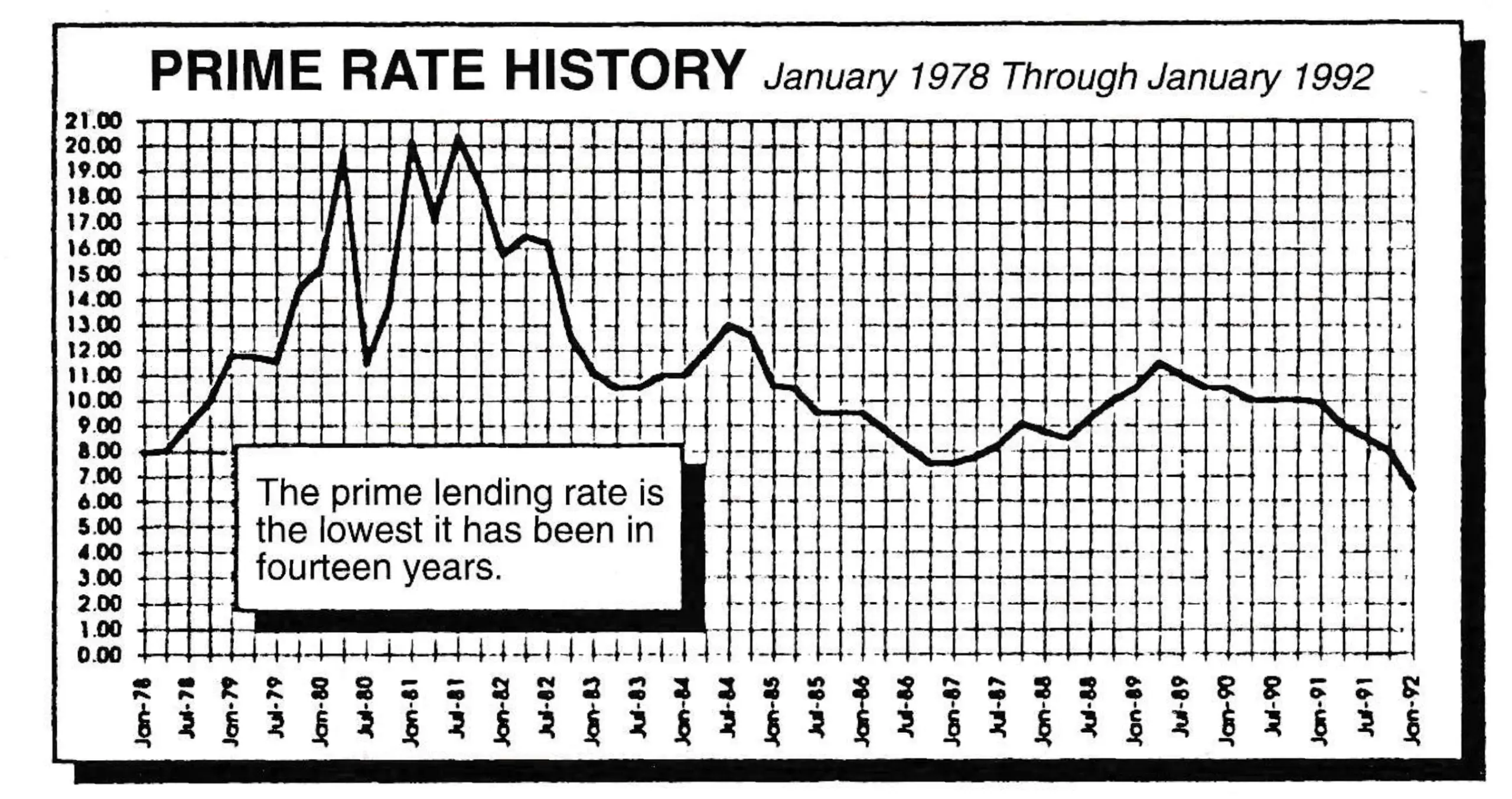
Such volatility in interest rates has created an active market in techniques for altering or controlling interest-rate risk. In one such hedging vehicle called the interest rate cap, if interest rates rise above a specified cap or ceiling, the cap underwriter (typically a bank or other financial institution) will reimburse the client for the difference between the cap rate and the current reference floating rate (that is, the prime).
In effect, an interest rate cap allows a purchaser the flexibility of having fixed-rate debt when interest rates are rising and floating-rate debt when interest rates are falling. In this way, a cap can be thought of as an insurance policy against a significant rise in interest rates.
In exchange for a one-time up-front fee, the cap underwriter agrees to compensate the client at the end of each quarter in which a pre-determined floating rate index (such as the prime rate rate) exceeds the specific cap rate. When the prime is below the cap, no payment or compensation is made and the client borrows at the current prime rate plus whatever spread the bank normally charges.
Prices of interest rate caps are quoted in basis points. The equivalent cost can be derived by multiplying the basis points by the amount of principal being protected. A cap quoted at 50 basis points on $4 million, for example, would cost $20,000.
Cap maturities (the term over which the agreement runs) vary from one to seven years, with two to four years the most frequently purchased. The amount of principal being hedged by the cap agreement can either be held constant or changed over the life of the cap. This feature is of particular advantage to seasonal borrowers such as ski areas, which typically have more debt outstanding during the off-season and less debt during the winter months. The minimum transaction amount is generally $1 million, and the price varies with the amount of principal covered, the cap rate, maturity and interest rate volatility. Caps can be quickly warranted by telephone and the legal documentation is short (typically three pages) and straightforward.

The primary advantage of a cap is that it provides interest rate protection while allowing the client to borrow at current floating rates, which are generally lower than fixed rates. In other words, the client benefits from declines in interest rates will retaining a hedge against a rise in rates. Unlike options or futures, the hedging cost and the level of protection are known throughout the cap period. Unlike fixed-rate debt, the borrower may prepay the underlying floating-rate debt without incurring prepayment penalties. In addition, the client retains the ability to liquidate the cap at market rates if the hedge is no longer required.
In addition to caps, there are other interest-rate protection products available, such as interest rate collars, a variation of interest rate caps. In which a floor is set in addition to a cap. Interest rate swaps are another variation that allows clients to exchange net future interest payments on an agreed notional principal amount.
In effect, an interest-rate collar caps the maximum rate and limits the minimum rate on a floating rate liability (thus reducing the cost vs. a straight cap). A swap allows the borrower to convert a floating-rate liability to a fixed-rate liability and vice versa, without changing the structure of existing credit facilities.
Even as the world’s capital markets expand and create business opportunities, there is increased volatility and higher risks. Interest rate caps, collars and swaps offer relatively low-cost and flexible alternatives to borrowers seeking to protect themselves from a significant rise in interest rates.