

Why does a ski area print its own newspaper? The question provokes varying responses from ski area operators, marketing personnel and observers, which fall into distinct categories: support or suspicion. Those who do not publish tend to give it negative marks, while those who do, believe it is a valid marketing tool.
Those who doubt the newspaper’s worth suggest that it might be a ski area’s attempt to glorify itself in print. An ego trip. They question whether or not skiers are “taken in” by “propaganda” and doubt that it contributes to sales.
Area newspaper advocates say the effort is not done to “reap” publicity, but to fill an information gap between the ski area, its market and its community. The newspaper is designed for readers whose interest in, and need for, comprehensive information about the ski area cannot be met by the brochure, existing channels of publicity or advertising. They document favorable feedback from their customers, citing the bond between the ski area and its skiers as well as the value of maintaining a solid skier constituency.
Yet, however, well-reasoned or defended, no one contends that a newspaper is appropriate for every ski area, or that every operator should run to the presses and start publishing. Best estimates are that nationwide, fewer than 5 per cent of the ski areas have newspapers . . . most of them east of the Mississippi. This estimate includes only those newspapers which are under the direction, and subject to responsibility of, the ski area.
While a few Colorado areas—Aspen, Vail, Steamboat and Copper—have local newspapers, most trained observers doubt their value in attracting or holding customers. This is true of other destination ski areas which are not only resorts, but towns where the ski and tourist business dominates the economic life of the community.
Even in the East, at Stowe, Vt., the Mt. Mansfield company has no in-house newspaper because it would be “out of character for the mountain.” However, the Mt. Mansfield Ski Club, with 2,000 members, has its own newsletter, and 10 per cent of the Stowe Reporter’s circulation is out-of-state.
But among the areas that do publish, basic information-giving is the reason most often cited for the effort. “Don’t underestimate the educational value of ski area newspapers,” says Rick Carter of Ski Sundown, Conn. He maintains skiers want to know what’s involved in snowmaking and other area operations as well as basic information not considered newsworthy by the other media.
Underlying this attitude is the belief that the ski consumer is unique and that to maintain markets and to achieve market growth, the consumer must feel a part of the skiing scene. He wants to know and be known to the ski area of his choice. The skier who receives the resort newspaper bearing his name and address knows that he is a recognized skier and that he is, in fact, a valued customer.
How does a ski area determine a need for this kind of involvement? The key, according to proponents, is to determine that an information gap does or does not exist.
Some indications of a need for a newspaper are: when there is a need for reaching consumers with more information than the brochure can hold; when an area operator notices that the costs for mimeograph supplies begin to equal or exceed the telephone bill; when he is asked by three ski clubs for a detailed explanation of next year’s price increases; and when neither the news media nor the purchase of advertising time or space can guarantee that a specific message will reach that specific market. In addition, there are many similarities among the areas that publish newspapers:
- A substantial number of their customers commute to the area.
- Primary markets are well-defined and concentrated.
- Numerous special programs and activities attract skiers.
- The availability of publicity and coverage of ski area news is limited.
However similar the answers to the question “why they do it,” ski areas with newspapers have different answers to the question “how they do it.” In fact, each area approaches its newspaper very personally and tailors the product to suit image and market characteristics. One area sells advertising and adheres to a standard newspaper format, while another assumes printing costs and uses a better grade of paper.
The major production problem in area publishing is the availability of personnel willing and able to do it. This, more than cost, is cited as one reason why there are not more ski area newspapers being printed.

“The first issue is a challenge, but subsequent to that, it becomes less difficult and more routine,” says Dave Buckman of Gunstock, N.H., who has published the Gunstock Gazette single-handedly twice each ski season for six years. Dave does the photography, copy, layout and paste-up before he delivers it to the printer. He says it takes him only about two weeks to prepare an issue for publication.
If this sounds like a hassle, consider these hints and recommendations from ski areas who’ve had the benefit of experience:
- Start by determining distribution: Who will get it and how to reach them. Better to underestimate requirements the first time and start small.
- Distribution is a primary determinant of format. Consider the limits of size and weight to minimize mailing ease and costs. Ski show handouts are affected by the cost of transporting to and from shows.
- Some area newspapers can be profit-making, so you might turn the newspaper over to an outside publisher. This cooperative arrangement is possible if the publisher is presently selling ads to those businessmen who would buy an ad in the ski area newspaper. In addition to assuming responsibility for advertising sales, billings, lay-out and printing, the publisher may even handle some distribution. In achieving this agreement, the ski area minimizes its responsibilities to that of furnishing copy and photographs and assumes only the expense of mailing or of other distribution.
- The local post office can furnish the latest regulations on third class/bulk mailing permits, and the postmaster can offer helpful hints and advice. There is an initial permit fee of about $20 and an annual fee of about $40. To qualify for the permit, the purchaser must agree to use it at least four times annually to send no fewer than 300 pieces of “like” printed matter through the mails. The cost per piece will vary from 7.5 cents to 10 cents depending upon weight.
- Preparation of the newspaper for mailing is, according to ski areas, the task which qualifies as an “ordeal” unless fewer than 1,000 pieces are being sent. Bulk permits require zip code identification, meticulous sorting and bagging and, because most ski area mailing lists and procedures are not scientifically organized, this may become a frustrating and time-consuming labor.
- To determine content, list the most newsworthy ski area stories starting with new developments throughout the area. Look for stories beyond the resort proper. This makes the newspaper look less like a “mouthpiece” and more like an objective, outside effort.
- The newspaper will have a longer-life if it includes matter not just for reading, but for reference. Select material which prompts the skier to retain the newspaper, at least until the next issue is scheduled.
- Finally, every newspaper proponent stresses that the ski area must attempt simply to report mountain activities and news, and resist the temptation to exhibit its own achievements.
Some Case Histories of Mountain Newspapers
KISSING BRIDGE, Glenwood, N.Y.
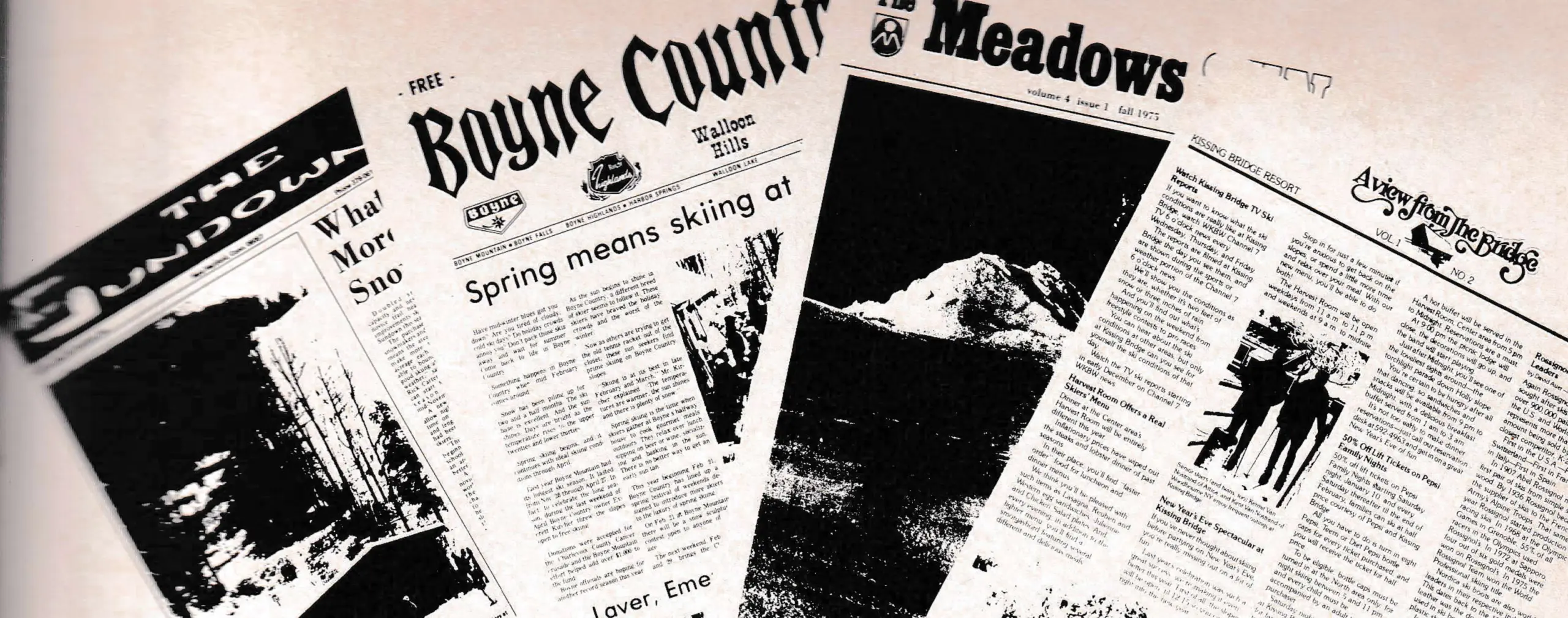
50,000 copies are printed in September, December and January. 20,000 are sent by direct mail to skiers; 10,000 mailed in bulk to out-of-town ski shops, travel bureaus and tourist information services, with the remainder distributed locally. The View from the Bridge format is newspaper-like with ad space sold by the area. “Our skiers read it cover to cover,” says Director of Skiing Bobby Foster. “We know of no other way to reach skiers with information on our numerous programs and happenings and it’s our responsibility to inform our market.”
SKI SUNDOWN, New Hartford, Conn.
14,000 copies were printed in the first annual issue last Fall and 1,000 were sent direct mail. The remainder was consumed by Hartford ski shops, local businesses and through the resort. The Sundowner consists of four pages of newsprint without advertising printed at a cost of $400. “Serving a metropolitan area, our skiers get more involved in our activities and they want to know what’s happening,” says Rick Carter, general manager.
JAY PEAK, Jay, Vt.
This ski area goes to press monthly year round with 3,000 copies of the Advocate. 2,000 copies are sent by direct mail, half of them to the mountain’s Canadian skiers. “Advertisements take space,” says Marketing Director Al Cahill, “so we hold it at four pages of copy to minimize mailing costs.” Printing expense is about $240. “We initiated the service last July after the third attempt of independent local newspapers failed to survive. Our effort fills this void and serves our customers and in the Fall we print 30,000 for distribution at ski shows.”
MT. HOOD MEADOWS, Oregon
Pre-season and mid-winter, the staff prepares The Meadows Sun for press runs of 10,000 copies, 50 per cent of which are sent direct mail to season pass holders, mailing lists and skiers who request information. The remaining half is distributed through ski shops and at ski shows. Business Manager Bill Farwig says the Sun has been an effective vehicle for four years, and the area will continue to utilize it “to keep customers up-to-date, to promote departments and various events during the season.” No ads are sold.
SNOQUALMIE SUMMIT,, Washington
The Snoqualmie Flyer is not strictly a newspaper, and according to area owner, Webb Moffett, this may be why it is so effective and valuable. “We publish 65,000 copies in the fall at a cost of only three cents each,” he says. Using heavier-than-newsprint stock, Moffett maximizes mileage by distributing it as a supplement to a ski feature section of a major newspaper. The front cover of the four-page paper—which is also the area’s brochure—is four-color.
GUNSTOCK, Laconia, N.H.
7,000 copies are printed for a Fall issue and 5,000 for a mid-winter (February) issue. Only 1,000 are mailed. Using a heavier stock of paper, this publication carries many photos and is free of advertising. The mountain’s cost is about $500 per issue. Local ski shops dispense 2,500 of the papers and the remainder are distributed through other local businesses. “We do it to provide skiers with a broader, more complete look at our ski area,” says Marketing Director Dave Buckman. “We receive excellent feedback, loyalty and involvement from our skiers.”
TELEMARK, Cable, Wis.
5,000 copies are issued weekly during the ski season, a practice which has been maintained for 10 years. No advertising is sold. The staff does all writing, photography and layout with the mountain assuming the cost of $525 per issue ($400 for printing, $125 for postage). “We publish our newspaper/newsletter to keep our property owners, ski shops, media and devoted skiers informed about activities and news developments at the area,” says owner Tony Wise.