
If you examine successful ski schools you’ll find those doing the “best” financially are the ones that offer the most creative and successful programs. Interestingly enough, these same schools put a great emphasis on instructor training knowing their product is ski instructing which means helping people enjoy and learn to ski.
Are instructor training programs expensive? Are they practical only for the big ski schools at big areas? Are they superfluous as far as your regular instructors are concerned? No, no and no.
Well, then how can you hold such training programs?
First of all, ski instructor training does not have to be costly. Some ski schools actually make money that supports ongoing training through the season. The programs are offered early, by this I mean during the first weeks of the area’s operation. This has several important benefits for the school, area and instructor: a) it gives work to key supervisory staff early, b) it generates added income in other departments such as the bar, restaurant, and surrounding lodges, c) it generates substantial money for the ski school early in the season, d) creates a reserve of additional instructors, and e) complete attention can be concentrated on training.
The program can be of two to five days in length. However, if your area is not a large destination resort, a one weekend or two consecutive weekend program may be more appropriate.
The program can be a series of all-day seminars that first meet indoors with the ski school director giving general philosophy, methodology and responsibilities of ski instructors. Then there can be on hill sessions in small groups dealing with the variety of skills needed by competent ski instructors (i.e., teaching methodology, communication skills, demonstration skills, psychology of ski teaching, class handling, personal ski improvement and equipment). These sessions can be led by ski school supervisors or ski pros who are certified and experienced. Additional help can be recruited from other areas or your division of P.S.I.A. Outside help will probably cost between $50 and $100 per day.
Additional social sessions should be part of the program. A wine and cheese party or a keg of beer provides great incentives for ski instructors. Everyone who participates in the clinic should receive a general certificate of completion and a manual about your school and its various incidentals. Designing the program to include others besides potential ski instructors, contributes significantly to its financial success. Some areas have had up to 30 per cent of their enrollment from just advanced skiers wanting to expand their understanding of ski instruction.
Once you have the program outlined, the next step is to develop a flyer or sales piece that can be taken to market. A flyer must have all pertinent information, and a local printer may be of help designing such a piece. The following sample may be of assistance.
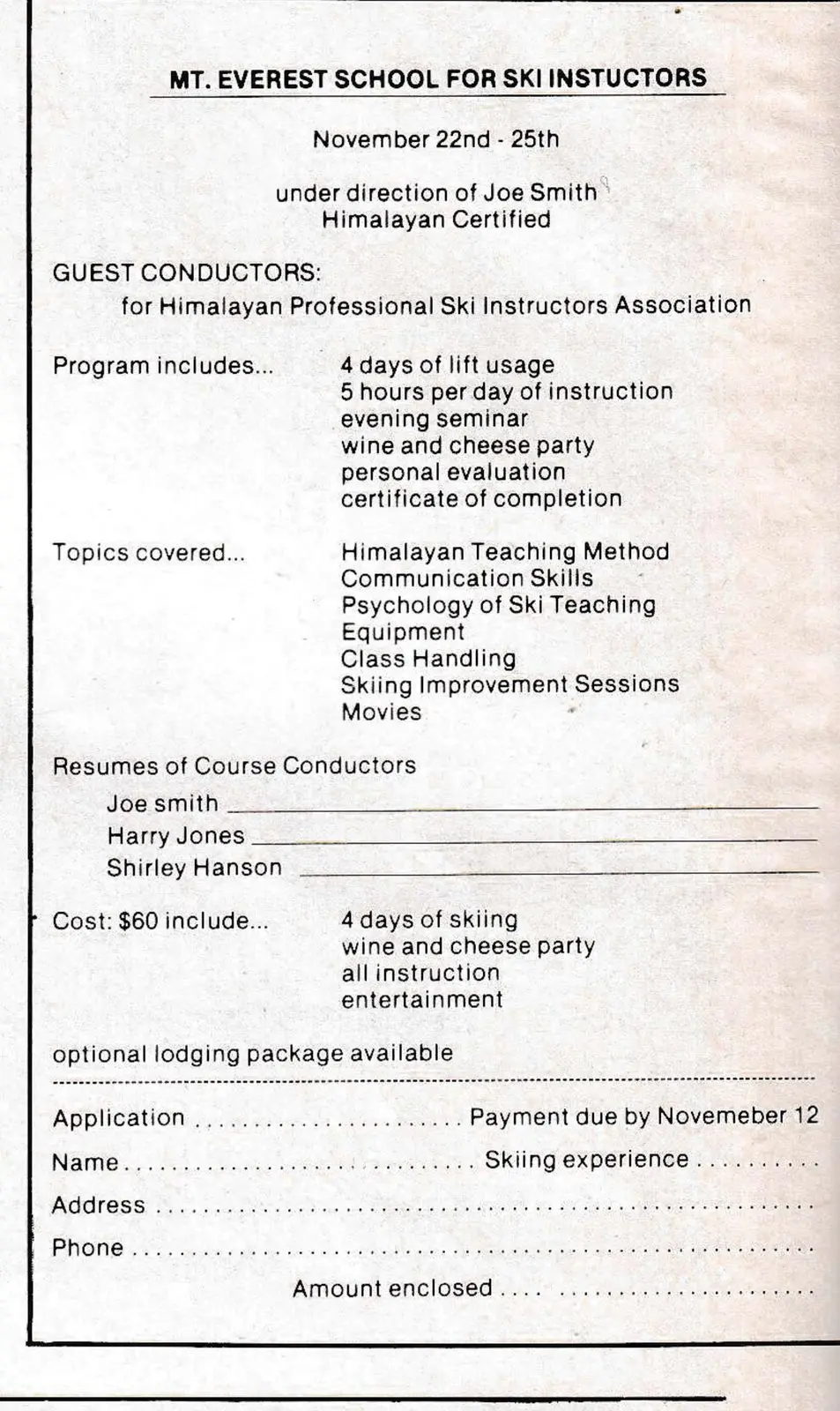
There are many ways to generate business including advertising in local newspapers and in skiing periodicals, mailings to season pass holders and past clients of your ski resort, circulating flyers and posters in ski shops, colleges and other high visibility areas. Another approach is telephone calls to tour companies and ski clubs who often have groups of people interested in becoming more proficient skiers and gaining insight into ski instructor programs.
One of the best ways is in the “help wanted” section of a local paper. A small classified saying “Ski Instructors Wanted” with phone and address proved to be the best pull for a small commuter-type ski area. However, you’ll find all efforts joined together will get the best results.

Most important is to get this program together and on the market by Mid-September, October 1 at the latest. Process all requests and applications quickly and set a deadline for enrollment two weeks prior to the start of the program. This allows plenty of time to prepare the necessary materials for the big day.
Establishing a cost for the program may be difficult the first time it is offered. However, depending on how many in-house staff you have, and an assessment of nearby competition, you’ll probably come up between $12 and $25 per day.
From the moment the participants arrive, the program should be in operation. Have a well-organized registration desk that checks in the candidates and issues them an itinerary of events for the particular clinic. Usually a numbered bib is distributed, to serve a dual purpose: it’s a lift priviledges pass and a way of continuously evaluating the candidates for potential employment.
The ski school manual is an important reference item that provides handy information to reinforce the daily training. Supplementary information can be obtained from P.S.I.A., which has a variety of manuals discussing all aspects of ski teaching and provides excellent supportive reference material.
A final element that will be of great help for future programs is an evaluation form asking the participant’s reactions to the program. This will help in making an objective analysis of the strengths and weaknesses of the programs for the future.
One potential problem, of course, is NO SNOW.
In the case of no snow, be prepared for more extensive indoor sessions, possibly some support films from P.S.I.A.. Outdoor sessions can be conducted with ski poles and boots on the hill running through the elements of teaching, methodology, stance, etc. If the area management supports your programs they may make a small area of snow offering adequate sliding terrain. In any case, no snow is a challenge to your creativity and an opportunity to sharpen your speaking skills.
The most important element to insure a successful program is to manage it professionally from registration to completion. It must be organized, promptly run and fulfill the objectives promised. Only that will insure the success and growth of future programs.