
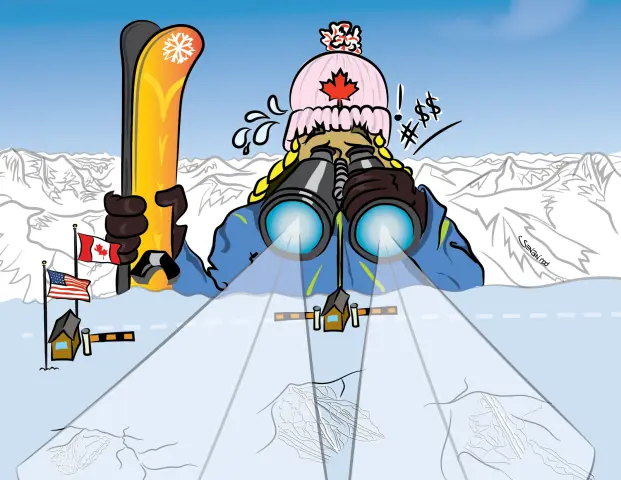

It’s time we all put this matter of skier market growth into proper perspective. The past two years have seen a sudden erosion in confidence based on an honest re-evaluation of the rate of growth. The application of the old 15 per cent per year to today’s market has rightfully been challenged; at the other end of the scale are those who see zero growth, or even negative growth. (That one always gets me! Do you suppose anyone honestly thinks that negative growth sounds better than loss or decline? But that’s marketingese for you.)
Awakenings such as these, especially when they occur to such nice people as us, in such a comfortable growth industry as ours, are especially disheartening. But they are necessary. And our industry has responded with characteristic vigor. “Let’s do something about it!”—this has been the response. And things have been done. The gasoline and energy crunch of ’63-64 uncovered a lot of latent marketing hustle in our industry, and the spectre of fewer skiers kept it all going. Everywhere there are programs for attracting new skiers: Beginners’ Packages; Take-A-Friend-Skiing programs; highly creative introductory programs in cooperation with local industry and regional distributors of consumer goods (See Page 54 of this issue).
On the national level a major promotion with Coca Cola was launched, designed to bring new skiers to the sport. It met with mixed results, but it was a start, and there is no denying the huge exposure that the sport got through Coke’s efforts.
Into this hub of self-help activity comes the study of the ski industry by Glendinning Associates, a prominent marketing organization. The report came in two stages, the first being a pilot study, which, if satisfactory, was to lead to the development of action-oriented marketing programs. Sponsor of this program was the American Ski Federation (translate that essentially into five parts SIA and two parts NSAA). The $5,000 Pilot Study was accepted, and Glendinning was directed to proceed with the $30,000 Part 2—the Recommended Marketing Effort.
The Pilot Study is a sensible-enough excerpting of existing statistical data. About 30 ski industry studies were analyzed, including most of the classics (regional studies by banks and area associations, the subscriber studies of Ski and Skiing etc.) and selected findings were correlated with national consumer research—specifically, the Starch Profile of Major Market Segments (1969) and the National Sporting Goods Association Review (1973).
Glendinning also conducted what is known as Focus Group Research in Ridgefield, Ct. Small groups of about ten people who might be considered potential skiers (i.e. right age, demographics and interest in participant sports) are led in a tape-recorded discussion to determine attitudes of non-skiers toward the sport. It is a legitimate research tool, but it must be said that nothing much seems to have been learned in this case. And it is debatable whether data gathered from the quintessential Fairfield County community of Ridgefield could be projected nationally anyway. But that’s not important.
The Pilot Study concludes that there is a considerable potential for growth. Glendinning states it with great conviction: “Participation levels are extremely low, at about 5 per cent of the ‘able to ski’ population. Given our vast amount of expertise in motivating consumers, this low level is, in the absolute, unacceptable from a consumer marketing standpoint. Beyond this, we believe strongly that the ski product can be a sport that will appeal to significantly more than the current small population group.” If so, that is good news.
I was a little surprised that no correlation was made of existing data with the significant shifts in ages of the total population—the “war baby” effect and the “zero population growth” effect. But let’s not quibble. The Pilot Study passed the beady-eyed inspection of Bob Parker and his committee, and more importantly, it was an investment in the education of Glendinning Associates in the ski industry. Without this they could hardly have been expected to bring their marketing talents to bear on behalf of the ski industry.
And that brings us to Part 2. The first part of this provides a grab-bag of marketing ideas for individual ski areas, for retail ski shops and for ski clothing and equipment suppliers. The great temptation is to say, “They’re all old hat.” And, true, one can find plenty of instances where each recommended promotion or event has been tried, or is being used. Like Ladies Day, or Ski Free with a Friend. But that’s not the point. The ideas are all worthy of consideration by the individual businessmen in the ski industry. The section is clearly a useful primer that will be used effectively by many areas, especially those that haven’t yet got their creative marketing programs in gear. There is some good thinking here.

The other part of the Glendinning marketing report is the biggy: it is the national, industry-wide marketing program designed to impact on about 52.5 million potential skiers, with a goal of hooking one per cent of them. This would mean getting over half a million people to try the sport. Put another way, it would mean a stimulated increase of ten per cent in skier population in one year over the current estimate of five million skiers. This would be great!
The national program would cost up to $1.4 million the first year. At the heart of it is an offer to “Ski for $9” which would include rental of all necessary hardware, an introductory ski lesson and a beginner’s slope lift ticket. Since the 525,000 new skiers would be spending nine dollars or more, the industry would get an infusion of $4,725,000, while the total program cost is only $1,400,000. Only? Not to worry. Glendinning feels they can find a large corporate sponsor—or sponsors—who will underwrite the costs in exchange for close identification and tie-ins with the ski sport.
The major thrust of the program is a newspaper supplement that announces the “Ski for $9” introductory offer. An 8-10 page affair, it would give the non-skier some sound, helpful, welcoming advice on how to become a skier. “It’s not hard to learn—it’s fun” . . . “It doesn’t have to be expensive” . . . etc. The supplement would go into newspapers with circulations totaling over 15 million. It would also be mailed to select lists totaling three million and would be distributed elsewhere, such as in airline seat pockets. The program would also be advertised in selected magazines with readership totaling 22.5 million. After adjusting for duplication, and for multiples because of household size, the Glendinning people project the 52.5 million net unduplicated impacts.
These are big numbers! This is an attractive invitation to a quarter of the country’s population to try our sport with an attractively-packaged $9 RSVP. It is, of course, at this stage that one must start asking the difficult questions, because it is better to ask them now than to buy the package unquestioningly.
- All of the numbers stem from an assumption that one per cent of the target consumers will take advantage of the $9 offer, which will amount to over half a million skiers. Is this realistic? Glendinning says it is, and they are the experts. But the estimate should be scrutinized carefully. It turns out that a higher response rate is anticipated from the newspaper supplement and direct mail efforts than from the magazine ads (a big, multi-page package versus a single page). So, if the 525,000 number for triers is to be achieved, the newspaper supplement and direct mail efforts may have to pull at a higher rate of, say, 1.3 per cent. Furthermore, the Glendenning estimate of reach of 52.5 million should be scrutinized. In estimating the magazine part of it, for instance, Glendinning has applied a multiplier of 2.5 for the number of households the magazines get into, as well as a multiplier of 2.1 for the number of people over ten years old in each household. One or the other of these multipliers is fine, but the figure for pass-along readership is much too high if both are applied.
- Glendinning does not promise, but holds out great hope for finding a partner, or partners, among the big consumer product corporations who would pick up a substantial part of the $1.4 million tab. Is this realistic? Glendinning says, “Yes,” and it is their business to be able to deliver on proposals like this. But the question remains, and the doubts stem from two questions: A) What does the sport offer, and what will ski area operators have to give, for it to be worth over a million dollars to get involved with us? For one year? Schlitz doesn’t pay anything like that sort of money to “own” NASTAR, any more than Benson & Hedges does to “own” professional ski racing, or Chevrolet to “own” freestyle competition. In fact, all three of these programs together don’t come to that sort of money, and they are all high-visibility affairs with good press and TV pick-up. Glendinning answers that they don’t necessarily envisage the type of sponsor who is looking for high profile promotional opportunities. Rather, they expect to be tailoring a program to fit the marketing goals of a company that gives them unique access to the unique qualities of the skier market. Glendinning emphasized that the ski industry will have to “give a little.” They cite as examples, “the industry may have to distribute samples of other manufacturer’s products, or their coupons to skiers; or provide some other worthwhile service in return for funding.” B) What will be the level of participation and cooperation by ski areas? In marketing terms of coverage, a sponsor would be looking for 80 per cent or so. Can we deliver it, and deliver it on a broadly national basis without regional holes?
Those are the two basic questions. One other question I have is less important, and perhaps ungracious, but I have to wonder about allocating 10 per cent of the money proposed for magazine advertising in Ski and Skiing magazines when the stated thrust of the effort is to reach non-skiers. That’s like looking for virgins in a brothel. Glendinning says the purpose is to reach the readers who have stopped skiing and persuade them to become active again. I can’t buy that. If there are that many, it has to be a bit of a shocker to the regular advertisers in those magazines. Best solution is for the ad space to be made available free.
The next threshold is the decision-making by SIA NSAA. The Glendinning Report is something of a milestone in the history of the ski industry, and I am inclined to think the creation of a Marketing Committee of the American Ski Federation is another milestone. Here are the ski retailers, the ski clothing and equipment manufacturers and the area operators getting together on a practical marketing level. This committee, if properly staffed and funded, and if given a good free-wheeling mandate, could do wonders.
DR