



The use of automation in snowmaking has been a progression from the first days that this revolutionary technique was introduced. The evolution of machine-made snow is, in part, due to a visionary quest to duplicate the natural substance. There have been many participants in this technical evolution, from backyard inventors to professional engineers and scientists. All were caught up in the fascination of converting water droplets into ice crystals; all have contributed to the current state of the art.
Snowmaking now covers a large percentage of skiable terrain in regions of the country that are not blessed with an abundance of natural snow. Even regions that have abundant snowfalls still require the use of snowmaking systems to cover high traffic areas and to provide the reliable early-season trails that customers now expect. The quantity of machine-made snow produced in the United States during a single season perhaps approaches or exceeds 50,000 acre-feet or 10 billion gallons of water.
The following factors will continue to force the evolution of snowmaking systems and operational practices: increased snowmaking coverage, large system size, increased water usage, available seasonal manpower limitations, increased snowmaking plant hours and quality snow marketing.
The majority of areas still use the tried and true method of snowmaking: a snow gun and a snowmaker to position and adjust the snow gun. This method requires a dedicated worker who can perform hard physical labor under conditions that are extremely arduous and mind-numbing. In many areas of the country, the supply of seasonal workers willing to perform this type of work, at barely above minimum wage, is limited. In some instances, ski resorts have raised wages to attract seasonal snowmaking applicants; however, rapid turnover still leaves these departments understaffed.
The majority of large and many medium-sized ski areas have some level of snowmaking-control systems. These control systems are able to provide a graphic view of all the components necessary to produce the ultimate product: quality snow. The sheer size and complexity of these operations have forced the integration of some form of automation. At this level the process is increasingly complex, requiring pressure, flow and temperature information to be continuously monitored and controlled in order to maintain a stable and smoothly-functioning snowmaking system. The interaction of pumps, compressors, water and air-cooling systems has to be closely controlled so that all the components can function effectively in unison. Electrical power demand issues require monitoring of electrical consumption and the capability of selectively shedding load at remote sites.
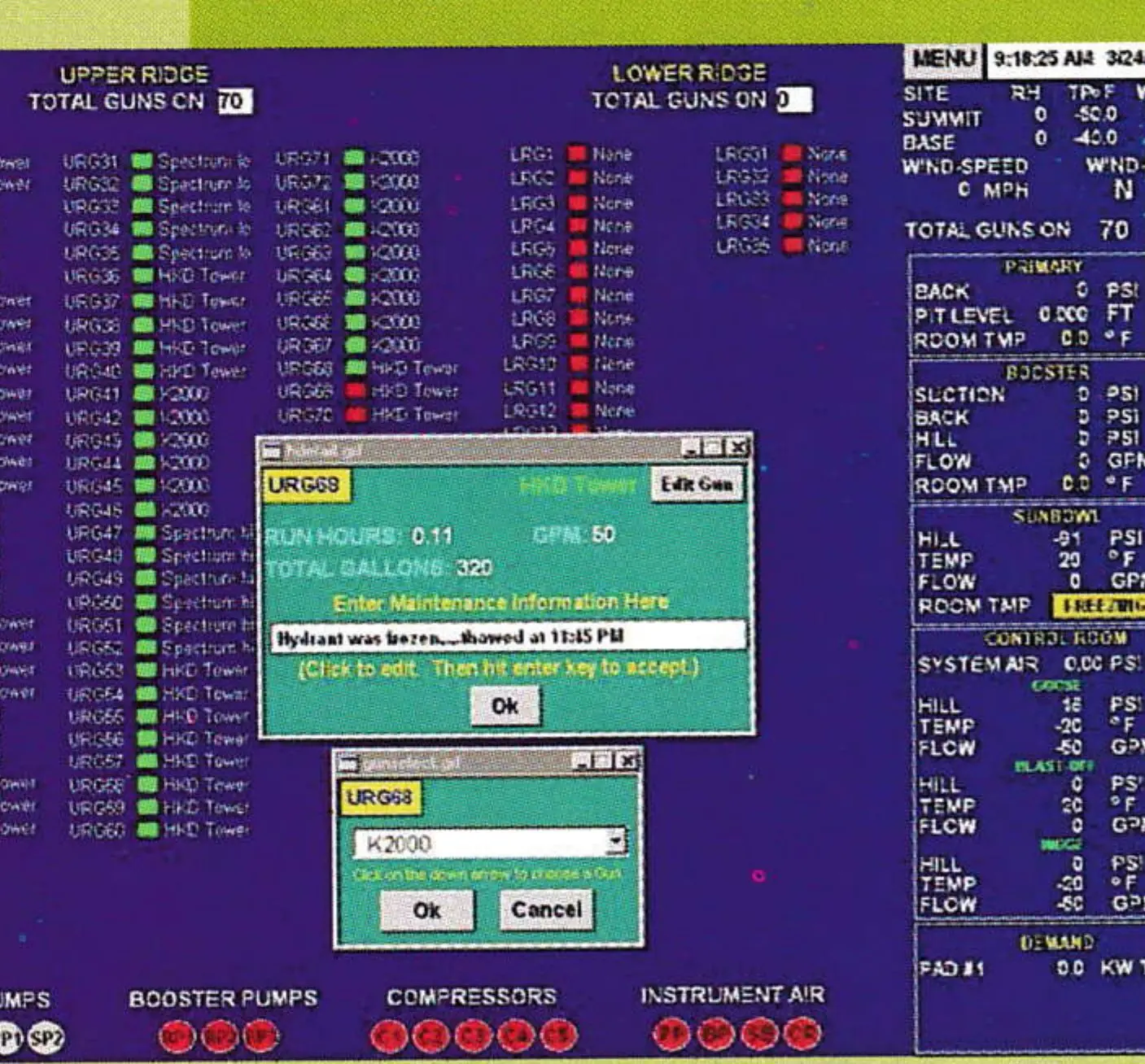
This type of automation has effectively made the snowmaking process much more stable and productive. System water and air fluctuations are minimized to the operating snow guns, thereby enhancing the snow quality and consistency, and the response time of automated systems is immediate. A valuable man does not have to adjust pressures and flows.
Technology and automation have also spread to the snowmaking components and hydrants. There are a number of air-water snow gun systems that are adjusted via a pressure gauge or moveable nozzle to settings that are based on wet-bulb temperature. Fan guns have selectable banks of water rings that are opened or closed based on wet-bulb temperature. There are fan guns with on-board computers and temperature sensors that automatically adjust to the prevailing conditions. There are automatic hydrants that can be retrofitted on existing systems. And, there are fully-automated snowmaking systems that incorporate all the features above.
Following are system descriptions with comments and opinions elicited from snowmaking managers from around the country who are using a variety of automation technologies. This overview should provide readers with the good, the bad and the ugly aspects of emerging technologies.
Sun Valley, Idaho—Sun Valley committed to a York Snow automatic snowmaking system 11 years ago and the system now covers 630 acres of terrain with 520 York air/water hydrants. The air (22,000 scfm) and water (3,200 gpm) system is capable of operating 30 to 80 snow guns, depending on the wet-bulb temperature. The system is fully-automated and essentially starts up with the click of a mouse after the selection of the appropriate trails, hydrants and other desired parameters. The water-pump stations, air compressors and air/water hydrants are controlled by a proprietary York software program integrated into a Windows NT environment. The electronics and instrumentation are integrated into the control software via a Siemens S-5 I/O hardware system and RS-485 communications protocol from the remote stations.
Peter Stearns, assistant mountain manager and snowmaking manager, speaks highly of the advantages of this integrated automatic system. He admits that, though the system was costly to install, it does have a number of major benefits. His snowmaking staff totals 12 during the season with three shifts of three or four people per day and this number has stayed constant as the snowmaking system has expanded. One person on the snowmaking staff is dedicated to monitoring the system on the process control computer and relaying necessary information to the in-field snowmakers. All control and start-up is done via a point and click on-screen display.
The major advantages of the automated system are: 1) rapid system start, 2) easy selection of trail to run, 3) rapid shifting of operating hydrants to other trails for snow dusting, 4) maintaining maximum system productivity and 5) only a high initial cost.
The disadvantages are: 1) system is complex requiring a York process engineer to tune it every year, 2) process instrument failure can cause difficulties in operation, 3) maintenance expenses are higher for automated equipment and 4) level of staff maintenance and technical training is high.
But, the quality and consistency of the snow are very good Stearns says. “There is no way that I can envision going back to the ‘old way’ of manual snowmaking—I think that I would just leave this business.”
Boston Mills/Brandywine, Ohio—This Midwest ski area installed an Areco tower fan-gun system two years ago. Thirty tower-mounted and five portable fan guns are strategically distributed at each area with a total of 70 units covering 79 acres of snowmaking terrain with a total water pumping capacity of approximately 5,100 gpm. This semi-automatic tower fan-gun system utilizes manual hydrants that are connected to each snow gun. The tower units can be manually positioned for wind direction and have an oscillating feature that swivels the snow gun back and forth, thereby increasing the snow distribution area. Each tower snow gun is connected via an RS-485 wire communications network to a central control computer. Using remote temperature and humidity information, each snow gun can be started and controlled from this Windows graphical interface after the snowmaking hydrant is opened. The snow guns adjust to temperature automatically, but manual local control is available at each gun.
Rick Johnston, snowmaking manager, claims that this system has been a “Godsend” to the two areas. The previous two systems were a mixture of many different equipment types and it was difficult to maintain consistent snow quality and maximum water flows. The previous snowmaking staff required a number of experts on each snow gun type resulting in a lack of operational flexibility and consistency. The basic water pumping systems have remained as is.
The major advantages to this semi automatic system are: 1) snow quality assessments are removed from the snowmaker—snow quality setting is automatic, 2) rapid start-up, 3) consistent snow quality top to bottom—grooming is simplified, 4) able to open all trails in approximately half the time (two to three days) and 5) decreased snowmaking staffing of 25 to 30 percent.
The disadvantage is the high cost of installing buried communication lines.
The response of the skiers to the improvement in overall snow quality and consistency has been very favorable. “If you told me three years ago what an automated snowmaking system could accomplish, I would not have believed you,” said Johnston.
Keystone, Colorado—This Rocky Mountain resort added nine Lenko automatic fan guns to its existing air-water system that also happens to include a 192-hydrant York system. The snowmaking system covers 690 acres using a compressed air capacity of 22,000 scfm and a water pumping capacity of 3,300 gpm. The portable fan gun units cover 15 percent of this terrain and are positioned on strategic trails with 50 automatic hydrants and 120 electrical power pedestals available.
The automatic fan guns communicate with the dedicated control computer via radio modems, plus there are several radio modem weather stations that are an integral part of this system. The operator at the computer can view individual snow gun information and start, stop and engage oscillation on the units using the point-and-click feature. The fan units and hydrants automatically start up and adjust to the current temperature conditions. Changes in snow quality can be made through the control computer or via a snow-gun-mounted LCD display. The snow guns can be operated remotely or locally.

An interesting feature on the automatic snow guns is the ability to send warnings of impending problems back to the host computer for on-screen display. All the automatic control electronics are housed within a weatherproof enclosure mounted on the snow gun unit and an LCD display is mounted on the face of this enclosure for local display of information and manual control.
This York system, which has similar features to the Sun Valley system, covers 20 percent of the snowmaking terrain and has been in place for approximately eight years. Joel Peterson, snowmaking manager at Keystone, has a pragmatic approach to the advantages of automatic systems. “The automation technologies are still maturing and improving,” he says, “but they do provide great operational benefits and in the near future will be the way to go. I need to develop snowmaking technicians.”
The advantages are: 1) rapid start-up, 2) consistent snow quality, 3) reduced manpower, 4) rapid shifting of snow making hydrants and 5) useful for maximizing system productivity.
The disadvantages are: 1) difficult to assimilate and understand complex control systems and hardware, 2) employee technical expertise must be raised, 3) manufacturer technical support very important and 4) lightning protection very important to protect integrity of system electronics and instrumentation.
Sugarbush, Vermont—Four years ago, Sugarbush added a 120 Sno.matic automated air and water hydrants retrofit to its existing air-water system. Currently, there are two separate snowmaking systems that handle two separate mountain areas. The automated system covers an eight-trail portion or (15 percent) of the 175 acres of snowmaking terrain. The system capacities for this side are 31,000 scfm of compressed air and 4,000 gpm of pumping capability. The automated hydrants service 35-foot-high tower snow guns. The system is operated with a dedicated control computer that can stop, start and adjust the snow-quality setting on the tower guns.
The Windows-like graphical environment is primarily a point-and-click arrangement for automated operation. The hydrants have a worthwhile feature that allows the snowmaker to override the automatic mode and adjust in a manual mode. There are numerous temperature and pressure instruments installed to provide valuable information to the operator.
For reasons of economy, the system was installed by the mountain staff, which was a learning experience as to the proper set-up and positioning of snow gun towers, hydrant hardware and electronics. Some of the cost-cutting measures and lack of experience created difficulties with respect to reliable operation, particularly on shutdown and water drainage. The automated hydrants were installed above ground, causing them to be exposed to winter weather conditions, which has, at times, caused difficulties with proper hydrant operation and reliability.
Ted Williamson, snowmaking manager for the two areas, is critical of certain aspects of the system and says that while most portions of this installation work very well, others require more refinement.
The advantages are: 1) individual automatic and manual control of hydrants, 2) rapid start-up and shutdown useful in keeping system maximized, 3) extra instrumentation and sensors help in monitoring system operation and 4) hydrants have a fine degree of snow-quality adjustment.
The disadvantages are: 1) weather-related problems, 2) maintenance on electronics and hydrant calibration requires a technician to check system annually, 3) most operators and snowmakers are not comfortable with high-tech equipment and 4) still requires a man to walk the trail as auto hydrants are started because the system is not yet fail-safe.
Conclusion
The consensus of opinions from these snowmaking managers can be summarized as follows:
1) Automated systems are more costly to install than standard systems, however they provide tangible benefits to the operator when implemented on a large scale.
2) The benefits include reduced manpower, consistent control of snow quality, operation at maximum productivity for extended periods of time and rapid response to changing conditions.
3) The automated system must be installed with care and attention to protect automated-hydrant components, electronics and wiring from the rigors of the snowmaking environment. Exposure of sensitive components for prolonged periods reduces reliability.
4) A higher level of training and education is required for snowmaking personnel to understand, operate and maintain these systems. Certain software and computer aspects require the attention of an engineer or technician on an annual basis. The maintenance costs for automated systems are higher.
5) Automated snowmaking systems are the snow wave of the future and are available now.

