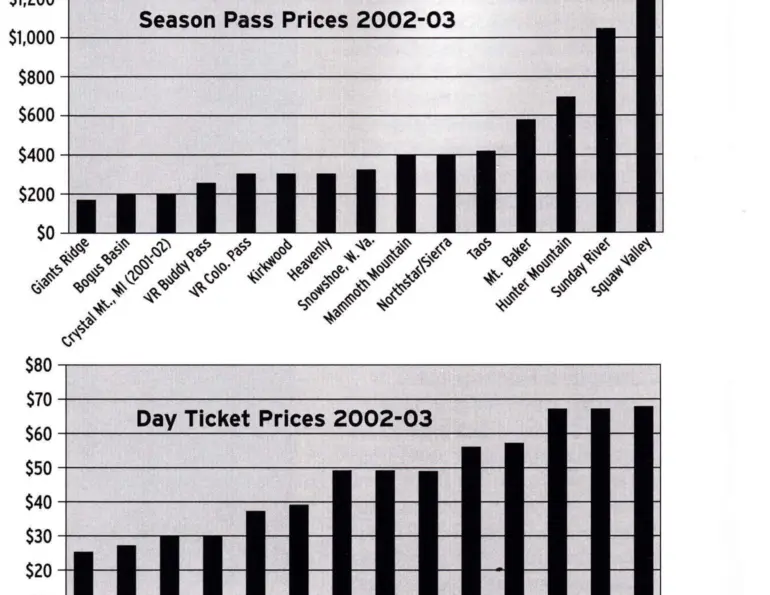
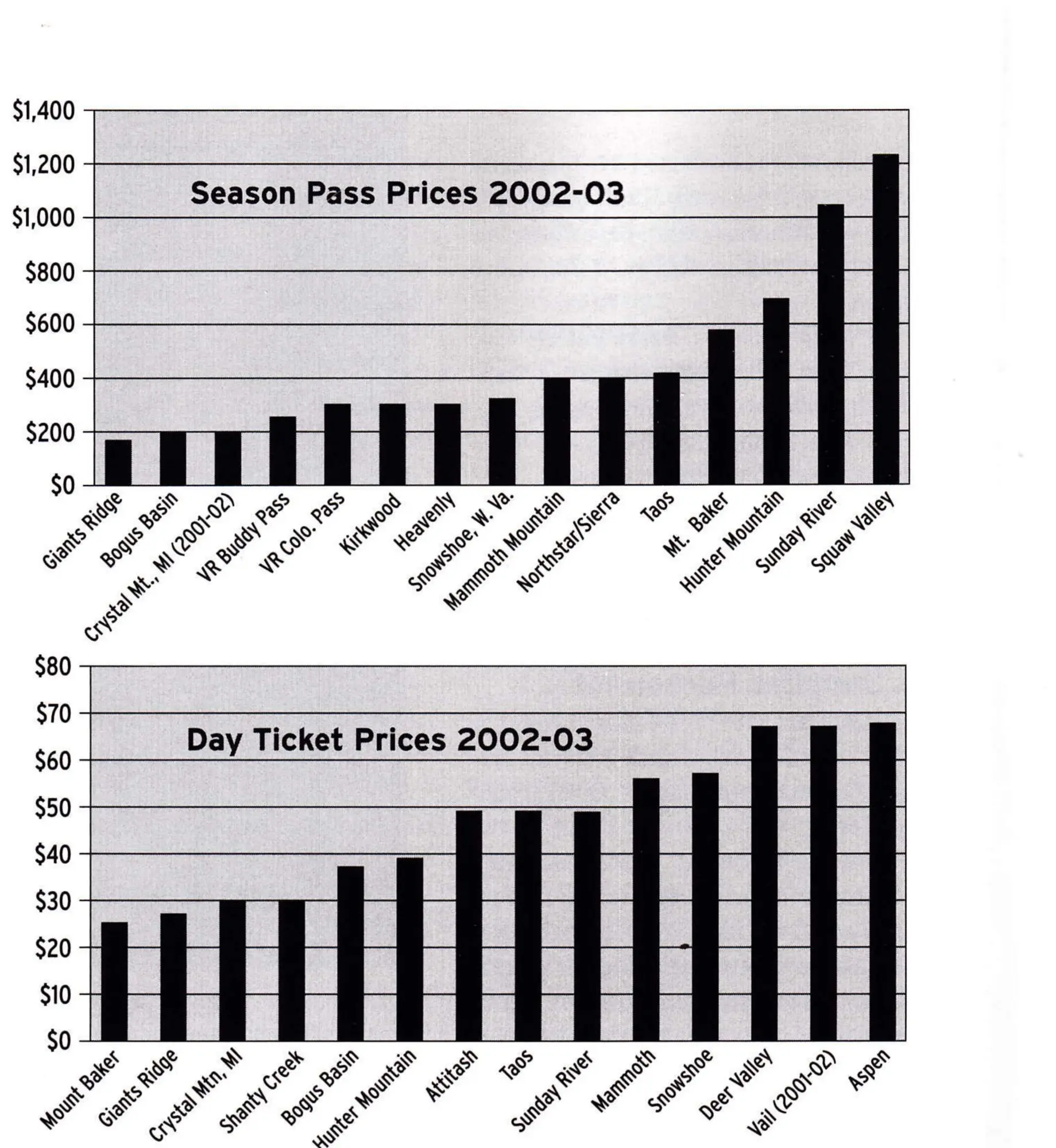
Remember when there wasn’t much of a ticket-price spread between the biggest and smallest areas? It wasn’t all that long ago that this magazine lamented the lack of price differentiation. Today, the range of prices within a single resort can be greater than the range across the entire industry ten years ago.
And remember when announcing next season’s ticket prices used to be a big waiting game? No more. This year Aspen had barely put the 2001-02 season to bed when it announced next season’s rates: $68 for a one-day ticket, up from $65 last season. And many areas announced prices on 2002-03 buddy passes in February and March, before the season’s end.
“People used to wait and see who announced first, see if anybody adjusted their prices after you,” said Jeff Hanle, communications manager at Aspen. “We’re seeing fewer and fewer people just walk up to the window and buy a ticket, so we decided to go ahead and announce it.” And since Aspen touts its multi-day prices as a percentage discount from full price, it pretty much had to set the top figure.
In an informal survey of ski resorts around the country, SAM found that most resorts have changed prices very little. That’s due in part to buddy passes, those deeply-discounted season passes for locals, which have become entrenched in several markets.
Let’s Make a Deal
The exception to the pricing calm comes from Lake Tahoe, where Heavenly, recently purchased by Vail Resorts, offered a Vail-style, buddy-pass-like $299 2002-2003 season pass for a four-week period in May and June. This matched the $299 early-purchase pass Kirkwood has offered for the past decade, and it inspired Northstar-at-Tahoe and Sierra-at-Tahoe to offer a two-area $399 season’s pass. All three are subject to holiday blackout dates.
The Heavenly pass was widely available—skiers could make purchases online or on the phone. Buyers came from as far away as the U.K. and Hawaii.
As we went to press, it was too early to predict how large the response to these passes will be. All the offers were set to expire between June 15 and 30, and Heavenly’s marketing vice president John Wagnon was unsure how prices would be set for fall purchases. But the discounted early-season passes “have definitely changed the landscape,” he said. “The response has been tremendous.”
Booth Creek expects strong sales of its $399 Northstar/Sierra pass, based on its experience with its Threedom pass (Cranmore, Loon and Waterville Valley) and discounted passes at Bear Mountain and the Summit areas at Snoqualmie. “We think that overall, it’s a good thing,” said Booth Creek’s Julie Maurer, vice president of marketing and sales. “It gets skiers committed and it drives business. All our other discount passes have been really successful for us.”
Maintaining the Status Quo
Elsewhere, there are as many reasons for maintaining the status quo as there are pricing plans. “After last season’s disaster we’re going to hang in there with the same prices,” said Bill Hungate, VP of marketing at Snowshoe, W. Va., where the top day rate is $57 and the lowest unrestricted season pass is $328.
Bogus Basin, Ida., the area that started the discount pass craze, is keeping rates steady, like Snowshoe—but for an altogether different reason: runaway record crowds. After posting more than 370,000 skier days last season, Bogus will keep the cost of a day ticket at $37 and a season pass at $199. That’s the same price as five years ago when Bogus first introduced its discounted passes.
“We sold 24,000 season passes last year, up 3,000 from the year before,” said Eric Stiegemeier, VP of skiing services. “It’s been a huge success for us.”
Early-bird season passes remain a popular option as resorts try to lock in skiers early with super discounted rates. Vail, where the window rate was $67 in 2001-02 (no word on the 2002-03 rate), is holding the line for the third straight year on its Buddy Pass (unrestricted access to Keystone, Breckenridge and Arapahoe), and Colorado Pass (unrestricted access to those three resorts plus 10 restricted days at Vail/Beaver Creek). The Buddy Pass sells for as low as $249, the Colorado Pass for $299.
“Pricing has obviously been an important tool for our Colorado resorts,” said Kelly Ladyga, director of corporate communications at Vail Resorts. “We sold a combined 118,000 Buddy and Colorado passes last year.”

Day Ticket Price Creep
Several resorts are increasing day ticket prices by $1 or $2. Deer Valley, Utah, hoping for a post-Olympic bounce, is raising its day rate from $65 to $67. Taos Ski Valley, N.M. is raising its day rate $2 to $49. Mammoth, Calif., will introduce a midweek (Monday through Thursday) ticket at last year’s $56 rate. No word yet on how much the weekend rate will be.
Season passes are another story. Many areas are maintaining 2001-02 prices. For example, Taos is holding the line at $425. Mammoth’s season passes will remain $399 and this season will include access to June Mountain as well.
“Last year we sold about 26,000 passes and we’re ahead of that pace this year,” said Kellie Hines, communications coordinator at Mammoth.
Mt. Baker, Wash., continues to be a real bargain. After putting in a new quad chairlift last year, Mt. Baker raised its day rates $1, to $25 (MTW), $27 (ThF) and $35 (SS). It’s putting in another quad this summer, and may again raise rates $1— which would still make it the lowest priced in its market. Baker will keep its season pass rate ($585) unchanged for the third consecutive year.
Tweaks in the Midwest
In the Midwest, Giants Ridge, Minn., is raising its day rate $1 to $37 ($27 on weekdays) but is keeping passes, which it lowered 10 percent two years ago, at $179. Shanty Creek, Mich., will remain at $40 weekend and $30 weekday (“we try to keep it simple,” said Barry Godwin, marketing director), and Crystal Mountain, Mich., will hold the line at $41 and $31.
“We’re very aware that there is a threshold that skiers are willing to pay even though our costs keep going up,” said Joan O’Neill, marketing director at Crystal. Even so, Crystal’s popular four-person Buddy pass, which provides unlimited access to four people for $199 each, is likely to go up next season after holding steady for the last two. “We’ve had tremendous success with that program,” said O’Neill.
Lest the Old Traditions Fail
In the Northeast, the old pricing traditions linger. That is, both single-day and season-pass prices tend toward the high side. Attitash, N.H. won’t change its window rate ($49) but will raise some other products, including its multi-day rates. Stowe, Vt., which does not even publish a single-day price, is also raising multiday rates. A two-day ticket will cost $101, up from $97 last season; a three-day ticket, $147, up from $141; and a five-day ticket, $222, up from $214.
At Sunday River, Me., season passes are going up $54, to $1,049. Sunday River is also raising its holiday and weekend day rates by $1, to $55 and $53, respectively, but weekday rates remain $49.
Rounding out the list in the Northeast, Hunter Mountain, N.Y., will raise weekend rates $1, to $49, but keep midweek rates at $39. Season pass prices, which haven’t changed in eight years, will remain at $699.