

By keying on these factors when initially constructing a hill or when cutting additional trails or connecting existing trails, you can prevent much of the wind scouring and drifting that might occur.
Snow particles, because of their lightness and large surface area, follow the turbulent eddy motions of the air. Their fall rate is very slow while their lateral transport velocity, caused by winds, is very high. High winds also cause particles to impact on the snow surface and dislodge more snow particles in a process called saltation. Thus, they can travel long distances before falling to the ground.
These facts make snow deposition and retention difficult on wind-swept ski slopes. To catch and keep snow, it is important that the ski trails provide a sheltered region of low velocity where the snow particles will settle to the ground and remain during high winds.
The wind moving over and around a mountain has many analogies. A fluid moving from point to point through a number of possible parallel paths (pipes) or electrical current flowing through a network of parallel resistors is similar to the wind flow pattern on a mountain. The dominant criterion determining the flow through each path is the resistance to the flow along the path with the wind taking the path of least resistance. In terms of the properties of an ideal ski trail, therefore, the trail should be minimal in width and with many turns in order to interrupt and reduce the velocity of wind flow.
There are several basic air flow situations occurring on a ski trail. An understanding of these helps to determine wind and snow behavior on the slope.
First, if the local wind is in the direction of the trail, the trail will act as a pipe or channel for the wind. The trees or rocks on the edge of the trail will slow the wind down to form a boundary layer near the edges with some snow depositing at the edges.
At gentle turns in the trail, the wind will channel itself around the corner causing a variance in wind direction at the trail surface and above the trees. In such a case, the wind velocity will normally be higher at the inside edge of the trail than at the outside edge, causing scouring at the inside edge and some snow deposition at the outside edge.
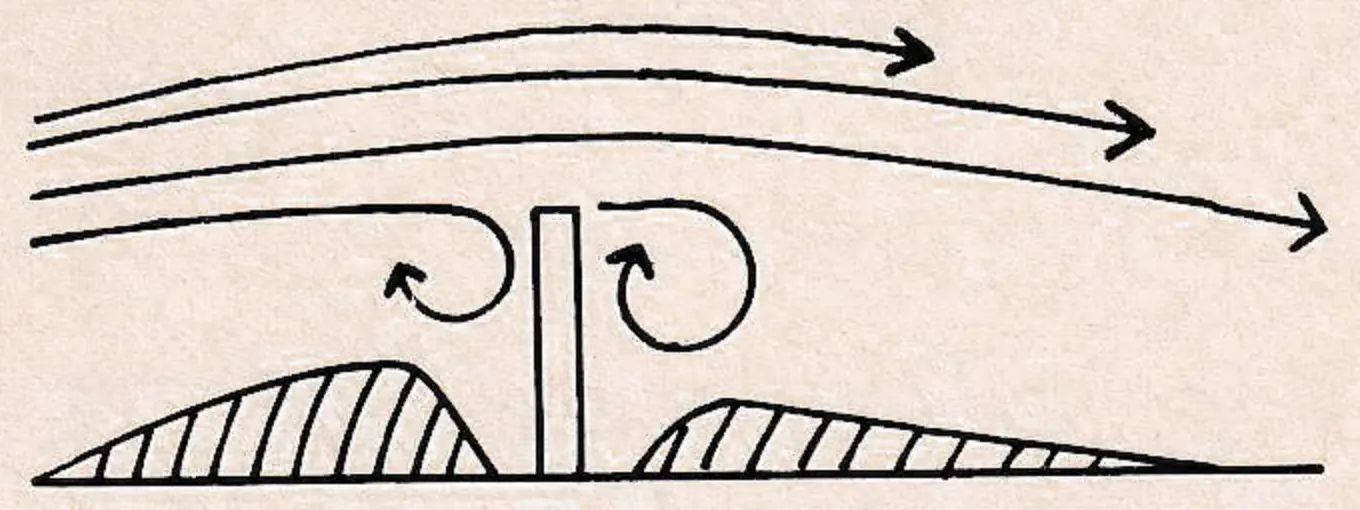
When the wind encounters a solid barrier in its path (Figure 1), it rises over the barrier and separates at the top. It forms a bound vortex (a circulating eddy) which scours the snow immediately behind the barrier. In this instance, snow is deposited in front of the barrier by the wind as it tries to carry the snow over the barrier. As snow particles fall out before they can overcome the barrier, only a few particles fall into the quiet region between the vortex behind the barrier and the point downwind where the wind again attains its full velocity.
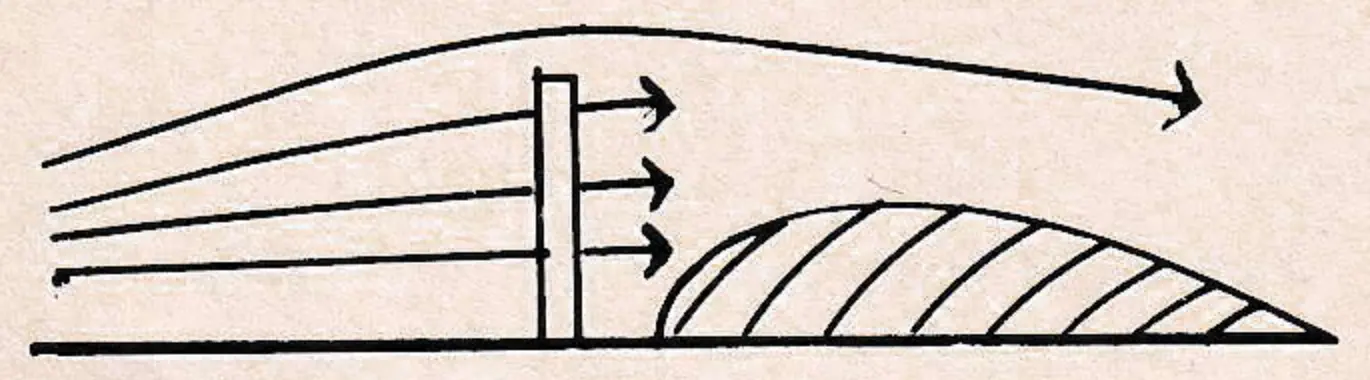
A porous barrier in the path of the wind causes the wind to move through and over it (Figure 2), causing a drift to form upwind and a small drift to form downwind.
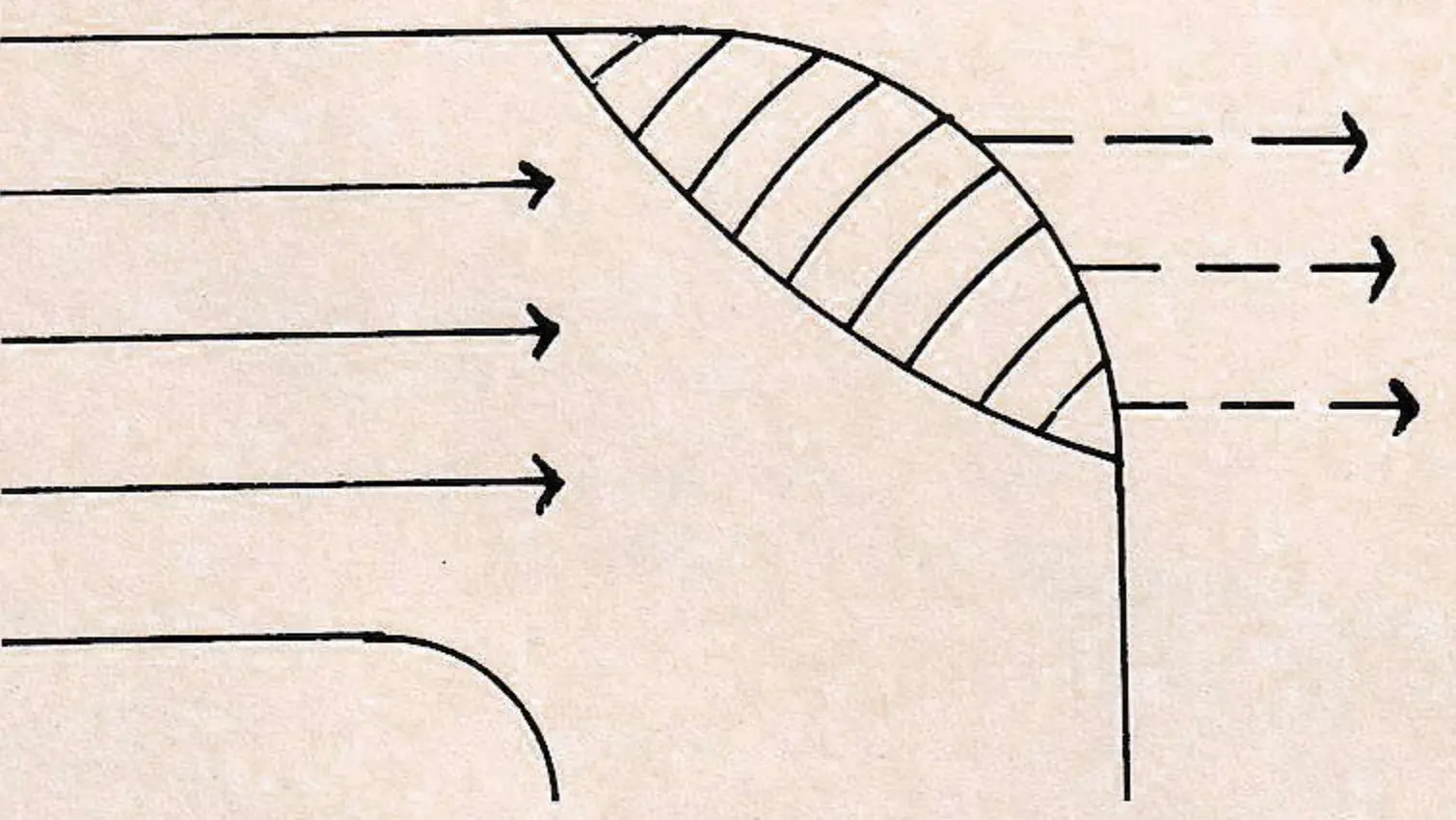
In still another instance, a sharp corner in a trail will act like a solid barrier (Figure 3). The snow, in this case, forms a drift at the corner of the trail and the wind moves up and over the trail edge, failing to negotiate the turn.
On most trails, combinations of all these situations occur which combine to cause a particular kind of snow deposition pattern.
To investigate the behavior of the wind as it travels over a ski trail, a simulated wind channel was constructed for the testing of ski trail models; a motor-driven fan was used to provide high velocity air. The air was directed over a scale model of a ski trail. Although plywood sides confined the flow, the top was open to simulate an actual mountainside where air can move over the top without compression. Ground lime and commercial borax were used for snow, greenhouse stakes for simulated trees. Wind velocities were measured with an Alnor velometer at various locations and heights above the trails; wind flow was also determined by watching the disposition pattern of the simulated snow.
Straight trails into the wind, it was discovered, act as pipes or channels which funnel the wind. They have high wind velocities at the trail surface which cause scouring over the entire length of the trail. There are, however, ways to reduce this wind effect. One means, we found, was to make the trail diverge slightly and act as a diffuser to the wind.

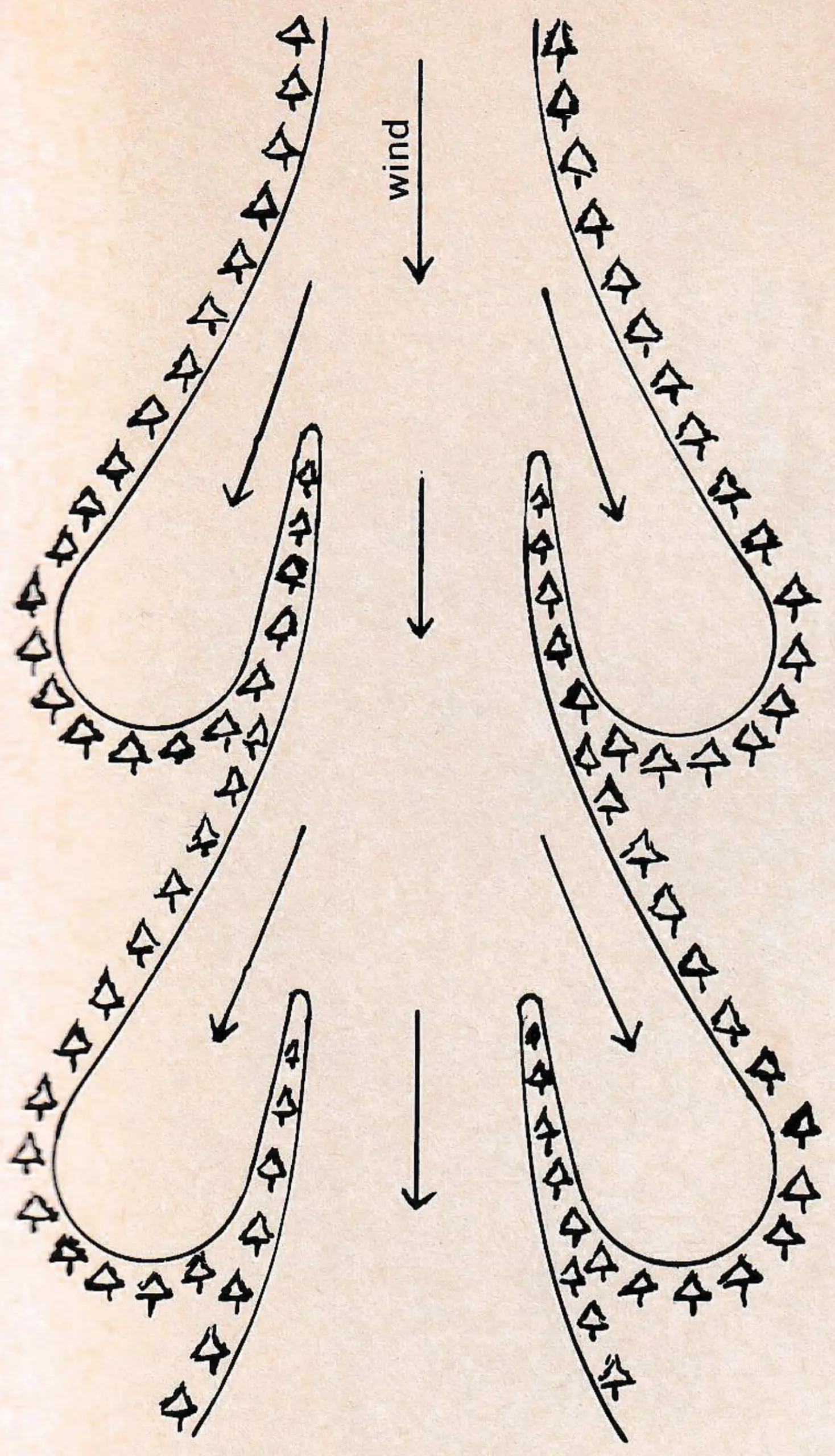
Another possibility is to open up the edges of the trail into bays (Figure 4) and provide room for the wind to diffuse into the trees. There is a further advantage in that snow deposited in these bays can be farmed out for use on the trail as needed. Care must be taken, however, not to open the trails up to too great an extent as increased air flow up the trail would cause more scouring on the main trail.
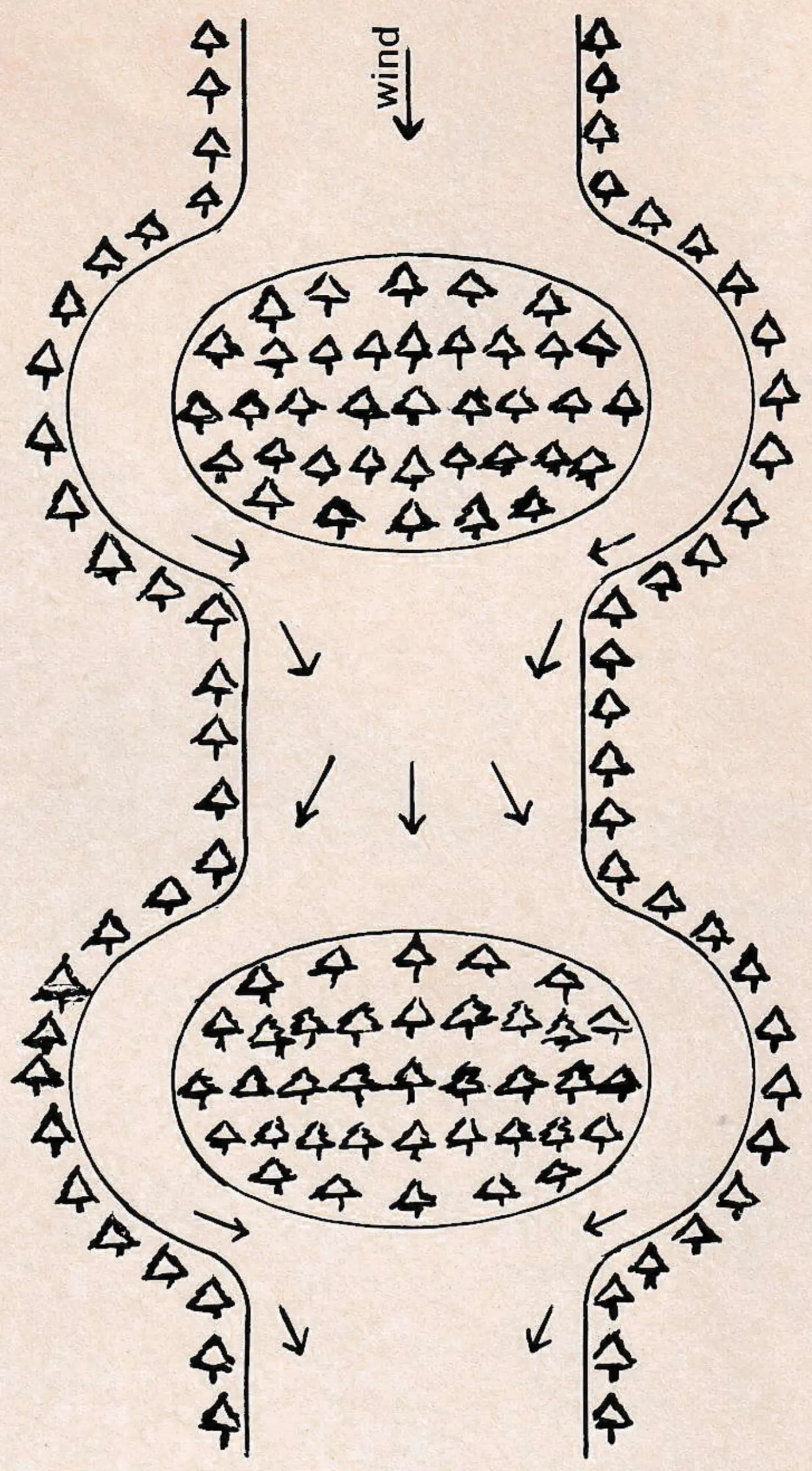
In some cases, long trails into the wind are unavoidable. In these cases, wind protection can be obtained by leaving a series of small groves of dense trees in the trail with avenues on both sides (Figure 5). The trees prevent the trail from acting as a wind channel and, acting as a natural porous-barrier snowfence, will cause the wind to diffuse onto the trees along the edge of the trail. The avenues around the grove must be fairly narrow with sharp curves to prevent the wind from moving around the grove.
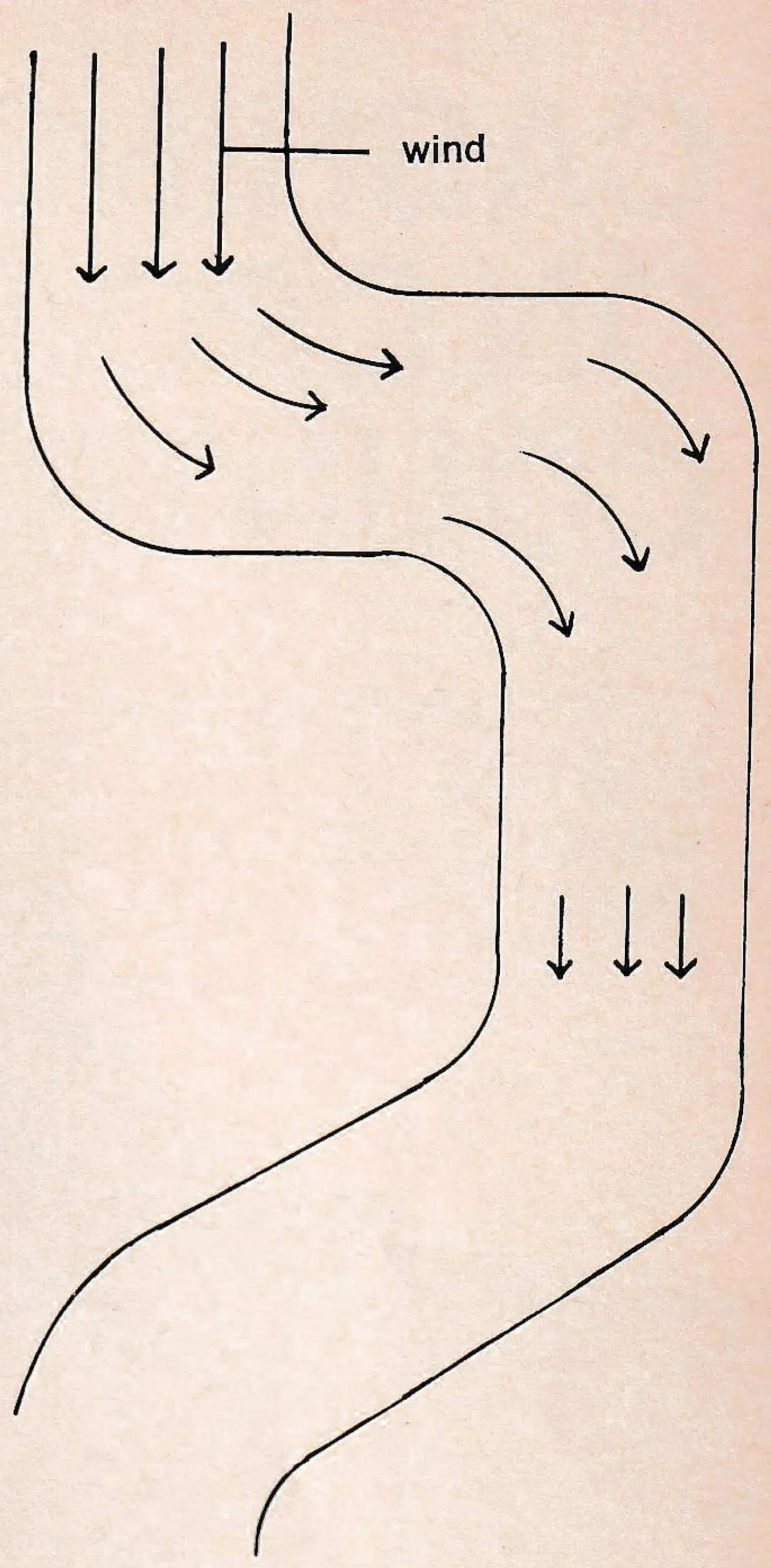
The effect of bends or curves in the ski trail is significant. Short, shallow bends in the trail have little effect on the wind near the trail surface. In fact, there will be more scouring at the corners where the flow has to accelerate to turn the corner. Sharp corners with a finite trail length perpendicular to the wind (Figure 6), it was found, are the only designs effective in reducing wind velocities on a ski trail. In this case, the pressure drop of the wind as it turns the corners was more than it would have been if the wind had difused through the trees or passed over the trees at the bend. Hence, the wind does not follow the trail, but moves above the trail or into the trees and dissipates.
The width of the ski trail can be a problem where the wind flows perpendicular to the trail. In this case, the trail width should be narrow enough to prevent the wind from coming down into the trail as it moves across the trees above the trail. Based on an analogy with snow fences, trail width should be less than twice the height of the trees to reduce wind scouring.
Interconnecting trails by access trails for work or skier access can cause wind scouring problems. In general, the same rules as above would apply. The side access trail should be cut on an angle perpendicular to the dominant wind direction or have sufficient curves to cause a pressure drop in the wind. This prevents the wind from dropping down onto the trails and scouring two trails simultaneously as the wind would then have a relatively easy path to follow from trail to trail.
Another consideration in cutting trails is the ecological impact on the trees remaining between them. If too little space is left between trails, trees on the trail edge, subject to the high winds and no longer protected by their neighbors, will fall. Since tree regeneration is slow, the effect is cumulative and eventually all larger trees along the edge of the trail would likely be eliminated.
The same results may occur if the ski trail cuts into the trail edges and weakens the support for trees on the edge. Initially, these trees will fall, and with no shelter upwind the large trees in the trail separation are gradually weakened and fall. Care should therefore be taken to insure an adequate belt of trees between trails to keep the winds from flowing through them as well as provide adequate shelter for trees remaining in the trail separation.
We have dealt here with factors in building new hills or cutting new trails. Existing trails, however, may have wind problems that also need attention. In the Winter issue of SAM, we will discuss the advantages and effectiveness of various types of man-made barriers that can reduce wind scouring and aid in snow deposition.
Authors Alperi, Taft and Lof of the University of New Hampshire are presently involved in a two-year study, sponsored by the New England Regional Commission, on problems of wind control on ski slopes and techniques for snow disposition.