


When one sees today’s grooming vehicles lumber purposefully by, bristling with hydraulics, it is easy to forget what a relatively new concept it all is. You don’t have to go back far to encounter the times when there was no grooming whatsoever, except for skipacking, which meant a bunch of people stepping up and down a slope on skis. (Cal Conniff reminds us of this in a letter to the Editor elsewhere in this issue, when he recalls ski-packing at Woodstock, VT., in return for a day ticket.)
Then there was the occasional converted (not very) surplus Army Weasel, digging great ruts in the snow. Later came some sophistication in oversnow movement with the Tucker SnoCats and sophistication in grooming with Steve Bradley’s wondrous skierpulled Packer/Grader.
Even as recently as NSAA’s threeday conference on grooming at Winter Park in 1972 the level of performance to be expected from machinery was minute compared to today’s. Bradley at that time was still calling for machinery that will “do work.” It was one thing—perhaps amazing—to be able to climb the faces they could, but what about doing something useful and economically productive? “How about designing something for the ski area industry instead of converting still another piece of farm machinery?” was the challenge laid down.
And isn’t that challenge being met! There is today a direct correlation between profitability and the level of grooming practiced. Indeed, in many cases over the past two difficult snow years, that correlation has been between grooming and survival. Some eastern areas, for instance, have essentially banned that condition that was euphemistically known as “Eastern packed powder”—the stuff that was capable of defying the finest dentist’s drill. The sound of the jolly tiller was being heard throughout the land.
And the skiers loved it! They were clearly (and understandably) showing their preference for the area that makes them look good and feel good —the area with manicured slopes, rather than the ruts and ice of the neighboring area.
Another economic factor that is being increasingly understood is that with today’s (and tomorrow’s!) cost of making snow you can’t afford not to take care of it. It is one thing to be profligate with what Nature provides when she provides it in abundance, but when the stuff is made out of thousand dollar bills, you had better nurse it and coddle it, and get the last penny’s worth of yield from it.
So it is that many area are proportionately stepping up their total grooming commitment, even as they ease back on the snowmaking throttle. Have the big snowmaking capability the rule seems to be, but use it cannily and in conjunction with grooming. A finely-tuned balance between these two dollar-guzzling commitments can save large amounts of money.
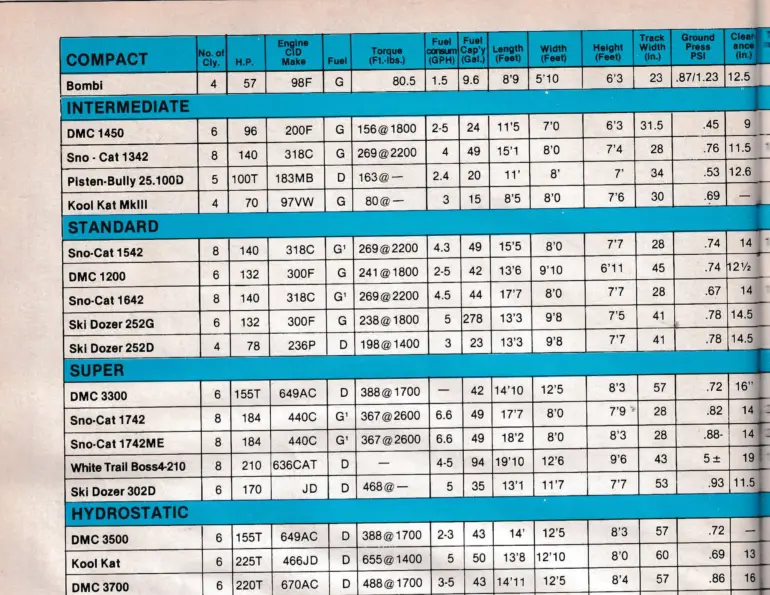
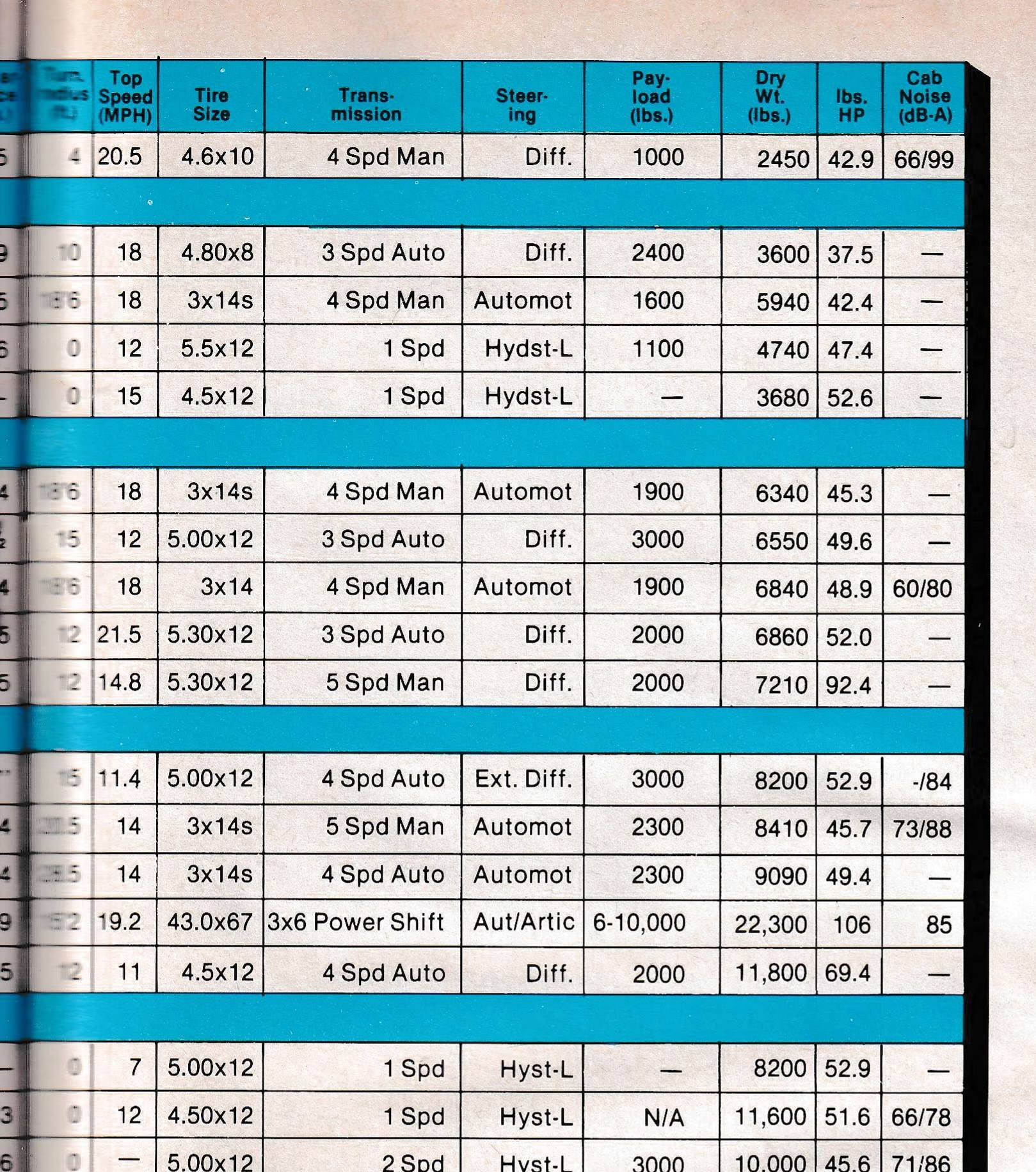
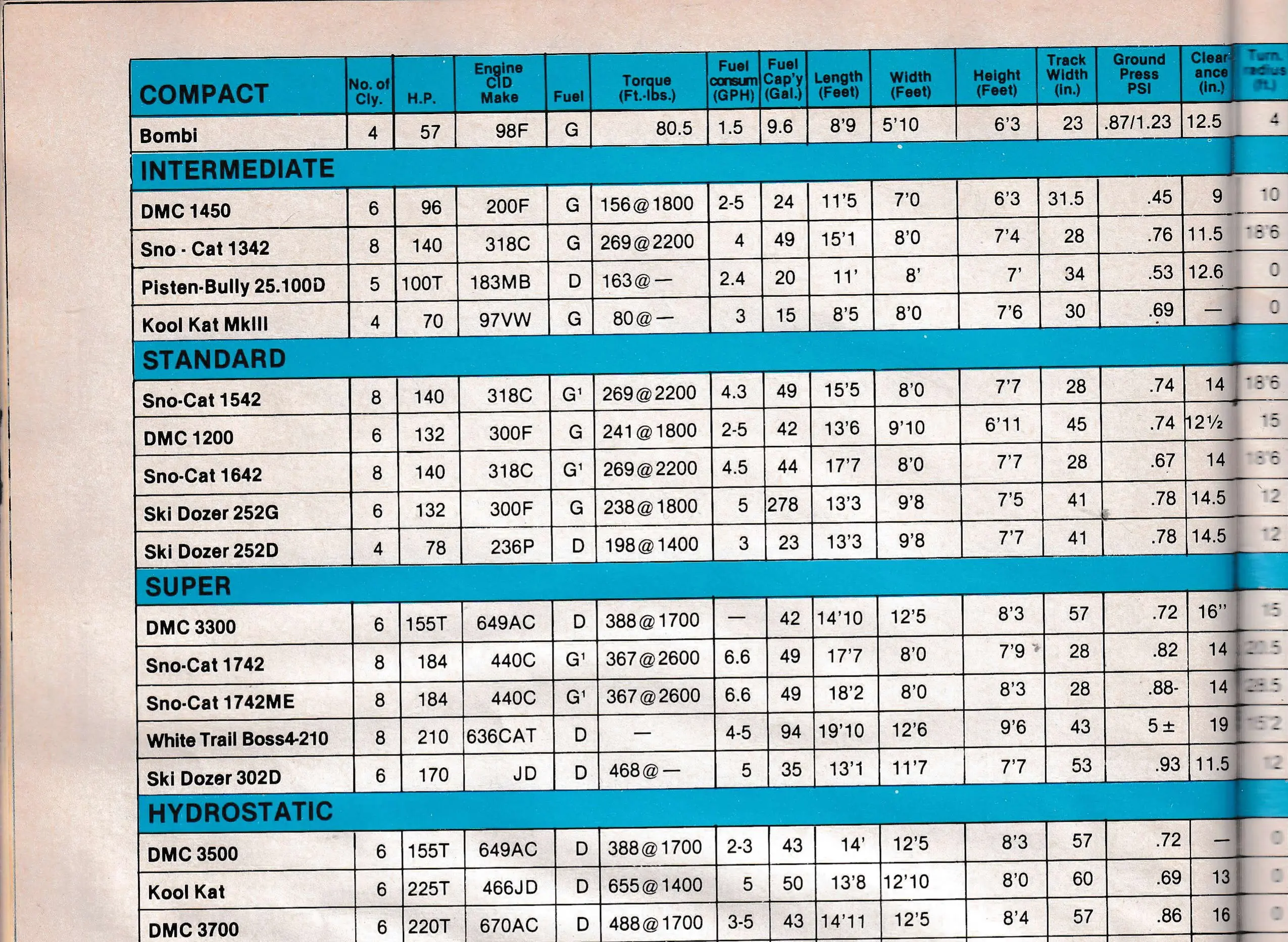
It is against this background that we present our annual review of oversnow vehicles, with technical data compiled by Technical Editor Nils Ericksen. The reader will note we have omitted the price information this year. Too many variables, too many noncomparables, too many potential hassles. Call up your friendly dealer. He’ll tell you. Have smelling salts handy, though. For 1981-82, fully-equipped machines will cost between $15- 25,000, with the biggest selection being in the $35-60,000 range.
How you might ask, do we arrive at the vehicle classifications of “Compact”, “Intermediate” and so forth, that we use in our table and how do we determine which vehicle goes where? It’s really quite simple, and it follows the style of what nannies routinely tell their questioning charges:
“Because I told you so.” But we’ll explain a little.
All of the equipment is classified by comparing four different criteria: 1) horsepower, 2) size, 3) weight and 4) price. Thus, when Kassbohrer added the many extra horses in their new Mercedes blown diesel and almost a foot increase in length, the “Baby Bully” has been promoted to Intermediate, leaving Bombardier’s “Bombi” as the only true “compact”. Similar rationale has relocated the littler Kool Kat Mk III from Standard to Intermediate. Now, over 800 lbs. lighter, 7” shorter and sporting a new VW powerplant, the “III” slips nicely into bed with DMC 1450 and the upsized PB 100.
Further up the ladder, we had to fit in two new additions to the stable: DMC’s 3500 hydrostat and the “biggest yet”, the turbopowered PistenBully 270. Being purists at heart, we acknowledged the White Trail Boss as a truly Super sized non-hydrostat machine and down-shifted it to the Super category. The DMC 3500 hyrdostat is being offered to complement their “brake-steered” 3300 and was brought into the lights last season. It is essentially the same machine as the 3300 and weighs over 1200 lbs. less than its well-established big brother, the 3700.
And then there is always the question of how to fairly represent the 29 different combinations of tracks, body styles and engine locations of the Tucker family of vehicles. Although it is still possible to purchase the steel track/pontoon type “Cat”, the ski industry has been mostly interested in the standard rubber-tracked 2-man “pickup”. Lately, the mid-engine (ME) series available in all models, has been gathering steam for use with front mounted attachments. We have listed only the one mid-engine, 1742ME to illustrate the basic differences between it and the standard units: longer, higher, heavier and 8’ more in turning space—offset by better weight distribution and excellent visibility. The Sedan and Crew Cab are also available but not on ME versions. And finally, rubber tracks that are 10” wider than the standard 28” can be supplied with the 1700 and 2500 series only, which adds over 800 lbs. to the vehicle weight.
What’s new? Aside from the inevitable price increases, (about 15% except for Bombardier which pretty much held the line) and introduction of new models, DMC 3500, Pisten Bully 100 and 270, really big changes are being bypassed for continuous refinements of existing hardware. Ski Dozer, Tucker and Pisten-Bully have increased the size of their fuel tanks. The DMC 1200 is now 8” longer and rides on bigger tires. And so forth.
What does the crystal ball in SAM’s editorial offices indicate is “down-the-road” for all you equipment owners?
Along the lines of “wishful thinking” we expect greater reliability with more emphasis placed upon “productivity.” The horsepower race will subside as the demand for powered attachments tapers off. Newer and more easily serviced steering mechanisms will be developed along with increased use of solid state monitoring devices. Experimentation with new and different track materials will continue indefinitely. Improved access to and maintenance of “hidden parts” will continue with lessons learned from Detroit such as engine diagnostics.
And maybe, just maybe, someone will produce a few more machines designed for the smaller ski operations at an affordable price or at the very least, not vacate that market in the future.
The Table headings and what they mean
No. of Cyl. – If you need help with this heading, perhaps another business would be of interest to you.
H.P. – The horsepower is (hopefully) all SAE rated at the flywheel. A “T” after the HP indicates the engine is “turbocharged” in one manner or other. Thus, it does not “naturally aspirate” as most engines do but has the air/fuel mixture rammed into the intake to provide more power with the same size engine.
Engine CID/Make – All engine displacements have been converted into cubic inches. (So much for metrics.) The letter following indicates the engine manufacturer: F = Ford, etc.
Fuel – Gasoline – G or diesel – D

Torque – (ft. lbs.) – This figure is decidedly more important than HP or CID in that it is a direct function of “power available.” As mentioned earlier, two engines of the same size can produce different power outputs depending upon the method of fuel delivery: carburetor, injectors or turbocharging or combinations.
Fuel Consumed (GPH – If you figured out what “No. of Cyl.”” meant, you should be able to handle this one also. However, this is a much more important piece of information. Although by itself, it seems conclusive, it is not. Not until the productivity of the machine in question is known can the actual fuel consumption be calculated. For example: using a ‘power tiller,” your average driver may be able to cover two acres per hour but could easily double that figure with conventional “blade and drag” grooming. Or a smaller, more fuel efficient machine may only groom a ten foot wide path (and downhill only) while a supposedly “less efficient” one will handle fourteen feet at a clip uphill as well.
Fuel Cap’y (Gal) – Size of fuel tank in U.S. gallons. Look for eight to ten hours of operation on one filling as an ideal.
Length, Width, Height (feet) – The machine, without attachments should fit inside a box of these dimensions.
Track Width (in.) – The most commonly ‘ supplied winter tracks. ‘
Ground Pressure (PSI) – More important for the “powder pushers” but ‘ does provide a guideline mostly for comparison purposes. Note that this “pressure” is computed by the manufacturer at “0” belt penetration with no attachments. (PSI? Pounds per square inch.)
Clearance – Not the space needed on both sides to go through your shop doors but the clear space between the lowest portion of the tractor and the ground.
Turn. radius (ft.) – The turning radius of a vehicle can be very important on narrow trails or a congested parking area. Beware, the figures provided are the “inside” radius. For a true picture of how much space is needed, add the width of vehicle. Thus a “0” radius turn of a hydrostat may actually be 12 feet.
Top Speed (mph) – “Use this figure for comparison purposes only…” Sound familiar? Aside from conducting a X-country tractor race, the mph is of questionable value, especially since it is a mathematical calculation and not done with red and green lights against a clock. Remember, it is still “productivity” that counts. |
Tire Size-Standard sizing. Mostly pneumatic except for Tuckers’ which are solid, and the lead tire on most other rigs which is usually solid or foam filled to help keep the tracks aligned better.
Transmission – The “tranny” as we used to call it, may be manual, automatic or variable speed hydrostatic.
There are many optional types in the non-hydro field so consult your dealer.
Steering – This used to be a very simple topic but not so anymore. Tucker, as always, provides “all-wheel automotive” type while the big White tractor has true “aritculated” (hinged near the middle) steering. Most of the nonhydro rigs “brake steer” through an oil-filled differential combo. The DMC 3300 has external brakes mounted adjacent to the differential instead of inside. Generally, the hyrostats are steered through expensive cable controls to the hydraulic mechanisms while the Pisten-Bully provides sophisticated electronic-over-hydraulic action via an aircraft type wheel.
Payload (lbs.) – This weight is the maximum recommended, in addition to the vehicle weight, to be carried by the vehicle structure (frame, wheels, suspension etc.)
Dry Weight (lbs.) – Must be done while the operator is sober? It includes the machine with no fluids, passengers or attachments. The operating weight can be far greater, as is the case with say adding a 10-way blade and power tiller to a DMC 3700 or PB 170 for a net increase, including fuel and driver, of 7000 lbs.
Lbs/HP – Usually shown as just the reverse, we like it this way since no decimals or fractions of any size are involved. It does provide an idea of how much “spare” power is available to handle difficult terrain or powered attachments.
Cab Noise (dB-A) – Each year SAM digs out its own Sound-Level meter to determine what level of sound the driver is exposed to on a continuous basis. The higher the number, the more effect it has. OSHA allows 8 hours at 90 dBA. The two figures shown represent the noise level at idle and at full speed operation. Due to the growing number of vehicles on the market, we cannot sample all of them.

