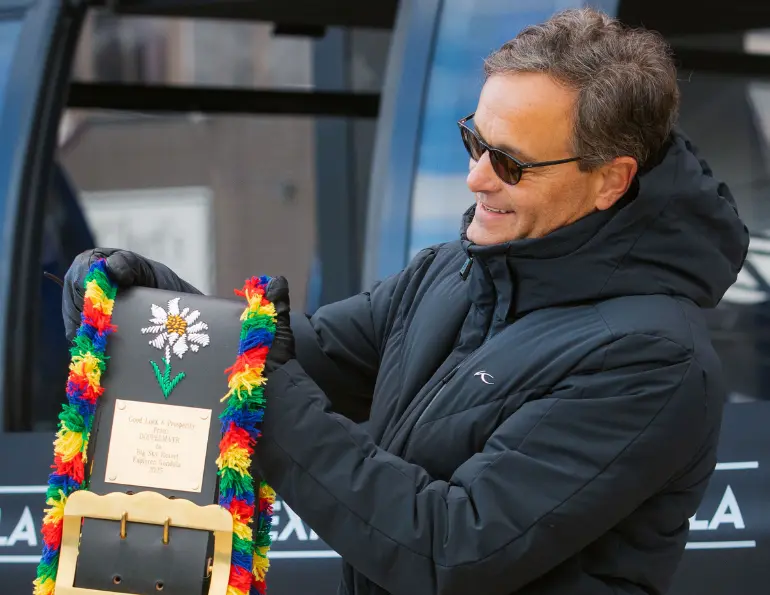
Since he became involved in the family business 48 years ago at the age of 14, Boyne Resorts president and CEO Stephen Kircher, who in May became the chairman of the National Ski Areas Association’s board of directors, has learned a lot. His father, Boyne Resorts founder Everett Kircher, “was the first and most complicated teacher,” Stephen told SAM in an interview. From Everett, Stephen learned the value of innovation and being an early adopter, a credo that has guided many of the company’s investments at its ski areas.
Conversely, Stephen recognized the importance of being something his father wasn’t.
“Boyne made a deliberate commitment more than 20 years ago to be engaged in our communities and in the industry,” said Stephen. “That was a lesson I learned from my father, because he was the opposite. Dad was fiercely private and rarely shared what he was doing. But what you give, you receive, and we’ve had a tremendous amount of reciprocity and we’re a better company because of that engagement and we’re better community members because of that engagement.”
As such, Stephen dedicates a lot of his time contributing to efforts beyond the company he runs. He has been an active member of the NSAA board of directors for about 18 years and was on the hiring committees that landed the last two NSAA CEOs, Kelly Pawlak and her successor, current president and CEO Mike Reitzell.
He’s taking this collaborative, rising-tides-lift-all-boats approach to his role as board chair, where he’s curating the knowledge and experience of all 28 NSAA board members to help guide and support the organization’s staff during an interesting time for the industry. So far, growth—in all its various definitions—has emerged as a priority alongside safety.
__
SAM: How are you approaching the role of board chair?
Kircher: I’m just trying to be a cohesive leader and do as good a job as possible to tap the experience of the executive committee first and then the board itself and harness that more effectively.
A big part of that is I’m doing one-on-ones with all 28 board members, which should be completed this fall. I’m trying to absorb as much as I can to get their perspective, so I have their voice in my head when I’m having conversations with the NSAA team. And so, it’s not about me. It’s about synthesizing a better future. We can only do so much at NSAA, right? So, my aim is to be a proper interface between the industry and the professional team at NSAA.
SAM: When you hired Dan Cockerell as president of operations for Boyne Resorts, you said it was “the right time” to add that position to the company. Why?
Kircher: The timing of Dan Cockerell’s arrival as president of operations lined up with more than my appointment as NSAA chair. It was also when I became chair of our new nonprofit, the Boyne Forever Foundation, but the deeper reason was to support Boyne’s growth itself: as a family-owned company since 1948, we owe it to our future to keep investing in the long-term development of our team and in real succession planning, so that the organization never depends on any one person’s bandwidth, mine included.
That being said, adding this new role at Boyne has created room to give NSAA the attention a chair owes it.
SAM: Great. Now, with all this free time, what are some of your goals for your two-year term as chair?
Kircher: I’d say the goals are less a personal agenda than a set of commitments.
First, I’d like to tap the experience of the executive committee and the 28 board members far more effectively than a twice-a-year meeting cadence allows. The one-on-ones are the start of that, not the end.
I’ll also help the association turn growth from a topic into a discipline. That means measuring unique participants against the population rather than skier visits, and making sure the ideas actually reach execution. (Note: the number of unique ski and snowboard participants has remained at around 3 percent of the U.S. population for at least 30 years while the population has continued to grow.)
Never let up on safety, which is like breathing air: basic to our survival, and the precondition for everything else.
Through it all, I’ll support Mike and the NSAA team through a period of real transition, with clear roles between the volunteer board and the professional staff, so each does what it does best.
Success, two years from now, looks like a board that feels more connected and more useful, and a growth effort with measurable momentum behind it.
SAM: Tell us about the one-on-ones you’re having with the board members. What have you learned so far? Any surprises?
Kircher: The first surprise was to learn that no chair had done this in roughly a decade. The simple act of asking landed well, which says something about the opportunity in front of us.
There’s ample engagement by the leaders of industry on specific topics that are important to them. And this tour, which I’m about 60 percent through [as of mid-September], is about understanding where everybody’s head is at and what the priorities are and to get kind of the barometer of the industry, if you will, so that I have that context when I’m speaking to Mike [Reitzell] and the NSAA team about where we’re going.
So far, the most consistent theme I’ve been hearing, and this is something that the team and Mike have already embraced and are focused on, is the issue of growth. Board members differ on how to define growth and whom to prioritize. However, nearly every conversation came back to it as the defining issue. Rarely does a board and its staff arrive at the same answer independently. It should make the next two years more productive.
SAM: Speaking of growth, it’s been a front-of-mind concern across the industry for a long time and is arguably more acute now. What are the issues?
Kircher: For one, we have a perception problem in the U.S. market, which is a headwind for growth. What are the biggest things you hear when the news hits about skiing? It’s cost and danger. Avalanches or collisions, or “can you believe it’s 350 dollars to ski now?”
Yes, we’ve grown skier visits, and that is a success generally, but we haven’t really driven penetration of the U.S. population. Now, there’s demographics, too. More people live in the South than ever before. People are moving away from where they’ve got proximity to mountain environments in general. And our participants are getting older.

The Growth Committee has done, and continues to do, hard intellectual work. It shifted the primary metric from skier visits to unique participants and set two targets that cannot be reached by inheritance: 13 million unique participants and 40 percent of visits from those ages 24 and under. It also has subcommittees working on the 2034 Winter Olympics opportunity (the Winter Games will be hosted in Salt Lake City, Utah) and community engagement.
The brutal fact, however, is that ideas have outpaced execution, and no single person at NSAA has historically owned growth day to day. That’s why the new director of strategic growth role matters. The role’s first job is to translate committee priorities into operating plans with timelines.
NSAA’s job is to provide the water: tools, data, education, best-practice sharing and a better story about why this experience matters. Ski areas execute. Growth, as the churn math shows, is not a campaign. It is a permanent way of operating.
SAM: Can the industry’s collaborative nature play a role in driving growth?
Kircher: The question is, what are we—you know, Capital W, Capital E—doing as an industry to go outside of our core base of 10 million participants?
It goes back to the sharing of ideas that work. I think NSAA can play a role in that. Your magazine, I think, is an important resource for those of us who run ski areas to get the message out and expose people to things. You’re part of this growth engine in my mind because you communicate that potential desire to want to be creative. And if you highlight things that are happening of that ilk, it will help.
SAM: What are some other important topics the board has brought up?
Kircher: We need to keep pushing on safety. There are new innovations that are going to reduce the number of misloads on lifts, for example. We’re going to make huge strides in a lot of this stuff in the coming years, and we need to continue to focus on it. And it does inadvertently undercut growth if it’s not handled properly. So, there’s a direct connection between the two.
SAM: What about climate change, sustainability?
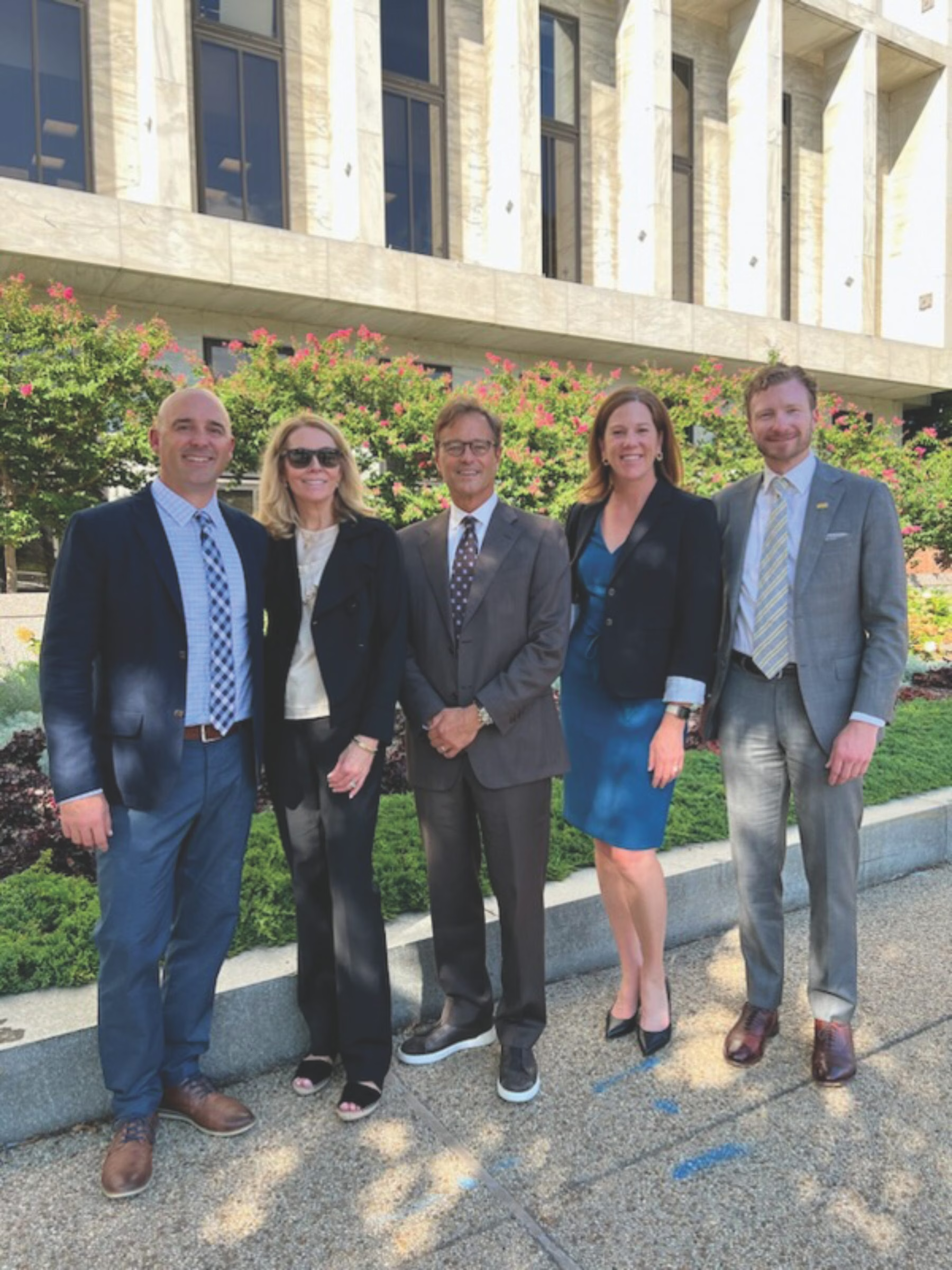
Kircher: Sustainability and climate remain a key pillar of NSAA’s priorities. We went to Washington last fall primarily talking about that issue to a great degree. There’s ebb and flow in the political environment—between DEI and human impact to climate change, those two things have gotten out of favor in Washington because of the current leadership.
There are a lot of operators that think we overemphasized climate in our efforts prior to the last couple of years. We still have it as a priority independent of that fact. And, you know, engaging in Washington hits on a lot of issues, including that issue because we’re the canary in the coal mine. We’re an example of what can happen to you as an industry if you let this climate train run off the tracks. So, we are vocal in the corridors of Washington and state capitals.
SAM: Beyond your father, who are some of your mentors and what lessons have you learned from them?
Michael Berry (former NSAA president and CEO) tapped me for the NSAA board twice, once when I was quite young and again when I was not so young. That second invitation taught me a lot about responsibility and stewardship.
Chip Perfect put a name to something Boyne has practiced for 78 years: R&D means “rip off and duplicate.” Find what works, wherever it is, and bring it home.
Jim Collins’ work (Collins authored the best-selling management book “Good to Great”), and time spent with him, gave shape to confronting the brutal facts, getting the right people in the right seats on the bus, and making sure you have enough oxygen (cash) to reach your destination. Those fundamentals have become bedrock to our strategic thinking.
SAM: How do you approach being a mentor?
Kircher: Personally, the discipline is asking better questions rather than supplying faster answers. It is a lesson still being learned, and those who know me would say my instinct is to drive. The best mentoring, however, helps someone find their own answer and then gets out of the way. Mentoring is also a long game measured in decades. The payoff is watching people you invested in go on to lead, here or somewhere else in this industry.
___
Kircher’s commitment to the chairmanship and desire to have a more engaged board of directors reflect the lessons he’s learned growing up in the family business coupled with nearly two decades of service to NSAA—innovation is the result of action, and action requires involvement.
Will his tenure lead to a lasting direction that ski areas can follow to grow the number of active ski and snowboard participants? Only time will tell.
Consider what Kircher said during our interview about making the effort to bring new and interesting experiences to ski areas: “You just need to set the table for guests, and they actually engage in it. And I think we, as an industry, need to identify those moments.”
Now is a moment the industry would be wise to pay close attention to, because progress—in growth, safety, and numerous other important areas—is a shared responsibility made easier when the table is set, which Kircher aims to help do during his time as chair.