
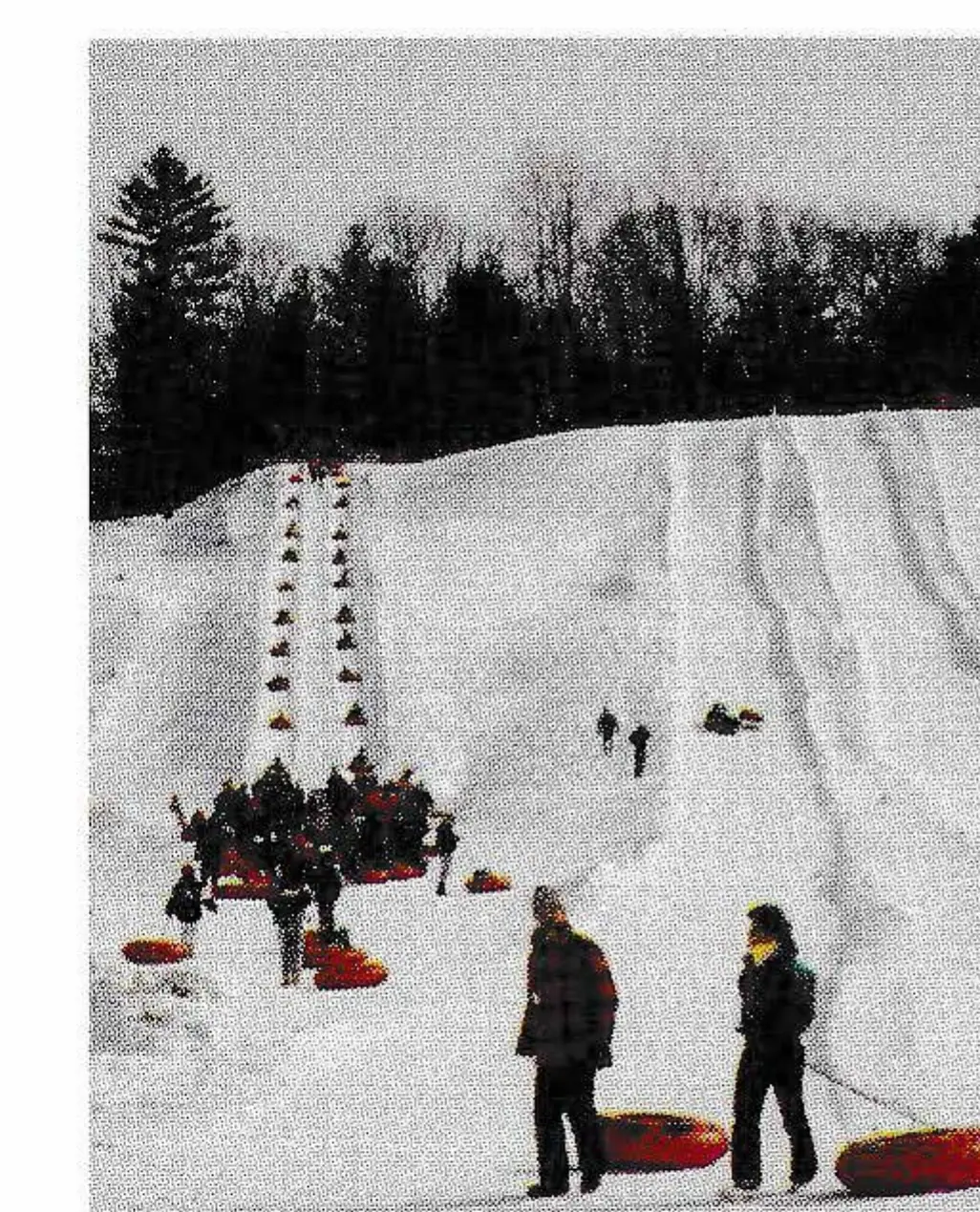
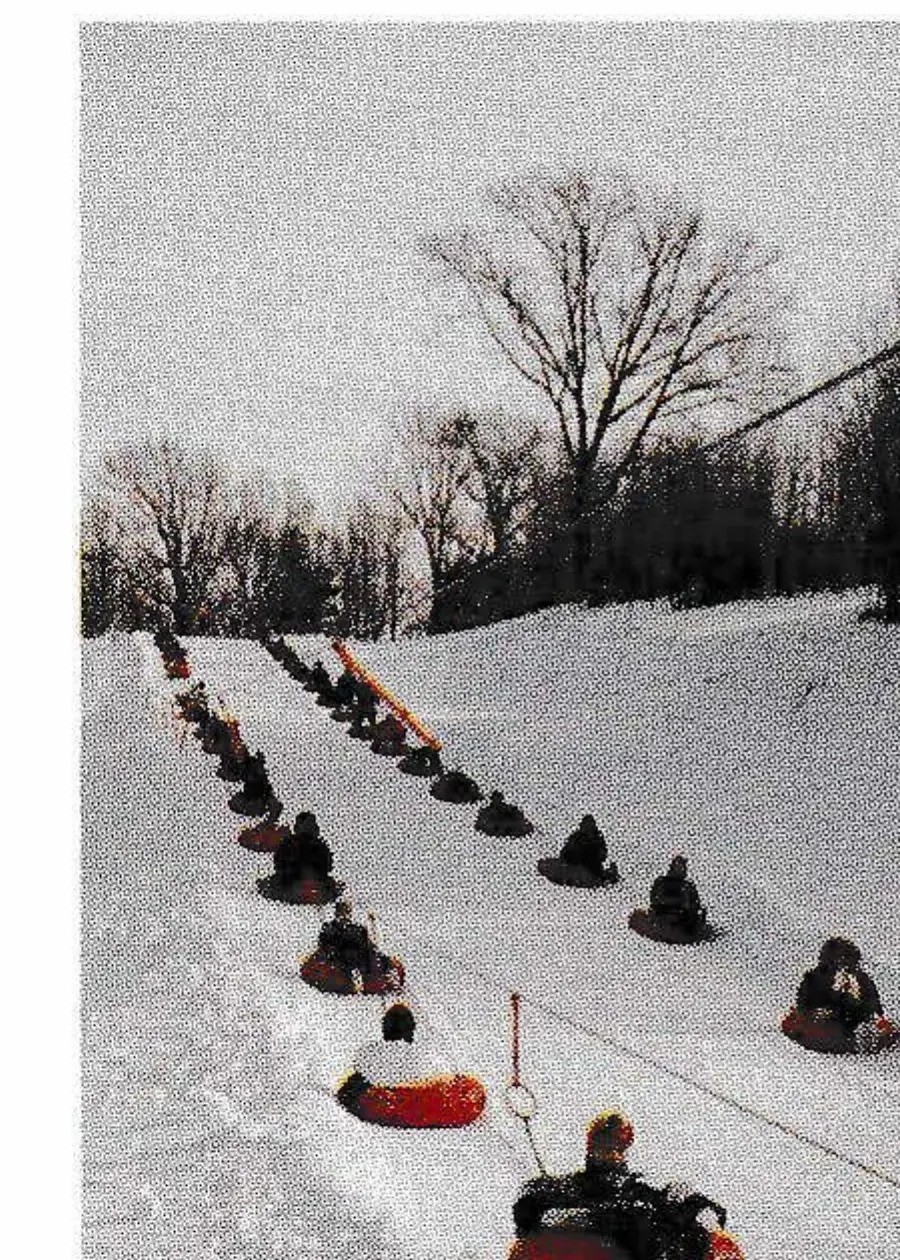
During periods between hockey matches, Park and his two sons slide down a hill on specially groomed runs in rented inner tubes. They were able to maintain a high intensity level because there was a tow to haul them back up. Everybody had such a ball, it got Park to thinking.
“Other than skiing, there isn’t that much outdoor winter recreation,” he says. “This inner tubing is something the masses can do. You don’t need lessons, you don’t need equipment, you can’t fall down because you’re already sitting or lying down … People who are 250 pounds and can’t ski can do this.”
Two winters and a lot of homework later, Park’s 20-acre Amesbury (Mass.) Winter Sports Park has had a bonanza of an initial season: 50,000 visits and lots of press. About 45 minutes north of Boston near the New Hampshire line (and next to Interstate 495), Park’s tubing hill had a slow start, operating only two of 10 days over Christmas. But once the weather settled down and word got out, people were willing to wait for more than two hours on weekends to rent a tube.
“It got so we had to stop advertising,” says Park, who controls crowds by the number of tubes he issues. A maximum of 600 to 800, depending on conditions, keeps runs manageable and lift lines no more than seven minutes. All-day rates are $12 on weekends (9 a.m. to 10 p.m.), $9 midweek (noon to 10 p.m.); evening and morning only rates are $8 on weekends, $6 midweek. A single ride is $2, and there are group rates.
Depending on weather, most people spend two to four hours tubing, says Park. Meanwhile, surprising numbers have waited for tubes during the snowiest winter in more than a decade. Families, kids, grandparents, skiers and non-skiers joined together to have fun and battle cabin fever. Ages ran from 4 to 60-plus; families dominated weekends and young people evenings.
Although hefty snowfalls this season set the right mood and tone, Park did not depend on Mother Nature. In 1991, after carefully searching out the right hill (“10 stories high” or about 100 to 120 vertical feet with a long runout and a northern exposure), he invested in Lenko fan snowmakers and a Pisten Bully grooming machine with tiller and blades.
He also installed four specially adapted cable tows, with hooks instead of handles over which lift attendants loop ropes that hang from every tube. Customers sit in the tubes for a two minute ride to the top where they are told to “roll out.” There below them are 10 runs (six “medium,” four “black diamond”), each sculpted into a kind of miniature half-pipe or bobsled-type run that controls the direction of the tube. The more advanced runs start a little higher, and a couple have bends in them. But repeated use of a run usually determines speed and distance, and speed is what tubers have in mind.
Park and his 60 wintertime employees constantly monitor the hill’s safety rules. Children under four are not allowed on the hill, kids under eight must be under direct adult supervision at all times and 4- to 6-year-olds (who are not charged) must ride in the lap of an adult who is sitting in a tube unattached to any other. The biggest lesson he’s had to learn, says Park, is “don’t trust people.” After repeatedly telling parents that kids under four aren’t allowed on the hill, he once found a 16-month-old coming down the hill in the lap of an 11-year-old.
Since mass and weight affect speed, older tubers lash themselves together with the tubes’ ropes (holding them by hand) and push off with screams and hollers. Rules say no more than four tubes can be linked up, but snow conditions can modify the rules either way. (The record on a slow-snow day, says Park, was 34.)
Park says he has demonstrated to at-first skeptical insurers, lift inspectors and town fathers that this “winter water slide” is “a controlled environment,” unlike sledding or tubing on an open hill, and a relatively safe pastime. (Insurance was obtained through American Specialty Underwriters of Woburn, Mass.)
Accidents, which have been few, he says, have included a broken arm, a concussion and a vertebra injury. Park says that a tubing fatality on a Greater Boston golf course last winter involved a child riding on someone’s back — something “we haven’t allowed since day one.”
Admittedly interested in “franchising and consulting,” Park says he’s had calls from as far away as Michigan and California expressing interest in the concept, but only one has been from a ski area. In Park’s view small hills in and around northern cities offer the greatest potential. Although he says a ski resort that wants to expand its breadth could benefit from a tubing hill, he doubts many would or could adapt a hill for the long runouts required — 140 to 200 yards at the Amesbury operation.
On the other hand, a tubing hill has long operated near Winter Park, Colo., and there is a tubing and sledding facility near Mammoth Mountain, Calif. In addition, there are popular public rides like Vail’s bobsled and the Olympic bobsled and luge at Lake Placid, N.Y.
Park won’t allow close-up photographs of what appears to be a simple adaptation of a handle lift and he is especially proprietary about his 800 red tubes, which are not truck inner tubes, he notes. Many come with bottoms and each has two blue handles to grip, a rope and white Coca-Cola and Amesbury Sports Park logos. The source and cost of the tubes are part of his consulting services, says Park.
This summer, the Sports Park becomes a driving range and miniature golf course with perhaps some batting cages. The foundation for a new 10,000-square-foot combination base lodge, cafeteria, sun deck and snowmaking pump house is already laid.
Park says a tubing facility can cost anywhere from $200,000 to $2 million depending in part on one’s ambitions and projections. He obviously sees a rosy future in expanding the entire concept of tubing on snow.