

A well-designed ski area should have as little effect upon the environment and its ecology as possible. Slope design should make use of natural rolls and grade changes, trail borders should be softened by silva culture and lift-lines can be made less obtrusive if the terrain curves and swells in a way that makes them skiable.
Environmental considerations, however, are not merely aesthetic. One of the most potentially damaging threats is erosion.
In the early days, slope builders simply cut the trees as close to the ground as practical, threw the brush into holes or at the base of the side slopes and covered it with body wood. While it was a fairly effective method of preventing erosion, especially after the new growth came up through the refuse, the trails required a heavy snow cover for safe skiing, and the summer fire hazard potential was real.
Acute maintenance problems caused the builders to rethink their approach. The timber and brush were removed and the stumps shaped on their uphill side to lessen the danger to the skier on impact. The slopes and trails, however, were still dependent upon heavy snow cover, and with the brush and body wood gone, the surface dried out more rapidly. The natural vegetation did not reseed itself and the stumps seemed to protrude farther and farther with the passage of the seasons. For a time, the root systems of the cut trees protected the soil, but gradually their effectiveness was lost. The result was erosion and, sometimes, landslides.
Now ski trail designers realize that erosion control is as important to their work as safely utilizing the terrain to accommodate the optimum number of skiers. However, as it is unusual to find terrain exactly suited to ski use, this means the terrain must be shaped, even if it involves massive earth movement, in order to control erosion and achieve the maximum skiing potential.
As a result, construction became sophisticated. Stumps, debris and rocks, etc., are used to form rolls both to turn runoff as well as enhance the quality of skiing. The sides of the trails are blended into the original terrain. Natural watercourses are protected and used to carry runoff. Schusses and long fall-lines are given slight side slope to prevent water from concentrating into the dreaded combination of volume and velocity. Sidehills are softened or eliminated, thus expediting the problems of winter grooming. Finally, sod is established after fine grooming, fertilization, seeding and mulching. With these precautions, the resulting area should be at least as well protected against water damage as the untouched environment was and, in many instances, even more protected.
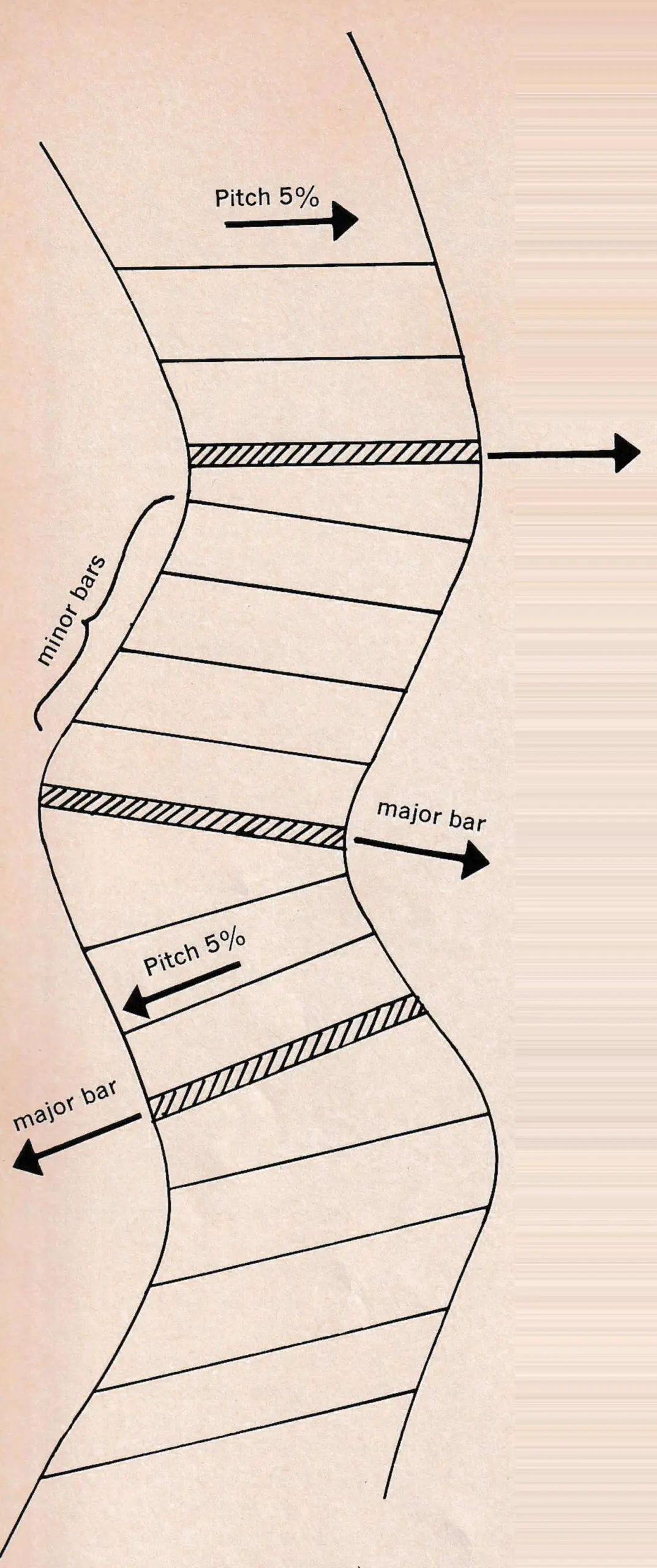
The need for precaution is equally crucial during the construction process itself. Strong waterbars must be constructed at critical locations to protect steep grades, sections of shallow soil cover and regions affected by large amounts of drainage.
Their purpose is to act as a safety valve, preventing damage from the unusual deluge, which always manages to occur during construction. The beds of the bars should have a shallow slope, between five and seven per cent, to prevent excessive wash within their course and be placed with an eye to the natural drainage systems. Between these major waterbars shallow ones, conforming to the same pitches, should be constructed to forestall sheet erosion (Figure 1).
In most situations the mulch is spread after the seeding. (The highway method of blowing on plant food, seed and mulch in one operation is not generally practical in mountain work). However, the work must be carefully controlled until the sod is stabilized. While this mulch is most beneficial in nursing the seed into grass and dampening the development of sheet erosion, it can become a hazard during flash flooding because without the grass to stabilize it, the mulch has a tendency to be washed into the waterbars, forming dams. If these dams are not broken, the bars serve as collectors and can dump volumes of water onto the slopes where the grade then increases its velocity. If the slope construction has been planned, as it should be, so that the sod is reasonably secure by late summer, fall work can focus on readying waterbars for winter.
Basically the waterbars serve as safety valves during the period when the soil surface is most vulnerable. Once the sod is established, they can be modified so that they do not become a hazard to skiers while still retaining their protective capacity. This means that during the late summer and early fall, the downhill wall of the bar is lowered, smoothed and seeded to a grass such as winter rye, which will take root in cold weather. The smaller bars, in most cases, should be cleaned out and left until at least the late summer of the second year. If construction lags and the sod is not well established, the lower wall of the bar must be maintained throughout the first winter season. In this situation, the fall work focuses on rounding off the lower wall and smoothing its crest so that it will not impede skiing and grooming. After the reshaping it should be seeded to winter rye.

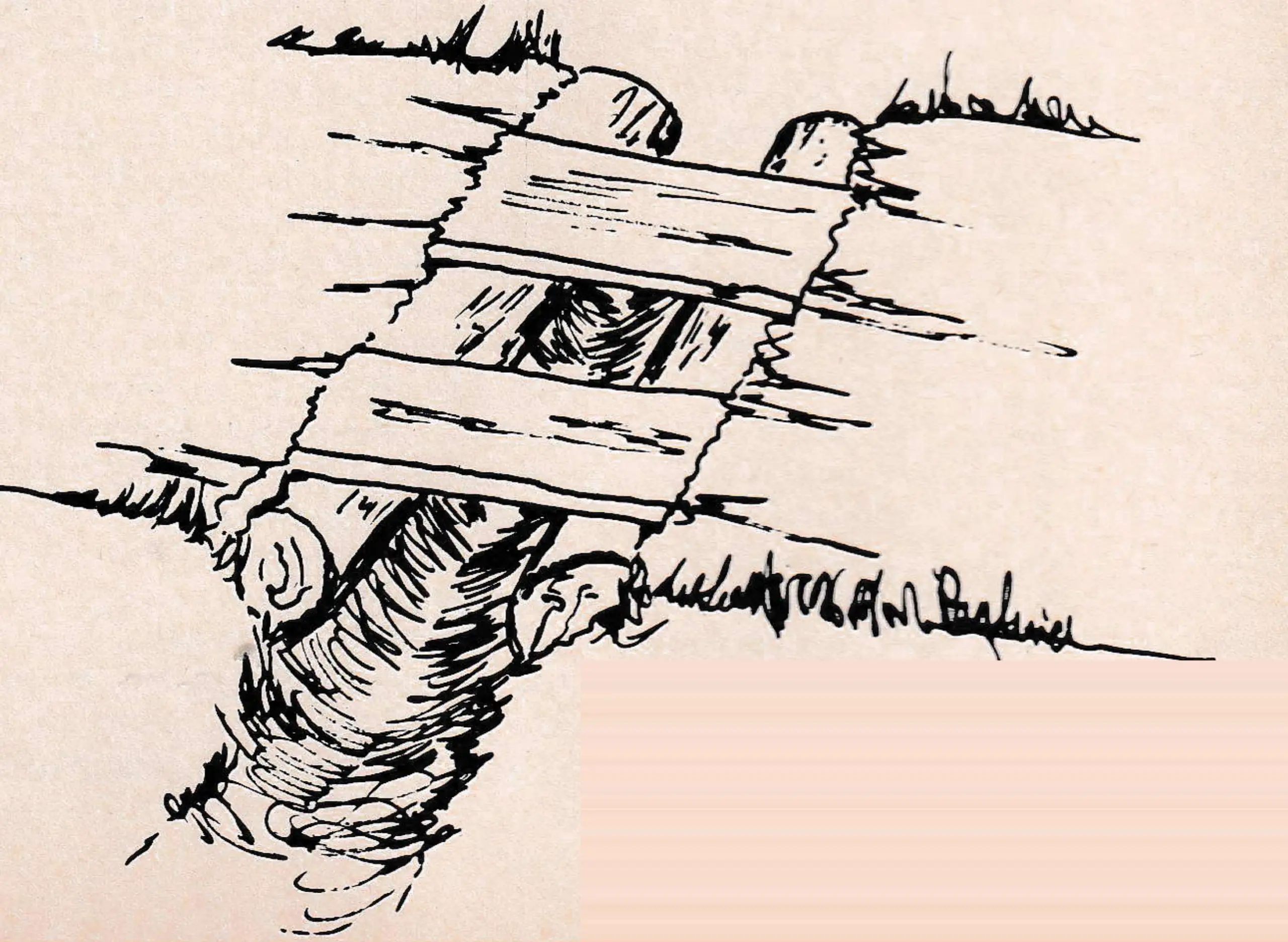
Whether the slopes are new or old, the protective system needs constant attention if it is to remain effective. Each autumn the bars should be checked for obstructions and breakdowns. The task is especially true for areas within hardwood stands where leaves tend to fall where they can do the most damage. A few man days spent in inspection and rectification can sometimes prevent a springtime disaster. It is a sound investment, for erosion gullies are difficult and expensive to repair. The network of work roads used to service lifts and slopes, especially by wheeled vehicles, can also create a serious erosion problem. To prevent an accumulation of water they must be carefully located and maintained. If culverts are necessary, the most practical type is the old log road type (Figure 2), consisting of two logs laid parallel at right angles to the road. These logs are separated by cross planks spiked down at the proper spacing to serve as tracks for vehicles. The fact that most of the culvert is open makes it easy to keep clean. Before the snow flies, these culverts should be carefully inspected and all drainage elements cleared for the spring runoff.
Before frost sets in, the trails and slopes should be inspected for signs of sloughing, especially on the steep sections over ledge or clay. If sloughing is discovered, the water course should be located and drained off to the side of the trail.
If the natural drainages, outside the slope system, are so situated that blockage could turn the water back onto the slopes, they must also be attended to. Remember that in the natural state, particularly in the mountains, streams are constantly dammed by debris and forced into new courses.
The sidelines of the trails and slopes are important in the long run because their appearance contributes to the overall image of the area—a soft outline helps the trail and slope system blend into the mountainside, and tree cover plays an important part in curtailing wind damage. But a variety of problems can crop up, depending upon the timber stand through which the cutting was made. Some conifers sunscald or have their roots loosened by wind when exposed. A hardwood stand may contain diseased trees such as beech scald or weed trees or border trees with root damage suffered during construction.
During the fall, trees which are in danger of tipping over in a wind should be felled. Diseased trees should be cut to provide room for replanting in the spring. And weed trees should be thinned for the same purpose. Even doing a little at a time can improve the area’s appearance considerably.
Where a stand is not adequate to provide a wind fence, preparation can be made in the fall to plant when the snow goes. This is especially pertinent in hardwood cover, where the inclusion of conifers will add considerably to the wind fencing effect.
The purpose of this kind of protective work—thinning trees, building waterbars and culverts, seeding and mulching—is twofold. First, it can prevent erosion and other ecological damage that in later years would require extensive manpower and dollars to correct. Secondly, and particularly significant at this point in time, it gives the critics of ski area development fewer legitimate examples of environmental destruction on which to base their crusades against the industry.
Artwork by Denise Paglina