


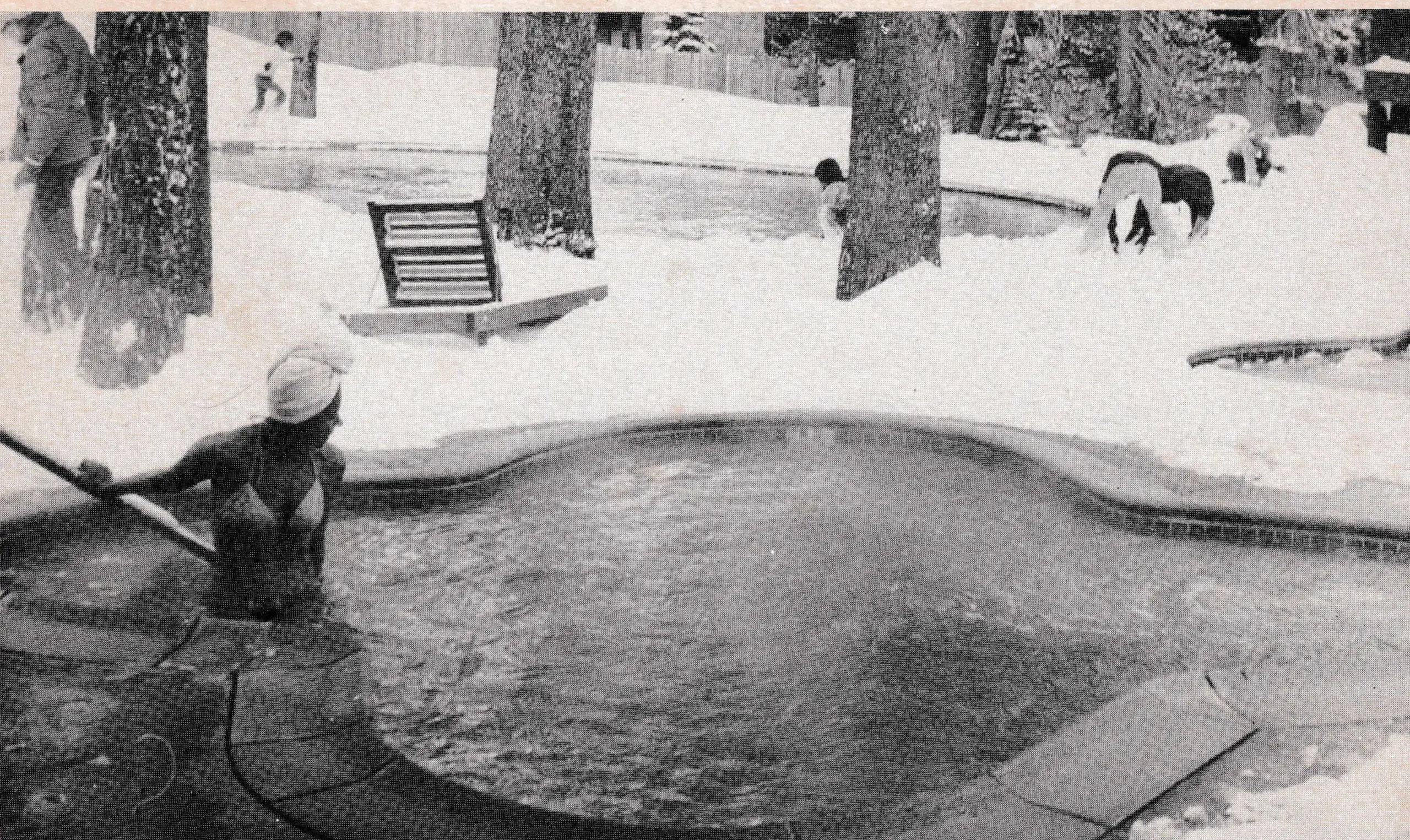
In ski history there has long been a relationship between snow and warm water. First there was the daring and innovative outdoor pool at Sun Valley, then skiers in the Sierras discovered the natural Hot Creek near Mammoth, and finally, along came Walt Schoenknecht with his “dream pools” in the Snow Lake Lodge at Mt. Snow.
Today there is a resurgence of interest in the salubrious delights of warm water after a day on the slopes. Emanating from Southern California, where the good life is measured in hours of outdoor fun, a modern version of the whirlpool bath is appearing at western ski resorts in the backyards of lodges and condominiums.
Unlike the whirlpools associated with Joe Namath’s knee, Whitey Ford’s elbow and Billy Kidd’s ankle, these new models are for feeling good all over—with your friends for company. The new whirlpools, to which manufacturers and dealers have added the name “spa” to help remove them from this clinical atmosphere, come in all the glamourous shapes and colors that molded fiberglass or concrete can be adopted to. The average size, whether rectangular, square, round or amoeba shaped, is from seven to 12 feet in diameter. Depending on the shape, size and conviviality of the group, 10 or 20 people might squeeze into the warm, gushing waters of such a whirlpool spa.
The feel-good part of the whirlpool is produced by jets of air and water (much like the snowmaking conbination), which when combined with the ambient temperature of 90 to 110 degrees in the surrounding water, provides a massage that can be powerful to gentle depending on how close one sits to the jets. Usually 15 to 20 minutes is the maximum time for this exposure.
While the Jacuzzi brand is the best known of the jet manufacturers, there are other manufacturers and even another style. The Hydra Spa is a mass of pinholes in the bottom of the bath through which plain air is shot. The water looks like a foaming washing machine, but the feel-good effect is more all-over than directional.
At the Aspen Health Center in Colorado, Tage Pedersen has been subjecting wounded skiers to the healing effects of whirlpools for years. “After the initial swelling has been controlled,” he says, “the whirlpool treatment stimulates circulation by the heat and massage of the water pressure. This loosens and relaxes stiff muscles and joints.”
Skiers who have discovered the healing, soothing, relaxing effects of whirlpool spas return and request them again and again, according to some condominium rental agents. “Last year 90 per cent of our reservation requesters asked for whirlpools with their accommodations,” says a reesrvàtions clerk for Mammoth, California, Reservation Service.
At Sun Valley, the outdoor group whirlpools have been such a hit that some new condominium units are being offered with or without individual whirlpools. In a highly competitive market, whirlpools are expected to be a key selling point. In Colorado, the Keystone Lodge gets up to 10 times more action in the whirlpool than in the swimming pool, according to observers.
Besides bringing business to lodges and condominiums, another advantage of whirlpools over simming pools is space. The whirlpool spa takes about one-fifth the space of a swimming pool. Even though it is heated to a higher temperature, the smaller size is more economical to heat and to prevent heat loss. Commercial covers are available for this purpose, but Tom Dempsey, a condominium developer at Mammoth Mountain, has been using the familiar plastic bubble packing material with greater success. These bubbles of air sealed between two layers of film are light, inexpensive and reasonably sturdy.
While whirlpools can be purchased in a package which includes a fiberglass “caldron,” skimmer, pump, filter and heater for about $2,000 and up, plus shipping, many developers prefer to buy parts separately. This permits them to build the bath or caldron of concrete or to prepare a concrete base for the pre-formed fiberglass caldron of their choice.
In addition to these working parts, decking is needed around the edge of the caldron. Cheapest and most commonly used is concrete, but quarry tile, brick, flagstone and wood are also possible, although more expensive. Dressing rooms, lockers and a retaining wall to prevent outsiders from entering are usually also needed for a whirlpool installation.
The total cost, according to Western developers, runs about from $3,000 to $4,000, including installation, building permits and rented equipment.

Operating Equipment
The operating parts of a whirlpool spa are main drain, skimmer, return inlet, pump, filter, heater, timer and air blower.
The main drain works in conjunction with the skimmer to return water to the filter along with the surface and bottom debris, keeping the spa clean.
The skimmer is an outlet at the water level with a flap type gate. The water level in the spa should be kept at the center of the skimmer for best operation.
The pump draws water from the main drain and skimmer and pushes it through the filter and heater returning to the spa through the return inlets (jets).
The filter cleans the spa by passing the water through a filtering system where debris and impurities are removed.
The heater: Most people prefer a 95 to 105 degree range. The rate of heating varies considerably depending on the size and type of heater. A 125,000 BTU heater for example will heat at approximately 20 degrees per hour.
Heaters can be gas fired or butane (LPG) fired. Experiments in solar heating are being conducted but for now they are not proving too efficient for ski resorts.
Pipes running from the heater to the spa can be used underground as an aid for sidewalk snow removal maintenance control.
Manufacturers and Suppliers
Whirlpool Packages
- Hydro Spas, 8914 E. Valley Blvd., Rosemead, CA. 91770
- Riviera Spa, Inc., Sun Valley, CA. 91352
- Baja Industries Inc., 1804 W. Price Street, Tucson, Arizona 85705
- Leisure Spac, Inc. 100 E. Thousand Oaks Blvd., Thousand Oaks, CA 91360
- Gerico Fiberglass Products, 7312 Murdy Circle, Huntington Beach, CA 92647
- Sun King Spa, 73-400 Highway 111, Suite 108, Palm Desert, CA 92260
Whirlpool Parts
- Raypak Spa Heaters Inc., 31111 Agoura Rd., Westlake Village, CA 91361
- A. O. Smith Corp. (spa heaters), Consumer Products Div., Kankakee, Ill. 60901
- Jacuzzi Bros., Inc. (jets), 1440 San Pable Ave., Berkeley, Calif. 94702
- Vico Products, (jets), 1808 Potrero Ave., S. El Monte, CA 91733
- American Products Co., (underwater lights) 10913 Vanowen St., No. Hollywood, CA 91605
- Sealed Air Corporation (covers), City of Commerce, CA
- Seeley-King Thermos Co. (covers), Winchester, Mass.
- RCK Enterprises (covers), 16043 Valley Wood Rd., Sherman Oaks, CA 91403