


This second article on Yellow Flag Management will again develop a scheme to reveal early warnings of trouble which an astute manager can use to grasp tighter control of this area of responsibility. Again, the importance of budgeting, considerable help from accounting and timely reaction by managers is fundamental to success.

Those who read the first article in this series on revenue control will recall the important elements needed to improve profits were:
- Timely, weekly revenue reporting.
- Reporting by department against the prior year and budget both weekly and year-to-date.
- Immediate identification by management of seeming problem areas followed by quick follow-up with departments involved.
- Gradual supervisory reaction to the system such that problem areas get corrected even before the reporting system reveals them.
The article generally concluded that the sooner the “yellow flag” of caution got up, the sooner corrective measures could be taken, and the less risk there’d be of revenue or profit disappointment at season or year-end.
The same thing can be done with labor cost, but it requires a two-step process, because accounting departments cannot typically convert labor hours expended during a week into dollars for an immediate report. This can be solved by requesting a report be submitted the day following each week’s end showing man-hours expended for the previous week in each department. The report can easily be set up to show each week’s, the prior year’s, budgeted and the prior week’s man hours as illustrated in an example for the Ski Patrol (Table #1). Each department would have a similar report accumulating new figures weekly.
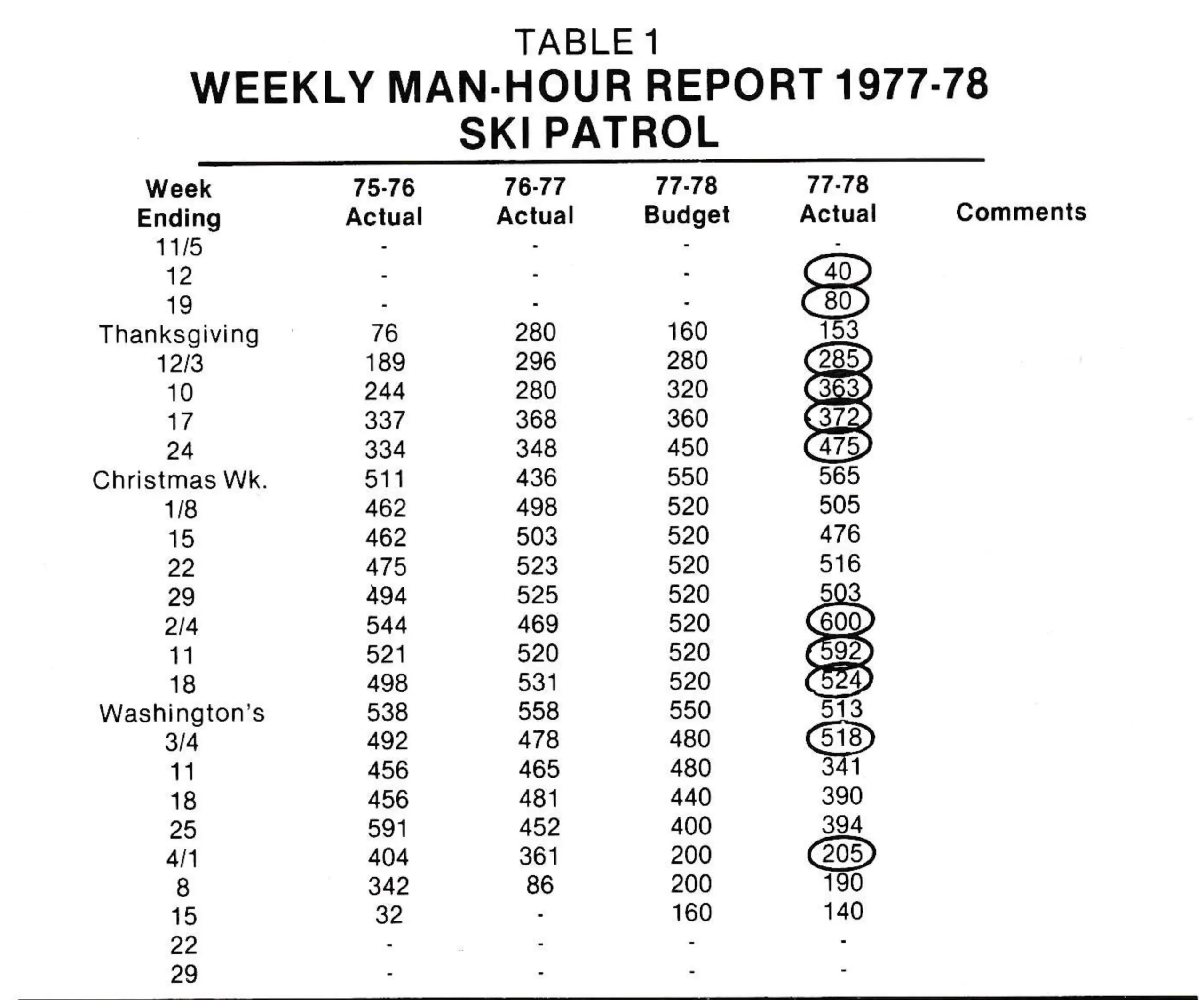
Supervisors may say budgeting man hours weekly is impossible, and surely it is difficult. But they also know that during a typical week certain lifts run and require certain staffing. It is precisely that normal figure you want used as the budget.
Then you, Mr. General Manager, can scan the prior week’s Man-hour Report each Monday. You can quickly identify whether the department involved ran consistent with budget, prior years and prior weeks. And, of course, if it didn’t you can hoist the yellow flag, circle the figure in question and contact the department head for further explanation.
Sometimes the reasons for excess labor will be good, i.e. an additional lift scheduled, a big snow storm, a special event (note the week of 2/4 on the report), but be sure the labor hours drop down the following week. Don’t allow the extra part-time employees to linger on the payroll as apparently happened on the Patrol the week ending 2/11.
There is another very important element to this report which may contribute more to profit than frequently explainable deviations as above. That is the role of early and late season budgeting and record keeping. In the ski industry there is a great tendency to start employees too early and to retain them too long. A good budget, prior year record and weekly attention will absolutely tighten your control on this. The general manager who sees an extra 40 or 80 hours (see weeks ending 11/12 and 11/19) suddenly appear prior to opening when they weren’t needed in prior years and weren’t budgeted, typically must receive a pretty complete justification from the department supervisor involved. In turn, the supervisor knowing he will be “on the carpet” isn’t likely to be sloppy about such a hiring situation. Using Table #1 the Patrol continues to exceed man-hour budgets and prior years up until Christmas, but then came back under good control for the middle of the season.
In the spring when employee reductions are tricky, judgmental and unpleasant, both general manager and supervisor can see when they should be coming, can plan them, and can rationalize the unpleasantness as an annual event which always transpires at about the same time. Note how the Patrol supervisor reduced his crew on April 1 right on schedule. If the report does nothing else, it makes you feel like less of an S.O.B. when you take action and after a long season being less of an S.O.B. is helpful.
Very similar to Part I on revenue control, this simple man-hour reporting system done on time can be revealing and helpful to profit management. But it must be used religiously the day after a week closes — on Monday, not Tuesday, not Wednesday—on Monday!
There is a second element to labor control which really cannot be as timely. That is the cost of labor not usually available until the payroll is done; typically at least four days after the week ends. For immediate reaction this is not good enough, but it is helpful to double-check where departments stand if summarized in a Payroll Report such as #2.
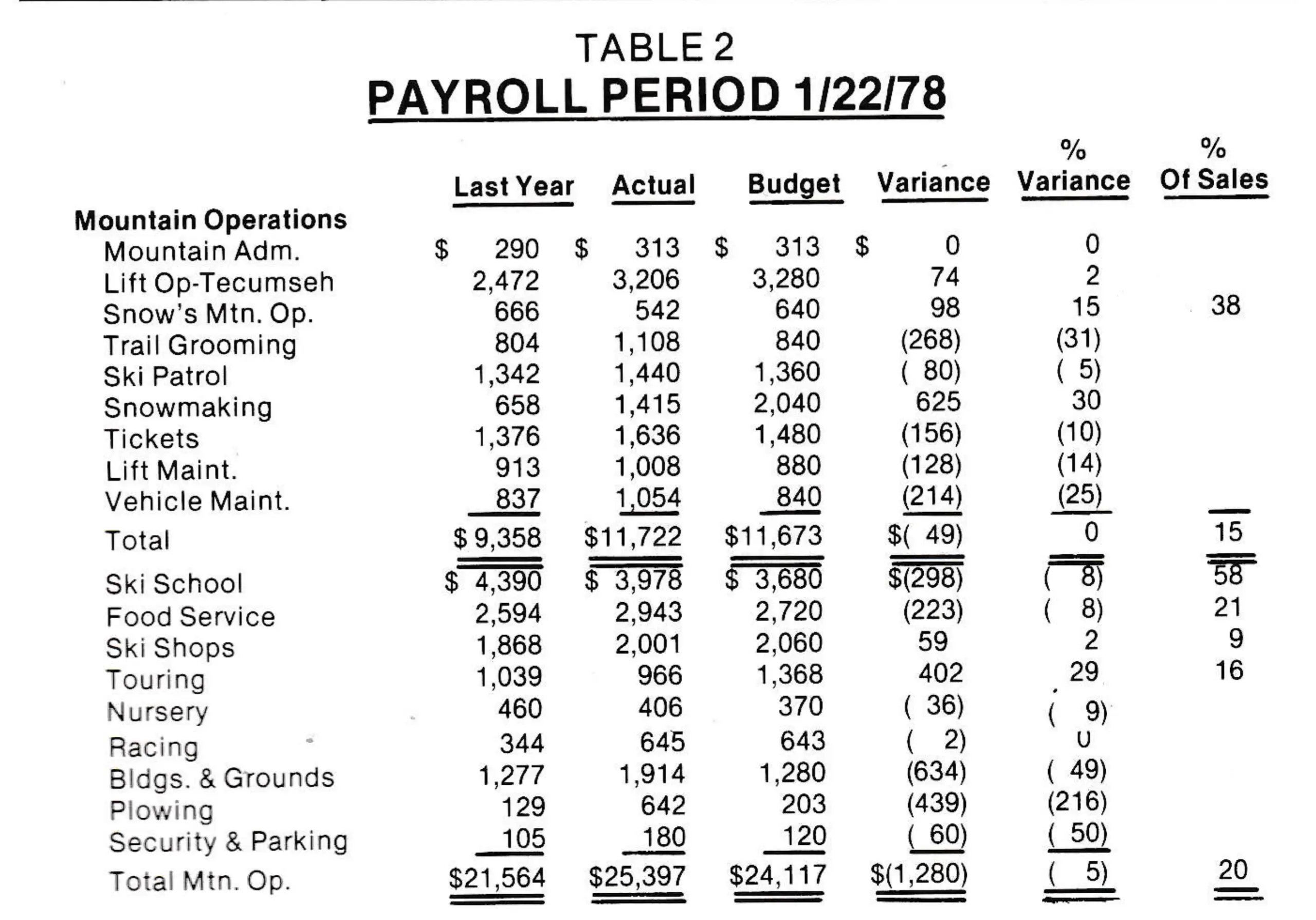
In scanning the report summary, remember the figures are dollars not hours. But you should not see many surprises, because earlier in the week you’ve already analyzed the hours expended. However, watch for several things. The Ski Patrol dollars exceeded budget for the week ending 1/22 even though the hours turned in on Monday were less than budget. Was there excessive overtime, an unduly highly paid employee or what? As general manager you should find out, because every little bit counts.

But the real impact to a good manager is the percent variance figures. Recall back to the revenue report for the same week (Part I of this series) which showed skier days for the week 2% higher than last year, 10% ahead of budget. Those departments like Grooming and Ski School where costs went up more than these percent figures have hurt your percent profit. Those like Lift Operations and Snowmaking which have stayed less than these percent figures have helped your profit margin.
Here you have to think before you act, because some departments such as Vehicle Maintenance may have a relatively fixed labor bill which is very difficult to vary with customer volume. Others, like Ski School, may have greater capability to adjust the number of employees to revenues. Recall that the Ski School revenues for the week ending 1/22 were actually off 22%. Here the general manager sees the Ski School’s labor bill is up 8%. There may be a one-week reason for this, but a general manager cannot allow this situation to persist.
General managers have to develop their own guidelines with this report, because different companies have different attitudes about labor flexibility. For instance, I expect labor dollars in Food Service and the Ski School to vary closely with skier volume. I don’t expect the labor bill to increase in other departments if revenues are really good. As a matter of philosophy I specifically seek excess profit when times are good and watch this report closely to be sure I get it.
There is a flip side to the report which is also important. If a ski area is having a lousy year general managers must insist each department cut its labor costs regardless of how fixed this labor cost typically is. You have no choice if the area is running 30% under the revenue budget to insist that all departments cut costs to show 30% cost reductions. You may never completely accomplish this, but if you start early and push hard, you can salvage a potentially disastrous year. This report can really help you to measure your success in such an unpleasant situation.
Without unduly prolonging the value of this document there is one more point. The percent figure to the far right shows the labor costs as a percent of revenues for that category. Again a quick check against budget or prior years tells you whether you are doing better or worse than you’d like. This sort of summarizes all the controls—sometimes makes you feel good, other times adds further insult to injury.
Although this article only illustrates the Payroll Report for a one-week period, most managers will also want it on a year-to-date basis. Year-to-date success or failure tends to influence action decisions on week-to-week deviations even though it is less valuable to operating managers.
Obviously this second Payroll Report expressed in dollars adds impact in a less timely fashion to be Man-hour Report expressed in hours. It should force an astute general manager to take serious action as trends develop, whereas he should have taken the week-to-week action necessary using his Man-hour Report.
By now those who have read both these articles on Yellow Flag Management should be able to anticipate the conclusions. This one on labor cost control has developed a form to identify problems immediately and a form which shows their real impact in a little less timely fashion. These give the general manager the ability to ask questions immediately, to be on top of problems and to prevent recurrences. They also force him to realize he may be in real trouble or may be doing really well. And they tell his subordinates the same things so they can anticipate their boss’s feelings and act before he calls.
Although Part III of Yellow Flag Management will have a similar theme as it deals with capital project management (area’s biggest hidden cost), it will focus more on pre-planning as a method of keeping the yellow flag of caution under wraps and then go on to develop an easy reporting system to measure success or failure.