
The Voice of the Mountain Resort Industry  |  Est. 1962

Advertisement

Terra Nova – 728×90

Winter 1979 Issue

Something For The Bunny

Ed. Note: Tony Sowder's article is the first in a continuing series on lift technology by the people who design and build them.

Photograph is taken from behind the bullwheel loading position of the lower tension terminal of Chairlift #5 showing the resulting skiing slope for beginners and the new position of the Chairlift #2 drive terminal in the upper left-hand corner of the picture. The area in the center of the beginners' slope was, before the excavation, approximately 16 feet higher than shown in the picture, therefore creating a severe undulating slope not suitable for the absolute beginner. The original location of the drive terminal of Chairlift #2 was to the left and adjacent to the lower terminal of the new Chairlift #5 and it was foreshortened to prevent the intermixing of experts and beginners on the beginners' slope. In the upper part of picture the separation fence is visible that directs the expert skiers to the Chairlift #2 loading area and yet allows the beginners to enter through a gap onto the upper part of the beginners' terrain. This beginners' terrain is approximately a nine-degree continuous slope from the upper terminal to within about 100 feet of the lower terminal, where it levels out for the lower terminal waiting line area.
Photograph is taken from behind the bullwheel loading position of the lower tension terminal of Chairlift #5 showing the resulting skiing slope for beginners and the new position of the Chairlift #2 drive terminal in the upper left-hand corner of the picture. The area in the center of the beginners’ slope was, before the excavation, approximately 16 feet higher than shown in the picture, therefore creating a severe undulating slope not suitable for the absolute beginner. The original location of the drive terminal of Chairlift #2 was to the left and adjacent to the lower terminal of the new Chairlift #5 and it was foreshortened to prevent the intermixing of experts and beginners on the beginners’ slope. In the upper part of picture the separation fence is visible that directs the expert skiers to the Chairlift #2 loading area and yet allows the beginners to enter through a gap onto the upper part of the beginners’ terrain. This beginners’ terrain is approximately a nine-degree continuous slope from the upper terminal to within about 100 feet of the lower terminal, where it levels out for the lower terminal waiting line area.

The Mt. Spokane ski area is located in Mt. Spokane State Park, approximately 30 miles northeast of Spokane, Washington. The presently operating ski area was established in 1956 with the installation of a Riblet chairlift and several rope tows. Prior to 1956, two other locations had been utilized briefly for rope tows and an old converted bicable-type freight tramway that was used as a double chairlift for a few years with minimal success due to the improper location on the mountain.

Between 1956 and 1977, an additional lodge and three additional chairlifts were installed to serve the intermediate and expert skiers of the eastern Washington and northern Idaho skier market. The terrain of the mountain always precluded the installation of a chairlift to serve the absolute beginning skier, thus making it very difficult to attract and develop beginners. In the spring of 1977, permission was received from the State Parks Commission to perform a 30,000 cu. yd. excavation and leveling project, to shorten the existing Chairlift #2 and install a beginner’s Chairlift #5 on the resulting man-made beginner terrain.
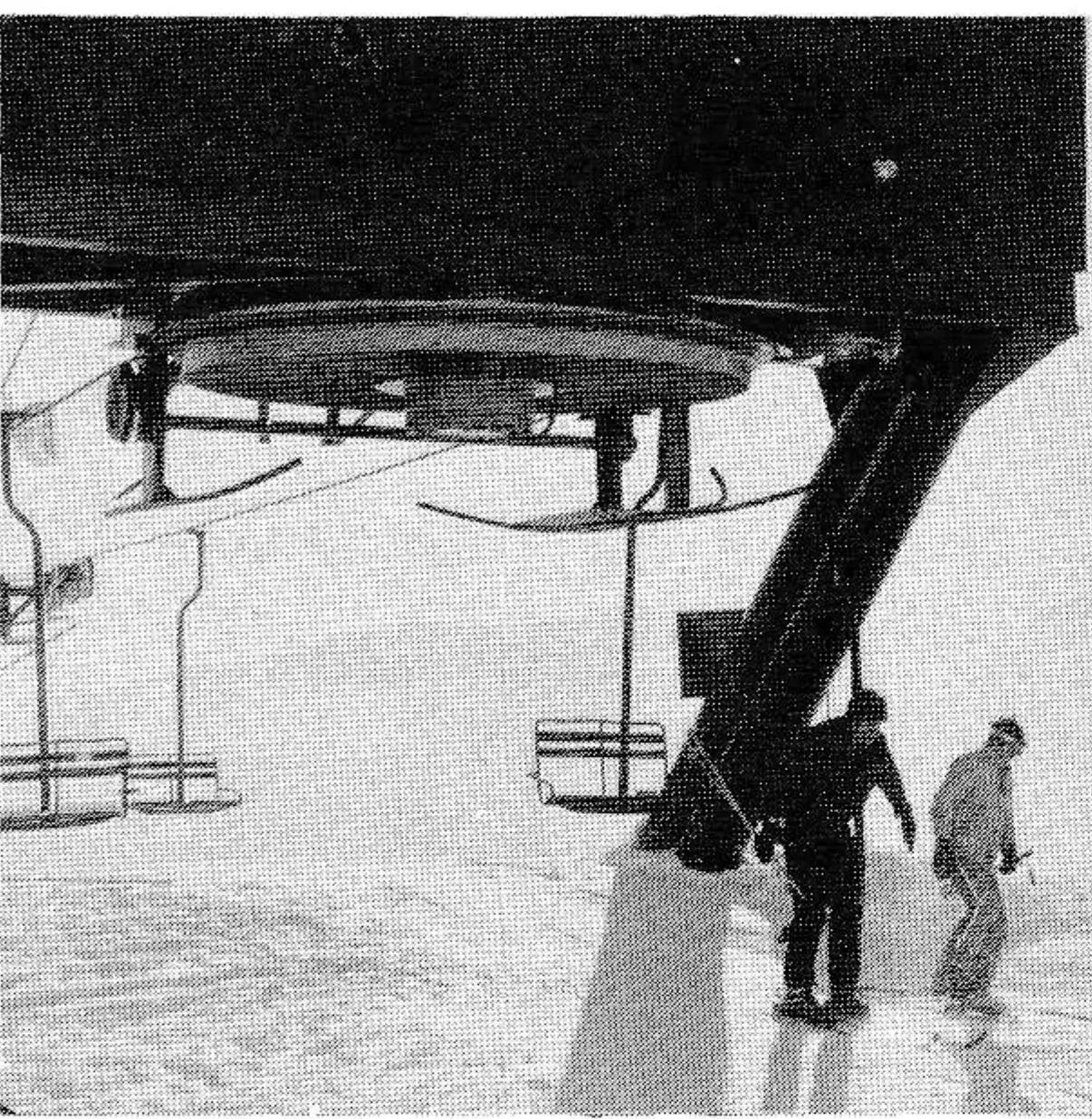
The lower terminal (left) is designed so it can be used as a bullwheel loading or conventional loading unit, whichever is desired. The counterweight is located in a pit immediately behind the rearward vertical column of the tension terminal structure, thus allowing the skiers to approach the loading point in a straight line from the rear.
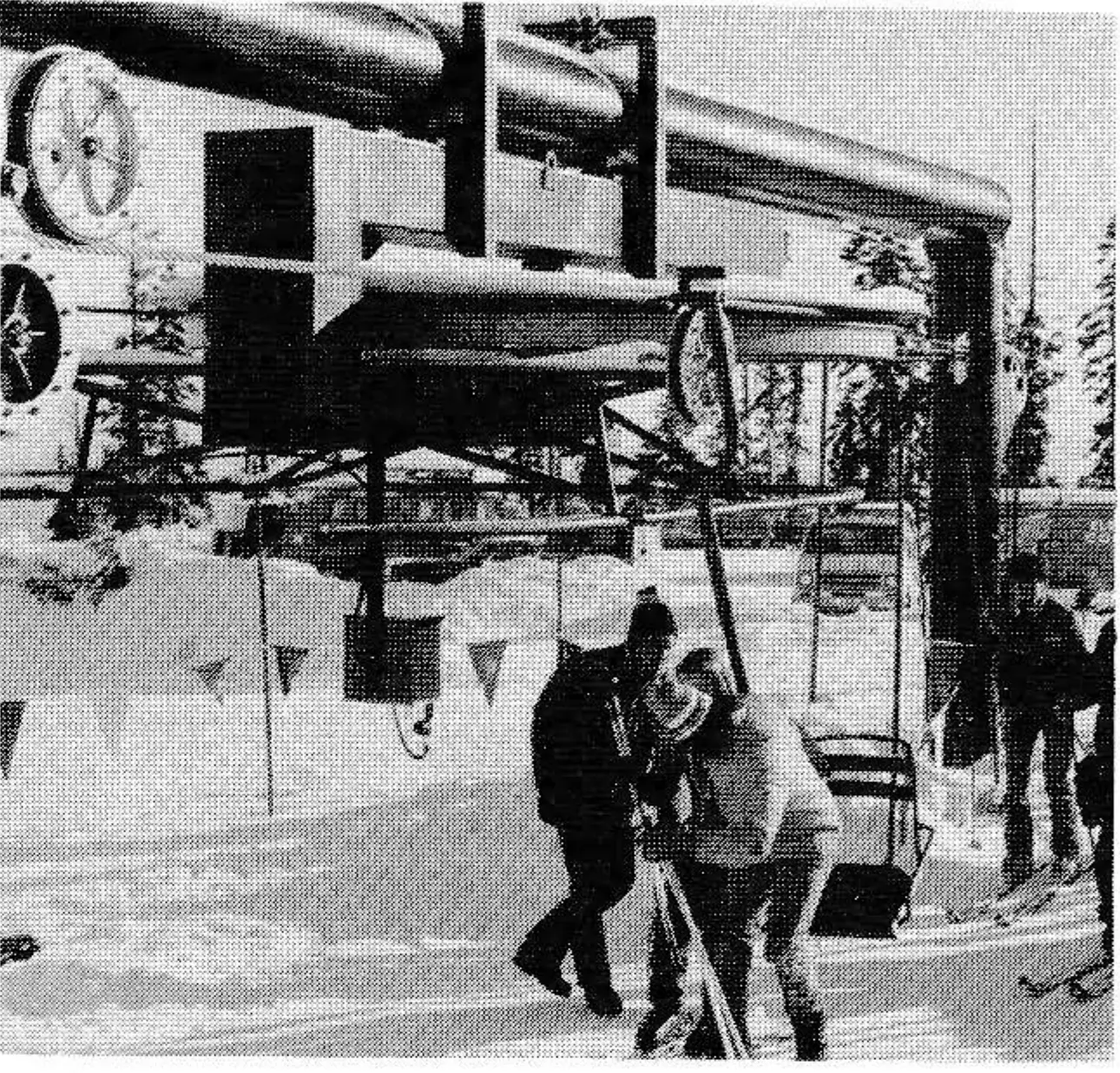
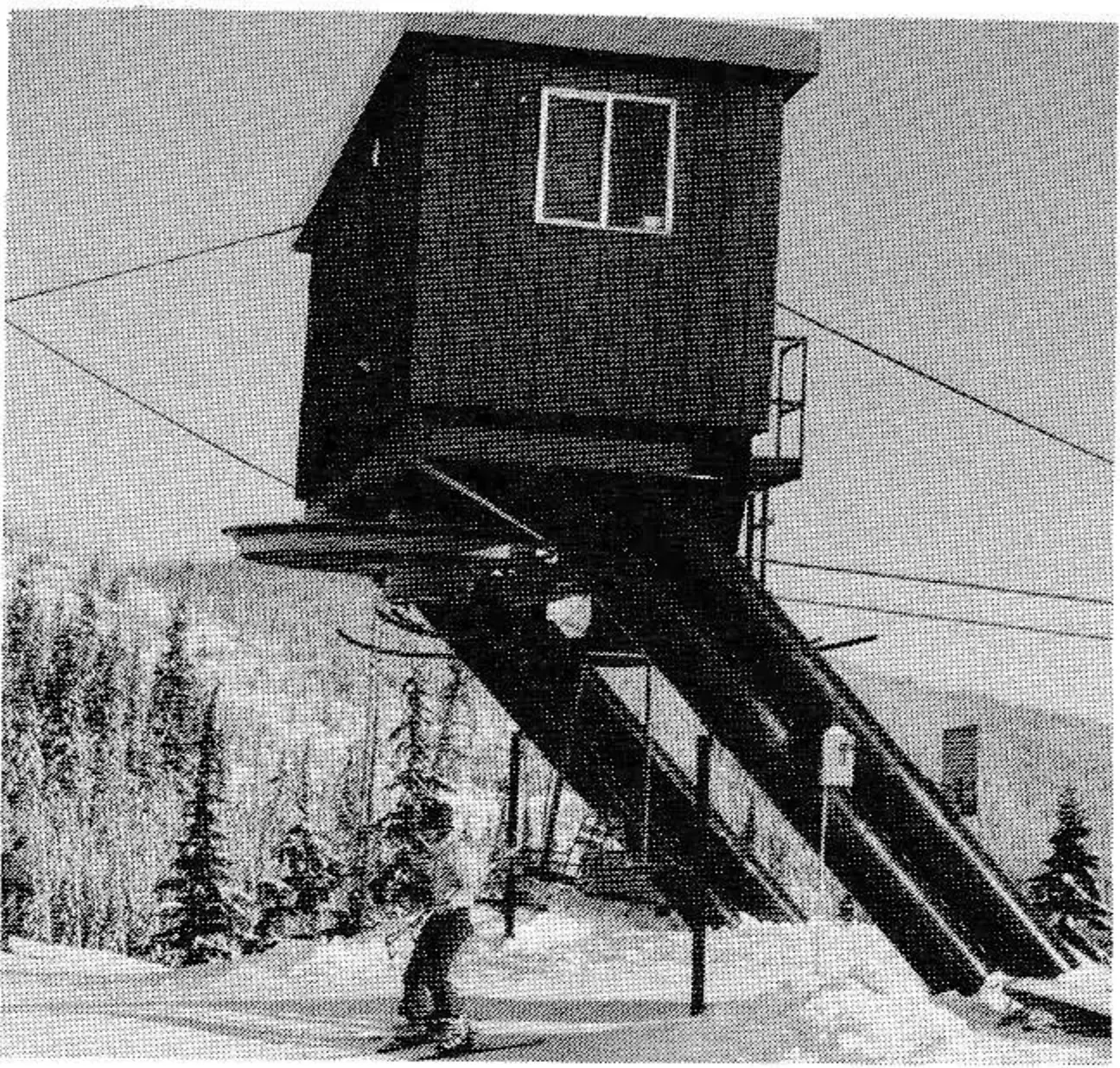
The upper terminal (center) is of the overhead gantry type, bullwheel unloading system with the cantilever support structure sloping at 45 degrees to provide for complete freedom to turn immediately after the skier leaves the chair. Picture #4 shows a side view.
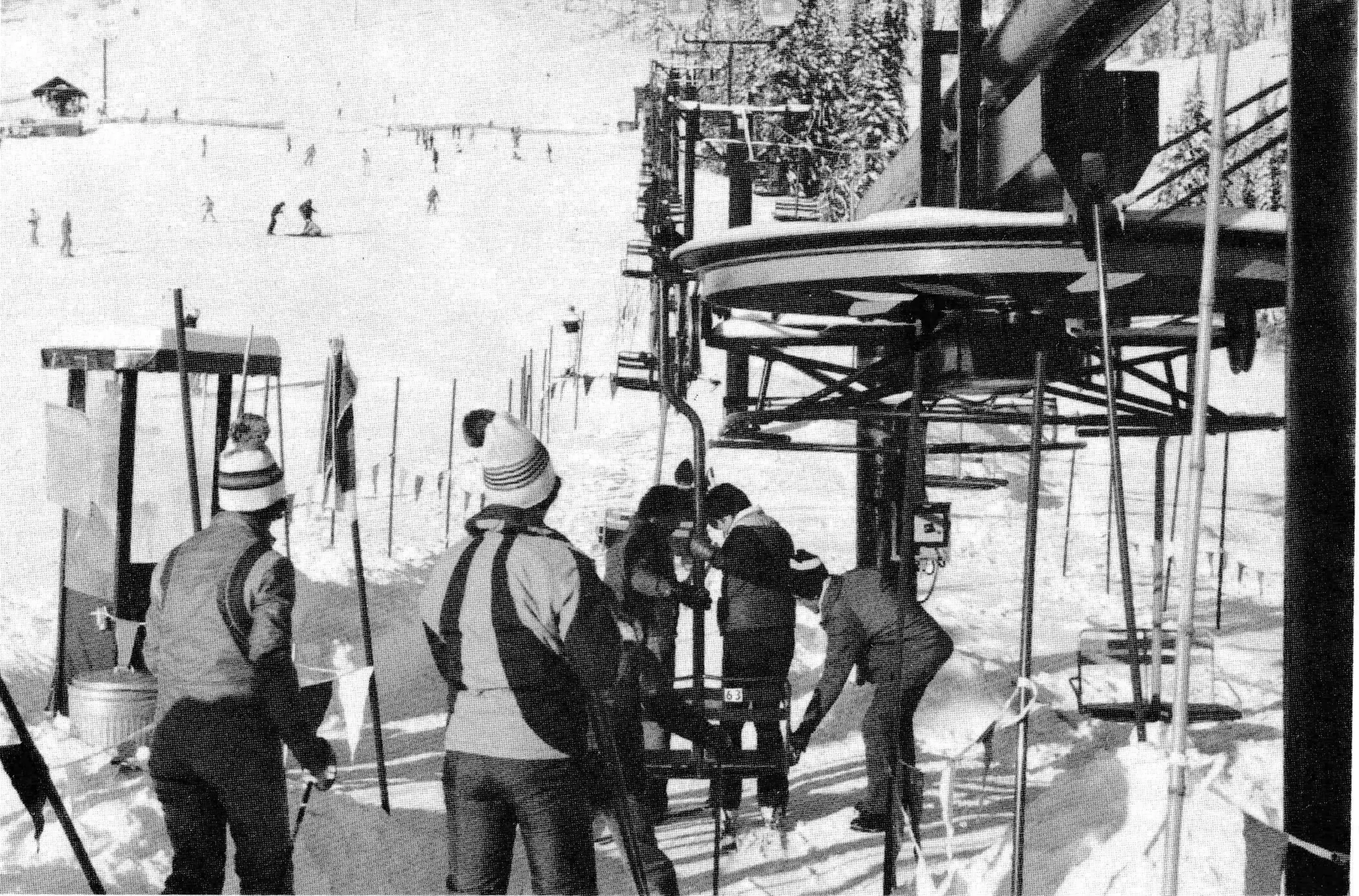
View from the rear (right) with the skiers away from the chair and ready to
View from the rear (right) with the skiers away from the chair and ready to “hit the slopes.”

The selection of a very slow speed of 300 fpm was made to provide a very soft contact between the chair seat and skier during the loading process. This has been vindicated by the ability of the absolute beginners to ride the chairlift after only 10 to 15 minutes of walking around on shortie skis. Most of the beginning ski classes start out on this “Bunny Special.” After riding it a few times, they are able to cope with Chairlift #3, which has a top speed of 450 fpm, but actually takes them on a ride of about 3500 feet to additional beginner and lower-intermediate terrain.

The basic specifications of the unit are:

Slope length1000′
Rise149′
Snow depth – lower terminal1′
Snow depth – upper terminal5′
Snow depth – along line5′
Capacity1200 pph
Maximum speed300 fpm
Number of chairs67 double centerpost
Number of towers6 pylon-type
Lower Terminaloverhead tension, bullwheel load
Upper Terminaloverhead drive, bullwheel unload
Prime Mover40hp squirrel-cage electric motor w/fluid coupling
Auxiliary power unitV8 automobile engine w/automatic transmission
Traction rope1-1/8″ diameter
Line gauge10′

The single-speed design, using a fluid coupling with squirrel-cage electric motor, was selected due to the fact that speeds slower than 300 fpm are not needed for absolute beginners, and the squirrel-cage motor and fluid coupling are the simplest and most reliable drive combination available. Operator’s training is at a minimum with this type of drive since the chairlift is either “go” or “stop.” There is no speed control required to be learned.

We believe this experience at Mt. Spokane Chairlift #5 is of major importance to the skiing industry at large since the installation and utilization of chairlifts of this caliber make it possible for even the middle-aged nonskier to enjoy himself the first time he puts on a pair of shortie skis and starts up the lift.

The one-year history of this machine has proven this point and has attracted many nonskiers to the sport already. It should be pointed out that three of the chairlifts on Mt. Spokane operate day and night and the new #5 is one of these.

Some apprehension was present concerning the shortening of Chairlift #2 and the creation of the beginner’s lift immediately in front of the lodge, which dictated that all of the skiers, including experts, would have to use Chairlift #5 to leave the lodge area. It was felt that some of the experts would object to this, but such has not been the case. Apparently, the experts all realize that it is absolutely necessary that the industry broaden its facilities to provide “something for the bunny.”

Advertisement

MDMT - Card

Advertisement

ParkPro