
At the end of the 1977-78 ski season the U.S. Forest Service undertook a nationwide skier market study. Sno-engineering, Inc. and Opinion Research Corporation collaborated with the Forest Service to estimate the number of active skiers, inactive skiers and potential skiers. Telephone interviews were conducted with 2,191 potential, active and inactive skiers drawn from 7,106 households selected nationally. The sampling methodology was developed jointly by Opinion Research, Sno-engineering and the Office of Management and Budget of the Federal Government. Due to the stringent guidelines applied to the sample selection there is a high degree of statistical reliability in the selection of respondents for the survey.
Persons 16 and over were interviewed using a priority system of potential skiers first, then inactive skiers and finally active skiers. Those persons indicating that they had never skied and had no interest in skiing were screened and the interview terminated.
The study was directed toward identifying user participation and market potential for downhill and cross-country skiing. But, because the study relied heavily upon recall, there obviously is a bias toward overestimation. We have no way of identifying how great this bias is in the present study; however, there is little doubt that it has resulted in overestimation of participation.
The highlights reported below represent the first analysis of the data. By the spring of 1979 the Forest Service will have published the findings of the study. Further levels of refinement and secondary analysis are being undertaken and an additional report with much greater depth will be published. In the second volume the data will be reported using smaller geographic and demographic market areas which should make it very useful to the ski industry in target marketing. This first summary presents the growth findings that resulted from the telephone interview survey.
We found that 74 percent of the U.S. population over 16 years old had no interest and no experience in skiing. Eight percent of the population or 12.8 million people actively participated in skiing during the 1977-78 ski season. This figure (our definition of an active skier) includes both downhill and cross-country activity. We found that there were 11.2 million downhill skiers, of whom 2.3 million were also cross-country skiers.
An additional 1.6 million were cross-country skiers only. Comparing these figures to the recent Skiing magazine study (“How big the market”—Summer SAM), we find that the two studies produced similar results.
Inactive skiers were defined as those persons who had skied in the past but did not ski during the ’77-78 ski season. They were further classified by length of time before they intend to go skiing again. Only those persons who indicated they planned to go skiing during the ’78-79 ski season were considered temporary inactives. Those who indicated that they would probably never ski again, or that it will be sometime after the ’78-79 ski season, were considered to be permanent dropouts. The number of inactives who intend to go skiing in the upcoming seasons is 6.9 million, which compares with the seven million inactive skiers identified in the Skiing magazine survey using a different definition of inactivity.
The potential skiers—those individuals who have never skied—were broken into groups. Based on these classifications a total of 10.2 million people were preliminarily classified as potential skiers; however, only the 7.3 million high potentials—under 26 and indicating an interest in skiing—are considered as serious new skier candidates.
Collectively, the past, present and potential skiers over 16 years of age could equal nearly thirty million or 19 percent of the U.S. adult population over 16 years of age. The 11.2 million people who indicated that they are presently active downhill skiers represent 7.1 percent of the adult population. Based on our definition this figure should remain a reliable estimate of the active U.S. ski population. The inactive and potential skier figures are not nearly as reliable since they are based upon intent to ski rather than on actual skiing behavior.
In the survey we spent a great deal of time trying to identify the constraints to participation among all of the skier market classes. Are the active skiers skiing as much as they want to? If not, why not? Why did the inactive skiers drop out? Why will they or why won’t they become active again? Why have the potential skiers never tried skiing? The responses to these questions yielded some interesting, though not totally unpredictable, results. Barriers to participation were evident. Those most often mentioned were lack of time, that it is “mainly a young sport,” and cost. Active skiers were most concerned with the perceived high cost of skiing, the crowding and the unavailability of facilities.
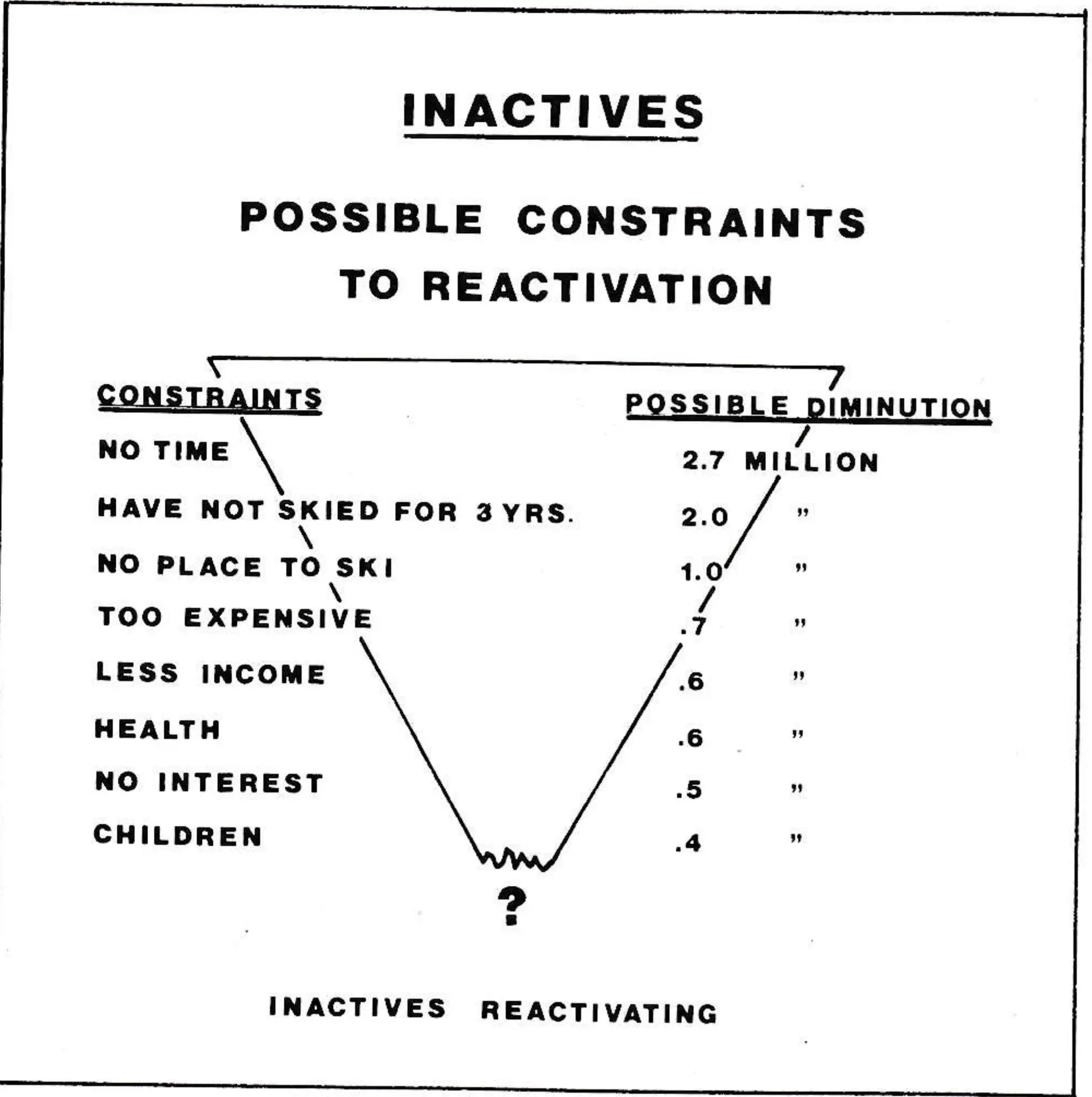
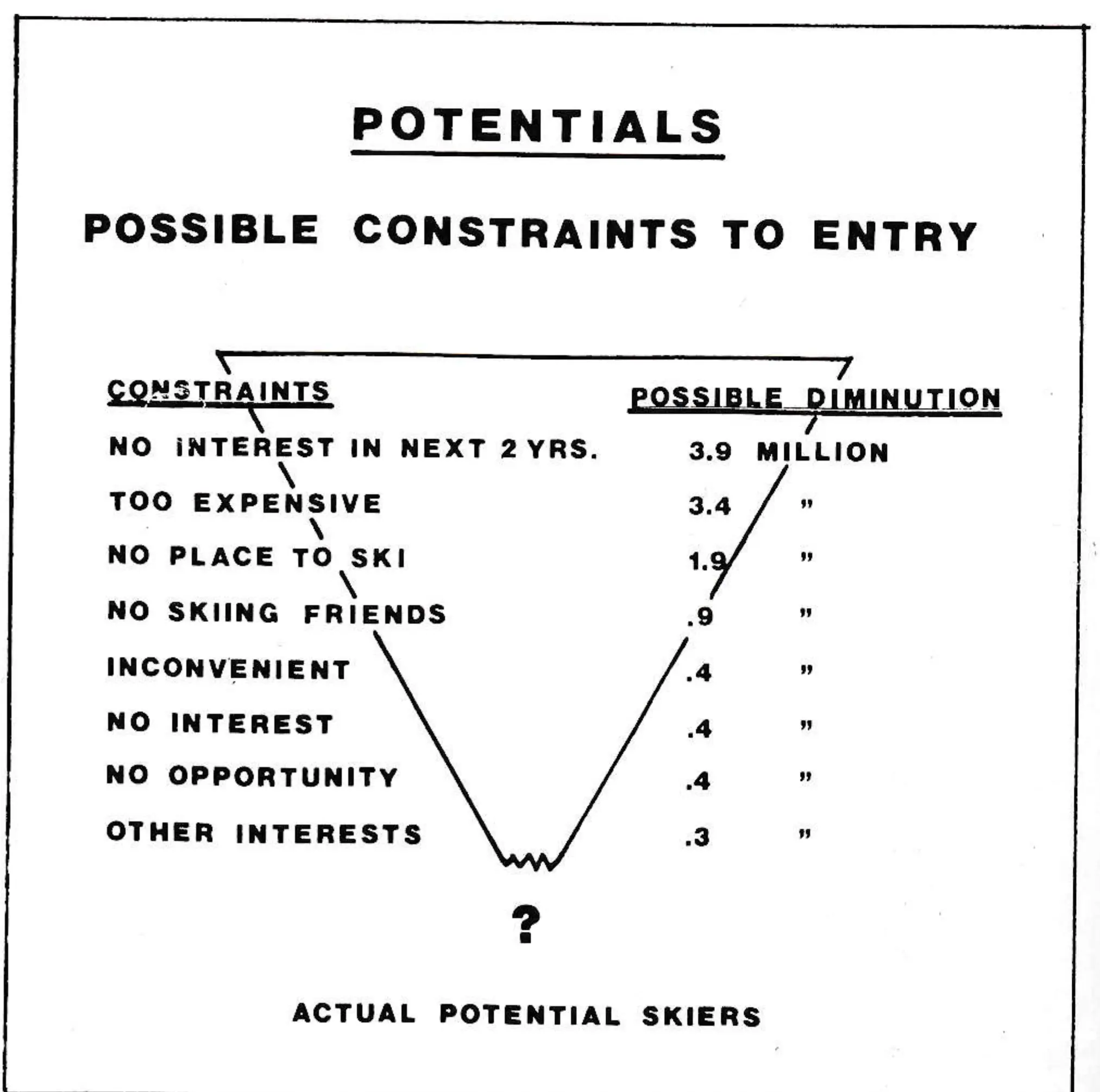
Skiing’s most consistently negative image is its high cost. More than half the potential skiers view the activity as an expensive one, and a similar proportion of the active skiers felt that the cost had kept them from participating as much as they wanted to. Forty-six percent of the potential skiers stated that the cost had kept them from participating at all. Similarly, forty-five percent of the temporarily inactive skiers stated that cost was the reason they were not participating. It seems as though cost influences a higher proportion of the active skiers than the inactives or potentials. Skiing is perceived as an expensive sport and that perception has apparently had some impact on limiting the size of markets and frequency of participation. The figures below identify the possible impact of many of the constraints to skiing mentioned by inactive and potential skiers. (Some respondents were identified with more than one constraint.)
The average skier has participated about 4.3 years and is a low intermediate skier. Skiers were found to take 1.4 ski vacations of four nights or more duration over the past five years, and 3.3 ski trips a year of less than four nights. Median days skied over the ’77-78 ski season were nine. An example of the bias that occurs in recall surveys is apparent in the median days skied last year of nine compared to the median days skied in each of the last five years, which were reported to be 16. This points out again the overenthusiastic response of people in estimating their own participation in glamorous activities. The Northeastern skiers were found to be the most active with 13 days skiing during the last season, while the Southerners—not surprisingly—were the least active with only six days. The North Central and Western skiers each skied nine days.

Nationally, only 37 percent of all skiers took a ski vacation of more than four nights during the last season. However, nearly three-quarters took an overnight ski trip of less than four nights. Over one-half of Southern skiers took an extended ski trip, whereas in the Northeast and North Central region of the country less than one-third took an extended trip. Shorter overnight trips were most often taken by Western skiers, with 85 percent indicating at least one ski trip of less than four nights during the past season. The Western skier and the Northeastern skier skied locally more than skiers in the North Central and Southern part of the country. Ninety-one percent of the Northeastern Skied exclusively in their own region and seven percent visited the West. Similarly, in the West, 93 percent skied locally and six percent traveled to the Northeast. Southern skiers were the most diversified with 32 percent skiing in the Northeast, 39 percent skiing in the West and only 21 percent skiing in the South. Two-thirds of the North Central skiers skied locally; 22 percent skied the West; while eight percent skied in the East.
Colorado and California led the popularity pole as the states most often visited by skiers with 21 percent each. They were followed by Vermont (15%), New York (14%), Pennsylvania (12%), New Hampshire (9%), and Wisconsin (8%).
Fifty-two percent of the active and inactive skiers were male and 48 percent, female. Among potentials, however, there were only 46 percent male and 54 percent female. Not surprisingly, there were significantly more singles among potential skiers than in the active or inactive groups. However, marriage was identified as the strongest single deterrent to skiing involvement. So, while skiing was cited by all market classes as a good family sport, as skiers became married they tended to drop out of skiing and not get back into the sport over time.
| High Potential | Active | Temporarily Inactive | Skier Days | |
|---|---|---|---|---|
| Northeast | 16% | 30% | 24% | 44% |
| South | 34 | 14 | 20 | 3 |
| N. Central | 30 | 25 | 25 | 15 |
| West | 20 | 31 | 31 | 38 |
| 100% | 100% | 100% | 100% |
The median age of active skiers was 26 years and of the inactives, slightly older, was 27.2 years. Regionally there was no difference between the median age of skiers. Active skiers had an average income of $20,200, while inactive skiers were slightly lower at $19,200 and the potentials were further back at only $15,000. Since the potentials represented a lower age group, it was not surprising that they tended to have lower incomes; they have not yet reached their earning potential. However, for the inactive skiers to have lower incomes than the active skiers tends to support the premise that the cost of skiing is, in fact, a deterrent to participation by certain market classes.
The skiing involvement cycle graphically portrays the activity and the dynamics of our industry. Skiers go through four different cycles of involvement with skiing, and to a limited extent there appears to be movement in both directions toward greater involvement and a withdrawal of involvement. The frequency and rate of these changes are unknown since a replicate study would have to be undertaken to allow us to measure the changes. However, looking at the numbers of people in each of these involvement categories lets us start to recognize the great potential that exists for the expansion of the ski industry in the future.
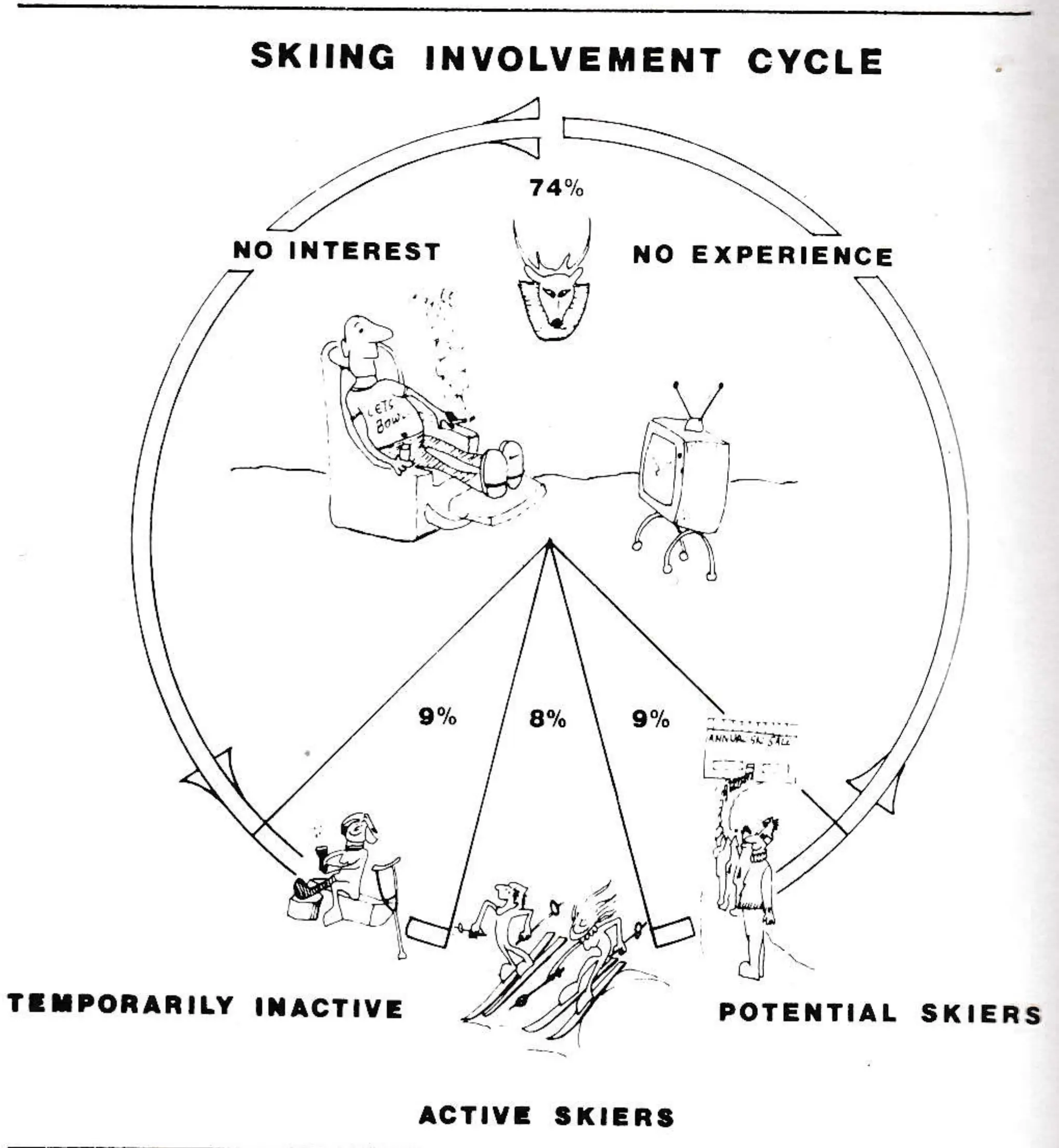
Presently, eight percent of the adult population over 16 years of age are active skiers and nine percent each are potential and inactive skiers. For the industry to grow, the active skier segment needs to expand by attracting potential skiers and reactivating former skiers.
In May at the NSAA spring meeting we will be presenting a workshop using the complete report of the U.S. Forest Service nationwide skier study. The data available in the study is so extensive that the two-volume report will be required to explain and present the information adequately. Only the highlights have been touched upon here. The regional data as well as the specific information regarding the market classes of skiers should prove valuable to those interested in our dynamic and rapidly evolving industry.
Stacy Standley is Director of Special Projects for Sno-engineering, Inc. with offices in Aspen, Colorado; and Franconia, N.H. Mr. Standley, Mayor of Aspen since 1973, has been involved in numerous studies of the skiing industry and skier market since 1968.
Wilbur F. LaPage is the leader of a U.S. Forest Service research effort to develop social indicators of outdoor recreation trends, located at the Forestry Sciences Laboratory in Durham, N.H. Mr. LaPage has authored numerous studies of the camping and recreation vehicle markets since the mid-1960’s.