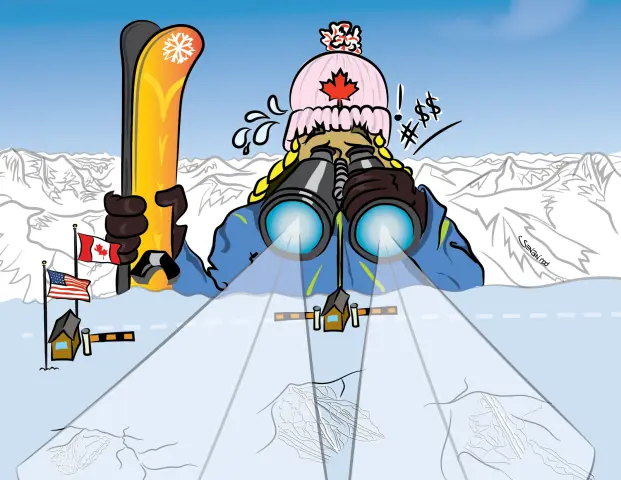

There will be a significant surge in the development of Canadian ski resorts. The Federal and Provincial governments in Canada are beginning to provide outstanding levels of support for the ski/tourism industry. In the U.S. we still have to contend with the protectionist movement and its associated layers of government regulation. In Canada a project can actually receive the endorsement of and direct assistance from the various ministries involved in expediting a ski project; as opposed to Colorado where the Joint Review Process for obtaining authorization to commence construction (after all levels of planning have been completed) takes a minimum of 56 months.
Obviously, ski growth in Utah, Wyoming, and Montana will also move ahead of Colorado under such circumstances. In any case, the 80’s may well see a severe shortage of ski capacity unless development constraints are eased and appropriate forms of assistance are made available to the industry.
The growth of new major facilities in the East will be virtually zero, but the numbers of areas merging, syndicating, or being outright purchased will grow markedly. Mergers and takeovers in the East will be primarily from within the industry. In the West, we will see an increasing number of large publicly traded non-ski related businesses acquire resorts in the medium to major size range. Their need to keep price/earnings ratios up through constant cash flows may dictate significant changes in corporate and pricing strategies. In any case, the cost of the ski lift ticket will continue to rise. And as areas become more time proven successful the ski industry will be increasingly viewed as an attractive investment potential.
The scope of ski area planning in the 80’s will include social structuring and organization at a level of importance almost equivalent to physical design. Off-site impacts on lifestyle, as opposed to concern with the bio-physical elements, will become a focus for the environmental evaluation process. Our ability to respond definitively in this sphere is just now reaching a level of competence that allows us to predict “what will happen if . . . .”
Physical planning will more precisely address the issue of skier circulation (rather than a static body count) in determining that all-elusive number called “comfortable capacity.” Skiing is increasingly a social sport and we find that as long as people are together and moving they will be happy. The thrust will be to disseminate the crowds through creative lift placement rather than concentrating them according to optimum ski acreage. This approach, of course, has to be balanced with providing an adequate amount of good downhill time each day—and with better equipment those demands will be increasing.
The high cost of entry into the ski market today and the extended lead times for planning/approvals virtually dictate that new projects be conceived in the four seasons mold. Single season resorts, other than those of smaller, urban-oriented nature, are extremely difficult to prove viable. Thus, coordination of planning in which accommodations, commercial services, real estate and skiing are balanced will be the key to future developments in the 80’s. This will mean expanded and professional management staffs since the day of the “one man show” is a thing of the past.
Skiing is still perceived of by government administrators at all levels as being a “sport for the rich.” Therefore, we do not anticipate any significant growth in municipal or community owned ski facilities, although in truth, the small beginner-area-on-the-golf course should be a reality in every snow covered town in the U.S. Breeder areas such as that would ensure our future growth patterns beyond any doubt whatsoever.
A number of large private or semi-private club-type ski resorts will emerge during the 80’s. Perforce these will be located on privately owned land, and most will be of extremely high quality catering to those sophisticates who wish to “move up” from the Aspens and Vails. Skiing will be only one part of a socio/economic spectrum in which members enjoy outstanding hospitality service, individual recognition (hard to get in any resort today), stratified scales of privlege related to investment, total credit card purchasing, and uncrowded conditions. The more harried our urban life becomes the more appealing the high quality, low pressure resort environment will become.
Skiing by reservation (including Ticketron) is already a reality and will expand its focus in the 80’s. Even the government regulatory agencies are recognizing that it is impractical and unwise to sell an unlimited number of lift tickets just because the demand is there. Smaller areas will move towards time period skiing in the 80’s, offering skiing by the hour ($2/hour from 9 am – 12 noon and 2 pm – 5 pm, with a $2/hour premium from noon to 2 pm, for instance) and large areas may well get into morning half – day ticketing in order to relieve crowd pressures. Ticket pricing by VTF will also become an accepted fact based on the premise that “the more you use the more you pay.” This may assist some of the more expert-oriented areas in reaching economic viability.
In terms of technological changes there are some interesting, but not mind boggling advances. At major resorts, ground transportation systems—shuttles, drop-off areas, open jitney type service—and remote day skier service centers with lockers, changing areas, vending machines) will replace close-in parking lots and huge monolithic base lodges. Land in those areas is too valuable to devote to parking in view of ski to-from residential and commercial uses. Also, as “ski areas” evolve into “ski resorts,” the old fashioned base lodge can become a white elephant which pre-empts prime development space. The technology of people (skier) movers ranges the spectrum from converted school buses to sophisticated, fully automated mini monorails or air buses—individually powered bus-type bodies slung on horizontal cables. At the present time, the cost factor precludes all but the more simplistic systems for ski resorts. However, underground parking at major resorts will become the accepted fact rather than the rare exception and will be paid for by increased values in the village mall space above.
On the mountain, ski lifts will remain essentially as in the 70’s with the double chair lift still being the workhorse of uphill transportation. As the detachable chair grip becomes more refined, the high speed/high capacity chair will make significant inroads into the gondola market if on no other basis than cost. It will also allow for greater freedom of mountain design due to its higher delivery capacity and greater distance/reduced exposure time capability.
There has been (and always will be) talk about elevators, enclosed escalator systems, horizontal moving pedestrian ways, etc., but until the initial cost factor can be brought down significantly, these types of systems will not be feasible by and large for ski resort implementation. There is even talk of laser beam boring of tunnels through mountain rock and putting skiers on conveyer belts to get to the top. Future, yes; 1980’s, no.
Snowmaking will remain about the same in the 80’s as in the 70’—basic systems will be air/water or “airless.” However, in view of the energy requirements of either type system, a new concept is evolving in which the water stream is disintegrate and vaporized by a high frequency ultra sonic gun. Whether the new approach would also blow the lid off the beer in your rucksack as you ski by has not yet been determind.

The basic elements of food service will remain about the same, except for the fast food innovation. Cooking is today and will be in the 80’s, about what it was at the turn of the century. We won’t see total food requirement pills, test tube meals, or “astronaut delights” for quite awhile yet.
New machines such as the tunnel microwave / broiler / steamer / browner use in Sweden for 20 years) is now being accepted in the U.S., as is the 100 plus unit per hour automatic souffle maker, and multipurpose oven. These will undoubtedly be incorporated into centralized kitchens with professional staffs which will provide gourmet foods (less frying, more broiling and steaming) and delicatessen dishes on a fast food basis. New technology will preserve fresh food eight to ten times longer than is now the case so your tomatoes, as opposed to being gassed in the truck to turn them red, may well be truly “garden fresh.” Thus gastronomes can look forward to better, broader, healthier and more attractive resort menues in the 80’s.
In ski equipment the trend is toward the very light, medium length ski and away from the “short shorts.” One future design concept is the mono-molecular ski construction in which the ski can be “tuned” to the skiers weight, strength, and ability by increasing or decreasing tension on elongated plastic threads built into the ski. Changing the diameter of the threads can put the flex in the ski where it is most appropriate, and external adjustment can accommodate powder versus ice. Another ski design element which may reach market will be the full one-shot injection molded ski with a honeycomb core—the placement and size of the honeycomb cells dictating flex, torque and other performance characteristics.
Ski boots will continue to get lighter, stronger, have better insulation and better fit. The old Molitor leather boot weighed about 12 to 15 pounds. The first plastic boots weighted even more. Now boots are down in the 5 to 6 pound weight range, will go even lower, will have less gadgetry and better, simpler closure devices.
Boot and binding combinations will be on the market by the mid – 80’s. One prototype bindings shaped like a cigar and can be mounted either in the boot sole or on the ski top. It is easily detachable (to carry in your pocket), can be individually machine ground so it fits only your boot/receiver (stops theft) and can move back and forth on a ski top track to adjust for ski style, terrain, and different snow conditions. Another 1980’s product will be the “safety boot” which breaks open in a fall, the outer boot remaining on the ski and the inner boot remaining (hopefully) with the skier.
Ski clothing using products such as 3M’s Thinsulate will be lighter and warmer. New materials can generate insulation ratios as high as seven to one over down, and although not totally perfected, are being used in new designs. One rather far out material currently being researched is solar oriented and has the ability to absorb solar energy on the one hand, transfer it throughout the material, and diffuse that heat to the wearer’s body over a period of several hours. (Could a skier literally “burn up” in a hot day?) And, as for prices, the day of the $250 parka is already here, yet we will see lower cost packaging to bring the potentail customers into the market more quickly.
In ski schools, video tape/play back is now a common feature and a great teaching tool. For the 80’s, simulation of the ski experience in order to speed up the learning process—much as flight simulators are used by NASA and the airlines—is in the offering. A skier would stand on sensor monitored skis on a gimbeled platform, the action of which is synchronized with computer controlled “sensurround” tunnels incorporating visual, audio, and physical perception programs. An appropriate level of “experience” is pre-selected (from absolute beginner to high speed racing), and the fun begins. The skier is immersed in a three dimensional environment of wind, cold, speed turns, etc. depending on his programs. His actions are recorded and played back, giving him not only a feel for developing reactions and reflexes, but also a “report” on how well he performed.
Far out? Perhaps, but that’s just part of what’s coming in the 80’s. It portents to be the most exciting decade in the history of our industry. Let’s hope that management and development teams will meet the realistic challenges professionally—but also, let’s hope that the dreamers, the visionaries, keep right on looking into their crystal balls. That’s the essence of skiing.
Credits: Disney Enterprises; Dr. Charles Greenidge; D. Hanson; N. MacNiel